Showing posts with label South Korea. Show all posts

Tuesday, 3 December 2024

The Farcical South Korean Coup

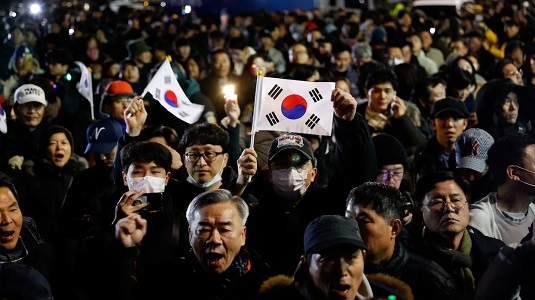
The attempt by South Korea's President Yoon Suk Yeol to abolish democracy and install military rule was not on many people's bingo car for December. Coming out of the blue, Yoon declared martial law on Tuesday 11pm Seoul time to see off "anti-state forces" and imaginary helpers of North Korea. The articles of the decree suspends all political activity and the subjection of the mass media to army control. This is, you couldn't make it up, to "protect liberal democracy". It's just as well that the National Assembly completely ignored the president's command, with several members clambering over the railings to vote down the coup - which it did so with 190 out of 300 legislators present. With the constitution on their side and protestors out on the streets in the early hours, Yoon had little choice but to climb down and rescind the order. Perhaps the most farcical coup attempt of modern times, but thankfully without the tragedy that usually attends them.

Why did Yoon have a stab at overthrowing Korean constitutionalism and turning the clock back 40 years? This BBC report lays out proximate causes. Yoon has been hampered by losing his assembly majority. He and his entourage have been on the receiving end of corruption allegations, some of which smacked of our very own freebiegate. And he was forced to make a humiliating public apology over botched investigations into Kim Keon-hee, his wife. Stymied at every turn, it appears a cocktail of frustration and desperation are what guided his hand to press the coup button.

Looking at his politics, Yoon is fairly typical of conservative figures who flirt with extreme right rhetoric and tactics. Following the play book of the right the world over, his election in 2022 was off the back of scaremongering against the North, the permissive society, and "liberal elites". In office, alongside corruption we've seen the usual diet of deregulation, kickbacks to the well heeled, and a found fondness for neoclassical economics. Which just so happen to enrich his class further. Likewise the kind of accountability dodging that would have made even Boris Johnson wince was the Yoon hallmark. Small wonder that his approval ratings had collapsed.

His emboldening by domestic democratic backsliding is only some of the story. The international scene has to be taken into account. Trump's election is a signal to many on the right that there's still plenty of gas in the reactionary tank, and that support for authoritarianism is real enough. But more important is the showing up of the American-led "rules based" international order as a sham without any consequences. The fact the International Criminal Court has issued warrants for Benjamin Netanyahu which several Western governments have said they will ignore, and that there has been zero accountability for leaders who've allowed Israeli forces to commit atrocities in broad day light must have been a consideration on Yoon's part. As a strategically vital US ally, he was perhaps hoping that the plot armour the US have conferred on Israel as part of its schemes for the Middle East would extend to him. Especially given how Yoon has spent years talking up the apocalyptic threat from the North and that the South is riddled with Kimist agents and their useful idiots. It was a desperate gambit and one that, thankfully, appears to have failed.

What now? The military have returned to barracks and the police have largely dispersed, but that is not the end of it. The botched coup has led the Korean Confederation of Trade Unions to call a general strike to force his resignation. Parliamentarians are going to have to move fast to prevent what was to be a retrenchment of reaction from turning into its opposite: a mass radicalisation and demands for broader democratic and social concessions. Don't be too surprised if Yoon is put out of office in short order, and will be pondering retirement from the hospitality offered by the nearest custody suite before long.

Image Credit

Friday, 10 April 2015

UK Marches Against South Korean Puppet Regime!

Britain-based friends and comrades of the Democratic People's Republic of Korea held a mass action outside the London embassy of the fascist, puppet regime of the so-called Republic of Korea last month. Here you can see them in action.


That looks like One Brewer's Green in the background. I wonder what Labour Party staff thought when they stumbled upon this living expression of workers' movement solidarity with People's Korea?

According to the press release reporting on the event, there were attendees from the "New Communist Party of Britain, the British Association for the Study of Songun Policy, the British Group for the Study of the Juche Idea, the Korean Friendship Association UK and the Korean Friendship Association headquartered in Spain and citizens." Looking at the turnout, there were probably more organisations present than protesters - though I was pleased to see revolutionary inflation alive and well when the lead spokesman indicated there were "13, 14, 15 present".

H/T adamcathcart and @moonbootica

Sunday, 14 April 2013

Psy - Gentleman

The Americans haven't made a series of surgical strikes against the North's nuclear facilities. And neither has Kim Yong-un let loose an artillery barrage as prelude to a ground invasion. But there has been a horrifying development on the Korean peninsula all the same: Psy has a new single out. Here is his official video for Gentleman.


Does it match Gangnam Style for sheer awfulness? And can it be construed as an ideological weapon in the North/South cold war?

Wednesday, 2 June 2010

How Do You Solve a Problem Like Korea?

While the left's eyes have been diverted by the stupid brutality of Israel's actions on Monday, which have seriously raised the prospects of a clash with Turkey, in the Far East the world's last Cold War frontier has quickly and worryingly heated up. On 26th March a South Korean warship mysteriously exploded in its territorial waters and sank with the deaths of 46 crew. The finger of blame pointed to the senile Stalinist monarchy of the "Democratic" People's "Republic" of Korea who, in its typically hysterical fashion, threatened war if the South pressed ahead with sanctions in response. Its denials have been compromised by a multinational investigation which concluded a North Korean torpedo caused the explosion, backed by the recovery of the device in question by the South's navy.

As far as the North are concerned the South's song and dance is really a provocation, one that follows a long line of others.
This piece argues that the Conservative government elected in 2007 is an "ultra-rightist" formation committed to engineering confrontation and, in the process, clamping down on organisations and cross border institutions that advocate reunification. The North also claims the sinking was caused by the South to bolster the government's chances in regional elections held today. Apparently some 54% of voters have said their vote will be influenced by the North's "provocation".

If one was of a conspiratorial mindset and knew little about the permutations of North-South relations, you would find circumstantial
suggestions that, at most, wouldn't put it past the South's government. The president, Lee Myung-bak, has a reputation for being no stranger to the murkier side of Korean politics. Formerly a high flyer with Hyundai, his 18 year political career has seen him fined for campaign overspends, accused of illegal property speculation, and has been implicated in fraud allegations. Since taking on the presidency Lee has pursued "business facing" policies, including the 'Grand Korean Waterway' - a mega-project that would have deleterious impacts on the environment as well as being of questionable commercial value. And as a good neoliberal his has overseen a round of unpopular privatisations. Nevertheless by the start of this year his approval ratings had recovered from a low of 17% in summer 2008 (on the back of a row over US beef imports) to 52%.

Everyone can agree that Lee is a slippery character. Taking his hard line conservatism, anti-union politics, authoritarianism, and hubris into account one cannot but draw comparisons with Thatcher. But for all this his administration doesn't need to manufacture a clash with the North for electoral expediency's sake.

If one reject's the North's claims and accepts the South's findings, what possible motive could they have for sinking the warship? If this was a shot across Lee's bows in protest against the harder line, it could not have backfired more than storming a ship of aid workers and shooting nine of them dead. There is the possibility of an accidental firing without official sanction - after a lifetime of being pumped full of paranoid propaganda, you can understand how a young officer might have an itchy trigger finger. There's also the small matter of major
joint South-US naval exercises next week, though its difficult to believe the torpedo attack would make deter them from undertaking a major demonstration of sea power.

If it turns out to have come from the higher echelons, it could be an example of the oldest trick in the book.
According to The Economist (admittedly not the most value-free observer of international affairs), there is evidence of a few cracks in the Jucheist monolith. A botched currency reform - ostensibly to manage inflation and curb the influence of private markets - knocked two zeroes of North Korean bank notes and abruptly slashed already precarious living standards. These have been rescinded and the regime has publicly apologised (scapegoating and shooting the minister that oversaw the roll out), but the prospect of a return of mass starvation remains. This most unwelcome of spectres could put the DPRK's legitimacy into question ahead of the centenary of Kim Il Sung's birth. So what better way to try and avert this by uniting the country against perceived external aggression?

There is a tendency among mainstream commentators to portray the North as the most rogue of rogue states. The grotesque personality cult, the toe-curlingly primitive propaganda, the nuclear weapons and massive military all give the appearance of a regime that is as irrational as it is unpredictable. But context is everything. The disfigurement of the North's economy by its 'army-first' policy is rooted in the USSR's reluctance to provide it military aid in the aftermath of the Sino-Soviet split (Kim sided with Mao against Krushchev's de-stalinisation). Whereas the countries of the Warsaw Pact enjoyed Soviet guarantees right up to its dissolution, North Korea did not. Facing its own Cold War frontier with a large South Korean and US military presence (who were armed with nuclear weapons) it struggled to plug the gap itself: it was no coincidence that an obscure reference to the Juche idea in a 1950s article by the Great Leader was dusted off and placed at the heart of DPRK propaganda from the mid-60s on (glossing over the significant
industrial aid it continued receiving from the Russians until the mid-70s). Its moves to build up military capacity to counter that of the US and the South has, in the twisted logics of Cold War geopolitics, been used to justify the US's continued presence, which in turn feeds into the North's armament, and so it goes. Both sides refuse to stand down for fear of attack by the other.

The truth is no one has an interest in war. While the US would like to see a united Korea under its military protection as strategic leverage against China, Obama's administration like all those before it know the price paid in lives, materiel, and funds would be too much for the American public to stomach. It's one thing to take on lightly armed decrepit states and insurgencies: it's quite another to enter a war with the prospect of chemical, biological and nuclear weapons being deployed against US troops. Similarly for the South - even if fighting does not dip south of the demilitarised zone, the 10 million inhabitants of Seoul and the 25 million in surrounding areas are in range of the North's guns. In all likelihood the area up to the DMZ would be comprehensively devastated. And on top of that the South would face the bill of absorbing the North.
The Economist puts the cost for unification at $900bn - it would of course be much higher if the North gets raised to the ground. And of course, the North itself knows it cannot win and hopes a combination of hysterical denunciation, rocket launches and nuclear testing will be enough to keep its enemies at bay. I might not think much of Trotsky's analysis of the USSR, but his insight that the Stalinist bureaucracy wants peaceful coexistence with the big capitalist powers so it can carry on living off the backs of workers and peasants is spot on.

How then do you solve a problem like Korea? You could wait for North Korea to collapse of its own accord - but since the cessation of large scale Soviet aid in the 70s it has proven durable in the face of opposition without and calamity within. The Stalinist monarchy hasn't lasted as long as it has without knowing how to manage dissidence. Its lifespan, discounting war or some crisis beyond the regime's capacity to handle, could still be measured in the decades. Therefore to diffuse the situation, to prevent a flashpoint escalating into war, there has to be moves to comprehensive demilitarisation of the peninsular. As a start the North should re-sign the non-aggression pact it withdrew from with the South last week. In return the South should restart its aid and cross-border cultural exchanges. But none of this can exist independently of US action. Instead of piously calling on the North to disarm while it continues to point nuclear weapons in its direction, if Obama is serious about peace between the Koreas he should sign the non-aggression treaty the North proposed after the USSR's collapse.

With these small steps the road to a real and lasting peace could open - but will they take it?

Tuesday, 3 November 2009

South Korean Defects to the North

This was too superb not to share with the rest of the world. This press release came to me via the ever-dependable Leftist Trainspotters discussion list. When someone defects from the South to the North it's bound to be big news. Now, no sniggering at the translation. Just read, reflect and salute the Juche Idea!
S. Korean Resident Defects to DPRK

Pyongyang, October 27 (
KCNA) -- Kang Tong Rim, 30, who resided in Polgyo Township, Posong County, South Jolla Province of south Korea, Monday came over to the northern half of Korea by crossing the Military Demarcation Line in the eastern sector of the front.

According to him, he served in the First Platoon of the 9th Company under the 3rd Battalion of the 56th Regiment, the 22nd Division of the south Korean army, from September 2001 to November 2003. During the military service he made several attempts for defection with his longing for the northern half of Korea, but in vain.

After being discharged he worked at the Samsung Semiconductor Company as a worker and then left it. He was employed at a pig farm in Polgyo Township before defection.

He is pleased with the accomplishment of his desire for defection.

He is now under the warm care of a relevant organ.