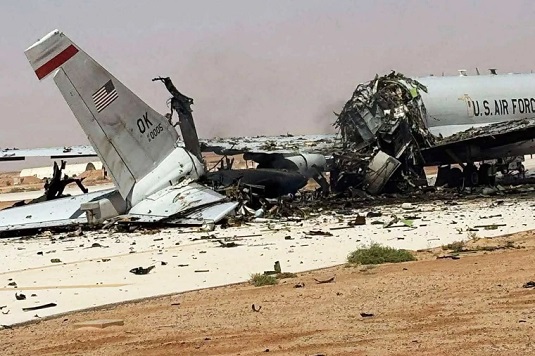
As the third gulf war drags into its fifth week, neither the end nor the end game are anywhere in sight. Big bets on the stock market before Trump makes an announcement are now routine. And the President's remarks are as incoherent and contradictory as ever. "We're talking to nice people in Iran" one hour, the next is a threat to smash power stations and destroy desalination plants. He says negotiations are ongoing, while Tehran denies any such dialogue. The bombs keep raining down from Iranian skies, while in return their ballistic missiles and drones prick Israel's Iron Dome hype and thwart US defences to make life at 13 of its regional bases difficult. Here, Keir Starmer castigates the Tories and Nigel Farage for wanting to drag the UK into this war, while at the same time the US Air Force is using these islands, as well as Cyprus and Diego Garcia for "defensive strikes". Airstrip One is very much part of the conflict.
It doesn't take much to bamboozle Trump, but the White House and military planners cannot grasp why Iran is still fighting. The boasts about annihilating the navy and air force are noisy brags, but do contain some truth. Conventionally speaking, Iran cannot hold a candle against the firepower America and its Israeli satrap can field. So why aren't they surrendering? Why aren't they keen to cut a deal? Why haven't Iranians taken to the street to depose the regime? Instead, Iran is absorbing the punishment, following through with promised retaliation, shouting its defiance, and trolling Trump with Lego memes. He was expecting a gift-wrapped victory, as per Venezuela, or perhaps an Iraq-style collapse into barbarism. Something that could be sold at home as mission accomplished and, for the Israelis, the elimination of the one regional power that goes some way to matching them. None of this has happened, nor is it likely to happen.
The inscrutability of Iran, its refusal to play by the White House's rules of war is not new. It was something dissected with precision by Jean Baudrillard over 20 years ago in his famous essay, The Spirit of Terrorism. Written in November 2001 and reflecting on the September 11th attacks, much of what he diagnosed then carries over to the Iran war and the country's - apparently baffling - resistance to overwhelming force.
On the spectacle of the attack on New York, Baudrillard wrote the destruction of the Twin Towers fascinated and appalled because of their position in the global order. It symbolically embodied American-led globalisation. But, at the peak of its power, order begot an internal will to disorder, a dream of destruction fed by the conveyor of Hollywood disaster movies. As he put it, "Very logically - and inexorably - the increase in the power of power heightens the will to destroy it." (The Spirit of Terrorism and Other Essays, pp 6-7). Entertainment was meant to exorcise this suicidal impulse through pyrotechnics and special effects, but instead of dampening it down it readied us for catastrophe, almost to the point of desiring the spectacle of disaster. The West was primed for September 11th long before it happened, and the spectacle of the attack was captivating precisely because it showed the mortality of the world's greatest military power. Trump, as a television man, understands the superficiality of the spectacle. Burning Iranian cities and cratered infrastructure is dazzling to him, and plays well to his base. But far more fascinating are the military reversals - the banned footage of Iranian missile strikes across the Gulf states, the hard-to-find smashing up of US military bases, of Israeli cities mourning their dead and counting the cost of demolished districts.
The spectacle of one's own defeat goes beyond the furtive hunt for concealed imagery. It's seen in the endless reams of punditry. The discussion of how, come what may, Iran can exert its control over the Strait of Hormuz. Of how targeted bombing taking out leading regime figures, past and present, has solidified the Iranian position. How Trump's war is spiralling into global economic chaos. How, despite the severe asymmetry in the respective militaries, the US is on the brink of a catastrophic strategic defeat. The talk is of nothing else. The spectacle is as much about the tarnishing of Trump's star power and how he can lie his way out of the calamity. Like all good reality TV, the audience wants his actions to rebound back on him in abject humiliation.
What makes this more acute for Trump and the US is that Iran are refusing to abide by their rulebook. Baudrillard talks about the singular character of large scale suicidal terrorist attacks. In a system of generalised exchange, which American-led globalisation is, this kind of terrorism cannot be "exchanged" - there is no equivalent of it. 20-odd years ago pundits characterised the domestic terrorism in Europe, be it of separatist/nationalist provenance or rooted in political extremism of the left or right, as entirely understandable. Their goals were within the horizon of the modern, if not theoretically possible within the prevailing system. But suicidal Islamist terror was not. The very thing Western societies try and deny - death as a rude tragedy, as the worst thing that could possibly happen to any of us - lies at the heart of its fundamentalist nemesis. This itself is an inevitable outcome of the free, unhindered, and unbalanced operation of global capitalism since the end of the Cold War. Baudrillard argues that the duality of struggle, of good and evil, or capitalism and communism, are as interdependent as they are opposed. When one triumphs over the other, as the principle of good has in the operation of our system, and capitalism has versus its other, the defeated party becomes disarticulated but autonomous. Resistance to and the rejection of globalisation assumes an unpredictable virality, of which Islamist terrorism was one example. And one that, because its existence lies in the inherent contradiction of the system's victory, appears anywhere and everywhere against which the most powerful society in existence appears impotent.
The virality has moved on since then, but the character of Islamism has not. The Islamic Republic is now the repository of this logic. Iran's defiance attacks the logic of an order based on the positivity of life. By propaganda and by deed, the Iranian state is willing to stake its lives and those of its citizens in what amounts to a symbolic challenge. It knows Iran cannot possibly win a military confrontation, but through sacrificing itself while inflicting damage on the US, Israel, and the Gulf states, it assumes the monstrosity of terrorism, of a fundamentally 'other' foe that will not yield. Faced with such an implacable opponent, of seemingly suicidal defiance, the US is powerless. It can commit troops to a ground invasion, carry on the bombing, see through the promised destruction of civilian infrastructure - but because the Iranian state will offer up any number of lives to maintain this position, the US is doomed to defeat. For Baudrillard, as it was for the 9/11 terrorists the same applies here. For the Iranians are in a duel with the Americans, it is very personal. Their maximalist demands - reparations for damages, closure of American bases, sovereignty of the Strait - dovetail with the "internal" Western desire. Both want to see the US humiliated, not liquidated. Hence Iran's responses to missiles and bombs are missiles and drones, its counter-violence is governed by a symbolic logic, not the operational calculation of x airfields destroyed, and y soldiers and civilians blown up. Trump's empty boasting about victory secured followed swiftly with fire and brimstone is the usual bombast that ordinarily keeps his opponents unbalanced, but Iran has rejected this logic. And that is why underneath it all, panic is the mood among White House insiders, the military, and their allies abroad.
Trump then is looking for the exit ramp, and nothing he does now can look like a victory. More killing and more unnecessary destruction is, sadly, entirely likely. But the strategic defeat has already happened. Iran knows this, and so does the rest of the world.
Image Credit

17 comments:
This is an excellent piece and a brilliant explainer. Thank you.
"America and its Israeli satrap"
I think you might have those two the wrong way around.
The USA really appears to jump upon Israel's command.
A piece of writing far, far, too flowery for me I'm afraid. And utterly bizarrely , the central role of the settler colonial , now genocidal, state of Israel in the long series of attacks on Iran, and the Lebanon, Syria, etc etc, in line with its 'Generalplan Ost' -like 'Greater Israel' project , gets no mention !
Unpalatable as the current Iranian theocracy is as a government form, as was the Assad family dictatorship in Syria, and Gaddafi's Libyan regime, and Saddam Hussein's Baathist Iraq dictatorship, the destruction of these regimes has reduced these previously functioning societies to utter warlordist chaotic barbarism (though Iraq seems to be improving) . This is the aim of both Israel and the USA in their assault on the only standing state opponent of Israel's unlimited barbarism on its neighbours and its Gaza Palestinians.
Regardless of the current Iranian governmental form, the Iranian nation as a whole cannot stop fighting now until both Israel and its partner in death and regional destruction, the USA are soundly defeated. Because to stop now will merely ensure yet another mass Israel/US attack a year hence. Current damage levels to oil and gas supplies ensure that the global economy is on the irreversible cusp of a global economic crisis on a scale not seen since world war 2. Iran's 'demands are not ' maximalist', but essential if it and the entire Middle East is to survive.
"Iran cannot possibly win a military confrontation"
Not so sure that's true. You could have said exactly the same about the Taliban, and yet in the long game they did; and the IRGC is much stronger militarily than the Taliban. Presumably the remaining sane heads at the Pentagon are spending much of their time right now attempting to communicate through the skull of Hegseth exactly how expensive it will be, under all available measures, if US boots are forced to go in on Iranian soil.
It's all about the asymmetry. The war is on Iran's turf, by the choice of the USA. They can lose their manufacturing base, while the USA cannot lose theirs. But the USA can lose its will to fight, while the IRGC cannot unless it is destroyed to the last man. If you reversed the initial circumstances of the war - had Iran somehow invading the mainland USA - everything else would probably be reversed as well.
There's really only one genuine win condition available to the USA now that they have made the initial decisive error, and that's to bomb Iran's civilian infrastructure flat until it is no longer functioning as an industrial nation. Exactly what Israel wants them to do, I'm sure. But even if you care nothing for the Iranian people - as I'm sure that Trump and his supporters do not - the practical obstacles to achieving that goal and getting away with it (even for the leaders on a personal level, never mind a national level) are formidable. The Zionists would put themselves in the same position as Putin did when he launched the invasion of Ukraine.
Who won? The US had a 'strateic defeat', Iran's infrastructure, economy, air force and navy are in a bad way, the Gulf Monarcies are exposed as unable to defend themselves despite massive defence spending, NATO is in turmoil, South East Asia entering depression - but Israel has expanded its borders, got US help in bashing Iran and proven yet again that acting as the 'wests' gendarme in the region has few downsides, just the ocasional, 'Oh dear, don't commit genocide so openly.'
I wonder if one big reason behind Trump's miscalculation in Iran is that he saw an industrialised nation in which the majority will of its populace appears to count for little, and assumed that it must be of the same type as Putin's Russia, the kind of national power that he himself fantasises about leading. One in which the entire industrial base is subjugated to the will of one top mob boss; and that with the death of the godfather, his replacement would be focused on consolidating power, and open to negotiations with external enemies.
Which we can all now see that
it is not. As much as any modern country, it was designed from its inception to be resistant to "decapitation", just as much as it was designed to be resistant to any change in its national character and "mission" regardless of what its hapless citizens might come to desire. In the former aspect it's far more comparable to China than to Russia, and in the latter aspect it's probably more extreme even than China.
Many have been saying that Iran has been preparing for this war for 40 years, but arguably that's an understatement; the constitution of the nation itself could have been engineered specifically to face down the aggression and military-industrial advantage of the USA and Israel.
"its counter-violence is governed by a symbolic logic, not the operational calculation of x airfields destroyed, and y soldiers and civilians blown up"
Arguably Iran's response is still very much governed by that logic, if you include all the various attrition rates. Iran has never fired everything it has, it's always held back knowing that the enemy might be more vulnerable later. It seems to have deliberately retained the ability to escalate as and when the Trumpo-Zionists do. While the USA is blithely firing its weapons stocks dry, and Iron Dome must surely be down to its last interceptors any day now.
Even in "civilians blown up" Iran appears to have succeeded in making this a two-sided conflict (while still being more restrained than the other side). As much as can be told through the various attempts at media blackouts and spin, comparable numbers of Israeli citizens have been injured as have Iranian and Lebanese, even while the reported deaths of the latter are vastly higher.
Anonymous 11:55, sadly you have completely drunk the ideological coolade of what caused the 2022 war in Ukraine. Try finding out about the deliberate US /NATO planned and backed 2014 coup, soldiered for the West by fascist militias, that overthrew the democratically elected president and government, and installed a neo fascist junta which immediately set about removing the language rights of the very large Russian speaking Russian ethnic minority . This led directly to the Donbas versus Junta civil war, and eight unceasing years of shelling by junta fascist forces of the civilians across the Donbass.
The Russians finally invaded in 2022, to forestall an imminent huge invasion of the Donbass rebel areas, after years of bad faith deliberately broken agreements by the Western powers and the neo fascist Ukrainian Junta to sort things out peacefully, ie, Minsk 1, 2 and 3.
You might grasp the issues behind the current war against Iran, but you sure have slurped up NATO propaganda wholesale on the Ukraine proxy war.
Maybe this is just another one of the growing number of forever wars that serve to prolong zombie capitalism? In which case who knows how it will eventually end. That would seem to be Israel’s preference. Trump will be happy as long as he continues to enrich himself.
Anon 16:47, I grow very weary of your repeated attempts at asserting an obviously Kremlin-authored narrative, scarcely varying from one dogged try to the next. Today there are chatbots which sound more varied and worldly than you do on this topic. We've had this same conversation at least a half dozen times.
Who are you getting that crap from? Craig Murray...? This tedious little dance is a microcosm of the modern information war.
It would probably be more honest to say that Iran's supposed "demands" are no more or less maximalist than those of Israel and its superpower servant.
The mad leaders of Israel see this conflict as existential for their entire Jewish population - and are very close indeed to making that a self fulfilling prophecy. Meanwhile, for the Iranian "revolutionary regime" - which is extremely distasteful, but no less murderous than the Zionist state, and so far appears by far the saner of the two - the conflict unquestionably IS existential, since its opponents are open in their desire to destroy it.
Neither side can back down until one is militarily forced to. The decisive factor looks like being the limits of what Israel can force the USA to do for it, since their leash has never before been tested like this.
In recent months I've seen Germans remarking that the Trump regime is speedrunning in the USA what the Nazis did in Germany.
Well, they might just have got as far as their Eastern Front moment, on an equally accelerated time scale. A ground invasion of Iran is sure to make Iraq, and maybe Vietnam, look like a stroll in the park. Iran has land borders with Russia and Pakistan (the latter a nuclear armed Shia-majority country of 200 million which is only superficially a US ally). The IRGC are fanatics, probably as fearsome an opponent as the NVA were whilst also as resilient as the Taliban. Shipping through the Strait of Hormuz is near impossible to defend, and China still depends on Iranian oil coming through it - which requires the oil still being pumped by Iran in the first place! Europe is likewise dependent on LNG through the gulf, and has now decisively had enough of Trumpo-Zionist bullshit (even if our own Brexit-crippled country is forced to reluctantly go through the motions of tagging along, hoping for the yanks to turn tail before we have to). The tolerance of Americans for imperial adventures so far from home is already exhausted, and the homeland is on the brink of civil war. The USA's missile shield can't even cover Israel any more, never mind the entire gulf peninsula... And so forth. It's difficult to even enumerate the factors stacked against the Trump regime getting out of this intact if they can't break the Iranian regime by targeted bombing alone.
Anon 00:00, your regular , apparently automated, "reply" to my historically fact based , and easily checkable, statements on the causes of the Ukraine proxy war never contains any countering facts at all , just "you are a Putinist" slurs. Why don't you do some actual research, matey ? Or maybe you are just a NATO troll who has no counter facts to offer ? Very tiresome.
Well, today's news is that Israel apparently hit the specific guy who was arranging the negotiations which the USA needed to extricate itself!
Truly astonishing levels of cynicism and audacity, if not apocalyptic desperation. How can the USA let that go unpunished, no matter who nominally rules it...?!
surely Iran can win a military confrontation because the West would need to mobilise on a scale like that of the second world war? a land mass the size of western europe with a population of 93 million and a million in uniform?
Most of what you wrote, Phil, whooshed over my head. Something about the dominance of one movement fueling its own opposition but using much fancier language. Anyway, the point seems to be that the more force they use, the more resistance they create. Israel needs to learn that lesson because if you look another 75 years ahead, can anyone see them still hanging around like the neighbour from hell? America is close to some sort of civil conflict and when that happens, its eyes will be entirely on itself. A tiny place that has neither the population nor the industrial capacity to maintain its own military at the level it expends it will be left adrift, surrounded by people with deep seated and justified anymosity. Israel is committing slow suicide, while imagining it is winning.
Similarly, the USA is thrashing around in the dying throes of the Washington consensus and the final days of the American century. It is breaking the institutions and international laws that it created to seal its dominance. Creating a world of chaos and confusion where disorder will be the norm, and all the carefully constructed interconnections of trade and finance will start to unravel. Smaller nations will turn to each other and to self-reliance, as they cease to trust those offering them 'protection', and find the flows of resources fail.
On your last paragraph, Aimit, China actually appears to be sitting very prettily indeed right now. Having their own deep seated problems, but in a position so vastly more stable and future-proofed than the Russkis and the Yanks, that they've got the tea and popcorn out to watch the show. In Cuba they appear to be toying with the Yanks.
Protection under the wing of China looks like keeping its value a little longer.
(Meanwhile Israel has switched from slow suicide to fast suicide, and the USA is effectively fighting both Israel and itself to GTFO of there before it's too late. Horrifying, terrifying, and blackly hilarious all at the same time.)
Post a Comment