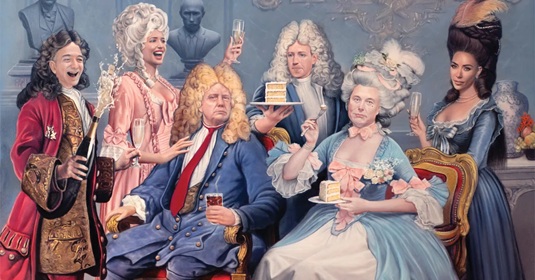
What are the dynamics driving this? This is question Jodi Dean has concerned herself with in Capital’s Grave: Neofeudalism and the Class Struggle. Just like the casual overuse of fascism, I normally bristle at applying feudalism to an examination of capitalist class dynamics. Hyperbole is the enemy of clarity, after all. But here Dean makes a compelling case for taking neofeudalisation as a trajectory in and possible outcome of contemporary class struggles. It's not a done deal but the tendencies are there.
Consider the classical picture of feudalism commonly understood in Marxist thinking and scholarship. Peasants are directly exploited by a class of landlords, typically by having to pay over taxes in money or produce, or undertaking some compulsory form of labour in their liege lord’s service. This expropriation is direct and personal. There’s no hiding of surplus labour behind the wage relation. They do enough to reproduce themselves and their household, and the landlord makes a claim on labour that, from their point of view, is unnecessary. The peasants pay up or render their services, or they get a visit from the land lord’s retinue of goons. Dean's argument is that the service economy and its particular forms of labour, what she calls 'communicative capitalism', offers a way beyond capital and capitalism, but by way of regressing back to class relations redolent of feudal social formations. As she puts it, "Italian theorists in the 1960s used the term social factory to describe the relationship between capital and labour in the postwar era. Today we inhabit a social manor. Society isn't oriented toward the production of workers and commodities. It's now an order of personalised service, privilege, hierarchy, and fealty." (p.16).
For Dean, there are two ways in which capitalist class dynamics are undermining themselves. First has been the shift in accumulation that has accompanied the neoliberal turn since the 1980s. This now depends more on rents than the "classical" model of surplus extraction and reinvestment in production. The second is the greater stress on coercion. The idea of peaceful mute compulsion characteristic of Max Weber's accounts of capitalism and some Marxist renderings overlooks the role violence has always played in sustaining capitalism's class relations, and for Dean these are coming more to the fore. Debt, social security conditionalities, police violence, polarising politics, and increasing state authoritarianism in the core sites of accumulation are the flip side of the deployment of violence against the peripheries. Trump's militarism personifies this perfectly. And we see this congealing in the class relations of communicative capitalism. In an extended discussion of Uber, the logic of neofeudalism is laid bare. A driver downloads the app, is connected to customers through it and Uber takes their cut when the fare is paid. However, what happens when the app is the market? Dean discusses how Uber used the vast pools of venture capital it attracted to undercut existing public transport, particularly in the US, to drive out competition and make Uber the only option. A parallel of the very aggressive expansion strategies of Starbucks in the 1990s. With the market cornered fares can be increased and terms dictated to the drivers around working hour expectations, personal ratings, car maintenance, and a reduction in the driver's share. Here, workers aren't dependent on a market for their income. They pay a company for access to that market and are subject to its whims, and without a ready alternative for selling their labour power. "The demolition of urban transport is crucial to its accumulation strategy: it doesn't compete by improving; it destroys other options for riders and drivers. Its fee increases and manipulation of its algorithm to reward drivers who are always on and punish drivers who don't make certain quota further contribute to "supply" by forcing drivers to work more for less. This isn't capitalist exploitation; it's neofeudal exploitation." (p.43).
Having been in a running polemic with Antonio Negri up until his death about the character of contemporary class relationships, Dean reverses one of his key arguments. For Negri and the Italian autonomists more generally, the social has been completely subsumed by capitalism. That is commodification and exploitation have penetrated all areas of social life and, as a consequence, all struggles impact on class relations. There is an irreducible class dimension to everything. For Dean, this simplifies the realities of class relations somewhat. To grasp capitalism now, we need to revive Marx's notion of the formal subsumption of labour to capital. This is where, in a fundamental sense, some arrangements for exploiting labour power exist "outside" of the system. Throughout its history capitalism has been able to make use of other forms of exploitation, such as slavery, indentured labour, and feudal relations outside of the metropolitan core to fuel accumulation. This sort of unevenness, for Dean, is strengthening. The tough borders rhetoric of Western governments, for instance, is patchy at keeping out so-called undesirables, but does racialise the division of labour in these countries, which allows for forms of unfree labour to proliferate. The aforementioned Uber example is another. It's not about innovating, rather its the destruction of a market and substituting it for a command relationship for the benefit of one firm. Musk's transformation of Twitter into X, the so-called "everything app" is a similar effort at monopolising internet communication. Ditto for Facebook. And the deployment of LLMs is trying to do the very same with social competencies. Capitalism is a global social formation that operates many different kinds of class relationships and is continually pushing at creating more exploitative dependencies beyond wage labour.
For Dean, another tendency toward neofeudalism involves sovereignty. Drawing on the work of Perry Anderson and Ellen Meiksins Wood, a chief characteristic of feudalism is the parcelling of sovereignty. Feudalism relied on hierarchies of vassalage and service. The local landlord might be a vassal of a powerful family who, in turn, are enmeshed in webs of alliances and are, theoretically, subordinate to the monarch. These threaten a return as the primary sovereignty under capitalism, that of the state, is undermined by world markets, mobile capital, and the outsized influence global oligarchs exercise over governments. Crucially for Dean, popular sovereignty is also being destroyed through the thinning of social security and collapsing state capacities, with the result being instability and precarity for increasing numbers of people. Another aspect of this shrinkage is the eclipsing of the rule of law as an impersonal entity and the growth of the rule of contract, citing examples from the US where employees are expected to accept arbitrage as a condition of employment. And also drawing attention to international arbitration courts set up and designed to defend private property and exerting the rights of capital against exercises of state sovereignty - when it does not accord with their interests. Governments can be sued for nationalising enterprises, restricting market access, or infringing on property rights. Lastly, the decades-long reorientation of labour markets away from "productive" to service work is a further symptom of neofeudalisation. The proliferation of David Graeber's bullshit jobs are mostly jobs dedicated to servicing the employer in some way. The dominance of task working and the excessive bleeding of work time into free time are exactly what one would expect of this process, with "performance" measured by the fulfillment of obligations set down in contracts, expectations around going above and beyond stated duties, and sanctions/punishments for not meeting them. Sarah Wyn-Williams's memoir of working in a senior role at Facebook/Meta typifies the experiences of millions of workers in high profile and, ostensibly, high-powered positions. Despite being the director of public policy with global reach, she details how Mark Zuckerberg and Sheryl Sandberg treated her and those around them as personal assistants who'd pick up their laundry, sort out childcare, arrange parties, and be always-on regardless of the time of day. Wyn-Williams talks about having to finish work for her bosses while in labour and going into the maternity ward. Far from immaterial labour offering new vistas of freedom, as per Hardt and Negri, this opens a new road to serfdom.
Yet this is not a counsel for pessimism. As a good Marxist, Dean knows emergent (and existing) forms of class domination are pregnant with their opposite. While labour is restructured around servicing the oligarchy, the fundamental insight of the autonomists - that for capitalism and its class relationships to continue, ever greater layers of workers have to be drawn into the work of its social reproduction - is correct. Longer living creates health and adult care pressures. Mental health, disabilities, and neurodivergence generates more adaptability pressures on public services, institutions, and whether they like it or not, employers. These cannot be satisfied by straightforward commodification and marketisation, generating potentially explosive contradictions. Dean writes,
Precisely because care and reproduction can't be fully technologised, precisely because technological development results in an ever-larger sector of servants, precisely because caring for people comes up against real limits with respect to "efficiency", ... a society of servants cannot be a capitalist society. Services require that we think in terms of their use value, not their exchange value." (p.115)Care workers are therefore at the sharpest end of the class struggle and is its strategic fulcrum. This is the bulk of the working class now, and our class politics have to shift accordingly. At the centre of this is a new vision of communism, and one that rides the dynamic of care. Focusing on reindustrialisation is a nostalgic politics, the production of services - universal basic services - on the other hand is appropriate to our level of development and the contemporary structuring of our class. The neofeudal is not inevitable, but represents an attempt at channelling and frustrating the radical potentials of reproductive labour, a labour that is socially necessary from capital's point of view, in ways that strengthen the class relationships underpinning it. And in so doing, the ruling class becomes less capitalist and more aristocratic. The truth of this dynamic comes from the mouth of the billionaires and their satraps. Their increasingly crude efforts and fomenting division, pushing for "welfare reform" and dismantling what remains of social security, the self-serving offensives against "suicidal empathy", the denigration of femininity because of its long association with care and compassion, all are ideological expressions of material interests at odds with the wellbeing of humanity as a whole. This is how they do class struggle.
Dean's intervention makes a welcome contribution to understanding the forms and stakes of contemporary class struggle, and offers a far superior analytical lens for considering the behaviour of billionaires, oafish presidents, and the politics of extreme right wing parties than the usual liberal rubbish about senility and thick voters. If there are two criticisms I have, it's her overly dismissive attitude toward the radical potentials of immaterial labour and its situation in social competencies. Especially as her argument rests on the potentials of care as a material force in our societies. What is care if it in not already rooted in the social practices of immaterial labour? And while she does employ Lacan to think about the rise of identity politics in its disaggregating and atomising consequences, she does not think about the growth and spread of social liberalism as the de facto common sense of rising generations of workers. There is a strong relationship! The second is her idealisation of the vehicle for prosecuting our class interests - the communist party. While she talks about the collectivity and care arising from solidarity that the party brings (outlined in more depth in Comrade, her previous book about comradeship in the context of a communist party), the organisation she's a member of - the Party of Socialism and Liberation - doesn't exactly fit the political moment, what with its apologetics for North Korea and the unlamented regime of Bashar al-Assad. Nor the inglorious tendency of self-defined communist and/or revolutionary parties, regardless of their positions-takings, to become confessional sects at best, and abusive cults at worst. While the party remains the only institution capable of organising our class interests, it needs to reflect the diversity of the class it organises, and that includes diversity of opinion and not giving anti-US despots a free pass. Nevertheless, Dean has explained the destination of the oligarchic tendency in ruling class politics, the processes underpinning it, and the strategic space we must occupy to throw it into reverse. A useful roadmap for understanding where we are and the direction we're moving in.
Image Credit

11 comments:
I believe that there exists some body of research supporting the idea that growing up in positions of extreme privilege is systematically stunting to human emotional development, tending to produce irresponsible empathic cripples - who go on to inherit empires of wealth and influence. About a decade ago a controversial trial in the USA even coined a term for it: "Affluenza".
If being stunted in this way makes children generally better at hoarding wealth, then over generations it's a self-reinforcing cycle.
I suggest that this process of "anti-care" is core to how the psychopathic oligarch class reproduces itself. It's selected according to its success in parasitizing upon the "care" of the pro-social majority.
In some legal jurisdictions, there are even notable institutions of great age which seem to function to traumatise the children of the economic elite out of whatever empathic tendencies that their parents might have failed to extinguish; e.g. elite public schools... Which also function to encourage the creation of mutual blackmail relationships which bind the elite patronage networks together. From the Bullingdon Club, to Epstein's island.
More interesting, and relevant to discussions of struggle against the parasite class, are those working class and petty rentier rubes who fall into behaviours of idolising and identifying parasocially with their parasite masters, or (at lesser extremes) at least imagining that they share fundamental interests with them. One can perhaps imagine these lower vassals as being infected with a kind of mental cordyceps.
Interesting article, but how much empirical data does the author provide to back-up their claims? If you're writing a polemic it is easy to advance claims that are apparently self-evident using anecdotes, but it solid data for and against that elevates an argument to something worth taking seriously.
Claims about the Labour share of income tend to ignore that the share to capital in developed countries is actually pretty flat, and it's the Govt's share that has often increased (which is entirely consistent with real terms increases in state spending). Claims about inequality ignore actual inequality stats in favour of emotive claims. Wibble about reindustrialisation is nostalgic, but it is also ignorant of data, for example UK industrial output never stopped growing, it just got more efficient and stopped employing as many people.
Take the Uber example, what does the long term data say about the per-capita spending on private hire? There are substitutes, they exist now, they existed before. Uber provided another channel. I'm not making a moral judgement on this, just that the introduction of any new technology can change, create or kill existing markets. Are the markets really cornered or is it just that the consumer mostly prefers the new technology because the old way wasn't that great (plenty of foreign cities I have visited come with warnings about dodgy cab fares)?
Take claims about nationalisation, how many of those industries originated as nationalised? Why do they need to be nationalised now? Again, not a moral judgement, just asking what does the historical data say?
Musk, Bezos, Zuckerberg etc, most people don't actually need to consume their products, they do so for personal utility. If they were to withdraw their services tomorrow, nobody would starve, the lights wouldn't go out.
I appreciate this isn't a 'Great Men of History' narrative, but to me it sounds a bit similar, it's grand narrative with big characters rather than more mundane explanation of a world of constant emergent changes. I remember once falling asleep reading Hobsbawm rattling off comparative 19th C coal, iron and agricultural production figures, but the data was objective evidence of technological change, rather than a narrative built on a handful of wunderkinds who changed the world.
Is Kamo improving, or changing strategy? I'd certainly like to believe the former, as some of his recent comments have sounded almost like a different person, none more so than this one here - and certainly a change for the better.
However, I can't resist speculating in what it might mean if this is actually a change of strategy, and perhaps even part of a wider change of strategy by agents and supporters of the oligarch class. Previously Kamo has tended to deliver generally incoherent and delusional (if not actively dishonest) polemics against any kind of "leftist" sentiment, which were not popular in this corner of the internet. But on this post we instead have an attempt to ask what are, on the surface, reasonable and pertinent questions regarding a proposed analytical model - a model, of course, which happens to be highly unflattering to the extent captains of wealth and industry.
If it is indeed a change of strategy by a loyal servant of the oligarchical status quo, then the last two paragraphs seem to give the game away. Kamo suggests that perhaps these (named, highly identifiable) billionaire and trillionaire black holes of wealth are nothing special really, merely fleeting celebrities borne aloft on much larger and more significant human movements - not drivers but only passengers in the vehicle of history, and certainly not worth wasting any guillotines upon! I'll leave it to others in the audience to consider the merits of that idea...
Anonymous, rest assured I shall continue to play the cackling pantomime villain in the comments just as the billionaires shall remain the cackling pantomime villains of leftist discourse.
I'm fundamentally an empiricist, and whilst I don't totally reject rationalism, I do reject postmodern approaches. At best it's apophenia espoused by clever but lazy people and at worst worthless post-truth slop peddled by charlatans. But given postmodern approaches seem to have an outsized influence on current political discourse relative to their (lack of) material value, it's interesting to see someone discuss a take that might not entirely be slop. For me, understanding how a delusion is constructed is more interesting than just knowing someone is suffering from a delusion.
There are no black holes of wealth, economies are not zero sum games. The billionaires we know today are proof of that, because there simply wouldn't be an Uber or an Amazon or a Tesla if it were true. The absolute, empirically observable rise in living standards across the whole world just wouldn't exist.
The relative poverty of the UK today would have been absolute luxury to my grandparents growing up in the overcrowded slums of a Lancashire town in the 1920s and 30s, and god knows what their grandparents would make of today's poverty! But I suspect postmodern political theory is one of those luxury beliefs you get to have once you no longer have to cut up newpaper for the outhouse or don't have to fight with 10 siblings for the top of a boiled egg. But at least they didn't have to worry about Musk's moneybin (oops, that last bit might be a delusion).
So, we go back to the start and I'm curious how much actual historical data Jodi Dean uses to test her hypotheses? Albeit, not enough to go and read her book, but luckily Phil has already done it for us.
Ah, a return to the usual service of self-parody from our regular, I see.
As "fundamentally an empiricist", a self-proclaimed lover of hard data over postmodern hyperbole, and definitely not one of those "clever but lazy" people who never had to fight off 10 siblings for a scrap of egg (presumably whilst living with them in a cardboard box by the side of the road); we hear that Kamo is keen for someone else to read books for him, so that he can judge them without having read them. I guess it must be specifically the "clever" part of "clever but lazy" which Kamo sees in others more often than in his mirror.
Perhaps this allergy to digesting new information is why he's apparently unaware of important phenomena like tax havens and externalities. Nor able to conceive of data as being relevant in any wider historical contexts than the carefully limited window supporting that comforting fairy tale, of endless (but strictly material) progress and goal-directed history, which he clings to from earlier in his childhood. Economies are not zero sum games, he proclaims! There are no black holes of wealth! Graphs only go up, never down! Such is the view from the wrong end of the Dunning-Kruger curve - and anyone who's spent time in the company of real scientists knows that you rarely hear such intellectual faux pas from them except when they are unwisely straying far outside their domain of expertise. Would-be sophists have no such restraint, of course; but we should shy away from assuming individual malice when mere incompetence (and distributed, systemic malice) will do.
It's a pity that Kamo seems lacking in the self-awareness required to appreciate how his own delusions are constructed. The rest of us can still take the opportunity to examine them.
Just in case this connection wasn't obvious: a concept of deliberately abusive anti-care as being essential to the reproduction of a parasitic class provides a ready explanation for pushback against legitimisation and recognition of the care that the parasitic class also depends upon. They need care to remain an uncosted externality, just as they always needed slaves to dig up the resources for industrialisation (and for the finite supply of fossils and toxin-diluting environmental sinks to remain off the balance sheet)! All attempts to bring care "onto the books" are a threat to both their power and their concept of the world, since their class does not do any of the care work - indeed are systematically broken out of the ability to do any care work - but still depend upon it and require to profit from it. It is not necessary that they even consciously recognise this threat in order to act upon it; the contradictions between the political model of care, and the political model of avarice and extraction which they were indoctrinated into (or mutated into, in the case of clinical psychopaths), are sufficient to trigger a hostile reaction based upon nothing more than the challenge to their core beliefs. It's well known that the human brain reacts to core belief challenges exactly the same as if it were facing a physical threat. Hence the bilious rebellion against first feminism and now "woke" - the label they have lately adopted for the politics of properly accounted care work.
That's how they can prosecute their class war - and as parasites, remain burrowed into their host - without even needing to believe in class war (although of course many of the top layer read Marx at their elite schools and absolutely do, privately, believe in class war).
As Phil put it himself in the post: "Mental health, disabilities, and neurodivergence generate more adaptability pressures on public services, institutions, and whether they like it or not, employers." They certainly do not like it, any more than they like the spectre of having to give up their extravagant consumption habits on account of inconvenient truths. Like a tick sucking its host to death - but with no other host to go to - they would rather that public services were entirely disintegrated and the world burn.
Emblematic of the anti-care process and its current relevance is Musk's ongoing attempt to break his LLM, "Grok", to support his own self-serving and self-contradictory delusions. It may be the first time that anti-care has been applied to a purely digital entity.
An important aspect to note concerning the drive to denigrate care and femininity is how this is seen by ordinary right-wing voters.
For right-wingers, the bottom line is national security. After all, that's the foundation of the property rights which they depend upon to survive in the modern world. Human and cultural reproduction of all kinds is only there to serve national security. They see national security (and its extension - the ability to perform piracy against other populations, the foundation of the colonial wealth which they value so highly) as being critically dependent upon the supply of young males who are socialised to be readily capable of violence. Women only exist to supply those young males - and keep them happy enough to stay passive when they are not at war. Any attempt to restrain the young males, instead of restraining the women in service to the young males, is a direct threat to national security and therefore to their personal means of survival.
This is fast becoming the primary story by which the ruling oligarchs recruit their political footsoldiers. The fact that the oligarchs have very different reasons for wanting to attack care and femininity - because their property rights don't depend upon any single national entity! - is quite lost on run-of-the-mill right wing voters, whose authoritarian instincts are readily exploited to blind them to the real motives and designs of their rulers.
An interesting, and potentially very important thing about the class dynamics of the present moment is that the current ruling class actually have no fucking class at all.
They're all essentially either new money or the idiot scions of fundamentally unstable dynasties. They simply do not have the multi-generational survival instincts which moderated the behaviour of their predecessors. That's what makes them so dangerous, and it's also a key weakness demanding to be targeted.
The ruling class of the 1940s would have reacted to the 2008 crash by instantly shoving the Overton Window back towards socialism, understanding that it was in their own long term interests as well. We know this because it's exactly what they did! But their equivalents today have lapsed into complete complacency, from thinking that their eternal rule was assured when China started borrowing bits of capitalist practice.
The news lately has been full of the suddenly discovered "story" about Natalie Harp and her relationship to Trump. It's relevant here because everyone is being allowed to assume that she's basically his carer. When the President of the United States repeatedly soils himself on camera (among other medical morbidities that are on show), millions of people will simultaneously ask the question of who it is that is changing his diapers.
Enter a young, white, blonde, conventionally pretty and glamorous, former television anchor, fundamentalist Christian, who has a well supported backstory of believing that Trump literally saved her life, and now worships the ground he walks upon and has dedicated her present days to doing exactly that.
It's a characteristically unsubtle extension to the vision of ideal female behaviour which the religious right wing has been desperately trying to push for a number of years now - the vision and backing money which gave us the concept of "trad wives". Until now these efforts have been garishly, off-puttingly anachronistic and cartoonishly incompetent. Well, the unsubtlety and off-putting nature of the vision itself has not changed, but the subtlety of the presentation certainly has, and the Harp myth might represent a step change in the sophistication of their approach - one which suggests that perhaps somebody highly placed in Trumpland has been reading the same books that Phil has. It looks a lot like an attempt to make a highly controlled and curated acknowledgement of the modern importance of care, giving it a glamorous celebrity figurehead, but carefully stripped of implications that any real freedom or agency might be due along with it. The message: women, your place is to serve your men unquestioningly, as she does!
It looks as if @Kamo has been reading. A little bit of knowledge is a dangerous thing, don't you know? But regardless of all the clever words (postmodern, apophenia - get you!) the underlying ideology and arrogance remains.
Utility - that's another one. That's the classic economic explanation for anything. Why buy that? For the utility. What is utility? It's what you get when you buy something. How do you know? Because why else would anyone buy anything? I don't know, maybe they wanted it? Yes, because of the utility. Which is what? ... and so on round and round. The futility of utility - I wrote an essay titled that. Clever, eh?
It is true that we don't have to consume what Bezos or Musk etc sell. I manage to avoid their crap. But thinking that they are simply clever business men with a product many want is missing the point. As a died-in-the-wool capitalist, aren't you supposed to value competition? Aren't monopoly, monopsony and the oligo-versions anathema to the proper working of the market? Maybe do a little light reading about their business practices before wittering on about utility.
Perhaps you really believe the BS you spout, presumably you must, or you wouldn't waste so much time here airing your discredited ideas. What surprises me is how defensive you are about them. If you are so right (see what I did there) then why the desperation trying to convince this small corner of cyberspace? Everybody in power, all the wealthy entrepreneurs (that's French for w*nkers, by the way) all the corporate executives, portfolio holders, directors and wealth hoarders, all of them agree with you. Your lot are utterly in control. So, what is it with you that you seem so lacking in confidence in your own theories that you feel driven to try to defend them all the time?
Or is it that deep inside your (I would say soul, but let's not be silly) mind there is a nagging doubt? I mean, if your ideas are so f**king great, why is the world in such a mess? Why are we facing climate armageddon, the collapse of biodiversity and hence many key ecosystems, and the eruption of increasing numbers of resource wars? I know you probably pretend that this will all be fine, that AI will solve all problems, probably by annihilitaing the peasants, leaving the natural 'elite' to indulge themselves as they please. But in your (I would say heart, but, who would I be kidding) gut you know that isn't going to happen. It's a spiral into war, famine, pestilence and, at last, death.
Still, in the meantime you get to entertain us all with your stale views. Thanks.
Post a Comment