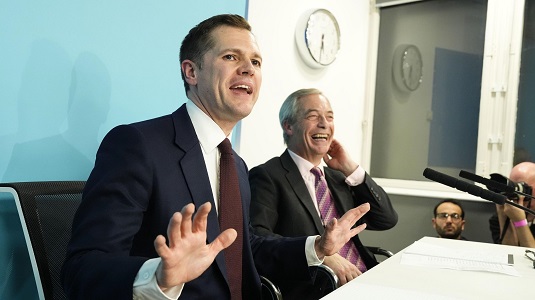
There are fewer people in politics worse than Robert Jenrick. So a plague on Nigel Farage for accepting his defection to Reform, and then installing him as their economics spox. Because the party is still ahead in the polls, when Jenrick now gives a speech we have to have some awareness of what he has to say. And on Wednesday it was Reform budget time. What would Farage in Number 10 mean for economics and public spending? And the answer is ... we've seen it all before.
Top of Jenrick's pops was the restoration of the two child benefit cap. This had already been trailed by Farage, with him suggesting earlier in the month that he wants the cap brought back so punters can save 5p a pint down at Spoons. Performative cruelty for pocket change? The most spiteful sections of Reform's support would lap it up. But how this sits with Matthew Goodwin's view that women should be fined/taxed punitively if they don't have children, and the generalised panic on the right about birthrates is anyone's guess.
Also on Jenrick's agenda was a pledge to keep the OBR, and the supremacy of the Treasury in state spending matters. And with that, the continued "independence" of the Bank of England. Something the establishment would be happy about, seeing as the symbiotic and interpenetrating relationships these institutions have with each other and the City of London are a crucial nexus of class power in this country. He also committed Reform to a low inflation strategy, which - as per previous governments - would be wheeled out as a technocratic wonky argument against increasing public spending. Which, funnily enough, never applies to splashing out on the military.
There wasn’t much else to Jenrick's speech, but as with such things it's the silences that are pregnant with meaning. Wanting to force hundreds of thousands of children back into poverty, dressed up as instilling "some realism into this business" could have come from any speech of George Osborne's during his time as chancellor. Indeed, one might expect Reform to go down the path of the Tories' 'austerity populism'. The arguments the Tories deployed in the run up to the 2010 general election that successfully persuaded enough people that the crisis in state finances was caused by public spending and social security commitments, and not the global response - largely led by the British government - to bail out the banks. Blaming the poorest for Britain's woes would be right up Jenrick's street. There has never been a group of vulnerable people he didn't want to punch.
This also definitively kills any suggestion of a "left turn" on Reform's part, which was always a stretch, despite Farage toying such a position for a bit of attention-seeking. Likewise, combine Suella Braverman's rants as their education spox against universities and mickey mouse courses. This is the completion of a movement back into the Reform leadership's preferred policy diet, a menu of foul tasting warm ups from the last decade. As the party's position as the main political force on the right is consolidated, making an offering that looks like traditional Tory fare might, they hope, extend Reform's reach into what is left of the Tory coalition. And perhaps those softer, more liberal-inclined elements that might otherwise go Liberal Democrat because the liberalism they care about is more of the economic than the political kind.
On the other hand, this comes with a set of difficulties. Reform's success derives from its distance from the Tories, of being the owners of Brexit in our post-Boris Johnson politics and the scapegoaters du jour of a range of powerless people. Reform aren't about to drop their racism, their anti-environmentalism, nor their soft anti-vaxism and conspiracy theory dog whistles, but sounding identical to the Tories on economic matters and getting former Tories from the last, failed government to front it? That's like exposing a swathe of ankle and renaming themselves Achilles. The populist posturing starts looking just like that, a poor cover for a programme that made life more difficult for significant sections of Reform's volatile voter coalition when the Tories were last in charge. There are political costs to positioning Reform as a racist mk II Conservative Party, and it could be a move that is already starting to depress their polling numbers.
Image Credit

6 comments:
Jenrick ran his speech past Osborne, apparently:
https://x.com/realBenBloch/status/2024478285044789453
As you say Phil, and as I predicted in an earlier post months ago, Farage has simply filled his front row of Reform leadership with ghastly old Tory re-treads from the last Tory government. This is partly because the Right wing "talent" out there to make up a full proto ministerial team is decidedly thin from non Tory sources. The bulk of alternative leading Reformers are simply too bonkers to fill the roles, and Farage has really always wanted to lead the Conservative Party, being a rabid saloon bar Tory, not any sort of neo fascist radical with a pseudo leftish "Strasserite" programme . Which could indeed attract masses of ex Labour "Red Wall" voters, as Le Pen's French Front National/National assembly did in its pseudo "Left Turn" for a number of years.
This is in fact a weakness now, When UK party politics is so extraordinarily febrile , and old voting allegiances are shattering. It surely must be obvious to many, particularly working class, potential Reform voters that this cynical lash-up is just a neoliberalism on steroids, Tory Party mark 2 - led by the same Tory grandees who carried out the "Boris Wave" of unprecedented mass immigration after Brexit, and served only the interests of the rich.
Interesting if Farage can make the potential Reform voters believe the "end mass immigration" promises from the same old Tory riff raff from the last government in the Reform "shop Window" . A certain David Cameron promised to reduce net immigration to the tens of thousands about 10 years ago now, and yet another very obvious set of recycled Tory rogues rebranded as "Reform" promising the same surely must fail to convince . Especially once they are questioned on their NHS privatisation, no taxing of the rich, etc, plans.
Starmer will be happy with this, as would McSweeney if he was still in post. The Farage Show is really testing the intelligence and attention span of every single voter that it has previously swayed from Labour (and None Of The Above).
No doubt this is experimentation with, most likely, 3 years still to go until the crunch... If neither the continuing Tory vote nor the defecting Labour vote appear to be fooled, then there's still time for a performative leftward tack.
All current predictions about the future of Farage's now quite clearly Tory Nasty Party 2 project , and indeed the looming Denton/Gorton By election could well be dramatically influenced by the now very, very, imminent external economic pressure (like petrol prices going through the roof ) of a now almost certain Middle East all out war , and the closure of the Straits of Hormuz. We are almost certainly on the cusp of a sudden global economic crisis sparked by this unnecessary war , which is fully backed by Starmer and his corrupt cronies. Such a global crisis will change and massively accentuate the current dynamics of UK politics I suspect , in ways that are hard to anticipate in advance.
With James Orr involved, their intent is probably to look like Tories to Tory voters, while simultaneously looking like UK Trumpism to nativist working class voters.
I wonder if the latter are desperate and/or naive enough to knowingly invite Project 2025 into this country.
Perhaps the economic shock and destabilisation of that event is what the christofascists in the US intend to use for a declaration of martial law, and filling up all the new concentration camps that they have been building.
Under most circumstances it would be suicide for them to spike their own domestic petrol prices. But they have to be operating on cornered animal logic right now, being effectively in the "if you shoot at the king, don't miss" position. The Epstein affair, or the - not yet widely noticed - collapse of the petrodollar cartel, or a failure to sufficiently rig the midterms, or the death of their barely-functioning figurehead, or any combination of those will probably see their coup attempt ending pretty soon (or at best collapsing into an actual civil war which they can't adequately control) if they don't get their Reichstag Fire.
Post a Comment