Commenting on the first book in a trilogy is a perilous affair. Not all of the author's ideas or characters are fully developed. The impact is staggered across the subsequent volumes. The vision and the achievement of the work has to be taken in the round. These were the gist of many replies my review of Liu Cixin's The Three-Body Problem provoked around various the corners of the internet. Having now read the sequel, The Dark Forest, if anything the story takes a turn for the worse. This middle book is very middling.
To summarise where we left off, a Chinese radio scientist advertised the location of the Earth to a nearby predatory alien civilisation. Their world is threatened with destruction by their suns, and have launched an invasion/colonisation fleet in our direction. Owing to the distances involved they will turn up approximately 400 years after the close of the first book. The 'Trisolarians' are assisted by the sophons, microscopic supercomputers they sent to Earth at the speed of light to mess with physics experiments, preventing significant technological advancement, and to put the preparation of the planet's defence under total surveillance. Also assisting the aliens are groups of humans who, for a variety of reasons, would rather see our species destroyed or placed on reservations under the extra-terrestrial boot. Thanks to some plot-convenient violence to how quantum entanglement operates, both can instantaneously communicate with approaching fleet and the home world.
Spoilers follow.
The Dark Forest is about how Earth meets this threat. The narrative orbits around the efforts of the wallfacers, experts selected by the UN to come up with strategies for stopping the invasion. They are not to write their plans down, nor converse with others about them. They are granted unlimited resources and the authorities are expected to obey their orders. The sophons cannot read minds, and so they can only guess at what the facers are doing. However, several turncoat humans have appointed themselves "wallbreakers". They shadow their opponents, figure out their plans, and confront them when they have done so. And surely, one-by-one, the facers' schemes are rumbled. All except for Luo Ji, a washed up social scientist turned astronomer who for some reason the Trisolarians are trying to murder.
In the second half of the book, Luo wakes up after a couple of centuries in cold sleep. He comes to in a science fictional future: wireless power transmission, vast underground cities, colonies on other planets, and a hefty space fleet. While all this is amazing to Luo, it's the result of applying already-understood physics. There have been no qualitative breakthroughs since the aliens shut down all our particle accelerators. Nevertheless, the world is confident that they can take on the Trisolarians. And by way of a demonstration, a thousand-strong battle squadron of ships are set to rendezvous with a probe the aliens have sent ahead of their fleet. What could go wrong?
Unfortunately, instead of suspense all Liu's leaden prose conveys is tedium. Not that this necessarily matters for genre SF. It never did Arthur C Clarke's or Isaac Asimov's sales any harm. Like its predecessor, Dark Forest goes big on the big ideas, and I suppose for those not versed in the usual tropes they can appear spectacular. For example, this book has leant its name to the so-called dark forest hypothesis, one of the "solutions" to the Fermi Paradox. I.e. If there are aliens, why are they not here? Liu's answer is they're there alright, but they keep themselves to themselves lest they be espied and destroyed by another civilisation. Kill them before they can kill you is the pessimistic resolution of the great silence. Luo demonstrates the truth of this supposition. Sending out a signal that purports to come from a star 50 light years away, several decades later it goes nova. Astronomers spotted a fast moving object slam into the star. Someone out there wasn't taking any chances.
The real problem with Dark Forest is its misanthropy. Liu betrays a rather dim view of his fellow humans. We are cast as irredeemably credulous, stupid, cowardly, and cruel. In the present, the wallfacers are feted as rock stars who can do no wrong. Forget the cynicism that is the lot of contemporary culture, including Chinese culture, it's like we've all become participants in personality cults - but we mean it. This enthusiasm manifests itself in a hysteria against "escapism". The masses push for and successfully see laws implemented forbidding states and individuals from building their own ships to flee into the cosmos. We're all in it together as the herd insists we keep our eggs in one basket.
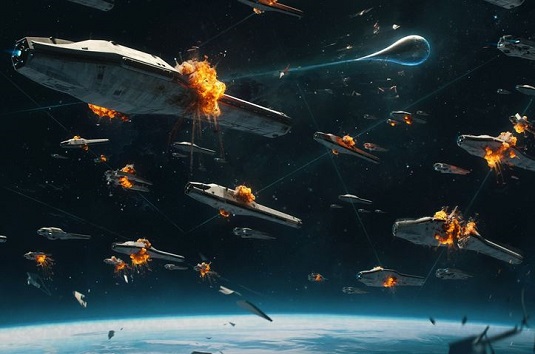
All of these collective flaws come to a head in the space battle. As the probe comes to a halt, the thousand warships line up in formation for the show down. What we get instead is a massacre. Thanks to the Trisolarians' hoodoo physics the probe becomes a wrecking ball that smashes through the engines of the lined up ships, causing them to explode one after the other. Evidently, our descendents had learned nothing from ocean-going navies, let alone three-dimensional space combat video games. Some ships at the margin of the massacre are able to escape and chance it on an escapist, interstellar run. A good job they remembered to pack the cryogenics. But before they do, they butcher each other so the victors have enough supplies and parts to keep them going for a centuries' long voyage. And because of the defeat, everyone on Earth, everyone panics and starts treating Luo as the second coming. They're soon disappointed as he concentrates working on a project seeding the solar system with dust, which will help determine the coordinates of the Trisolarians when they arrive. He's condemned as a fraud while civilisation falls into despondency.
The rendering of these dramatics are rather amateur. Clunky, mechanical, grating, none of this was worth the eventual pay off. It's not just that the writing is poor, the plotting obvious, the whole book - much more than the first - oozes condescension. The dim view of human nature and the patronising 'we are but children who know nothing' sentiment was a real drag, as was the implicit endorsement of putting trust in the abilities of out betters. Humanity here is not a civilisation trying to defend itself, it's the backdrop, a collection of bystanders that can only cheer or cry.
Obviously, this is not a recommend. But despite itself, two books into the Remembrance of Earth's Past trilogy I am masochistically invested enough to put myself through the final installment. Read this as a warning and save yourself some time.
Image Credit

15 comments:
I noped out after the first book, even though it massively redeemed itself in the final stretch with a sudden explosion of luridly entertaining wild ideas. I just wasn't hopeful that the rest would be worth it after such a shaky start.
Your criticism of the second reminds me of what I thought about Nolan's The Dark Knight. For all the OTT greatness of every scene involving Joker (and all the half-baked tedium of most scenes which don't), so much of the film's plot hinges on the population of Gotham behaving like creatures which would make sheep - or even MAGAts during the pandemic - appear to be geniuses. However dumb that you've seen real humans behaving, it's just not that dumb.
Anyway, "dark forest" as in the Fermi solution doesn't stand up to much close inspection nowadays (probably rather like the series of the same name). If whole solar systems were getting routinely massacred out there, we'd see it happening. If it was done on a smaller and quieter (but still crass) scale - planet crackers rather than star crackers - then the flight time for the cracker to arrive is a nearly fatal sticking point, hence the need for the "sophons" in Cixin's world. If it was done on a still quieter and stealthier scale, by actually sending "sophon"-like agents to observe and interfere with the target world, then why don't the paranoid aliens' agents arrive long before the industrial revolution, or indeed the stone age? The whole idea requires some serious handwavium to make the numbers add up.
Something which just occurred to me: Cixin's trilogy is rather like a science fiction equivalent of the works of J. K. Rowling. A series which achieves great commercial success precisely because of the sheer mediocrity of the thinking behind it.
Although I enjoyed a lot of the Iate Iain M. Banks there were regular occurrences of giant space battles. I'd skip forward 20 pages, muttering "The Culture wins, as usual," to avoid the tedium.
'a Chinese radio scientist inadvertently advertised the location of the Earth to a nearby predatory alien civilisation.'
Inadvertently? That she did it deliberately is one of the most powerful passages in the book.
You see Ken, it was a deliberate error to see if Scotland's premier writer of science fiction was on the ball. It had nothing to do with being sloppy and writing late at night.
She kinda did do it accidentally, the first time. Or rather, she did what she intended to do, but didn't expect a predatory alien civilisation to answer.
One of the more endearing parts of the book is how they initially answer, with someone exactly like a mirror of herself turning up on the other end of the line.
Well... Surface Detail did try to make a point about the giant space battles between contemporary equals getting rarer and rarer as those equals age into possession of more and more terrifying tech, resulting in them "continuing war by other means", in a new arena where the Culture isn't all that shit hot actually.
The space battle which does happen is an almost-accidental stomp of some definitely-not-equals who were trying it on. Plus there's a disjointed subplot reminding us that the angry elder ghosts of the Culture verse can still swat the Culture like bugs if they're disturbed. (And despite all this it's definitely one of the limper Culture books).
Kind of ironic that the premise of a book called ‘The Three-Body Problem’ appears to model all its interstellar relations purely bilaterally. The incentives on potential belligerents change dramatically when one introduces the possibility a bigger fish might already be watching them both to see if they are a threat.
I'm sure you'll be satisfied to hear that the first book's grasp of 3-body physics is similarly weak. Sometimes hilariously so.
But the setup of the series has more holes than a colander anyway. For example, it basically depends on two technological biospheres being next-door-neighbours (indeed, nearly roommates) in the comparatively vast expanses of both space and time, which is vanishingly unlikely unless they're common as muck in the first place; and in that case there's almost no chance - without suitable handwavium - that somebody much older and more powerful, who is at no risk at all from upstarts, won't be watching and making the final decision on whether or not they are allowed to survive and/or kill each other. (That's "zoo hypothesis", close to being the only game in town now, Fermi-wise). And so forth. On top of that there's the plot-critical coincidence that the aliens happen to be living on a dying world, giving them a reason to try and invade instead of merely lobbing a star cracker at us as the "dark forest" premise would otherwise demand.
Apparently, or so I've heard, the third book does get back into the more interestingly wild ideas which characterised the end of the first one, and casts our own universe as being basically the shrapnel from somebody else's Great Space War (or something like that) - echoing the way that the surprise subatomic aliens got summarily snuffed at the end of the first book. But I can't tell you whether or not that development rescues any of the gaping holes in plot or world-building, because I haven't been motivated to read it.
Did you mean "seeding the solar system with dust" rather than 'ceding'?
I despair
Despair not. As long as I've been reading it, this blog has been a Grauniad of typos, which never prevented it from batting well above average in the modern world even for professional literacy and proof-reading, never mind hobbyist writing. Trivial late-night typos which are easily corrected on the fly by your readers...? We should scoff at the fear of them.
Greetings, and yes, I also found it quite dull in parts, but I did get to the end.
I think and it isn't a developed thought, that this book isn't so much to do with space, but more about a defence of Mao.
In my view, a theme throughout the books is human weakness to do the "right" thing (not the morally correct thing). Indeed, moral correctness gets punished. It is more of a view that in order to preserve the collective, sacrifices must be made or the whole gets annihilated. In that, I think the author is channeling the propaganda of the old (I don't know about the new) Chinese communist party (for example, one child policy, moving swathes of people forcibly around the country, famine and so on)- all for the good of the greater China.
Not often I agree with you, Phil, but yes indeed Isaac Asimov was a dreadfully bad writer, on attempting to read one of his Foundation books I was amazed that he got so famous. His sentences just clunk along as if he didn't know how they were going to end when he started writing them. He couldn't write female characters and he didn't do aliens.
As for the "Fermi Paradox," it's not a paradox it's just an offhand remark by someone who wasn't even an astronomer. Radio transmissions from Earth would not be detectable beyond about a third of a lightyear away, and the nearest star is two lightyears. Aliens would only be detectable if they were deliberately trying to be detected, and there are several reasons why they might not want to invest in this effort.
My preferred solution however is that the future is more like Conan the Barbarian than Star Trek. Civilisations mostly self-destruct once their technological development overtakes their emotional development. Hence history is always cyclical and most alien races will be in the pre-scientific or post-scientific stage at any one time.
Anon is quite right that it isn't a true "paradox" in any sense, but should really reacquaint themselves with that particular offhand remark.
It was never about us detecting "them" from their emissions, or "them" detecting "us" from ours, an extremely unlikely circumstance which requires some very specific constraints to render realistic. (E.g. you have to imagine that they get to the point of spewing out detectable emissions and then contrive to remain essentially static for at least thousands, if not millions of years. Or that they pop up right next door at exactly the same time as we do, as in Cixin's threadbare scenario.)
Fermi's (quite astute) observation was about the fact that our best available numbers and astronomical models say that their frontier probes should already be here, in our solar system, unless there is something in the way that we can't see (the so-called "Great Filter"). Astronomical numbers dictate that unless life is much rarer in the universe than we have any good reason to think - and indeed, every new piece of evidence for some time has been pointing ever more strongly towards the opposite - then it requires an as-yet-unknown barrier to prevent some bunch of greys who evolved long before us from producing probes that could have reached every star in the galaxy, even travelling at entirely mundane sub-light speeds, before our own tardy mudball finally managed to break out of its reptile rut.
Astronomical numbers also basically snuff out "collapse to barbarism" solutions, because it only takes one bunch of greys to get lucky by a factor of a few centuries (which is geological pocket change, never mind astronomical). Once they properly get going, they're unstoppable by any concrete force that we can yet conceive of, which wouldn't also generate telltale signs that are spectacularly absent. Technological collapse alone is therefore insufficient as an explanation; the requirement is that reaching the ability to send out workable galaxy-exploring probes is not merely unlikely but actually impossible, for some reason which is barely hinted at in all of the evidence available to us thus far. Motivation for sending the probes is also guaranteed, according to present day knowledge, by means of the necessity to avoid the "dark room problem" - that is, the civilisational equivalent of sticking your head in the sand like a cartoon ostrich and contenting yourself to hope that the universe doesn't throw some unsurvivable concentration of dumb energy in your direction.
There are indeed a lot of potential "solutions" to the Fermi question which are far more plausible than those considered by second-rate sci fi writers, and anons with second-rate sci fi literacy. However, the ones which don't require "some invisible horror that we can't even yet conceive of" have been getting pretty thoroughly shot to pieces by the accumulating evidence. Save for Zoo Hypothesis, which proposes that the alien probes are indeed here watching, and have been all along, but aren't choosing to make themselves obvious to us. (It covers not merely zoo metaphors, but even less palatable farm metaphors - although the latter very quickly stray into the territory of inconceivable cosmic horrors anyway. During a cow's days grazing in the fields, it never sees anything that could lead it to imagine the abbatoir, otherwise we'd have a much harder time keeping them penned up.)
Post a Comment