I was set on spending the evening writing about Keir Starmer's speech, but instead we tore the house apart looking for a mislaid mobile phone. It did materialise, but only when it was too late for inspiration to work its way through my tired carcass. Instead then, it's tune time. Ignore the awful video and enjoy - especially the famous, gorgeous drop toward the end.
Saturday, 7 December 2024

Wednesday, 4 December 2024
The Full Montie
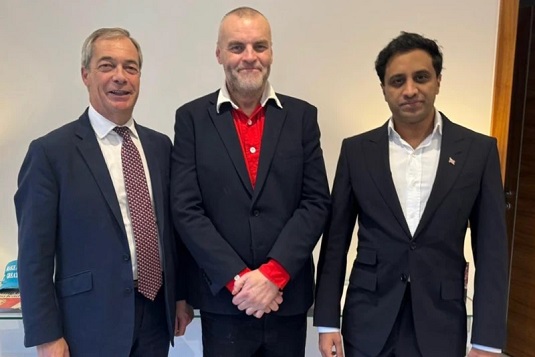
Then on Tuesday there were two more good news stories. The press were awash with reports that Elon Musk was set on donating $100m (£80m) to Reform. Which, in turn, would catapult Farage into the leagues of the very wealthy considering the "party" is his personal property. Cue frantic rebuttals and backstairs briefings about Labour's intention to impose donation caps, or only allowing donors to be UK residents. It's probable nothing will come of it, and is yet another episode in Musk's negative fixation with Keir Starmer.
A bit more significant than either is the passage of Tim Montgomerie from the thinning ranks of the Tories onto the rolls of Farage's customers. Announcing his decision during his regular slot as most-favoured right wing commentator on Times Radio, he said it was Tory failures over immigration that did for him. In a refrain anyone familiar with the Tory leadership election would have heard time and again, because the Conservatives promised to cut immigration while overseeing almost a million new arrivals in the last year, they had lost his support.
Why is the recruitment of a politics commentator a big deal for Reform? Firstly, "Montie" is as establishment as they come. A former bag carrier/speech writer for William Hague and Iain Duncan Smith, the co-founder of the misnamed Centre for Social Justice and a year later Conservative Home, he was able to leverage this as a vehicle to build a profile and from there a career as a ubiquitous talking head. He's even been on a Radio 4 discussion panel with me. Because of his connections, for Reform he offers the promise of a conduit for more Tories - especially sitting MPs - who might take the plunge. With someone as urbane and "respectable" as Montgomerie on board it knocks off some of Reform's rougher edges, at least where elite opinion is concerned. And with such an influential Reform-supporting voice in the bourgeois media - for Montgomerie's defection will harm his career not a jot - Farage and his backers hope to steer the Tory party and with it mainstream politics further rightwards. They have a a desire to fulfil, after all.
That said, no one who knows Montgomerie's politics would be the least bit surprised. He was one of the first Tories to try and introduce the fringe ideas of the far right into the party, attested by his championing of the "cultural Marxism" conspiracy theory long before it was a twinkle in Suella Braverman's cynical eye. As connected as he is, every Tory on his contact list knows about his straying off the piste of what passes for mainstream conservatism. And while some, including the Kemi Badenoch can divine a path to election victory by heading right, being too close to Reform, absorbing them, or effectively half-inching their programme makes it much harder to win back the swathes of seats lost at the general election. Especially with the process of long-term decline continuing unchecked and so there's no guarantee the voters who'll be impressed by displays of right wing extremism today will be around tomorrow.
As far as our Tim is concerned, he can now shrug off the heavy overcoat of Toryism and give us the full montie of where his politics are really at. And who can say, it might help with defections now and in the future - Richard Tice has teased another "big announcement" next week. But in the medium to longer term does it change the fundamental facts of British political life? It does not.
Image Credit
Tuesday, 3 December 2024
The Farcical South Korean Coup
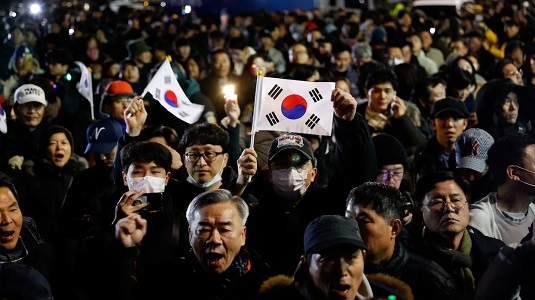
The attempt by South Korea's President Yoon Suk Yeol to abolish democracy and install military rule was not on many people's bingo car for December. Coming out of the blue, Yoon declared martial law on Tuesday 11pm Seoul time to see off "anti-state forces" and imaginary helpers of North Korea. The articles of the decree suspends all political activity and the subjection of the mass media to army control. This is, you couldn't make it up, to "protect liberal democracy". It's just as well that the National Assembly completely ignored the president's command, with several members clambering over the railings to vote down the coup - which it did so with 190 out of 300 legislators present. With the constitution on their side and protestors out on the streets in the early hours, Yoon had little choice but to climb down and rescind the order. Perhaps the most farcical coup attempt of modern times, but thankfully without the tragedy that usually attends them.
Why did Yoon have a stab at overthrowing Korean constitutionalism and turning the clock back 40 years? This BBC report lays out proximate causes. Yoon has been hampered by losing his assembly majority. He and his entourage have been on the receiving end of corruption allegations, some of which smacked of our very own freebiegate. And he was forced to make a humiliating public apology over botched investigations into Kim Keon-hee, his wife. Stymied at every turn, it appears a cocktail of frustration and desperation are what guided his hand to press the coup button.
Looking at his politics, Yoon is fairly typical of conservative figures who flirt with extreme right rhetoric and tactics. Following the play book of the right the world over, his election in 2022 was off the back of scaremongering against the North, the permissive society, and "liberal elites". In office, alongside corruption we've seen the usual diet of deregulation, kickbacks to the well heeled, and a found fondness for neoclassical economics. Which just so happen to enrich his class further. Likewise the kind of accountability dodging that would have made even Boris Johnson wince was the Yoon hallmark. Small wonder that his approval ratings had collapsed.
His emboldening by domestic democratic backsliding is only some of the story. The international scene has to be taken into account. Trump's election is a signal to many on the right that there's still plenty of gas in the reactionary tank, and that support for authoritarianism is real enough. But more important is the showing up of the American-led "rules based" international order as a sham without any consequences. The fact the International Criminal Court has issued warrants for Benjamin Netanyahu which several Western governments have said they will ignore, and that there has been zero accountability for leaders who've allowed Israeli forces to commit atrocities in broad day light must have been a consideration on Yoon's part. As a strategically vital US ally, he was perhaps hoping that the plot armour the US have conferred on Israel as part of its schemes for the Middle East would extend to him. Especially given how Yoon has spent years talking up the apocalyptic threat from the North and that the South is riddled with Kimist agents and their useful idiots. It was a desperate gambit and one that, thankfully, appears to have failed.
What now? The military have returned to barracks and the police have largely dispersed, but that is not the end of it. The botched coup has led the Korean Confederation of Trade Unions to call a general strike to force his resignation. Parliamentarians are going to have to move fast to prevent what was to be a retrenchment of reaction from turning into its opposite: a mass radicalisation and demands for broader democratic and social concessions. Don't be too surprised if Yoon is put out of office in short order, and will be pondering retirement from the hospitality offered by the nearest custody suite before long.
Image Credit
Sunday, 1 December 2024
Five Most Popular Posts in November
Yes, it's been a quieter month on the blog than I hoped. But what can you do when the mechanism is gummed up with other things, some of which deplete enthusiasm, energy, and thinking time that goes into this place? That's life. Nevertheless, there were some posts and here are the ones that did the business.
1. The Failure of the Democrats
2. Amsterdamned
3. Why the Migration to Bluesky Matters
4. The Insanity of American Politics
5. Trump's Tory Fifth Column
The shocker of the US presidential election makes it to the top of the list. But was it a shocker, really? The most arrogant and managerialist campaign since 2016, the refusal to listen to what people had been telling them for four years about life in Biden's America, and actively demobilising sections of its voter coalition - Labour's handbook for winning here far from worked out over there. Coming in second was the riot of Maccabi Tel Aviv fans. Or, to be more precise, the outright propaganda pumped out by governments and media outfits to cover for the violence and present it as something not unlike Kristallnicht. It's as if there's no bottom to mainstream politics. In third was the huge migration to Bluesky, the non-Musk alternative to Twitter. I am a fan because it's meant time spent on rolling news and comment is worthwhile again. In at four was more cogitating on the nonsense of US politics, and coming in last are the efforts Tories are now engaging to use the incoming administration to frustrate Keir Starmer's government. This is what right wing internationalism looks like.
A couple more worth your time. There's the brief piece on the resignation of Louise Haigh from yesterday. I can always rely on shenanigans taking place somewhere to unclog writer's block. And sticking with politics, a quick piece on Kemi Badenoch's victory.
Next month? With Santa due and the end of the year imminent, there will be some reflective pieces. There's going to be something on science fiction, something else on Bluesky, a couple of book reviews, the usual best dance music of 2024 (the real reason why everyone comes here), and other things. As ever, if you haven't already don't forget to follow the (very) occasional newsletter, and if you like what I do (and you're not skint), you can help support the blog. Following me on Bluesky, Facebook, and for what it's worth Twitter, are cost-free ways of showing your backing for this corner of the internet.
Image Credit
Saturday, 30 November 2024
Louise Haigh's Resignation

There isn't much more to be said about Louise Haigh's resignation, especially when this piece from the Telegraph (outside the paywall) covers all the bases. Her departure wasn't because of a spent conviction from a decade ago. It was the shenanigans that did for her. Leaving aside its digs and insinuations, the paper reports that the axe has hung over Haigh for some time. Apparently Keir Starmer's and Rachel Reeves's noses were put out of joint because Haigh successfully negotiated an end to the Tory train strikes without their say so. And this claim is supposedly proved by Starmer's 60-word response to her resignation letter. But reading on, we see that there were efforts by Labour apparatchiks to get the Tory press interested in Haigh's conviction before the election. What? The so-called civil service of the party working against its political masters? Say it ain't so.
When it comes to the Labour Party, one cannot understand the present state of play without acknowledging the simmering guerilla campaign waged by Morgan McSweeney and friends against anything that smacks of social democratic politics. And with the left either elsewhere or chained up in a box, that means the soft left are now their targets. They are the designated enemy within for two reasons. For some, they are opposed to the soft left for exactly the same reasons the Tories are. Their closeness to trade unions, the (relative) enthusiasm for pro-worker policy, and a belief that politics are about values and that Labour's mission is to improve society somewhat is too much for the grey we-know-best managerialism that dominates right wing Labour thinking. They believe re-election will be won on straightforward delivery, which typically reduces itself to the statsplaining politics of tractor production figures. The same approach that worked so well across the Atlantic. The second reason is the idea that anything smacking of old Labourism is an electoral bromide. Never mind giving the Tory press fresh angles to attack the new government from, most voters themselves - or at least those the Morganiser thinks the party needs on side next time around - don't like better paid workers, fully funded public services, or the idea that life might get better. Because of this, even had Haigh not successfully negotiated a deal with rail workers, Labour's permanent deep party had sharpened its knives and were waiting for the right moment to skewer the former transport secretary.
For all this, it might be that Haigh gets the last laugh. Because she has resigned over tiny potatoes, she has now set the bar for Starmer's ministers where it comes to conduct. For instance, her departure weakens the position of the chancellor. Who, you will recall, has freely admitted to plagiarising "her" book, and has spent the last week on the wrong end of a right wing campaign highlighting inconsistencies between what she said about her career and the actual CV. This means in the future when a difficulty or a scandal presents itself, because Haigh has gone over something inconsequential it will be politically harder for Starmer to defend his ministers. And it also suggests the Tory press will go harder knowing that their efforts has already scalped one career. By caving to the dirty work of the back room boys, Haigh has inadvertently made Labour's immediate political future harder to manage.
Image Credit
Friday, 29 November 2024
Council By-Elections November 2024

Party
|
Number of Candidates
|
Total Vote
|
%
|
+/- Oct
|
+/- Nov 23
|
Avge/
Contest |
+/-
Seats |
Conservative
|
45
| 21,280 |
22.6%
| -4.8 |
+3.2
|
473
|
+7
|
Labour
|
43
| 23,298 |
24.7%
| +2.3 |
-2.7
| 542
|
-2
|
Lib Dem
|
40
| 17,325
|
18.4%
| -2.8 |
+0.2
|
433
|
0
|
Reform*
|
31
| 9,561
|
10.1%
| +4.7 |
+9.1
|
308
|
+3
|
Green
|
37
| 6,102
|
6.5%
| -4.5
|
-4.0
|
165
|
-1
|
SNP**
|
15
| 11,841 |
12.6%
| +8.6 |
+9.3
| 789
|
-4
|
PC***
|
0
| | |
0
| |||
Ind****
|
20
| 3,199 |
3.4%
|
-11.3
|
160
|
-1
| |
Other*****
|
21
|
1.8%
| -0.5 |
-3.3
|
80
|
-2 |
* Reform's comparison results are based on recomputing their tallies from last year's Others
** There were 15 by-elections in Scotland
*** There were no by-elections in Wales
**** There were three Independent clashes this month
***** Others this month were Alba (239, 118), Communist Party of Britain (23), Heritage Party (61, 20, 11), Scottish Family Party (83, 71, 53, 51, 25), Scottish Libertarian (15, 9), SDP (33), Socialist Party of Great Britain (22), Swanscombe & Greenhithe Residents' Association (395, 252), TUSC (68, 56, 25), Workers' Party (40). The comparison figures from last year have been recomputed minus Reform's contribution.
Last month was Labour's worts performance in council by-elections since May 2021, so those who care about such things will be glad to see its performance has improved. Still losing a couple of councillors, but if Labour can stay at this level the position isn't as worrisome as last month's results suggested. The Tories, of course, were the runaway winners but polling lower than Labour and losing out on the vote average suggests their position is far from peachy. Especially when older voters are more likely to turn out for these contests. Still, partisans of the Tories will take heart from these small wins so soon after the catastrophe that befell their party.
The Liberal Democrats are holding steady after October's wobbly performance, but Reform are continuing to surge. 10% off 31 candidates is their best performance and largest intervention so far, and likely will be until next May's by-elections coincide with the locals. As they go up, so the Greens' vote share is pushed down. Not a great month after strong performances, but the real test will be if they can continue to do well out of discontent with the Tories now Reform are available as a strong alternative. Also, an unprecedented 15 by-elections in Scotland distort the overall result and see the SNP come in strongly, despite losing four seats to the Tories. If July's result wasn't emphatic enough, the party's performance since illustrates the problems they've got holding together their coalition.
December is going to be a much quieter affair, but as opinion polls these days more closely resemble monthly round ups of council by-elections I don't see any reason to believe the festive outcome is going to be much different to this one.
7th November
Aberdeenshire, Central Buchan, Con gain from SNP
Aberdeenshire, Fraserburgh & District, Con gain from SNP
Aberdeenshire, Mearns, Con gain from SNP
Blackpool, Bispham, Lab gain from Con
Bracknell Forest, Great Hollands, Lab hold
Herefordshire, Bishops Frome & Cradley, Grn hold
Inverclyde, Inverclyde West, Lab hold
Moray, Elgin City South, Con gain from SNP
Wyre, Marsh Mill, Ref gain from Con
14th November
Derbyshire Dales, Calver & Longstone, Con gain from Grn
East Ayrshire, Doon Valley, Lab hold
East Ayrshire, Kilmarnock West and Crosshouse, Lab hold
Edinburgh, Colinton/Fairmilehead, LDem gain from Lab
Greenwich, Shooters Hill, Lab hold
Milton Keynes, Bradwell, LDem hold
Milton Keynes, Broughton, LDem hold
Redbridge, Wanstead Park, Lab hold
Telford & Wrekin, Hadley & Leegomery, Lab hold
Telford & Wrekin, The Nedge, Lab hold
West Lothian, Whitburn & Blackburn, Lab hold
West Oxfordshire, Chipping Norton, LDem gain from Lab
21st November
Dacorum, Bennetts End, Lab gain from Ind
Dacorum, Hemel Hempstead Town, Con gain from LDem
Dartford, Greenhithe & Knockhall, Ref gain from Oth
Glasgow, Drumchapel Anniesland, Lab hold
Glasgow, Maryhill, Lab hold
Glasgow, North East, Lab hold
Gosport, Harbourside & Town, Con gain from Lab
Highland, Fort William & Ardnamuchan, LDem hold
Horsham, Denne, Con gain from LDem
Kent, Swanscombe & Greenhithe, Ref gain from Oth
Rutland, Oakham North East, LDem hold
Sefton, Litherlan, Lab hold
Somerset, Blackmoor Vale, Con gain from LDem
Somerset, Rowbarton & Staplegrove, LDem hold
Swale, Murston, Ind hold
28th November
Barking and Dagenham, Northbury, Lab hold
Barking & Dagenham, Village, Lab hold x2
Enfield, Jubilee, Lab hold
Fife, West Fife & Coastal Villages, Lab hold
Islington, Junction, Lab hold
Sheffield, Woodhouse, LDem gain from Lab
South Gloucestershire, Frampton Cotterell, LDem hold
West Dunbartonshire, Kilpatrick, Lab hold
York, Haxby & Wigginton, LDem hold
Image Credit
Monday, 25 November 2024
Blocked

Feeling a bit blocked on the writing front to be honest. Which isn't great when a book chapter about the crisis of the Conservatives is due this Saturday. Ho hum.
Past experience suggests that when I moan about "not feeling it" or having "nothing to say", it's enough to uncork the barrel and watch the torrents of words spill forth. Here's to hoping this is one of those occasions.
On the radar of things I'd like to talk about is the gamed petition calling for a general election, calls on Labour to reverse their tax plans, the decision to let Ukraine use long-range missiles on Russia, the further growth of Bluesky as an alternative to Twitter and the long-unusable Facebook, and something on a rather good science fiction novel I polished off recently. If I can't even manage to write a wee comment on current affairs, weightier pieces or bad tempered eviscerations of the government aren't about to land.
Anyway, just to let you know I am alive and this place remains a going concern. But in the mean time, any suggestions for getting the writing flowing again will be gratefully received.
Wednesday, 20 November 2024
Revolt of the Rural Rich
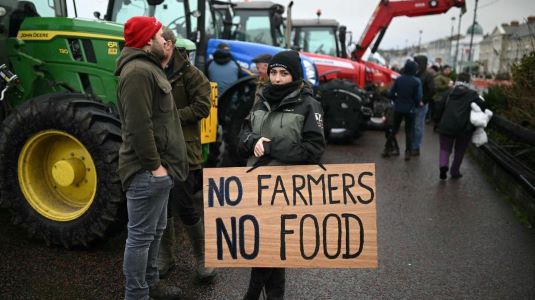
There's been a lot of rubbish written in the right wing press about the budget and the changes made to farmers' inheritance liabilities. Taking to their tractors for a demonstration in London on Monday, there were joined by self-confessed tax dodger Jeremy Clarkson and, among other things, drove one of their machines through a police barrier. Needless to say, Just Stop Oil activists have been handed hefty sentences for less. On the substance of the changes, the National Farmers' Union and its wealthier patrons are acting like the sky's about to fall in. Whereas other analyses, not just those proffered by the government, are in agreement that only a small minority of farmers will be required to cough up under the new rules. This, predominantly, is a revolt of the rural rich.
Thinking back over the future of the Tories last year, I argued that with a Commons wipe out we were bound to see extra-parliamentary movements of the right mobilise against the new Labour government around real and imagined grievances. This happened far quicker than anyone expected in the summer, but it had been glowing and flaring in the embers of the dying Tory government. There were, for instance, the anti-ultra low emission zone protests and the attendant "direct action" of vandalising and ripping up enforcement cameras in London. And we don't have to look too far back in the past to recall the blockade of refineries in 2000 and the Countryside Alliance march a couple of years later. Ostensibly against the ban on hunting with hounds this was a coat peg for a cagoule full of anti-townie grievances. Not all of which were unwarranted.
The coverage of the "plight" of wealthy land owners reminds us whose mouthpiece the media is, but it's a warning. It's easy to mock the likes of Clarkson and James Dyson, for whom their investments in agricultural land is to save their well heeled offspring from a tax bill when their clogs are popped, but what Labour and the left have to be wary of is the capacity of capital to mobilise a wider constituency. Rachel Reeves's taxes on unearned income has already driven the right to apoplexy because she has dared touch the lynchpin of their class power. But this is enough to stir up petit bourgeois layers as well, even though they're not caught by the inheritance tax take nor likely to ever be. For them it's a statement of intent, a declaration that the government might come for their more modest incomes next - in much the same way pledges to raise income tax on the highest earners sends jitters through the next layer down. It plays into their fears, and despite promising to be the most pro-business government ever, there are sections of capital, big and small, that are instinctively worried about a Labour government because of its class basis.
Therefore, as wealthy landowners mobilise their well of concerns - tax, subsidies, minimum prices, DEFRA regulations and inspections, townie arrogance - it's like casting seed onto particularly fertile soil when Labour are in office. Contrast this with how the Tories shafted farmers without any blowback from the right wing press, or self-appointed celebrity friends of farmers, nor much action from the NFU itself beyond strongly worded lobbying.
Labour and the labour movement aren't necessarily helpless, but they are if the ground is ceded to the rural rich. Already, the government have decided to push managerial over political messaging when it comes to controversial issues, a decision that renders it vulnerable in the medium to long-term. But there are advantages to be accrued from driving a wedge, which the inheritance tax changes are, between the majority of farmers and the layer of wealthy land owners. One would be the disincentive of the tax dodging rich to pile up agricultural holdings and encouraging sales, sending the ever increasing value of land into reverse and freeing up more for farming at the expense of land banking. The unionisation of agricultural workers, of which several drives are ongoing, is another, of making the presence of organised labour felt in the countryside - particularly among migrant workers who are often at the sharp end of the most exploitative contracts and employer abuses, could also work against the political influence the rural rich enjoy in their manors.
The art of politics is not just about winning, but demobilising one's opponents and preventing them from taking a lead on issues under your control. The handling of the so-called farmers' protest suggests that the ruthlessness the Labour leadership has shown its internal opponents is conspicuously lacking where those outwith its ranks are concerned. But with only a thin layer of votes to fall back on, if they want to be in for at least a decade to fulfil Keir Starmer's "missions" they're going to have to take this more seriously.
Image Credit
Sunday, 17 November 2024
Hacking the State
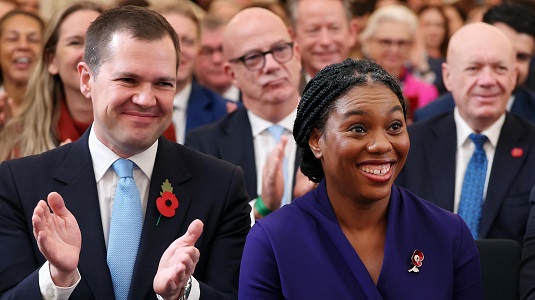
Writing in the Sunday Times, Kemi Badenoch has set out her vision of what government would look like if she becomes Prime Minister. The principles, which she calls "reprogramming the state" could be more accurately described as hacking it. Into smaller and smaller pieces.
In her argument, Badenoch does not attack the people who work for the state. Her target is bureaucratic process. Drawing on her time as business secretary, she says the inability to pay out compensation to the victims of the sub postmasters Horizons debacle in a timely fashion was symptomatic of the problems afflicting the state. Every decision has to be backed by x number of reviews, y gaggles of consultations, and z quantities of impact assessments. Attempts to abbreviate the process would find ministerial decisions subject to court challenge and, therefore, more delay. The risk averse culture afflicting the civil service, she concludes, is not a case of the mindset of staff but their experience of having to satisfy all the reporting requirements. These, Badenoch acknowledges, might have grown out of sensible concerns for accountability and transparency but in practice they only lengthen administrative processes and make them more opaque. The more laws that are passed, the more the state grows, the more the prospect of litigation enlarges, and with it the risk averse culture. A perfect doom loop.
If this is her problem ("I made this diagnosis the central plank of my campaign to become leader"), the solution is reprogramming the state. Government must stop rewarding managerialism among ministers, and every level of the state needs looking at afresh - but "box ticking" and "judicial review" must be avoided if the problem is to go away. In all likelihood improving "accountability", Badenoch style, will be the subject of suggestions churned out by the Tufton Street think tank complex. As well as the churn from Elon Musk's anticipated evisceration of the federal state in the US.
There are a few things of interest here. Or rather, interesting absences. If this is the culture of the state and it's so irksome, the Tories had 14 years to change it so why didn't they? Was it a symptom of talking conservative but governing left? Well, no. There were plenty of changes to governance over that period of time, and all of them embedded the Thatcherite settlement further. I.e. The counter revolution that started under her and was consolidated in the Major and the New Labour years, which saw bits of the state sold off, or forced into debt relationships with private finance, or forced to "compete" in internally constituted "markets" with one another. This was consolidated under the Tory/Liberal Democrat coalition. To put it another way, the proliferation of performance indicators, targets, "market intelligence", and the requisite legal expertise to go alongside them increased the amount of administrative work required. Neoliberalism is the bureaucrat's friend. But this was in the context in which the coalition government slashed at the state. Form filling multiplied as form fillers were laid off. More work was demanded from a shrinking workforce, and so the system was prone to seizing up. This is the first "inefficiency" Badenoch "forgot" to mention in her article.
The paradigm of this consolidation of neoliberal governance was the vandalism committed against the NHS during the first term of the Tories' long stint in office. Effectively, Andrew Lansley abolished the NHS as was and replaced it with a market, underwritten by state money, in which NHS organisations and "any willing provider" competed for contracts handed out by the hundreds of fund-holding Clinical Commissioning Groups. This meant huge sums diverted from health care to the maintenance of a wasteful and needless internal market, and rampant profiteering as private health concerns won contracts and subcontracted them to NHS organisations, creaming off layers of profit in the process. This was supposed to run autonomously of government and, formally, responsibility for the NHS no longer lay with the health secretary. As it happened, increasingly CCGs and NHS trusts found ways around the market and established cooperative relationships contrary to the designs of the legislation. With the immediate first wave of Covid out the way, the Tories belatedly discovered this and returned sweeping powers to the health secretary - then Matt Hancock - with unprecedented range to intervene and micromanage. The kind of model Badenoch seems to be hinting at. I.e. Ministerial direction unchecked by established procedures and remits to enhance accountability. And how has the NHS looked since this innovation was introduced? Yet another slice of pertinent recent experience from government the leader of the opposition chose not to dwell upon.
Lastly, completely by coincidence her "reprogramming" of the state is consistent with Tory efforts to wind down its capacity to do things. It bears comparison that Badenoch's view is a reskinned version of Jacob Rees-Mogg's planned civil service cull. In short, the state has not failed because of a magic theory of bureaucracy. It has virtually collapsed because under the Tories this was the policy objective. It has been starved of resources, saddled with extra responsibilities, and forced into a governance strait jacket that could only produce sub-optimal outcomes. And Badenoch's answer is to make this crisis of capacity the desired goal of the next Tory government. Her big idea is the regurgitated pap of the recent past, a programme and an agenda that saw the Tories crash to their heaviest ever defeat.
Image Credit
Saturday, 16 November 2024
Trump's Tory Fifth Column
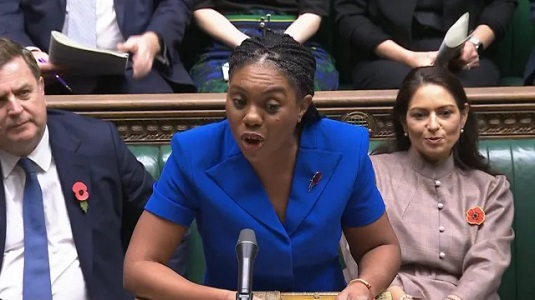
Already a veritable industry has sprung up advising Keir Starmer how his government might cultivate the second coming of Donald Trump. Should he pivot toward America, get the trade deal signed, and attempt to mitigate the White House's dysfunctions and excesses through the offices of the special relationship? Should the Prime Minister seek instead a closer relationship with the EU, considering the tariffs Trump has vowed to impose on imported goods to tackle inflation helped win him the election. Or should Number 10 try both these things at once, as the Bank's former chief wonk Andy Haldane counsels? Wherever Starmer steers to tread, he has something else to contend with: the yapping of the Tories and the other runts of the right.
Despite suffering their worst result ever, what should have felt like a cataclysm has been received by the Tories as a slap on the wrist by the electorate. They were buoyed up by the fact Labour's popular vote was far from spectacular, and have convinced themselves that to win again they have to turn right and scoop up the support lost to Reform while watching Labour combust in government. The consequences of which will take care of the rest. But one way Labour's immolation might be sped up is by the Tories stirring mischief and trying to cultivate difficulties for Starmer vis a vis the White House.
Not content with destroying Twitter, for some time now Elon Musk has criticised Starmer and Labour. For instance, inside the last month he's said Rachel Reeves's closure of the agricultural land tax loophole is "wrong", and of the investigation into the Telegraph's Allison Pearson over an alleged racist tweet said "This is insane. Make Orwell Fiction Again!!”. Obviously ignorant that the probe is under the direction of social media legislation drafted and implemented by the Tories. Nevertheless, this presents them with an opportunity: lever Trump into opposing UK government policy to undermine its credibility and room for manoeuvre at home and abroad.
An example is the "debate" about the sovereignty of the Chagos Islands. In the summer, the government announced it was formally handing the islands over to Mauritius. The United States would sign a further lease with them on Diego Garcia for its strategically useful air base. In other words, to all intents and purposes nothing changes. The Tories, however, are opposed to the transfer despite negotiating it in the first place. And so, the Telegraph reports, Tory peers are looking at blocking it in the Lords so Trump can come in and veto the decision, thereby thwarting China's schemes for the region - apparently. The real reason is to put Starmer at loggerheads with Trump and force a humiliating climb down that the Tories would politically profit from.
This is how it's going to be for the next four years. For all the froth about "sovereignty" that underpinned the "long-held" and "genuinely felt" principles behind Brexit, and the denunciations of "foreign courts" and the European Convention during the Tory leadership contest, this goes out of the window for the Tories and their cultivation of Trump. Yes it's hypocritical and, in conservatism's own terms, arguably anti-British if not treasonous. But this isn't because of ideology, of a congruence of ideas between the Tories here and the extremism of Trump's Republicans. More important is the perceived commonality of interests.
Trump is set on shredding the federal state for the profit of America's oligarchs, and his appointments - as irrational and as crazy as they appear - reflect this ambition. The sum total of all "small state" politics is the same: run down state capacity in everything but law and order and the military, force people to provide for themselves if they can or somehow survive if they cannot, and the horizon of politics is levelled down. Why demand anything from the state if it simply cannot deliver what meagre social responsibilities it has left? This was Rishi Sunak's project, and is now Trump's. Though this being the USA everything has to be bigger. While Labour with Reeves in Number 11 is never going to nationalise the top 100 monopolies nor, for that matter, break with business-centric politics, for the Tories her taxation of unearned income is a step too far. It's not that the people the Tories represent can't afford it, they fret that any measure, no matter how modest, that touches the core of class relations in British capitalism can only lead to more demands. If capital gains tax is increased now, what's to stop if from going up tomorrow? And having implemented one set of tax rises, what's going to stop Labour from introducing more aimed at property, share income, rentals etc. in the future? That way, they fear, lies a shift in the balance of forces that the Tories have done so much to right after the shocks of Brexit, Corbynism, and Covid.
Let's not over egg the pudding. Most of business are broadly supportive of Starmer's modernisation project. But the rump Tory party, the most conscious, far-sighted, but paranoid section of their class worry that Labour might uncork all manner of genies with political consequences that will echo down the years. That's why this government has to be brought to heel. If that means constantly sucking up to and petitioning Trump and his allies to do Britain down, put pressure on diluting or abandoning the mildest of social democratic policies, and showing up this country's claims to sovereignty as a joke, this is what they will do. The national interest, their national interest demands no less.
Image Credit
Subscribe to:
Posts (Atom)