Interesting workshop coming up at Keele Uni. I'll be putting something in.
Social and Political Critique in the Age of Austerity
A one day workshop at Keele University
10.30am-6pm, Wednesday 12th February, 2014
This one day workshop is devoted to the discussion of critical politics in the contemporary age of austerity. Following the 2007 global economic crash, which led to a raft of government bank bail outs and nationalisations across America and Europe, a cunning ideological reversal took place – the crash was no longer the result of the hubris of the neoliberal financial sector, which had developed the idea of ‘riskless risk’ where reckless stock market speculation and the creation of value ex nihilo could produce endless profit, but rather the immoral wastefulness of the people and society. According to this ideological position, which was advanced by governments across Europe, the welfare state, and in many respects society itself, was transformed into an ‘exorbitant privilege’ that was simply unaffordable. In fact, in order to pay for their wastefulness the people were not only expected to give up their public services, but also required to accept ever lower wages, and a general state of social and economic precariousness.
This is the current state of play across America and Europe, where the neoliberal state has exploited the crash in order to retrofit society for violent competition with Asian capitalism. In the face of this race to the bottom, key thinkers such as David Graeber, Antonio Negri, Slavoj Zizek, Alain Badiou, and Costas Douzinas have spoken out against the new form Naomi Klein calls neoliberal disaster capitalism and given voice to the protest, rebellion, and revolt taking place across the world.
The objective of this workshop is to build upon the works of these key thinkers and explore the possibility for resistance in the age of austerity. We invite contributions from a range of disciplines focused on diverse social and political contexts and a variety of theoretical perspectives. Contributors may choose to focus on austerity and resistance across Europe, including the UK, Greece, Spain, and Italy; the Occupy movement; the media construction of austerity, including the idea of the undeserving poor who are seen to be living off public funds; methods for the organisation of resistance; the concept of the multitude and the digital commons; anti-capitalist thought; or transformative social and political theory and practice more generally. Most importantly, we are keen to emphasise that this list is not exhaustive - the key principle behind the workshop is that debate should open up a space for social and political creativity. In this way we are keen to encourage potential contributors to be creative and explore new possibilities for political change in a historical period where change seems absolutely necessary, but also impossible to envisage. In this respect, we encourage contributions from a variety of participants – academics, post-graduate students, activists, and others engaged in thinking through the possibilities of change under conditions of crisis and austerity.
The workshop will close with a lecture from Professor Costas Douzinas (Birkbeck), author of Philosophy and Resistance in the Crisis: Greece and the Future of Europe.
In order to take part in the event please send a 250 word abstract to Emma Head (e.l.head@keele.ac.uk), by Monday 23rd December. This event is being organised jointly by Mark Featherstone (Keele Sociology) and Emma Head (Keele Sociology and the BSA Digital Sociology study group). Registration will open in early January. Confirmed speakers will be notified by 7th January.
Friday, 29 November 2013

Thursday, 28 November 2013
Boris Dissected

1. de Pfeffel Johnson isn't like other politicians. He doesn't hide behind spin. He tells it as he sees it. It doesn't matter if his praise for inequality turns to ashes when burned by evidence. That IQ tests are meaningless. Or that selective education writes off kids - mainly working class kids - at a young age. He's the anti-politician politician. You know exactly where you stand with him.
2. Hold on a moment, de Pfeffel Johnson is caring. Read the speech carefully. Greed is good, but only if it's backed up by solid values. He notes "... if there is to be a boom in the 20-teens, I hope it is one that is marked by a genuine sense of community and acts of prodigious philanthropy, and I wish the snob value and prestige that the Americans attach to act of giving would somehow manifest itself here, or manifest itself more vividly." On one level he's repeating Adam Smith, who noted how the complex of needs and wants in a society are best met by millions of individuals pursuing their own interests in market economies. But like Smith, de Pfeffel Johnson isn't blind to ethics. The hard hearted logic of capital can be softened by the warm glow of philanthropy. Please note the absence of society collectively addressing market failure. Rather, it is left to the whims of billionaire softies.
3. de Pfeffel Johnson wasn't expounding his political philosophy because he felt like it. These things, whatever subjective motivations, take place against a political backdrop and will always be interpreted in that context. In this the speech fused together the two tendencies of contemporary Toryism - the patrician elitism sans one nation commitments, and hard right market totalitarianism. You could be forgiven for thinking some position-jockeying for life after 2015 is going on.
4. It's a Tory speech by a leading Tory, so it was always going to be riddled with stupid empiricism. And before he gave it, I could have told you it would be a backward looking speech. As the organic representatives of the most decadent sections of the ruling class, they have to return to the scenes of the 80s because there is nothing more they can do. What does a privatiser and deregulator do when almost everything has been privatised and deregulated? And when the needs of capital, the needs of their own class demand energetic industrial activism on the part of the state, what then?
Cut through the cynical bonhomie. de Pfeffel Johnson is as bankrupt as the rest of his party. If this is a foretaste of the programme he would offer as Tory leader, that permanent Labour majority is certainly more likely.
Wednesday, 27 November 2013
Far Left and Revolutionary Identity Politics

As Tariq Ali notes, Maoism was never a big deal on these shores. The Communist Party followed by the big three of Trotskyism more or less had the lion share of self-identifying Marxist activists. As such from the get go Mao-fans were consigned to the fringes. And we're not talking the labour movement here, their fringe was of petit bourgeois radicalism, of politicised intentional communes, "hard" anti-American/anti-imperialism, and uncompromising ultra-leftism. Taking their cue from the Trotskyists, but with a different pantheon, revolutionary history was of betrayal after successive betrayal. When Khrushchev betrayed and denounced Stalin, proletarian leadership passed to Mao. After his passing and the disposal of the Gang of Four by the "capitalist-roaders", the red thread was - depending on your preferences - grasped by Albania's Uncle Enver, or sundry Maoist groupuscules. Judging by Balakhrishnan's denunciation of British, Irish and Canadian Maoists I'm guessing he thought the world historic task of global proletarian revolution fell to him.
Messianism is not the unique property of Maoists. Just as the far right is divided among would-be fuehrers who brook no opposition, so the far left is split between collectives of varying sizes, each uniquely offering the correct politics and the right leadership to sweep capitalism away - if only the working class would listen to them instead of their traditional (mis)leaders. If you subscribe to a group with grand pretensions of a glorious mission, one shouldn't be surprised if they act a bit strange. Or self-destruct spectacularly.
Marxism remains the basis for a thoroughly materialist explanation of human societies. Its understanding of the dynamism of social relations and, particularly, how capitalism works remains unsurpassed. Just as one can only build on Darwin and Einstein, not junk them; so it is with Marx. So why are Trotskyists, Maoists, whatever, not prepared to turn the Marxist tools they fetishise back on themselves? Let's play with some rough and probably unready thoughts.
The upsurge of radicalism across Western Europe and North America in the late 60s did not correspond to an economic crisis, but were the consequences of newly-hegemonic processes unleashed by the post-war boom. One strand, at least in Europe, was the institutionalisation of class struggle via the various corporatist arrangements national capitals struck with labour movements. Across the Atlantic, the civil rights movement was shaking up politics. But at the same time, for both, culture was coming to terms with a new individual: the consumer. This was, and remains, a figure heavily coated in middle class varnish, but since the early 50s the media technologies of the day inculcated a kind of individualism that realised itself through commodities. This individualism had a heightened sense of self and a common sense feeling of freedom that could be explored away from the workplace. What was the preserve of the wealthy from previous ages, the individual, the self, was a "project" within the parameters the prevailing order conceded. So far, so Frankfurt.
There were limits to the new rules of the game. You were blocked from realising individuated freedom by your gender. By your skin colour. By your sexuality. By your education. By the money in the bank. And the subjectivity appropriate to consumption was never completely dazzled by commodity fetishism. The Civil Rights movement was, first and foremost, a reform-minded movement that wanted the American promise extended to African-Americans in the South. It assumed a more revolutionary quality in the North because the much more abstract intertwining of race and class thwarted that promise in the absence of easily-identifiable Jim Crow laws and overt institutional racism. Freedom, dignity, recognition, these were obviously denied in this case. In all these cases. And when society is hailing more and more people as individual selves, when capital needs them for the growing domestic markets, blockages caused by gender, race, class and sexuality make for social explosions.
Trotskyism predated all this by four decades. Before the war, the struggle between it and the dominant Stalinism was bloody, and it was almost always the Trotskyists on the receiving end. Key cadres were systematically murdered. Trotskyism was under siege. By the time the 1960s came around Stalinism and Trotskyism, a vast differential between them, had adapted to the corporatist arrangements of their respective countries. For the Stalinists, communism had some validity among West European labour movements. The Trotskyists too were firmly oriented toward trade union activity and/or entry jobs in their country's dominant social democratic party. Both were oriented toward a certain idea and understanding of working class consciousness.
This changed. Millions marched on to the political stage in the late 60s, and for most of them it was a fleeting experience. Yet some stuck around, being attracted to the New Left and the anti-Vietnam War movement, and latterly the "new" struggles against oppression. These hooked into the senses of self of many activists - women getting a raw deal in the movement, and they were many, entirely understandably gravitated toward each other on the basis of their experiences. The same was true of gay men. And, albeit to a more limited extent in Europe, black and minority ethnicities. A number of activists likewise gravitated toward Maoism and Trotskyism (giving dour Stalinism a body swerve). In Britain, the International Socialists (the SWP's forerunner) and the International Marxist Group (of Tariq Ali!) scooped up the new generation of activists for whom socialism and revolutionary politics wasn't rooted in "old-style" class consciousness, but a congruence of values and identity between the group and the new recruit. Such individuals had always been around radical and revolutionary causes. But what was different were the much larger numbers who were so motivated.
Throughout the period the class compromise of the post-war settlement was dismantled, the cultural trends driven by capital and encouraged by neoliberal reworkings of the state and politics strengthened the new individualism. The labour movement base of the far left, which was never massive, contracted sharply and the recruits picked up were increasingly drawn toward revolutionary politics out of personal disenchantment. The class wasn't the same, but The Class as an identity marker became more important - whether one was "authentically" working class or not. And with increasing numbers entering revolutionary politics and imbibing positions and party branding as markers of personal identity, so new drivers of sectarian behaviour came into play - one wasn't necessarily asserting one's self against the crushing anonymity of capital, but against "betrayers" in the labour movement. Up to and including other self-described revolutionaries, of course. Identity was reinforced by an insularity, of Stakhanovite paper sales and financial sacrifices, of the amount of work you personally undertook, of positions won in trade unions or wider struggles, of collective get togethers and jamborees, and a party press whose primary audience was an organisation's own members.
As the culture of individuality has shifted these last 10 years in an even more narcissistic direction, so the politics and activities of far left organisations have assumed more pathological forms. Accentuation of senses of self-importance is one, allowing some to think they're above morality and the law. The depravity and cultishness that sees an alleged rape survivor harassed by people who call themselves socialists is another. Into this mix you can add a determination to continue ploughing the same furrow, despite reality confounding perspectives time and again. Without the connection to the labour movement, indeed thanks to their growing alienation from it, membership replacement absolutely depends on picking up the atomised and the disenchanted. The more they lose their moorings, the more they are absorbed in the identity work the party is increasingly involved in. Analysis and policy is no more about changing the world. Revolutionary politics, which was always a tenuous proposition in Britain anyway, has given away fully to revolutionary identity politics.
Balakhrishnan's group was a product of the shouty, shouty ultra-leftist milieu of the 70s. British Maoism bypassed the decades-long fall of Trotskyism into revolutionary identity politics because they were adrift and degenerate to begin with. They were the vision of Trotskyism's future, of a fringe movement which, admittedly, did impact on wider politics from time to time, but were nonetheless in historic decline. Isolated, unable and unwilling to match its ultra-revolutionism with the real rhythms of British capitalism outside its 13 properties, it would have been remarkable had the Workers' Institute cult not collapsed into barbarism-in-one-household. With a future for British Trotskyism that holds nothing but the revolutionary treadmill, of ceaseless sidelining and permanent impotence, one is left hoping that whatever future pathologies and dysfunctions their condition manifests, please let none be as awful as the appalling abuses revealed this week.
Tuesday, 26 November 2013
How TV Frames the Working Class
That there Owen Jones has been in the media again, talking about the portrayal of working class people. Below is a much shorter American film about the same. Yes, it's a bit dated but the point comes through loud and clear.
Monday, 25 November 2013
Stupid Empiricism and the Conservative Party
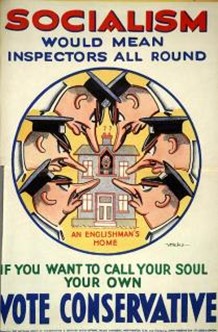
Even the Man in the Moon knows the Tories are in deep trouble. Political parties as mass membership organisations corresponding to certain constituencies of interests have taken an almighty hit all across Western Europe. Labour is weathering this trouble but is more or less treading water. If it wants to secure its future, it needs to do something about it. But the Tories, well, they are beset by intractable problems. An ageing and dwindling activist base, a menacing pretender to its right, competing claims to its record, and policies starting to owe more to mercury-laced milkshakes than anything else; only a miracle or colossal stupidity on the part of their opponents can save them in 2015. The Tories are right to be anxious, and anxiety has a tendency to cause desperation.
If you open it up, you'll find nothing new cooking in the policy oven. Just a few neoliberal warm ups and burnt offerings from decades past. Privatise this, deregulate that, whip up some tiresome xenophobia and hold a suicidal referendum on the EU. It's so grey and dull, it makes John Major look colourful. Dave can't even be bothered to wrap his agenda up in a fluffy, cutesy but utterly vacuous big idea any more. The Tories are politically exhausted, a largely spent historical force about ready to topple into the grave. All it needs is a good shove and they could be out of power for a very long time indeed. Not all Tories know this, but deep down they feel it. If victory eludes them in 2015, it's curtains.
With nothing to offer, but a self-interested need to cling to power, lying and mud-slinging is all the Tories have left. Between now and election day, they will pull out all the stops. No mistake is too small. No opposition difficulty is too minor for them to cry foul and point the finger. Even if flinging crap, as they have been doing with the Paul Flowers/Co-Op Bank debacle, ends up leaving the Tories a bit whiffy.
It's going to be dirty, that much we know. There's absolutely nothing new in saying this. But why are the Tory troops so eager for such a fight. Reading Twitter feeds of apparent grassroots Tories these days is like a glimpse into group think, of a hive mind that makes your typical Borg Collective resemble a Randian utopia. Attack lines - uniformly negative, uniformly petty, uniformly attacking Labour on a sub-political level - fed by Tory Press HQ are faithfully repeated. It's a good job tweets are not in audio as the Tory mantras would sound like the shittest Gregorian chants ever. Yet there is something about the Tory mindset that is particularly amenable to this sort of behaviour.
'Empiricism' isn't a lefty swearword that gets much traction any more, but it should. Quick crash course in a few lines. Empiricism is the philosophical perspective, if it can be described as such, that holds knowledge is primarily or solely the result of sense impressions, or, of experience. Great if you're interested in experimentation by observation. Not so great if you're using theoretical models at a certain level of abstraction to describe social or natural phenomena. Sociology and Cosmology tends not to among empiricism's biggest fans, for obvious reasons. There are, of course, different permutations of empiricism. And its emphasis on philosophical scepticism is a handy corrective to those who get caught up in building abstract theoretical schemes to the detriment of analysing and explaining. Why it is handy here is that a species of the school applies to the outlook of diehard Tory activists and MPs. There is empiricism. And there is stupid empiricism.
Allow me to illustrate by way of example. A stupid empiricist values the evidence of their own senses, and nothing else. Wet summer and rough winter? Climate change doesn't exist. Half a million job vacancies? Why isn't unemployment 500,000 lower than the published figures. Bedroom tax a problem? No it isn't, I don't know anyone affected by it. And so it goes. Stupid empiricism is an absolute security blanket that denies nearly all knowledge and evidence that contradicts their worldview. It's egoism gone mad. The sovereignty of the individual taken to extremes. It therefore follows that everyone and everything else that doesn't not chime with stupid empiricism is wrong and likely to be an enemy of common sense, if not civilisation. Locked up in their philosophical bunker, certain in their own ignorant certitude, the substance of the arguments they fling at the Labour Party and anyone else they dub the enemy doesn't matter. They don't care about the Rev Paul Flanders and the Co-op. They don't care about what happened at Falkirk, except they make for handy grenades. The messy truth, the nuance of detail do not matter. It's about damaging a movement they know to be wrong. There is no point engaging with such people either. Stupid empiricism has inoculated them against reason, against the rules of evidence. They are the political equivalent of pod people.
Stupid empiricism is not the sole preserve of the unhinged Tory grassroots. It's reached all the way into the Cabinet. How else to explain their pursuit of policies that are self-evidently damaging, their mania for cuts that cost the public purse more in the medium-to-long-term? Yet more proof of their decadence.
Labour are absolutely right to not engage with this nonsense. Tying Labour up in irrelevant side-issues is part of the Tory strategy and distracts from offering positive alternatives. Labour has shown time and again it can lead the political agenda positively, as it has done with phone hacking, Syria, energy price freezes, and payday loans - to which George Osborne has caved just today. The best way to deal with the smears and lies is carry on pushing our own timetable, and leave the Tories to make themselves look even more unpalatable.
Sunday, 24 November 2013
Lange - Drifting Away
Every lecturer I've ever known has told their students not to leave their work to the last minute. And yet, without exception, every lecturer I've ever known leaves it to the last possible moment to churn out their papers and their lectures. Who then am I to go against this inglorious grain? It does mean there will be no proper blogging tonight. So here, have a ditty.
Saturday, 23 November 2013
Day of the Doctor - Review

Well, no. Nothing could be, really. But it did a job of work. Whizz-bang special effects abounded. The rubbery monsters were a nice homage to baddies past. Loose plot lines were left unresolved (what did happen to those human/Zygon negotiations?) Daleks. And Tom Baker! All made for a canon-defining story, and Steven Moffat and team can have themselves a few tots at the after show party tonight. It was fun, jolly and entertaining.
Me being me, there are two quick points about those "deeper" things pseudo-intellectual blogs like this one tend to fixate on. First, must I go on about Steven Moffat and women again? I'm afraid I do. I've written about this on a couple of occasions, and this is just a tiny morsel of the Gallifrey-sized library of comment sitting on the internet. It's not just me saying Moffat has issues with the portrayal of women, it's hundreds of thousands of Who fans. On this occasion, women were positioned either as ciphers for weakness and indecision. Or both. Take the cameo from Good Queen Bess. Elizabeth I is portrayed as a saucy, bosom-jiggling minx who can't wait to jump on the Doctor's bones. De ja vu much? I would also have been very surprised had he not used the "I may have the body of a weak and feeble woman" line, which he did in vintage Moffat fashion. Come on, seriously, it's like she was plucked from a Carry On, complete with the unreconstructed dodgy gender politics.
Then there is Billie/Rose/Sentient computer programme and Clara. It has been canon since the 2005 reboot that the Doctor is the sole survivor of his people (apart from The Master, of course) and that he is haunted by his "necessary" genocide of the Time Lords. Necessary, because it was to save the universe from the Daleks. Day of the Doctor takes us to the moment where John Hurt, the missing "war" Doctor is about to press the button. He is joined by his two future selves - the David Tennant and Matt Smith iterations - so he does not do it alone. Pulling them back from the brink is the indecision, the consciences represented by the women. Their resolution, their grim conviction that destroying their civilisation is a necessity is dissolved by Clara's tears and weaponised Rose's visions of hope amidst the suffering. And so a new plot is hatched in which the Daleks are wiped out, but Gallifrey is whisked away and frozen in a pocket parallel universe to be retrieved by the Doctor at some unspecified future point.
It's a good job they did, of course. Though quite how Peter Capaldi is going to play a happy Doctor no longer burdened by historical guilt will be interesting. But why did the indecisive role have to fall on Clara and Rose when Matt's hipster Doctor carries enough self-doubt around to out-miserable Morrissey? Especially when moments later he exclaims he'd been thinking about the plan they go on to put into action for centuries. An innocent slip of the script? Or because it's only women who do conscience? Who fans are too familiar with Moffat by now to give him the benefit of the doubt.
The second point is how thoroughly Moffat has ploughed into the canon. Not that a show's mythology is sacred, or is a big deal anyone but the keenest of fans. Yet how he has treated it is telling. With Russell T Davies, the Time War was the reboot's jumping off point. No more Time Lords. No more Daleks (though, thankfully, he soon got around that). We were told that both species were erased from the history of the universe and secured in a continuity known only to the Doctor and the viewer. This way, Davies could set off and build a new mythology on his inheritance while being respectful with what went before. It acted as a clear punctuation, a break separating the old from the new. So old enemies came back and were updated, but that's as far as it went. Moffat, however, has twisted, pinched, tinkered and rewritten the canon Davies took care to bury away in a bunker of plot points. And so, paying little heed to previous continuity, three episodes into his reign the Mark Gatiss-authored Victory of the Daleks properly brought them back as bad 'uns. More audacious was last season's finale, in which Moffat inserted Clara into key points within previous Doctors' stories. This included suggesting that the Hartnell-era Doctor might want to take off in the TARDIS. And finally in Day of the Doctor, the mythology established over the last eight years is done. The key psychological flaw in the character was done away with.
Taken together Moffat has stamped himself all over the work of the last 50 years. He is to Who fandom what Margaret Thatcher was to the post-war settlement. Davies was the man who brought the series back, but it will be Moffat who will leave the most indelible of marks. Were Moffat to disappear to spend more time with Benedict Cumberbatch, his successors are unlikely to have as profound an impact on the show as he. His rewriting of the mythos will echo down the decades, much like the Doctor himself.
Friday, 22 November 2013
Capitalism, Asperger's and Autism

The point remains, the nature of the inequalities and prejudices disabled people face are different today than they were 30 years ago, and 30 years before that. But impairments too have a history. Short-sightedness wasn't much of a problem for the overwhelming mass of humanity in agrarian societies. It became an issue with the advent of mass literacy, but has been mitigated by technologies developed to overcome them - spectacles, eye surgery, etc. Impairments are therefore shaped, positioned, tweaked and coded by wider social forces. As physical and mental incapacities they have existed for as long as there's been humans knocking about - but what they mean and their consequences for someone with them vary according to the kind of society they live in, and its level of development.
This in mind, allow me to venture a hypothesis. I'm no mental/cognitive health specialist. What I know about the autistic spectrum and Asperger's Syndrome is very little. It's a complex area that is still being unravelled. But that isn't going to stop me advancing a touch of speculation on the main sociological question these two conditions raise. That is why have Autism and Asperger's only recently been codified as a social concern? It could part be media curiosity, part the growth and spread of the internet, and part visibility attained by the disabled rights movement. The inescapable trope of the autistic genius might have a role, too.
But I think something deeper could be going on, something to do with structural shifts in the advanced capitalist countries. Short-sightedness and Dyslexia were not social concerns prior to industrial capitalism. The point came when the demands of capital required something more than able bodies to work in its dark, satanic mills - it needed basic education to record and pass on information at all levels. Since then, particularly over the last 30 years, manufacturing has taken a battering. The old industries have fallen back and in its place are what we used to call tertiary industry: the service sector. This sector, from retail to investment banking, from call centres to consultancies, all absolutely depend on social relationships. Of course, thus it ever was. But now is different - the direction of travel clearly is capitalism's growing dependence on the wealth that can be mined from relationships. Hence the massive values of social media firms who've yet to make a single penny of profit. Hence the obligatory 'person spec' placed alongside graduate job adverts. Hence the growth of consultancies selling team-building experiences and organisational engineering. Hence the concern with Autism and Asperger's.
For Autistic and Asperger's people, the economic shift to service finds them singled out as disabled individuals. In front of the new emphasis on relationships, on the complexity of social cues and the (personal and commercial) premiums on networks; they are the newly dis-abled. And this is a very recent shift. Just 20 years ago when I was still at school, I can think of two boys who today would be diagnosed as autistic and with Asperger's. But back then, they were merely written off respectively as naughty and slow, and dim and simple. Their symptoms existed, but they had not been specially codified by the powers that be. Now, they would.
Therefore, could it be the case that the coincidence of capitalism's shift-to-service and the codification of Autism and Asperger's to a disability of social concern has deeper roots?
There is an alternative explanation, but again related to changes in political economy. We know Britain is in the midst of a mental health epidemic. One-in-four of us suffer with a mental health problem during the course of a year. Thankfully, the stigma attached to mental health is beginning to lift and it is starting to be talked about. Partly, this is because these problems are so widespread. Why should we be surprised that more insecure and pressured work situations lead to stress, anxiety and illness? That low wages, crushing debts and attacks on social security screw people up? It is reasonable to assume that more job security, more stability would have the effect of decreasing incidences of mental ill-health. But also, with capital's emphasis on relationship and service, any health problems impacting on its capacity to do business on that basis is bad news. It's a concern. A social problem. So, is it possible that the relatively recent problematisation of Autism and Asperger's is a subset of a wider recognition of a crisis around mental health?
Thursday, 21 November 2013
Stoke North: After Joan

I was privileged enough, almost by chance, to be at Stoke North Constituency Labour Party's meeting last Friday when Joan Walley announced her retirement. But no sooner had the story gone public the speculation began about who will fill her shoes after 2015 - assuming, of course, Labour wins in that part of the world.
On this matter, as an ordinary member in Stoke-on-Trent Central I have no nag in this steeplechase. Besides, it would be rather inappropriate if I was to back a particular candidate. I do not have any weight to boast of and, quite rightly, the members of Stoke North would tell me to sling my hook. But that doesn't mean I won't enjoy watching a good contest. Given the "safety" of the seat, the attention it's likely to attract locally, regionally and nationally, and the utterly scrupulous reputation of Stoke North's officers, it will be a proper competition. It's certainly going to be fairer and more open than the last one I closely watched.
Disclaimer time. These are my opinions. I don't have any inside track.
That out the way, Tony Walley has published his thoughts, so I'm not going to repeat what has already been said. Tony is right that it will very likely be an all-women's shortlist for the seat. When a woman steps down from parliament or a local authority, the National Executive Committee usually decrees that the seat will be reserved for a woman candidate. Some don't like it, but then again there's a reason why Labour has many more women representing it at all levels than the other parties.
I am a stickler for accuracy, and I think there are a couple of things Tony's got wrong in relation to one of the potentials - Ruth Smeeth. Firstly, as a Hope Not Hate coordinator Ruth has been in and around Stoke plenty of times. The anti-fascist work she and others put in during the 2011 local elections certainly helped make sure the local council chamber was a fascist-free zone. Second point, I did see Ruth out on the campaign trail last week. But that wasn't her first appearance. According to our by-election candidate Candi Chetwynd, she had been on the knocker and delivering leaflets before Joan said she had spoken to anyone about her decision. Unless Ruth is psychic, the idea she had privileged knowledge holds no such water. But is Ruth interested? Hers is just one name among many that's been doing the speculative rounds.
Others? I've heard about the rest Tony has mentioned. But there's more. I would be very surprised if my old mucker, Alison Wedgwood, isn't considering throwing her hat in the ring. I successfully campaigned with Alison in Bentilee in 2011 against the BNP, and I have no doubt she aspires to the Big House. After all, she was a Labour PPC for the Wrekin - a place the truly dedicated go for an electoral rite of passage! I wouldn't be surprised if a few words of encouragement are coming her way from my ex-boss either.
Another doing the rounds is Mabel McKeown. Who? Mabel was a member of Ken Livingstone's campaign team in London and is a former advisor to deputy party leader Harriet Harman. She also has a rather famous mum, but I'll leave that for the reader to google. I gather that she's a favourite in Unite's national office too, and recently lost out to Rupa Huq for Ealing Central and Acton's Labour nomination. Of all the names getting spun, Mabel's is the only one I don't know. All this said, now that Tessa Jowell has also announced her retirement in 2015 could it be that a vacancy much closer to home will catch her eye?
In all likelihood there will be many so-far-unnamed considering their applications, and there's plenty of time. The selection process proper doesn't open for another couple of weeks yet. But I shall be there, sat in my ringside seat with the lappy on my knee ready to blog it all for posterity.
Wednesday, 20 November 2013
Stoke Labour and Political Crisis

But you don't. As per, the talk of calamity and disaster is so much hyperbole. This isn't to say all is rosy in the Potteries garden. Of course it isn't. There are some very difficult problems besetting Stoke's Labour Parties. Examining the reasons why Labour is in the position it's in requires calm, sober reflection. The excitable rantings of do-nothing but know-everything party members on other fora are best left alone - they don't bring anything to the table. We need to analyse. Dig down.
Luke Akehurst observed in his most recent weekly overview of local by-election results, that Stoke local politics are "extremely idiosyncratic". Yes, they are. The reasons for this ultimately lie in the city's fractured political economy. The industries that built our city - mines, steel, pots - they're either history or much reduced. Like everywhere else, gone are the days of the job-for-life or leaving school for good on the Friday and starting work at the pot bank come Monday morning. But the relatively recent collapse of these industries - the mines and most of the pots went in the 90s, the steel in the 00s - has thrown the civic and political culture, the local ways of life, into profound crisis. Trade unions have withered and so has the Labour Party. The Tories, who until the late 90s had a social club in Stoke Town centre, have evaporated and condensed in seats on the city's edge. The path from the shop floor to political office is no more. And the new jobs, which have not been replaced the old like-for-like, are low paid and precarious. Call centres. Retail. Warehousing. Difficult to organise. Difficult to rebuild local politics with.
So what, some might say. Shock horror, Stoke isn't "special". Most Midland and Northern cities have gone through the same. Stoke's pain is pain Northampton, Nottingham, Bradford, Burnley, Sheffield, and dozens of other places have experienced. And I wouldn't disagree. There is, however, an important factor unique to Stoke-on-Trent. The overwhelming bulk of these islands' towns and cities are concentric, with a clear core around which are organised districts, suburbs, and satellite communities. Stoke isn't. The city is a federation of six towns, each with their own town centres and distinct identities. In the post-war period, this poly-centric character was compounded by the building of more-or-less self contained suburbs within the city limits. And there's also the small matter of Stoke being contiguous with Newcastle-under-Lyme, again with its own fierce sense of self-identity and - generally speaking - more affluent resident profile. Mix in Kidsgrove to the city's north and you have a conurbation of just over 350,000 people.
Yet the unique character of the North Staffs urban sprawl has held it back, economically speaking. Concentrating retail and other commercial services in a clearly definable city centre clusters together businesses, and drives people and business into the core areas. It is literally a case of the more, the merrier. But the advantages of this concentration has passed Stoke by, as its businesses are dispersed across different and not easily-accessible town centres. Effectively each town centre competes with one another both for local business AND funding from the City Council pot. These centres also have to compete with Newcastle town centre too. There's no easy way round this, as the one city strategy pursued by Labour and the local authority has shown time and again. Stoke has to find a way to overcome its fragmentation. But fragmentation is coded into the city's political DNA.
The collapse of the relationships that previously sustained local politics, and the insularity of the city's towns, suburbs and wards are a heady brew. Especially when economic regeneration comes into conflict with these remaining senses of identity. Also, feel free to stir in a widespread anti-politics sentiment (itself conditioned by the devastation wreaked on Stoke's economy) and a resigned antipathy toward the influx of East European workers, and you now have an idea of the background against which local politics has to operate.
Hence, last week's by-election. It is true that Labour's contact rate is low. It is also true that the achievements of Labour's Duncan Walker, the remaining councillor in the Baddeley, Milton and Norton ward aren't as well publicised as they could be. And there's the small matter that the former incumbent, an ex-Labour councillor who resigned from the party for "principled" anti-cuts reasons, has just got sent down for 16 months after stealing and defrauding my CLP of £10k. That publicity isn't what you would call "helpful". Now, it is tempting to note that the Tories topped the poll in this three-member ward back in 2011, when there was a swing across the country toward Labour and so believe we didn't have much of a chance. But no, Labour should have done better. It should have been a victory worthy of the energetic campaign my comrades Candi Chetwynd & co put in. But it wasn't.
The main message coming from the doorstep from former Labour voters was their anger and frustration with the local authority, which we've been running for two-and-a-half years. The perception is that Labour doesn't give a monkeys and doesn't listen. So the now-notorious decision to build a new Council HQ in Hanley (the nominal city centre for outsiders) to kickstart a new business park right in the heart of the city - and thereby maximising the economic benefits of clustering - is taken as evidence of folly as its budget is slashed to the bone by an uncaring and vindictive government. Folly, and trampling all over the city's unique identity. Why should Hanley get the investment while Stoke, Burslem, Tunstall, Fenton and Longton are left behind? goes the argument.
Labour also gets to carry the can for a high-handed, alienating and widely-believed-to-be-incompetent City Council bureaucracy. Its scandals and incompetencies are PR disasters for Labour. For example, in its costings for the new Council HQ the officers responsible overlooked the amount needed to kit out the new buildings with the innards, furniture, and other fixtures. Its less than robust tendering processes, its contempt for the third sector and housing associations, and the unceasing churn in personnel all reflect badly on my party, which in turn doesn't go down well with the electorate - to put it mildly.
But in a way, none of this should be surprising. Labour may be the only city-wide political party, but the dramatic changes of the last 20 years have hit it hard. The talent who would have worked their way up through the unions have been scattered to the four winds. The 2011 council was, in a number of ways, Labour's Year Zero. To recover, it has to bring stability to Stoke's economy. It has to allow people to feel secure in jobs that pay better and value people more than most of the fare that is currently on offer. If Labour can manage this which, to be honest, is not entirely within its gift - locally speaking - then the labour movement can rapidly make up for lost ground, and with it a renewal of our local parties can be carried through. This requires long-term planning and projects that will contribute to the city's economic health over a long period. So, junking the new council HQ may be popular, but would not help Labour's prospects in the long-term. The British disease afflicting our rulers has always seen short-termism win out over foresight and planning for the future. Stoke Labour has to have the courage to break with that, decisively.
Chatting to an old comrade on Saturday night at a post-election bash, he told me that Labour lost 15 or 16 seats when it decided to build the Potteries Museum. A similar number fell when it piled money into transforming a vast industrial wasteland to the west of the city into the 1986 Garden Festival, which in turn went on to become an out-of-town shopping and business park. These both bought long-term gain for the price of short-term pain.
The snipers and the gripers will never be happy. But Stoke Labour could be and must do better. Even with its problems and the continued issues with the City Council, it is on the right course. Stoke's political crisis won't be sorted out until its economic crisis is dealt with, and that is exactly what Labour is addressing.
Subscribe to:
Posts (Atom)