Party
|
Number of Candidates
|
Total Vote
|
%
|
+/- May
|
Average/
contest
|
+/-
May
|
+/-
Seats
|
Conservative
|
15
|
9,476
|
32.1%
|
-4.0%
|
632
|
-1,141
|
+3
|
Labour
|
12
|
7,062
|
24.0%
|
-8.6%
|
589
|
-895
|
-1
|
LibDem
|
7
|
4,009
|
13.6%
|
+5.1%
|
573
|
-17
|
0
|
UKIP
|
15
|
3,152
|
10.7%
|
+1.5%
|
210
|
-544
|
-2
|
Green
|
9
|
1,400
|
4.7%
|
-0.3%
|
156
|
-337
|
0
|
SNP*
|
0
|
|
|
|
|
|
0
|
PC**
|
0
|
|
|
|
|
|
0
|
TUSC
|
0
|
|
|
|
|
|
0
|
Ind***
|
4
|
1,827
|
6.2%
|
+3.0%
|
457
|
-99
|
0
|
Other****
|
5
|
2,620
|
8.9%
|
+8.2%
|
524
|
+115
|
0
|
* There were no by-elections in Scotland
** There were no by-elections in Wales
*** There were no Independent clashes
**** Other this month included Independent Community and Health Concern (404, 378, 326), Tower Hamlets First (1,472), Something New (40)
Overall, 29,546 votes were cast over 17 local authority (tier one and tier two) contests. All percentages are rounded to the nearest single decimal place. A total of five council seats changed hands. For comparison see May's results here.
The dust has somehwat settled after the election and we see the Tories charge hugely into the lead. Annoyingly for Labour, despite now being the largest party with a smidgen under 250,000 members not only did the Tories out-organise it, but so did UKIP. Surely a priority for the next five years is to work so that no local by-election goes uncontested.
Speaking of UKIP, didn't they do not at all well? A proper besting by the LibDems on less than half the candidates. True, there were a couple of very strong results for the yellows - they even won a seat from UKIP, which is something of a first for them. Yet those polling averages for the purples are not at all good. This can't be put down to geography in my opinion as a broad range of seats were contested that you would think are okay for the kippers. We'll see over the coming months if this is a trend or a blip. But as we travel further from the election, and with a new leader at the helm I expect the liberals will start polling better, and it will mainly be UKIP and the Greens that are set to lose out.
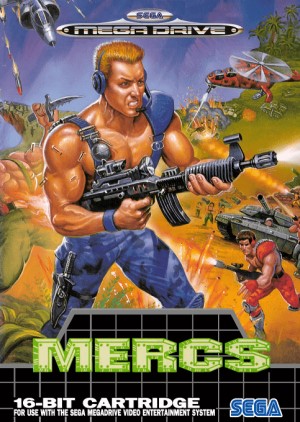
This is like writing about a piece of my childhood. Mercs was acquired around Christmas time 1991 and cost forty of my pounds from In Toto, a long-disappeared indie computer shop in Derby. And, good grief, wasn't this game played to death. Every difficulty, every type of weapon, every secret, the whole bloody thing was mastered again, and again, and again. I would note with satisfaction how my high scores crapped all over those printed in the likes of C&VG and Mean Machines. Every now and then I would return for a quick blast long after I'd more or less stopped playing games. And, unsurprisingly, when I disinterred my MegaDrive from the spare room's digital graveyard a few short years ago, Mercs was one of the first cartridges slammed into the slot.
Mercs was a Capcom coin-op released to arcades in 1990. As the follow up to the classic Commando, it kept to the formula of a lone soldier marching up the screen and shooting all-comers. Albeit with some contemporary touches. Up to three players could dive into the action simultaneously. There were power-ups and different weapons dotted about the game in destructible crates, and each level climaxed in a face off with the customary boss. Mercs was very well received, did quite well and received home conversions to most computer formats. Sega snagged the console rights and subsequently released the game for the Master System and MegaDrive. The latter, of course, being the best version by some distance.
While lacking the multiplayer options of its arcade parent, MegaDrive Mercs is a superlative product. The game is faithfully replicated within the the machine's technical confines. The bosses are as big 'n' beefy. The animations are all present and correct, including the satisfying fiery deaths when enemy soldiers are touched by your flame thrower. And, if anything, the music is slightly better with a greater range of tunes. The gameplay is the same too. Just waltz up the screen, shoot people, collect power ups, weapons, and health - what could be simpler. Except Mercs allows you to commandeer enemy vehicles. Jeeps, motorised dinghies, gun emplacements, even a tank can be seized hold of and turned against their owners. Thought Halo was the first to do this, eh?
The arcade game is a straightforward, mindless reflex-fest. It doesn't take too long to beat, especially if one can't avoid the temptation of using the generous number of continues. In all an average run-through takes about 25 minutes, and so it's good to return to if you fancy a short-lived but satisfying blast. That said, £40 for such a game 20-odd years ago is a touch steep. However, Sega avoided this problem by including a totally unique and exclusive iteration of the game on the same cart. The 'Original Game' has you soldiering your way up the screen, but with something of a different pace. Here the emphasis is on methodical progression as power ups and other goodies are often hidden off screen, or tucked away in secret places. You also collect medals and these double up as currency that can be traded in for nice things in the shops that appear halfway through each level. And, more interestingly, rather than picking up different types of weapons you collect other mercenaries. Each have their own unique weapon, two of which - laser and homing missiles - don't appear in the arcade game. Getting yourself through various situations means making strategic use of your men, and deciding who should receive what power up. Your men can be killed off too (though are able to be revived via expensive elixirs available at the shop), giving you incentive to master each one. And this game is much harder than the arcade version. No continues for starters, and the enemies are more vicious. Enemy bullets have a longer range. Baddies are handier lobbing grenades. Rocket launchers fire poison gas. Bosses are tougher. And there are no continues. It would probably be fair to say the arcade mode acts as a trainer for this - it took me much longer to crack all those years ago.
In all, a superb game. But as with nearly all games, there are some interesting readings to be made. The first are the in-game plots. In arcade mode you're secretly tasked by the US government to rescue the ex-President (on the boxes of the computer conversions, he bore a passing resemblance to Ronald Reagan) who's been abducted following an attempt to broker peace in a fictional African country by the name of Zutura. In original mode it's come to the attention of the US government that the rogue Caribbean island of Quira has acquired the capacity to build intercontinental ballistic missiles, and is feverishly assembling such a stockpile. The Merc has to go in and destroy their capability. Two things here. The first is the acceptance that the US has the divine right to intervene where it sees fit, thereby naturalising it. The second is that despite the action taking place in Africa and the Caribbean respectively, all of the enemy soldiers are white. There was no suggestion the two fictional states featured were stand-ins for South Africa and Cuba. An early attempt by Capcom and Sega to avoid provoking a racial controversy? Or, as is more likely, a reflection of the fact black people were virtually invisible in Japanese culture at the turn of the 80s?
Another thing Mercs accomplishes wonderfully is to concentrate superhuman attributes and effortlessly confer them onto the player, as per the neoliberal cult of the individual. In this game specifically, you are a muscle-bound aryan monster who, unlike your predecessor character in the original Commando, can soak up the bullets and the explosions. This marks you out from the thousands of enemy soldiers you encounter. All it takes is a mere brush of your weapon to see them off. So in the on-screen action, your attributes differ from the faceless mass you're warring against, it's your superhuman individuality that allows you to progress regardless of what the enemy throws at you. Of course, it's a common enough game mechanic that renders action games enjoyable and challenging, not impossible experiences. Getting through Mercs without taking damage would require a lot of practice. Yet what it can confer/reinforce is the neoliberal commonsense that you, as an absolutely unique individual, find your special qualities reflected and positioned in the character you're controlling. In this case you're a pumped up military strong man, but it can apply to virtually any other action game that has ever been created. And, of course, as such an individual you naturally fight under the colours of the United States, the ideological champion of such things.
As a teen dosed up on Hollywood militaria, post-apocalyptic science fiction, and the quatrains of Nostradamus, I concocted my own cringe-worthy narrative that played in my head alongside the on-screen action. It involved, basically, a genetically modified super soldier I had sent into battle against the forces of evil. Through that hokey fantasy, my own agency as someone who could impose their will on the world was affirmed.
Or perhaps my chin-stroking musings in 2015 are reading too much into it.
Political gravity is starting to assert itself on the Tories' ridiculous manifesto. You will recall that this gang of scaremongerers, who spent the entire election trading on economic competence, getting the deficit and public sector debt down, and "strong leadership" promised £28bn in unfunded spending commitments - presumably with the view that they'd never get chance to implement them because coalition negotiations, etc. There's a lesson there: one should avoid tempting fate. You may also recall the fright UKIP gave the Tories all throughout the last Parliament, the one that gave CCHQ willies enough to make a rash in/out referendum pledge on European Union membership. It's been fewer than 50 days since the general election, so let's take a look at how our overlords are doing.
Ooops number one. Page 14 of the Tory manifesto: "We will invest £38 billion in our railway network in the five years to 2019." No you won't. Patrick McLaughlin, the man at the ministry designated to carry the can has passed the blame onto Network Rail, saying the plan is no longer viable because of delays and so on. Nothing to do with trimming spending here to make up for pledges there, you understand. The upgrades to the Midland main line and the route between Manchester and Leeds are only being delayed. The advantage is funds can be diverted elsewhere in the short-term, though in the long-term it will end up costing more. Sacrificing tomorrow for the needs of the day, what says Toryism more than that?
Ooops number two. Page 72 of the Tory manifesto: "It will be a fundamental principle of a future Conservative Government that membership of the European depends on the consent of the British people - and in recent years that consent has worn thin. That's why, after the election, we will negotiate a new settlement for Britain in Europe, and then ask the British people whether they want to stay in the EU on this reformed basis or leave." Oh dear. This was always Dave's biggest gamble. Trying to get treaty change through with the consent of the EU's entire membership was always going to be a tricky business. Unsurprisingly, with the EU and the Euro facing its gravest challenge, other leaders aren't particularly interested in the immediate interests of Britain's Conservative Party to deliver a renegotiation according to an arbitrary timetable. And so another manifesto pledge is set to fall - the referendum can take place before Dave goes with his begging bowl to Chancellor Merkel, and looks like it will too. He's going to have a tough time extricating himself from this sorry and unnecessary mess.
In truth, both of these should be seen as kite-flying exercises. Dave and Osborne know there's a huge gap in their finances. They know money has to be found from somewhere. So why not start fudging on two pledges - one relatively minor, one quite major that can, at a push, be blamed on the vicissitudes of Network Rail and the EU, and seeing what happens. If nothing much does, and I don't think it will, the Tories can start fudging other bits of their manifesto. Can the education budget look forward to a cut? Are we going to see the bedroom tax extended to a small number of pensioners in overly large council houses? Are they going to row back on the free childcare commitment? Or, the biggie, will VAT go up - albeit at a rate less than inflation? The clock's ticking down to the summer statement. The government can't hide its cards forever.
The abuse of children is in the news again as a further 300 suspects have reportedly been identified by the authorities. As we know, while young girls were trafficked and gang raped with seeming impunity, this was occasioned by widespread institutional failure, as well as the suggestion of some backscratching cover ups. However, the official report into Rotherham didn't expend as much time as it might on something else that didn't acquit itself at all well: the police.
Now, I'm the first to admit that I have no special insights regarding the policing culture or operational challenges facing South Yorkshire Police. Though readers will be familiar with the awful testimony given by abuse survivors on TV, how the police didn't take their complaints (and those of their parents) at all serious and, in some appalling cases, returned some of them to their abusers. An example of institutionalised misogyny that can be overcome by judicious sackings and better training? That might assist in preventing some cases from going undetected/getting fobbed off in future, but another problem is a contradiction in the law. This doesn't excuse police (in)action, but might help to explain in part why this force, among others, had a care free attitude to the young girls caught up in the abuse.
In the UK, the age of consent is 16. The law rules out the capacity for children under this age (the 1989 Children Act defines a child as anyone under 18) to agree to sexual activity and there are a number of penalties that can be applied to any adult who breaks the law. However, keeping in mind the context that historically the legal risks associated with prostitution fall more on the seller of sexual services than the purchaser, the law introduces a difficulty. 16 may be the age of consent, but under the Street Offences Act 1959 boys aged 10 or over and girls 13 and over can be prosecuted for soliciting. So children in this age range cannot decide to have sex, but they are fully culpable if they try to sell it.
Hence the mismatch between public outrage and police indifference. Media coverage cannot fathom how the police were quite prepared to tolerate the prostitution and abuse of underage girls. Because that's how they were framed, as underage. Whereas in addition to the problematic - to put it lightly - attitudes of the police, they tended to view these girls as prostitutes as per the strictures of the law on soliciting. As a rule crimes against adult prostitutes, particularly women out on the streets, aren't taken terribly seriously. As a prostitute is defined as any girl over 13, then the indifference shown to older sex workers was extended to the younger. The grooming, the rapes, the abuse, the pimping by whole gangs, the inculcation of drug habits, all this was viewed through a filter that was officially backed up by the law of the land. Nothing marked these hundreds of young girls out especially - they were just another group of women to be picked up, fined, and thrown back onto the streets.
It's time the law was tightened up. Legal confusion should not be an alibi for awful policing.
Documentaries looking at how local authorities are coping with the cuts tend not to end happily. Ask Stoke-on-Trent. I think the same can be said about tonight's featurette, Don't Blame the Council, featuring Wigan Council. Unlike the Stoke experience, this focused on the council's employees in one section: Environmental Services. And, unfortunately, thanks to some ill-judged admissions by some workers and some sharp editing - of which more shortly - a more unsympathetic portrayal is hard to imagine.
Like many local authorities in the outside of the South East, Wigan has been hit disproportionately by cuts to the government block grant. They have to take £100m out of their annual spend over the next two years to balance the books. To this end, and because there has been no municipal movement of resistance to cuts, Wigan have launched an initiative called "The Deal". Its aim is to manage the cuts, find better ways of delivering services for less money, and looking at developing income generation activities. There's nothing unique in this, of course. Most councils of the North and Midlands are in a similar position. Stoke has its 'Mandate for Change'. Wolverhampton it's 'Challenge', and so on.
Nevertheless, Don't Blame the Council was no neutral account of how a local authority is rising to meet the situation. It was to council management what Benefits Street was to social security.
Take the featured staff, of which two received a sympathetic treatment. Terry Dunn (pictured) is the Director of Environmental Services and was tasked with turning his department into a money spinner. Aside from some David Brentish moments - tips on PowerPoint graphics, uplifting logos, management speak about "customer satisfaction", and taking a spin on a sit down mower, he came across as a genuine but clueless bloke. The other was Dave Askby, an operations manager in charge of a council contract to upgrade 7,000 bathrooms. We saw him battling with a workforce seemingly unwilling to pull their weight as he struggled to squeeze a modest profit from the job. This was at some risk to his health too - the stress was giving him high blood pressure, forcing him to take time off.
The others fell into council staff stereotypes. We had the snooping busybody, this time filled by Sue Catterall of the enforcement department. Her job was to issue fixed penalty notices for incorrect storage of refuse. Residents' not sorting their rubbish correctly incurred £100k costs to the council in the previous financial year, but at the same time the issuing of fines saw £125k worth of income. So every cloud ... Sue also had the unenviable task of spying on dog walkers to make sure their furry friends didn't leave unwelcome deposits, and when the owner cleaned up after them she made chase to ... hand them a raffle ticket for a prize draw, in an attempt to incentivise "good behaviour".
Then there was the jobsworth. Tommy Robinson (no, not that one) worked as a 'drainage investigation officer' - a title he was in equal parts bemused by and contemptuous of. He was the "complainer", even if his concerns were genuine. Since the axe chopped down on the council's workforce, his workload was impossible to keep up with. He was being sent out on jobs that required two workers, not one. And he had a few choice words about "The Deal". Of the attempt to get residents to work with the council to clean up their areas, he observed "what chance is there of them cleaning streets if they're knee deep in dog shit?" In the end, he felt that more was being asked of hims without the requisite recognition in his pay packet.
And lastly, we had the idlers, a role on this occasion filled by the bin men. While touching on some of the difficulties of the recycling policies, and the obvious frustrations when they refuse to empty bins not compliant with the rules of what can and can't go in them, the main focus was on their work practices. Often when the wagon returns to the depot there is very little for the workers to do. As they're still on work time management would like them to do more, but in practice we see them playing darts, larking about on the job, having a kip. "It's tiring doing fuck all", one of the workers mused. Viewers were treated to a ringside seat where one was threatened with a disciplinary for going home regularly on work time, and then returning just to clock off.
So, on the one hand we have a well-meaning management and a group of workers unlikely to elicit much sympathy. What else does Don't Blame the Council throw into the mix? How about examples of "overstaffing". For instance, three council employees to meet with the lucky winner of the dog poo raffle? A half hour cleaning job, for which the council charged £15, that required four workers, one (hands-off) supervisor, two vans, and one jet wash? And lastly, was it entirely accidental that the film crew followed the workers onto council estates only. Why, for instance, weren't the refuse collecting scenes filmed in more salubrious parts of Wigan? I'm told they do exist.
What this all adds up to is background chatter for the next round of damaging spending cuts local government are expected to shoulder. What Don't Blame the Council managed was propagate a narrative of the hapless delivering services to the undeserving, the impression being there are large number of inefficiencies and non-jobs waiting to be deleted. And if council tenants have to wait a bit longer for their repairs, who cares cos the all live off the taxpayer anyway. This programme was all about soft soaping the cuts. If the film makers were more honest in their exploration of the council, they might have homed in on the pressures adult social care in Wigan are under. Or children's services. But that was not the aim, they wanted to put the boot in and that is what this apologia for more austerity duly did.

Suicide is commonly understood as a deeply personal act. It is usually linked with mental health problems, and is - rightly - regarded as a tragedy for its victim and all those their life touched. The bereaved are often left with so many unanswered questions: Why? How could I have helped? Could they have been stopped? As a recurring phenomenon, no two suicides are treated the same way. It is a highly individuated response to a unique set of circumstances experienced by the person who passed away. It's down to psychologists to explain and counsellors to prevent. Because it is so private and so individual, this is why Emile Durkheim wrote a book about it. His Suicide, published in 1897, sought to turn the tables on conventional wisdom. It was more than a personal, individual act. Suicide was a social phenomenon and, as such, was a useful topic of study for the then fledgling discipline of sociology. Hailed as a classic since its publication, Suicide has been a touchstone ever since. My cohort studied it when we did our A-Levels. My students had when they did theirs. And before me my teachers had. It's part of how we learn sociology in Britain.
Not any more it seems. It was announced last week that AQA, the exam board that covers the majority of A-Level students is dropping it from the syllabus and expunging it from AQA-compliant text books. This act of disciplinary vandalism, like most things, is done with the noblest of intentions. A spokesperson for the exam board went on the record as saying it has "a duty of care to all those students taking our course to make sure the content isn’t going to cause them undue distress”. Really. What then is so distressing about Durkheim's Suicide?
There are two aspects to Durkheim's study: an analysis of suicide statistics among Protestants and Catholics, and a delineation of various "types" of suicide based on his reading of the data. He found that men were more likely to take their own lives than women, single people over married people, childless people over parents, soldiers over civilians, a correlation between it and higher levels of formal education, and the most stand-out finding: Protestants more so than Catholics. From here, Durkheim moved to explanation.
As a theorist deeply interested in the maintenance and perpetuation of social order, this figured quite heavily. He suggested that suicide fell into four distinctive types. There was egoistic suicide, which was related to being adrift from one's community, of not being integrated into and feeling apart from it. A precipitating factor was excessive individuation that sharply differentiated them from the rest of the community, and without that anchoring suicide became more likely. People falling into this category tended to be those with little or no social bonds, such as single/childless men.
Durkheim's second category was altruistic suicide, or excessive "deindividuation". Think of Spock sacrificing himself in The Wrath of Khan to save the Enterprise, as "the needs of the many outweigh the needs of the few". In a society with high levels of integration and solidarity, suicide here is arrived at because it has a socially sanctified end and, in some way, protects that social coherence/the greater good (however that is defined). Taking one's life to protect one's/family's honour, or self-sacrifice in times of war typifies this kind of suicide.
Thirdly there is anomic suicide. In his earlier book on the division of labour, Durkheim argued that industrial societies rest on divisions of labour that are only going to get increasingly complex. As it diversified and specialised, so our lives becomes ever more interdependent on one another. Durkheim hypothesised that this could lead to new forms of consciousness, that an 'organic solidarity' may emerge in which each is conscious of everyone's place in the social system, and that we're engaged in a common human enterprise. While regulated by sets of values and expectations, real societies fall somewhat short. The division of labour does not work for everyone. Whole branches of industry can disappear along with jobs and the social fixity they bring. Where social conventions no longer match social realities, dislocation and anomie - a state of normlessness - may prevail, and for some people the new situation is too difficult to cope with.
Lastly, there is fatalistic suicide. If anomie is the outcome of meagre social bonds, fatalism is related to too many. Picture an institution or society that is overbearing, has too much regulation, that intrudes into various aspects of individual life; a social situation in which the power of the collective is as pervasive as it is stifling. With such crushing conformity, some, who for whatever reason cannot escape, may come to the conclusion that life is no longer worth living.
Suicide is a classic text that lends itself to A-Level sociology for a number of reasons. It is a tightly-confined study. It serves as a basic exercise in comparative statistics without getting caught up in complex mathematical procedures that can test their veracity, and so on. It's useful to show that social relations are probabilistic phenomena, not iron laws that grind out predetermined outcomes. It's a good introduction to Durkheimian concepts like anomie, and how scholars attempt to build theory from data. And, lastly, it's an early corrective to the facts statistics baldly state. For example, as Durkheim noted, is it truly the case that Protestant societies have higher rates of suicide than Catholics, or because of the stigma and shame traditionally attached to it by the latter do families and communities conspire to rewrite suicides as death by other causes? Suicide is a simple, straightforward study that, crucially, introduces students to sociological thinking.
Taking Suicide off the syllabus is incredibly shortsighted. It's not as if any A-Level tutor introduces the study as a jolly good larf, rather than a classic 19th century investigation of a vexatious issue. I can understand that AQA are adapting to the "triggering" culture, but then all other awkward and potentially upsetting topics should stay off the course. More students, for instance, are likely to have been touched by domestic violence, racism, and so on than suicide - should these be scrubbed out too? Suicide is upsetting, but ultimately AQA are in flight from their wider social responsibilities. The one thing worse than talking about suicide is not talking about it. Sociology's job, among many other things, is to demythologise social phenomena in a never-ending attempt to understand the patterns of behaviours of huge collectives of human beings. If some areas are ruled out and made taboo, that understanding ceases. It becomes strange and, despite AQA's laudable motives, ignorance can breed insensitivity, potentially leading to more discomfort for the students they aim to protect. It's time for a rethink - leave Durkheim's Suicide on the syllabus.

What is the purpose of a demonstration? The most immediate, obvious objective is to demonstrate the strength of feeling about an issue/sets of issues. More or less every weekend the capital sees some sort of mobilisation of one form or another. This week it was tens of thousands marching against the cuts. Last week a few hundred cycled around London in their birthday suits to highlight climate change. Despite the relative novelty of the latter, which protest commanded the headlines? Which activity attracted the snarks and the criticism? If it wasn't in some way relevant, then the anti-austerity demo would have been as safely ignored as the World Naked Bike Ride.
These numbers matter. Whether it was a quarter of a million people or not is neither here nor there. A lot of people marched. And there is a rough relationship between the size of a demonstration and the broader constituency sympathetic to its political message out there in wider society. A couple of million people marched against the Iraq War because that reflected the tens of millions who were opposed. While much smaller, the still quite impressive numbers are, again, indicative of widespread dissatisfaction in the broader population. The bigger its mobilisations are, the bigger the "silent" group of dissenters is. And this matters. Presently, Tory strategists can look at yesterday's march and put it down to the usual suspects. However, had it been twice or three times as large it may have given them pause.
The anti-austerity demo is also very much of the moment. In early July George Osborne's emergency budget - designed to clear up the mess of the, erm, last government - will unveil around £12bn cuts to social security. That inevitably means disabled people will suffer, trying to get by on the dole is set to be tougher, and people who rely on state top ups because their miserly employers are going to get hammered. There will be people in those sorts of situations who do not know the kicking the government is itching to give them is on its way. When austerity as an issue is crowded out by other stories, more than a few people who cast an askance view upon the news might have picked up on what's coming.
Also some, you know who you are, don't see much point in A-to-B marches. The routine of assembling here and marching there to listen to speeches ain't going to change the world, but that runs the risk of privileging form over content. As this report from the BBC notes, the march attracted all kinds of people for all kinds of reasons - socialists and trade unionists marched alongside NHS campaigners and anti-fracking activists. What a march like this does is help draw together various issues and links them up. Often times socialists forget that the common thread running through these issues aren't as obvious to most people, especially those who haven't got years of political activity behind them. Not only are they getting exposed to those arguments, they know who's campaigning alongside them on related issues. In short, a demonstration builds understanding and forges links between activists. A large demo, as per yesterday's, can be quite energising too.
Lastly, this kind of extra-parliamentary pressure sits uneasily with some of the commentariat, as well as a fair few who inhabit the House itself. As far as they're concerned, Parliament is the only sovereign decision-making body in the land. Politics is about presenting your wares at election time, getting voted in (or not), and then laying off until the next round of elections. Because the Tories were proposing more cuts in their manifesto and they got voted in, everyone should sit on their hands. Anti-cuts campaigners had their chance and they blew it. Therefore, demonstrations, protest activity, and the like are borderline illegitimate types of politics. Of course, if our forebears had taken that view there would be no such thing as universal suffrage and weekends, for one. Yet its funny how this logic isn't extended to other forms of extra-parliamentary activity. For the best part of five years, the right wing press traduced the character and printed outrageous stories about Ed Miliband. They've peddled lies about poor people, about immigrants, about the EU, about the Labour Party. And how does giving cash to political parties on the "understanding" that certain policies will and won't be pursued in office sound? Would any establishment figure dream of declaring these extra-parliamentary activities illegitimate? Or will they be accepted as part of the rough and tumble of how we do politics? It seems David and friends have forgotten that politics is always much more than Westminster and elections.