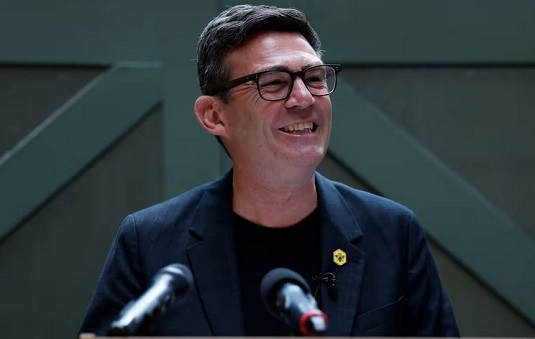
And here we are again. Andy Burnham's speech at the People's Museum was very good. No more pregnant pauses between short sentences for sound bites, no more dead-eyed staring at the camera, no prevarication. From a delivery point of view, Burnham spoke like most people, and came across plainly, coherently and, at times, passionately. Labour MPs versed in the Blair-era school of public speaking would do well to study this speech. Though putting on a Manchester accent might be too much.
What matters most is the content. And as far as making the right signals went, the boxes were duly ticked. Devolution, which was trailed in the pre-speech period, got a strong push. Whitehall obstructionism will vanish as decision-making about economic strategy and education and skills priorities are to be pushed out to the regions. The centrepiece is Number 10 North, a relocation of significant government powers to Manchester. And, for the first time since Harold Wilson, Burnham will not be residing in Downing Street. What didn't get a prior shout out was his commitment to the biggest council house building programme ever. There was "public control" of utilities, and changes to business rates so smaller businesses, above all hospitality wins out. Public procurement will also require mandatory social value tests, so the majority of goods and services purchased by state institutions are sourced from within this country. The Preston model writ large, in other words. In all the talk was good, but does Burnham have the game to match it?
Burnham's "public control" formulation has attracted criticism. The Manchester model rests heavily on the Bee Network, where bus companies remain private and for-profit but operate under a regulated regime. They provide good coverage and regular service, and in exchange they have guaranteed markets supported by the public subsidy of the fare cap. This is what Burnham seems intent on introducing for the utilities. Here there is some Labourist pedigree. In his The Future of Socialism, the classic statement of post-war Labourism, Tony Crosland argued there was no need to make further inroads into private ownership because, effectively, the state had capital on a tight leash. The system worked for them, so why change it? Manchesterism is Croslandism, albeit with localist characteristics. The problem is, as Mathew Lawrence writes in his recent policy piece on the productive state, private capital in foundational parts of the economy run on different cycles of investment and return than state capital. Which makes them inefficient where end users are concerned, and therefore should be nationalised. So while Burnham's Croslandism might work for the relatively small scale of Manchester's bus network, expecting the same for much larger and complex utilities infrastructure might be wishful thinking.
The reluctance to nationalise is not hard to fathom. It's for the same reason that this government and its New Labour predecessor were far from keen - it's the message it sends to capital. Burnham, presumably, would like the inward investment to carry on coming. But far from the animal spirits of capitalist myth, in actuality it's cagey, brittle, and terrified that changes in the overall regime of accumulation will see it underperform or leave it out of pocket. Less Scrappy Doo, more Scooby Doo. Public control sounds good to Labourist audiences, while the refusal to nationalise shows Burnhamism isn't about to make substantive modification to class relations. Also why he continues to stress fealty to the fiscal rules. This is not socialism, it's a typical social democratic compromise with capital.
Second, the Greens criticised Burnham for not mentioning the climate. Which is an omission, given the weather we've just had. By way of a reply, you could say it was there between the lines in the stiff about building resilience and making Britain energy independent. But that is not good enough. Outside of Reform, the Tories, and Facebook oddballs, the vast majority of the public are on board on climate change and understand the need for the green transition. Talking about it openly puts the right at a massive disadvantage, and could consolidate parts of Labour's coalition that Starmer's leadership have frittered away.
The biggest question about this speech is will Burnham actually deliver it? Certainly, he sounds more sincere, and he knows how to fire up those with bits of Labourism left in their souls. But we've had one Labour leader who lied through their teeth as they made their pledges, and then over the years tipped each one into the wheelie bin. Burnham offers a vision, a road map to a reformed state, a better functioning economy, more opportunities and, unusually for a contemporary politician, a kinder future too. If Burnham delivers this plan he will have saved Labour's bacon and can look forward to winning the next election. If he abandons it for whatever reason and defaults back to where we are now, then he, his party, and his brand of politics are done.
Image Credit

9 comments:
For goodness sakes, Phil. Just look at the ever-widening team of viciously Blairite, neoliberal, close advisors now surrounding Burnham - and quite possibly to be added to by an ennobled David Miliband as Home Secretary, and really tell us you believe the glib Andy Burnham will deliver ANY of his bullshit promises ! He is a frontman for the exact same agenda as Trilateral Commission member, Starmer was enacting for his puppet masters. !
Burnham would have to be a dedicated and ruthless revolutionary to turn the country round. a minimum of nationalising a couple of water companies, defusing the terrorism legislation and practice, changing the story told about national finance, curbing foreign influence and penetration of government, embracing green energy ......... it ain't going to happen, is it?
He's talking the right game, given the deep, deep hole that his predecessors left him in.
Given the depth of that hole, he doesn't have to deliver all that much before 2029; he just has to look, to suspicious members of the electorate, that he actually intends to deliver something worthwhile. A test which Starmer failed about as badly as can be imagined possible.
But as others are saying, his choice of staff is deeply worrying... A small army of characters who should have been frozen out entirely. The most charitable interpretation is "keep your enemies close".
The least charitable explanation is that the McSweeneyites have found a way to keep their bleak program shambling towards its goal, of preserving neoliberalism just a little longer and selling off what little remains of the family silver. By sticking up a frontman who can look just enough like he intends to deliver anything, in order to win back just enough votes to see off Farage (whilst deploying "do you want Farage?" cynicism against the Greens as planned, but from a much stronger position where it might actually gain some traction). All without any real intent to deliver anything that the electorate wants at all. If it buys them another 5 years until the inevitable, I'm sure that's good enough for them - and I suppose we might hope that, by that time, Toad will be a spent force and it will be the Greens who are positioned to inherit their mess.
In between those two interpretations, there is a tangled mess of quid-pro-quo arrangements that might have happened... After all, it was a McSweeney ally who oh-so-graciously allowed Burnham to return to Parliament and collect the top job.
I'm afraid that it is the the Anonymous 17:17 gloomier option for the actual direction of travel of shapeshifter Burnham that is definitely the correct interpretation. Because , as Fred Engels says, it is waaaaaaay too late for financialised Britain to reindustrialise (short of a revolution) , and a UK ruling class that has spent the last forty years pursuing its globalist, financialised, neoliberal agenda ain't going to switch tracks now. Particularly as, unlike in the post World War 2 period there was a mass, activist , Big Battalions, trades union movement to demand a bigger slice of the cake .
Also, alongside the rest of the European comprador political elite. our permanent Deep State bureaucrats (MI6 now run by the granddaughter of a really big time Ukrainian Nazi war criminal !) , and political class are determined to have the UK ready for open war with Russia by about 2030.
Andy Burnham is indeed just an unprincipled , willing front man for this continuing agenda . Forget all his guff about mass council house building, etc, as with Starmer's "Ten (Corbynite) Pledges", its just a cynical distraction whilst we collectively and manufacturing wise are readied for a major (utterly suicidal) war with the most powerfully nuclear weapon armed power on the planet ! Look closely at the ghastly creatures Burnham is currently amassing (actually being selected FOR him) as his core team and you'll see this is quite obviously correct .
The thing about Tony Crosland is that the revisionism he spearheaded came in the middle of the period of the fastest growth in our history and it was assumed that social democracy had solved the issue of economic growth which had so dogged us in the 30s (when the Soviet model actually looked more promising in comparison)
But this optimism didn’t last for long as the growth began to significantly slow in the following decade and by the 70s our economy suffered from stagnation which did for post war consensus and social democratic model. It’s this serious development which the left still hasn’t fully come to terms with. Keynesianism worked in the 1940s and 50s because while unemployment was high prices were low. With stagflation both were high and that is why inflation had to be addressed which can’t be done by simply ratcheting up government spending.
And now, to add to the already quite blatant "return of the nastiest Blairite zombies" schtic , press reports, from The i. to the Daily Mail, etc, that the ghastly Ed Balls is tipped leave his Breakfast TV gig, to join the CIA and Trilateral Commission's man, David Miliband, in the Lords, so as to serve in Burnham' s Cabinet !
Any Leftie who still thinks that Burnham has any intention whatsoever to deliver all his various Leftish promises, of massive council house building, reindustrialisation, a Northern economic rebirth, onwards, needs to wake up to just how monstrously neoliberal and warmongering the Andy Burnham new regime is going to be. Andy Burnhan is quite obviously now merely a willing puppet of Blair and Mandelson and their billionaire oligarch paymasters, and NATO, and Israel. War with Russia by 2030 ? Quite probably.
It is fascinating to look at his rhetoric. It seems to be a bit of Obama 'Hope' + some Johnson levelling up + a smidgen of Corbyn on public ownership + Trump's re-industrialisation + Truss on tax. + Brown on devolution and so on. There is something to please everyone.
And then as time passes to displease everyone. Why we should think a change of rhetoric and appearance can solve the long standing and deep rooted problems of the UK economy, political institutions and social conditions is beyond me. If wishing could do it, it would have been done a while ago.
If the left still hasn't fully come to terms with this reality, has anyone else?
Because neither "put psychopaths and narcissists in charge of a race to the bottom", nor "burn the chair you're sitting on while hoping for a sky fairy to save you" are solutions - except perhaps in the most final sense - I don't see much evidence that any other part of the politico-economic spectrum has dealt with it either.
And here we are. An outpouring of big talk, and yet the ghastly Mahmood remains in post, and Milliband is sent to the Foreign Sec gulag. Where he is presumably expected to busy himself with appeasing Israel and not get in the way of new North Sea drilling.
A very poor start. Our resident Kremlin advocate will probably like it even less with Healey being posted to the treasury.
Post a Comment