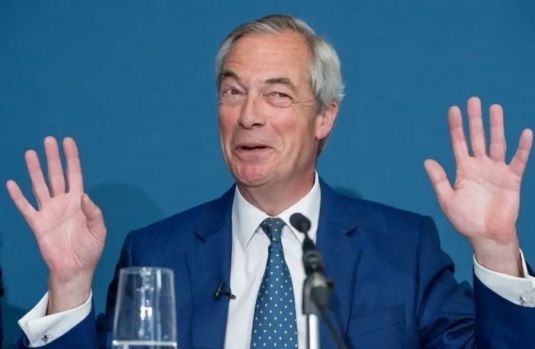
This is not the first time Farage has stood accused of receiving funds for political favours. Indeed, what characterises his relationship to money is its brazen transactional character and consistent repetition. A foretaste of the do-as-I-say-not-as-I-do relationship to the law we would expect during the nightmare scenario of a Reform government. But what are the political uses of such corruption, seeing as it's a common feature of the extreme right, here and abroad?
As already hinted, there is the shock and awe element, of being seen to be political teflon. I can imagine some canvassers hitting the doors in Makerfield and getting depressed that Farage's £5m kickback has not booted Reform's chances out of contention. As per Trump and what we've seen in the United States, allegations of corruption from political opponents go nowhere because, in many cases, they're rightfully perceived as being little different. Additionally, this can be threaded into narratives - spontaneously elaborated in the Facebook groups and retailed by GB News - that Farage is getting singled out and targeted for telling the "truth" about this country. The right in this country, whether in its Tory or more extreme forms, will not waste an opportunity to play the victim.
More important is the message Farage's corruption is sending to his class. Accepting money from here, there, everywhere signals that Reform is open for and to business. Farage himself, like Boris Johnson before him, covets cash and this ensures a congruence between his politics, the interests of the most reactionary elements of the ruling class in this country, and the globalised oligarchs. A bonfire of regulations, the dismantling of Labour's new, meagre protections on workers' and renters' rights, and the final destruction of the NHS as a free-at-the-point-of-use system fit nicely with those ruling class views that think we have it easy and need putting back in our box.
Yet this is not without risks. Farage is carrying on as if certain elite interests can shield him from consequences indefinitely, but this is not so. There's the obvious problem of investigations into rule-breaking. The £5m bung, for instance, puts Farage at risk of a Commons suspension and potential by-election in Clacton. One might be tempted to think he could walk it, but this is where the politics of corruption could bite back. While true not many Reform-minded people care about the provenance of his income and what he does to ensure similar gift giving continues into the future, but there are people outside the Farage fandom that do care a great deal. Brazen corruption could negatively catalyse and mobilise opposition to him and Reform which, considering their levels of support, could be hard to fend off. Imagine, for example, if the rest of the political establishment dredged up an independent anti-corruption candidate akin to Martin Bell's successful challenge to Neil Hamilton in Tatton during the 1997 general election. Could Farage see off Martin Lewis?
Risky or not. corruption is baked into extreme right wing politics. Farage can no more resist cash offers than he can the politics of scapegoating. The cash flow is the guarantee that Reform will stay in oligarchical pockets, and the closer we get to the next general election the more those taps will gush.
Image Credit

11 comments:
Just as with Trump in the USA, Nige's best ally in continuing to shrug off consequences from this sort of activity lies in the gormless, vacuous complacency of his political opponents. They just don't really want to take him down, because they need the greater evil looming large in order that people might be persuaded to vote for the lesser.
There's little between the likes of McSweeney, and the Schumers and Pelosis of the world; they are a life-threatening blockage in the arteries of the political system.
Farage seems to have mistimed getting his snout in the trough. The centrist politicians like Blair and most of his Cabinet choices from the 2000s wait till they are out of power to show their enterprise in gathering 'jobs' with corporations.
Should be no real problem for Farage to ride this out in the way you mention and he could make a virtue of it. Trump managed this when Ms Clinton pointed out he had paid no tax - 'that is what smart people do.' His base would agree with him. They buy lottery tickets each week in the hope of getting £5 million.
A sociologist instead of writing facile demagoguery about a spiv like Farage should know that corruption is pervasive in UK politics and civil society:
* Corruption is any form of illicit self-dealing, while bribery is the particular case of self-dealing by being paid to do something illicit.
* As to bribery people with business experience know how common it is in the *private* sector with private business purchasing managers regularly being offered more or less disguised "rewards" for choosing the "best" supplier. Everybody knows someone like that.
* As to corruption two statistics from "The Economist": 40% of local councillors declare "estate agent" as their occupation and 60-65% of local Conservative Association chairpersons are mortgage brokers. Also consider this candid argument by Dan Davies:
https://backofmind.substack.com/p/corporatism-with-a-flat-cap/comment/109924966 “Our main character is a likely lad who works for the environmental health department [...] if you’re planning on setting up a restaurant in town, he’s happy to earn a few quid off the books, he’ll draw you up a set of plans. They will be good plans – he knows the rules back to front so there will be no surprises when your planning application comes up before the committee. He knows all the committee members too [...] If your business involves something else, or wants to grow, he can pass you on to one of the other lads, who also does the odd “outsider” for pin money, or to finance a better holiday. The lads down the club help each other out. [...] And sometimes a quiet word is all you need. Basically, if you’re having business or regulatory problems at all in this place, chances are you’re going to end up at the corner table in the Bridge Inn, having a quiet pint with someone who one of your mates has introduced you to.”
* Some may include in a list of dubious practices that Owen Smith, Wes Streeting, and not a few others went through the revolving door between Parliament and lobbying businesses, and that the recently appointed heads of the Competition Authority used to work at Amazon and the chairman of the BBC used to work at Google. looks like "poachers turned gamekeepers".
Many if not most "Middle England" voters are "people of the world" and think that all politicians, party and local and national government officials are on the take, so £5m to Farage for whatever does not scandalize them, they only care about "getting theirs" too and do not resent other from doing the same (unless those others are those poorer than themselves).
Because by far the biggest and most corrupt group in UK politics and civil society is not purchasing managers, politicians, officials, etc. but a big number of *voters* because many of those with property have been relentlessly voting for self-dealing in the form of bigger prices and higher rents for housing, redistributing since Thatcher and Blair several trillions of pounds to themselves from the lower classes.
Consider this 79-year-old retired carpenter in Cornwall (from an article on "The Guardian" in 2022): «who bought his council house in Devon in the early 80s for £17,000. When it was valued at £80,000 in 1989, he sold up and used the equity to put towards a £135,000 fisherman’s cottage in St Mawes. Now it’s valued at £1.1m. “I was very grateful to Margaret Thatcher,” he said.»
That to me is just one exemplar of mass self-dealing.
While UK bribery is fairly common and corruption is pervasive the UK at least does not have much "petty" bribery (like slipping a banknote to the cop to avoid a fine).
«His base would agree with him. They buy lottery tickets each week in the hope of getting £5 million. »
A lot of poor irish (and northern etc.) workers used to to do that and they were sneered at for their gullibility and silly greed by their superiors.
It may not the intent here to dismiss the voters of a spiv like Farage or Trump as dumb rubes, but those poor irish etc. buyers of lottery tickets every week were not doing that out of gullibility or silly greed but as psychological crutch, as a way to hold a token of hope they had a tiny chance of exiting a life of drudgery or misery. Eventually they did better by joining labor unions and workers parties (and sadly after winning the very really mass lottery of property speculation they promptly became thatcherites).
B - you suggested that I might be sneering at poor workers for silly greed and dismissing them as dumb rubes. I suppose I should accept your example on the Cornwall thatcherite house shifter as being acorrupt self-dealer rather than as an intelligent and rational individual who has found a way to realise their subjective individual interest in a difficult environment with weak unions and no workers party.
I was a Councillor for some years, and the world you describe was very much NOT the reality I experienced. I was not aware of any Estate Agents among the 50 or so Councillors I served with (or Mortgage brokers for that matter). When matters came before the various Committees I served on any sign of self-interest or bias would be pointed out and was viewed very dimly. An officer that was touting for bribes in the way described would be quickly found out and sacked.
My experience was that decisions were made on the merits of the case in planning, licensing, and other quasi-judicial committees.
People like to fantasise about 'brown envelopes' and while that may happen occasionally in some of the more ensconced one-party stronghold boroughs, it is a very rare occurrence in most. It's the sort of nonsense that people come up with who are strong on ill informed opinions who have never been involved in local government and probably have almost no idea at all about what happens and how business is conducted.
I am looking at you Blissex. You seem to get all of your views by very selective reading rather than by living. Maybe you should get out more and mix with real people, try attending some Council meetings and if you have to read, try some of the council business documents that are almost always made public (apart form a few special circumstances). Stand for election yourself if you are so convinced of this pervasive corruption.
Eventually they did better by joining labor unions and workers parties.
Not to diminish the importance of psychological crutches, but perhaps they would have got there sooner had they joined labour unions and workers' parties sooner.
(Of course, doing things that actually threaten the ruling class is at least 100% more likely to get you beaten or shot at, unlike buying lottery tickets. Voters for spivs understand that, which is why they confine their political scapegoats to those who are more vulnerable than themselves. Sadly they don't seem to understand that voting for spivs is even less likely than a lottery ticket to improve your own circumstances. Whereas poor Irishfolk and northerners eventually did understand that risking being beaten or shot at was the only way to secure a better life for your children.)
Perhaps the darkest part of that particular psychological crutch - the lottery tickets - is what happens when the fairy tale comes through. AFAIK, most of them lose it all within a few years. Nothing in their life has given them the contacts, skills, or temperament to hold onto it - unlike the ruling class, which has been winnowed by centuries of survivorship bias to select for exactly those things (while also getting abusive social practices and induced dark triad personality traits on the flip side of the deal).
Many if not most "Middle England" voters are "people of the world" and think that all politicians, party and local and national government officials are on the take, so £5m to Farage for whatever does not scandalize them, they only care about "getting theirs" too and do not resent other from doing the same (unless those others are those poorer than themselves).
A bleak and temptingly simple explanation of our socio-economic rot, but doesn't seem to square well with a few things. Most obviously the fact that large numbers of people do seem to care about blatant corruption and rules-dont-apply-to-me arrogance, if it's brought to their attention forcefully enough. The takedown of Boris Johnson, for example. But perhaps those people are simply a disjoint set with "Middle England" and the Farage fanthings.
The other catch of course is that, to get traction, the corruption revelations require the engineering of a scandal - a media circus with significant staying power and bipartisan buy-in. And that usually requires a significant vested interest which really wants to take the target down, for some reason or another, and is prepared to commit the necessary resources - a factor which is presently critically lacking in the case of Farage.
This is very believable about local government. It is surely only the very optimistic who think that they are going to get rich, or make any significant long term impact at all, by serving in local government. Most ordinary people barely know that local government even exists; it does all the relatively little, unglamorous, generally unlucrative jobs which the national government can't be bothered with. Councillors for a cynical outfit like Reform are only standing because they know that, as an upstart party, they will get counted as symbolic notches in the party's belt, and being such a notch may give them a springboard to something bigger later; the steady stream of them quitting as soon as the reality of the job hits them is testament to that.
At national level of course the incentives are very different... In much of the country a certain level of corruption is probably a pre-requisite for selection by the established major parties. If the whips have nothing to threaten you with, then you're only likely to make trouble for your own party from the back benches, aren't you? Who ultimately gets taken down by corruption scandals at this level is much less a function of who is corrupt, or how corrupt they are (Peter Murrell stole pocket change compared to Nigel's £5m bung!), than it is a function of who it is that wants to take them down.
Derek Berneray writes: "My experience was that decisions were made on the merits of the case in planning, licensing, and other quasi-judicial committees."
I live in an area of the country which is perceived (by its residents) to be relatively enlightened and non-corrupt; and yet my two close encounters with local government over local issues have told a third story, different to both previously related here. On both occasions I witnessed the wishes of locals systematically - and quite dishonestly - steamrolled by mandates and decisions made at higher levels.
Technically-required consultations weren't carried out (the responsible entity claimed to have contracted a third party to do them, the third party didn't show up, and no remedy for this was available unless somebody was prepared to fight it through the courts). Legally binding decisions were handed down and the affected residents only told, years later, when they were given - by third party contractors, again - the option to choose from a pre-ordained menu of equally unpalatable options. I sat in a council hearing in which I heard local councillors and officers tell everyone in no uncertain terms that all of their own evidence favoured decision "A", and yet the next we heard, decision "B" had been made; it was as if the local representatives wanted us to know exactly how powerless that they really were in the matter.
We are all Arthur Dent.
Arthur, the issues you raise are very real. Of course, I was talking about decisions made within the framework that national government allows. They control the resources and the laws. At local level you are tightly constrained, and decisions can seem unfair and arbitrary (indeeed, I often felt they were, because we were so constrained, and justice, or fairness, or what the local community wanted had little 'weight'). Party politics also acts as a constraint, often preventing consensus or impeding compromise.
That is different from open corruption, which I never experienced. Less obvious, 'influence' was more apparent, but this was usually a minority, and mostly associated with party political affected issues.
My point was not the local government is perfect, very far from it. It is woefully under-resourced and over-constrained. The democracy it claims is theoretical, with the participation and involvement of the wider public is minimal. There is deliberation, but within the rigid rules imposed it can often seem empty and evasive. The framework imposed is rigid and inflexible, and does not allow for local differences, or the wishes of the community. It needs radical reform. But, the sort of corruption described by certain comments is a minor outlier.
Post a Comment