Since the EU referendum we've seen how anti-racism is being rolled back, and how in their manifesto the Tories are planning on singling out one minority - Travellers - for the scapegoating treatment. In her interview with Alex of Politics Theory Other fame, Maya Goodfellow talks about state racism and the cruelty of the UK's immigration system, and how the Tories' hostile environment built on as opposed to breaking with New Labour's border policy.
As always, Politics Theory Other could do you with your help so do please consider supporting via Patreon.
Monday, 20 January 2020

Sunday, 19 January 2020
The Return of Aspirational Socialism
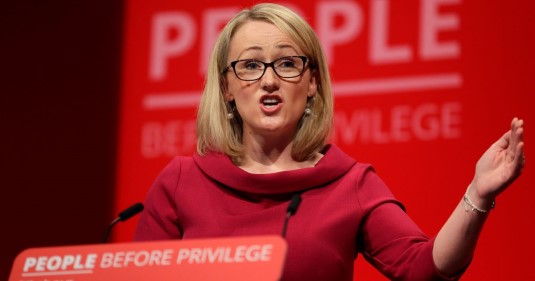
And here we are in 2020 with yet another leadership election. Except this time, it's the unambiguous candidate of the left who's talking about aspiration. In the speech launching her leadership campaign, Rebecca Long-Bailey forcefully argued for the linking up of socialism with aspiration. But not in the narrow, liberal-with-another-name manner the Mayor of Greater Manchester once defined it but in terms that make sense from, well, a socialist point of view. Referring back to the manifesto, she said the key problem was how our policies weren't linked to a notion of aspiration, implying they sort of hung separately. That's all very well, but what does it mean?
Sadly, in Labour's recent history aspiration has been understood in almost apolitical terms. Not that long ago, one of its (former) leading figures defined aspiration as "second home ownership, two cars in the driveway, a nice garden, two foreign holidays a year, and leisure systems in the home such as sound, cinema, and gym equipment." Stirring stuff while prices accelerated and millions of younger people were excluded from the housing market. Their idea of aspiration was entirely individuated, and framed in terms of an escape from working class life. And where are these people New Labour assiduously courted and looked after all through out the Blair and Brown years now? Lining up to vote for the Tories.
New Labour were right about one thing. Aspiration does involve wanting nice things. If aspiration means a nice house (or even a house), kids (and a future for them), a safe community, a life without debt, security, and an existence beyond the workplace grind , then it is pretty obvious the Tories are an obstacle on the road to fulfilling these straightforward desires. The passport to the good life has been revoked in one area after another as cuts have fallen on schools, the meagre supports offered by social security chopped away, and a career is nothing but a fancy name given for a series of low paid and insecure jobs. The government pays lip service to equality of opportunity and levelling the playing field, but refuse to pony up the resources and the legislation to make it a reality.
Therefore, Rebecca Long-Bailey is right to annex aspiration. If the right are willing to mislay one of its ideological weapons, the left are only so happy to take it up and radicalise it. Because the Tories are blocking the working class's right to the good life, aspiration immediately assumes a political character. It is less a matter of the consumerism of lip gloss and mobile phones and more one that takes up the collective means of existence. And no one knows this better than Labour's new base - it's why they support the party, after all.
In this sense, RLB is playing catch up with where our core constituency is at and talking the language of their interests. Meanwhile rest of the field are all at sea, whether misrecognising Labour's old people problem as a towns problem, or having a more conventional leader who'll play the conventional game. They haven't cottoned on to the realities of the class politics of our coalition, whereas RLB has. And there is the very simple reason why you should back her Labour leadership bid. Her talk of aspiration doesn't herald the rebirth of New Labour and its Blairist nonsense, but the maturation of the new socialism.
Image Credit
Friday, 17 January 2020
Rebecca Long-Bailey Leadership Launch Speech
Here you go.
The full speech with Q&A afterwards is on the blog's Facebook page here.
In all, I thought RLB's speech was excellent. She came over as funny, fluent, possesses an ability to think on her feet, and with a strong political message.If you're unsure who to back in the Labour leadership contest, this is well worth your time.
The full speech with Q&A afterwards is on the blog's Facebook page here.
In all, I thought RLB's speech was excellent. She came over as funny, fluent, possesses an ability to think on her feet, and with a strong political message.If you're unsure who to back in the Labour leadership contest, this is well worth your time.
Thursday, 16 January 2020
Comrades for Keir
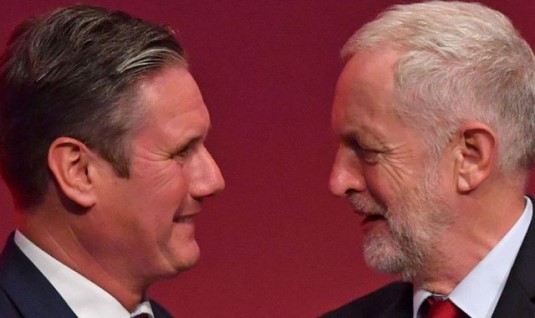
1. Paul Mason notes Starmer carries a professional air about him thanks to his background as Director of Public Prosecutions. He therefore knows the state and its bureaucracy, and has the lawyerly skills of mastering a brief and thinking on his feet. He is, in short, a serious figure. And no doubt he is. Whatever one thinks of the role he played in steering Labour in the direction of a second EU referendum, he did a good job at the despatch box scrutinising the government and having a better understanding of the Brexit deals bought before the Commons by Theresa May and Boris Johnson than his Tory opposite number. While Jeremy Corbyn's performance at PMQs varied greatly over his time, there is the belief Keir would consistently better the Prime Minister which, in turn, would provide the sort of theatre designed to play well on the evening news bulletins.
2. This however would be done from the left. As he was quick to establish, economically speaking, his offering is Corbynism with Keir and not junking the 2017 and 2019 manifestos - a different approach to Lisa Nandy, Emily Thornberry, and Jess Phillips who have either singled out individual instances or some of the policy menu for criticism. And to burnish his stance with a tinge of authenticity, we had that campaign video which saw Keir sticking up for working people and fighting the good fight. Just don't talk about the time he stood with the Tories and the LibDems in putting the screws on some of the poorest and most vulnerable people. Nevertheless, he is left enough for enough and some are prepared to see him account for this before even considering changing their vote.
3. If that can be overlooked, so can his participation in the 2016 coup. After all, he has served loyally in the shadow cabinet and has since hovered above the factions - reports of his favouring Labour First supporters in Holborn and St Pancras CLP elections notwithstanding. Naturally, hiring Matt Pound from the self-same faction doesn't give off non-factional vibes but, as plenty have pointed out, he has experience of campaigning against Momentum during Labour's last round of reselections. Though to credit LF with more than a dozen votes against the triggers is to overstate their reach and influence. Nevertheless, most of Keir's left support are again happy to either ignore the hire or put it down to campaigning practicalities.
4. The assumption of non-factional positioning obviously appeals to leftists worn down by four years of internal warfare, and they want to believe Starmer can heal the ceaseless conflict. Whether he has the appetite for shaping the party in his image and the struggle it brings remains to be seen. Nevertheless, in trying to read the runes and despite Labour First's backing they are not senior to his campaign. LF's backing stems from their anyone-but-Corbyn positioning and, therefore, anyone but RLB. They might fantasise about taking back the party and obviously see a Starmer leadership as a springboard for doing so, but Starmer also knows his best chance at victory in 2024 is peace within the party between now and then. If you stand as the unifying figure, turning against the most substantial section of the party is hardly clever clever politics. And with a PLP also weary of infighting, apart from the scorched earth ultras who've hitched their wagon to the sinking Jess Phillips campaign, the hope a Starmer leadership might see tensions simmer down are not entirely groundless.
5. Ultimately, taking all these into consideration, there is enough ambiguity for some of the left to project their own hopes onto him and see them confirmed by Keir's actions and interventions. So far, and it is early days, there is little suggesting to comrades that the party isn't safe with him, that the policy platform Corbyn stood on will be sacrificed, and that he stands a worse chance of winning an election.
This poses a number of challenges to RLB supporters. We know Becky's not about to junk Corbynism, considering she was central to it and is responsible for its green industrial strategy. But she's up against the competent image, the perception a rapid recovery and election win is more likely under Starmer, and that his leadership would be an antidote to the poison coursing through Labourist politics. This is where the campaign has to be most persuasive because these are the grounds on which the leadership will be won or lost.
Image Credit
Wednesday, 15 January 2020
An Evening with Grace Blakeley
In and around North Staffordshire on the evening on Monday 20th January, around the 7pm mark?
Wondered why, over a decade ago, a crisis in the American housing market spiralled out and brought the world's financial system to its knees?
Tried making sense of it all but find the jargon around equities, securitised mortgages, and collateralised debt obligations completely off-putting?
And how we can avoid a crisis of this magnitude in the future?
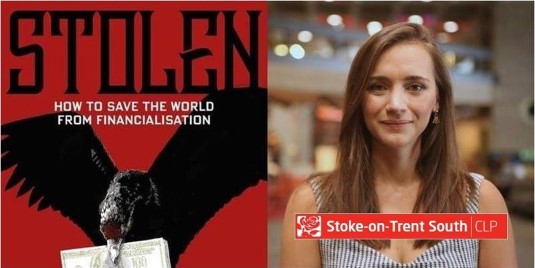
Grace Blakeley, author of the excellent Stolen: How to Save the World from Financialisation will be in conversation with some bloke called Phil Burton-Cartledge to make sense of the crisis, what it has to do with Thatcherism, how the Tories were able to use it to justify their decade-long programme of cuts, and why democratic socialism is the answer.
Hosted by Stoke-on-Trent South Labour Party, attendance is free but you will need to register. You can do so via Eventbrite here. And our evening takes place at
Fenton Town Hall
Stoke-on-Trent
ST4 3BX
There will be copies of Grace's book going for the cheaper price of £10 on the night. It comes highly recommended!
Tuesday, 14 January 2020
How the Tories Smashed Stoke Labour
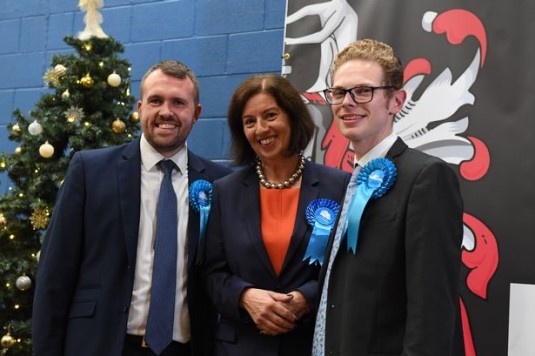
Well, why not listen to what the victors have to say? In a series of tweets accompanying her appearance on Politics Live West Midlands last Sunday, Tory council leader and master mind of the party's resurgence in Stoke, Abi Brown, argued it came down to campaigning and canvassing, and Labour being entitled and complacent. The first is self-serving nonsense because while they campaign they are outgunned by the numbers even Stoke and N Staffs's CLPs can count on. No, the truth of the matter is the Tories always benefit from the structural bias in what passes for our national conversation. Her second point however cannot be dismissed, because her diagnosis is on the money.
It's not the case Labour has enjoyed unrivalled dominance in Stoke politics in the 21st century, but it is absolutely true the party has failed to adequately respond to it. During the 00s Labour fractured over the mayoralty, which ran the city from 2003 to its abolition by referendum in 2009, all the while losing ground to the so-called City Independents and the BNP. Dumped out of office Labour unexpectedly did much better at the 2010 local elections, held on the same day as the year's general election, and the boosted turn out put us back into office in coalition again. In 2011 Labour did even better winning the local elections and having an absolute majority in the chamber. And from there things went into sharp decline, losing two by-elections in Springfields and Trent Vale (a campaign I ran, so loss was inevitable) and another in Baddeley, Milton, and Norton. Come the 2015 general election we did not see a repeat of 2010 as the Labour council's perceived poor performance saw us lose council seats, and Labour's Westminster votes took a battering. The fun of the Stoke Central by-election, the performance at the 2017 general election, which saw the Tories net Stoke South, and Labour's duff showing in this year's locals all marked the slippage of Labour's control. Of a party, if you like, in long-term decline.
The structural issues and wider political issues of Brexit and Jeremy Corbyn's leadership were background factors here as they were in similar seats across the Midlands and Northern England. But what's going on above our heads and behind our backs does not mechanically grind out predetermined outcomes, there is always agency and there were plenty of opportunities Labour could have taken in the Potteries to avoid outright disaster on 12th December.
The first is undoubtedly Labour's ill-fated stint running the council between 2010 to 2015. Like all urban local authorities, George Osborne imposed stringent cuts to the local government grant with a view to forcing Labour councils to attack their own people, which some did reluctantly while others went about it with alacrity. Owing to a thin spread of acumen among Stoke Labour's councillors and, sad to say, in some cases a complete absence of Labour values and a political understanding, too many fancied themselves as petty managers and approached the cuts as an administrative challenge as opposed to a political problem. Partly, some were bewitched by the flashy, overpaid chief executive and red carpet for business talk. Others were flummoxed by the senior officers they were tied to and were, effectively, led by them. And in one particularly egregious case there was a hush hush affair between a councillor and a officer that was so secret everyone knew about it. And throughout Labour Group were utterly impervious to even a little bit of politics. I remember suggesting that perhaps the council should think about local sourcing, as per the Preston model a lot of folks coo about today, but the ridiculous answer came back that EU rules prevented it. Of course they did. So bad was the lack of a handle on the council was that just as the Springfields by-election was scheduled in summer 2012, without any political oversight the council announced it would be splashing out £55m to build a new HQ in Hanley (the city centre, for non-Stoke readers) straight after two years of tough cuts. A sound proposition if you're a regen manager, an absolutely catastrophic blooper if you're a politician.
After this point, the council was seen as uncaring and uninterested in listening to residents, and this mishandling was compounded by not one, but two entries to the Chelsea Flower Show. Sure, the local press always had it in for Labour, whether it was pushing fair or unfair criticisms and, incredibly, talking up the BNP in the 00s, but as a general rule one should not go into battle after painting a target on your back. And so Labour lost office to a coalition of Tories, City Independents, and a couple of UKIP supporters - one of whom later turned out to be too right wing and unhinged for the purple party, so the indies had him. And since then, Labour's efforts on the council have proven much less than the sum of its parts. Except for the coverage Stoke's Labour MPs attracted, and my friend and comrade Cllr Candi Chetwynd who was/is arguably in The Sentinel more than the (ex) MPs and the rest of the Labour Group combined, the party is almost entirely invisible. Instead of being allowed to make the running with shadow briefs, those with positions are held back and not allowed to say boo to a goose, and everything has to be done through the person of the group leader, Mohammed Pervez. It's almost like the party is in lockdown.
Unfortunately, in more recent years the MPs haven't done a great deal to make up for this deficit. Rob Flello, who was recently selected for the LibDems and then humiliatingly had his nomination rescinded by the national party, is close to one of the worst Labour MPs I've had the misfortune to meet. Stupid, lazy, spiteful, but with the entitled arrogance you come to expect from such people elevated to lofty heights, I know any Labour MP is better than any Tory MP but he certainly tested the adage to destruction. Paul Farrelly over in Newcastle-under-Lyme also vied with Flello for the worst MP title, arrogantly doing the whole EU stan thing in a decidedly leave constituency and rivalling him in petty vendettas and general uselessness. Gareth Snell, recently ex-of Stoke Central, was very good on local issues and knew the constituency well but, unfortunately, tried placating the Labour leavers while turning off a layer of Labour's core EU-friendly voters, just as I feared might happen. And Ruth Smeeth, who was also diligent on local issues and an active campaigner like Gareth, cratered her own foot, and therefore her chances, by spending the last four years telling every Corbyn sceptic punter on the doorstep that she couldn't stand Labour's leader either. Hardly the stuff of which vote catching is made, but I'm sure the Jess Phillips campaign can make good use of her tactical genius.
All the MPs contributed to this problem by virtually hiding from the public. The first constituency office I ever went into belonged to Mark Fisher, who retired in 2010. It was also the most absurd. If you went into a white goods store down a back street in Stoke Town, right at the back of the shop behind the counter was a door with his parliamentary plaque on it. And remember, this was supposedly a man of the left concealing his operation from constituents. When the blessed Tristram Hunt came to Stoke, he at least elected to have a shop front, albeit on the same out-of-the-way street. For his part Rob Flello's was tucked away at the bottom of a block of flats, which you wouldn't have known were there unless you were one of Labour's cognoscenti. Ruth also hid her super secure office down a back street in Tunstall, while Gareth elected to have his in Hanley's GMB building, once home to Stoke's home grown potters' union. And what did Jack Brereton do when he deposed Flello in Stoke South in 2017? He set up his constituency office in the busiest concourse in Longton.
And this is the problem. While Labour have played amateur hour for the best part of two decades, every step of the way the local Tories have proven much more politically astute and savvy. Abi Brown, who has run the council for nearly five years, knows she's a politician not a manager, and acts like one. She has fronted up all the positive publicity stuff, such as Stoke's city of culture bid and this last week has combined the City Council's announcement of the latest round of cuts with its capital investment plans. That means job losses and selling off local authority assets has been buried by news of their ambitious council house building programme, and the further development of the site Labour built the new council HQ on. Tories are gonna Tory, of course, and there have been cuts to the vulnerable, the scandal of the council's inadequate children's services, the proposal - quickly dropped - to tackle homelessness by fining rough sleepers £1,000, and dozens of other examples. Yet, as politicians the Tories understand that most people aren't bothered about local politics, that cuts can, effectively, be socially contained and targeted at those who largely don't vote anyway, and if Stoke is seen to be changing for the better, what with building sites cropping up everywhere and amenities like the city's many parks spruced up and returned to their Victorian-era glory days, people will notice. If you're a life long Labour voter untouched by cuts to local services, seeing how the Tories affect competent management and are appearing to turn Stoke's fortunes around, it makes breaking voting habits of a life time that little bit easier. And thousands did on 12th December.
Can Labour come back? Yes, of course it can. The national heavy weather will turn against Boris Johnson sooner or later, but if we're to win again in places like Stoke, local parties have to think about how the local and the national intersect, and how MPs and councillors are dependent on one another. It has to think about visibility, policy, and campaigning like politicians, and not as third rate managers and technocrats. The party must consider communications and properly building an alternative media infrastructure of its own complementing the traditional dependence on the local press and radio, and also the kinds of figures who are going to front all this up. None of this is rocket science, and each Labour member in Stoke and places like Stoke have a responsibility to contribute to rebuilding. It's time for Labour to be a serious outfit. Because if we let things carry on as they are, not only will the Tories keep hold of Stoke in 2024, MPs wearing blue rosettes will get returned in dozens of former Labour seats elsewhere too.
Image Credit
Monday, 13 January 2020
Doctor Who and the Climate Change Zombies

Beginning with Ryan contracting a military-grade virus from a vending machine, the Doctor smells a rat. Why would one be lying in wait in a holiday retreat? Following an emergency alarm it is revealed that paradise is situated in a hostile hellscape. This planet is knowns as Orphan 55, 'orphan' being a designation of formerly habitable planets trashed by their native species and left to rack and ruin while the elite retreat behind high walls or, in this case, blast off into space. Therefore its stunning vistas and sub-tropical sunshine are effects of an advanced VR projection on to walls surrounding the resort and the locals, yes, the locals are kept at bay by means of a force field. And a good job too because they're big, pasty, have huge teeth and a taste for human flesh. Very Who. The native species, known as the Dregs, overwhelm the defences, eat the guests and puts the Doctor and team to flight. Needless to say, everything comes good in the end. A family is reunited in time for a horrible death but our intrepid chrononauts make it safely through to next week's episode.
So, yes. This one had a little bit of politics. While running around in the caverns beneath the spa, the Doctor, Ryan and Yaz happen across a Siberian railway station sign. Surely not? Further investigation turns up more ephemera of a dead earth, and a quick mind meld with a sleeping Dreg reveals them to be our descendants. Yikes. Once safely back on the TARDIS the Doctor gives her gang a lecture about how the future isn't fixed and what they experienced was just one possible timeline among many, but it requires everyone to do something now to prevent this less than optimal outcome. So heavily done it would get the gammon tendency in the country scribbling letters to Points of View, if it still existed.
Anti-capitalist green lefty claptrap? Well, no. Despite the references early on to elites getting away and the remainder left to fend for themselves, the Doctor's message is apolitical greenery dressed up as a hard edged rant. A socialist critique of planetary ruination is a bit too much to expect, but Russell T Davies era Who proved quite adept and assimilating a sly anti-bourgeois sensibility into proceedings. This was too on the nose and too "everyone's to blame". Though that will be too much for some. And yet there is a slightly more subtle level in play.
Much more interesting than the preachy tone are the zombies, for that is what the Dregs really are. With a bit of a nod to HG Wells's The Time Machine, they look sort of dead with their skull-like features and pale complexion, and they entirely fit the conventions of the neoliberal undead. Or, to be more precise, the bourgeois nightmare of resurrected flesh eaters. The anxiety of class rule is such that, never mind how harshly or paternalistically chummy you treat the multitudinous hordes, they can turn an engorge themselves on the body of your property at any moment. Singly they're pretty dumb and easily outwitted, but as a hungry mass they can swarm and strip your assets to the bone. The Dregs fit the part quite well. Consider even the derogatory name, for instance. They dwell outside the resorts walls, free to go where you can never see them and get up to who knows what. And in time they learn your vulnerabilities, finding ways round the best and most sophisticated defences. Once they're in, your goose is cooked. They cannot be stopped and even your laser beams bounce harmlessly off. Yet true to the narcissistic projection of their class, it is the shuffling cadres of Dregs who are to blame for this situation. Never mind that the bourgeoisie created them when they turned Earth into a cinder with runaway climate change and nuclear war, their ridiculous spa is revealed a way of reclaiming the planet they abandoned to the lower orders. In this case, using profiting off holiday makers to fund a terraforming effort. They broke a world and called it an orphan and, having forced the huddled proletarian masses to become monstrous to adapt, they want to take the globe back and leave the Dregs on the scrap heap. Remind you of anything?
The climate change warning then was for us, the everyday folk of Sunday evening television. But the meditation on zombies was just perhaps a more subtle warning to them, the vanishingly tiny boss class perched atop their piles of unearned cash, a preview of what might await them if they carry on as they are.
Image Credit
Saturday, 11 January 2020
Bruce Lee for the Amstrad CPC 464
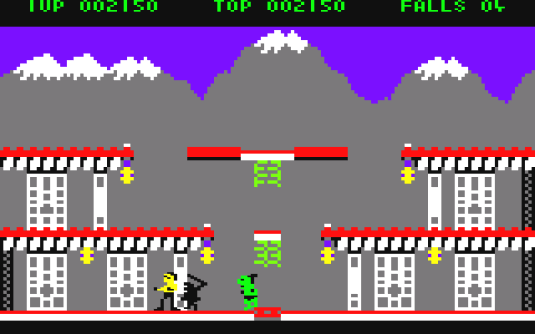
As the eponymous Bruce you make your way through 20 screens of platforms collecting lanterns, avoiding traps, climbing ladders and waterfalls(!), and finally facing up to an evil wizard firing what I presume are lightning bolts. And that's pretty much all there is to it. As early video games go Bruce Lee is an exercise in timing and therefore acquiring patience. It is very tempting to simply charge in, but doing so will find you butchered. Most rooms involve timing jumps to either avoid psychotic avians or electric charges running across the floor. Also liberally sprinkled about are the customary spikes and pressure activated ... fountains. Avoiding these obstacles and getting the timing right is the way to progress from one room to the next and, thankfully, it's not too frustrating to learn the patterns. And the controls are accurate and super sharp. If you die, it is because of you.
Where Bruce Lee adds a bit more interest is the recurring enemies of the Ninja and Green Yamo. These materialise in most screens and their job is to make your day worse. Ninja has a club to clout you with, and Yamo is quite handy with his fists and flying kicks. For a Sumo, the boy can move. But because you're Bruce Lee you can fight back with a mean right hook of your own, and the ability to fly through the air to place your foot in the face of your opponent. You can beat the pair of them up but they'll respawn and come after you with renewed vigour. What is also a nice touch and the source of a few cheap laughs is how they're both vulnerable to the same traps as you are. If they follow you down a drop and they get hit by a bird, it's goodnight. Stuck on a waterfall with spikes at the bottom, they'll get skewered. Electricity will zap them. And, most fun of all, run over a fountain with them hot on your heels and, wham, instant death.
And this is what marks Bruce Lee out from the cornucopia of early platformers. It was arguably the first to combine platforming with fisticuffs, setting the stage for later efforts like the NES adaptation of Double Dragon and everything since. Yet when you consider only a year separated this from Super Mario Bros, there's a real sense of how US video game design lagged well behind that of Japan's. In the British context though, it was an occasion where Amstrad's machine pulled off a better version than either the Spectrum or Commodore 64, having much better graphics and tighter controls than each. Though it has to be said choosing yellow for the Bruce sprite was a somewhat unfortunate decision.
All this considered, how does it fare today? Well, as you would expect a fairly primitive game from the 1980s to fare. It's a great whizz in short bursts, especially for those of us with the nostalgia goggles on. But I do get the feeling that younger gamers playing this will be thankful for growing up much later.
Friday, 10 January 2020
ContraPoints on Cancelling
Here's a very lengthy piece from our comrade ContraPoints discussing cancel culture (not to be confused with cancelled culture). Very interesting, as always.
Thursday, 9 January 2020
Labour and the New Working Class
Jeremy Corbyn was always going to be a hard sell given how much his politics are at odds with the political and media establishment. Indeed, this combined with my habituating to the miserably low expectations of what was then Labour's mainstream meant I didn't vote for Jeremy in 2015. My mind changed primarily thanks to the wreckers on Labour's right who warned a Corbyn-led party was unelectable, and stretched every sinew to ensure this was the case. And so when comrades went on the doors and found common Tory and press attack lines quoted back at us - Corbyn supports terrorists, Corbyn hates this country, Corbyn is an anti-semite, Corbyn can't make his mind up about Brexit - all of these lines were established years in advance and fed by people ostensibly on our side. Nevertheless, in 2017 the party weathered Corbyn scepticism incredibly well and given the trajectory of the polls, just one more week of campaigning would likely have returned Labour to government. Why not this time?
Given what happened then, you can understand why some comrades were champing at the bit for a general election regardless of timing. We had experience of circumventing the media, and the party membership did make a big difference. Not just in terms of volunteers campaigning, but thanks to the millions of conversations non-active members were able to have with their families, friends, and colleagues. This is why mass memberships matter because they can do a lot of the groundwork without the need for direction. Therefore the notion voluntarism could make up for Labour's other disadvantages was not official optimism or Maoist exuberance, but a belief we could decisively leverage the party's weight and make it a significant electoral factor. And the truth of the matter is the Tories knew this potential was there and did find the images of hundreds turning up for canvassing sessions, the take off of electoral registration, and queues forming up outside polling booths demoralising. Unfortunately, their fears proved unfounded.
Two years of demobilisation certainly had its part to play. Internally Corbyn's leadership failed to press home its advantage after the 2017 election, and what we got instead was a soggy compromise to suit trade union tops instead of the mandatory reselection we see in the radically democratic, ahem, Scottish National Party and the LibDems. We did not witness serious efforts about changing party culture to become more participatory and less obsessed by the dull proceduralism that unnecessarily clutter Labour meetings, and once the post-election sheen wore off we saw the party embroiled again in a lengthy and damaging drip drip of anti-semitism, Tom Watson-engineered wrecking, and second referendum remainia proliferate unchecked. Simultaneously, the Commons was the cockpit of Brexit struggle to which members and supporters could only spectate. In 2017, though the election was dropped on us the party was primed for thanks to two years' worth of mobilisations, aided by the fact Corbyn was largely unknown among the wider public. In 2019, we went from a standing start to full pelt in a blink of an eye, but by this point Jeremy was a known quantity and most people had made their minds up about him. The party responded magnificently to the moment, but the perception of the leader and Brexit was too much to get around.
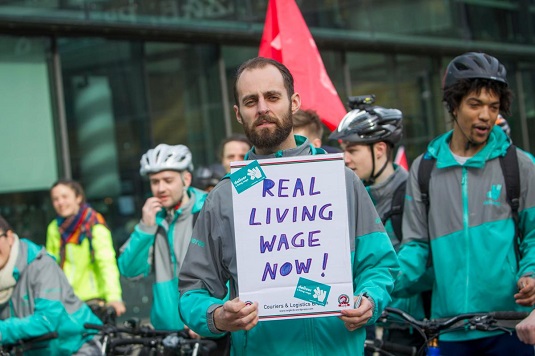
This cannot account for our failure though. If you consider 2017 as a turnout game, where Theresa May assembled a huge pile of Tory voters but was met with a very impressive response by Labour, Boris Johnson repeated the feat while we didn't. Turn out fell by just shy of 375,000 votes and we lost over 2.5m votes. Why? As argued here many times before, Labour's new base is the socialised worker, or the new working class. This is networked but heavily individuated, their work tends to be cognitive and social rather than just physical, and tends them toward socially liberal and tolerant attitudes which, as a consequence, made them more favourably disposed toward the EU. The younger you are, the more likely you are to be employed in this kind of work and be at the sharp end of precarity, uncertainty, low pay, flexible hours and zero hours, bogus self-employment, no prospects, personal debt, and to top it off much less likely to be able to ascend the housing ladder and acquire property. As the Tories are presiding over this, they're storing up problems for the future and, indeed, this election saw an even starker age split than 2017.
As other comrades have noted, Labour lost more votes to remain parties than leave voters to the Tories, but the latter were amplified thanks to their geographic spread. Undoubtedly, had Labour not pitched to the second referendum position the election would have been even more catastrophic. Not because the loss of seats would have been any worse than what actually happened, but because an even greater chunk of the new working class base would have visibly registered Labour acting against their interests and sealed their alienation from the party for many general elections to come. And this matters more not just because they're younger and have more votes left in them than the Tory base, but that they're less likely to vote in the first place. i.e. Our base is numerous, but less inclined to vote, which means every one of our people who stays at home costs the party more than if a Tory voter skips the polling station.
Turnout figures by age have varied over the years, but the same pattern is clear: older voters turn out in greater numbers than younger ones. If the age splits we see in elections and values surveys are functions of a class cohort effect, then it stands to reason the turnout differential also must be structural. What is it about the socialised worker that, at the moment, sees them much less likely to participate in mainstream politics even though Labour is now flooded with hundreds of thousands of its most radical layers, and went into this election with a programme speaking to their interests? If we iron out the conjunctural issues - Brexit, Corbyn's leadership (which was more a positive factor for younger workers) - what are we left with? In the absence of undertaking research, there are a number of hunches. The first is, simply, the absence of workplace organisation and other collective institutions of the working class. Employment, especially at the more precarious and lower paid end of immaterial work is highly individuated and segmented. Workplaces are not large, are criss-crossed by high labour turnover and individualised shift patterns, hours are by no means guaranteed, and that makes the formation of a trade union consciousness more difficult. Trapped in a privatised world of competition for shifts to try and make ends meet, there is little wonder that many find it difficult to lift their eyes to the horizon. This is their lot and nothing can be done about it, all you can try and do is survive. The second is a related political paralysis. Again, the absence of collective organisation means oppositional ideological resources are not simply to hand for millions of people, and in its stead we see all kinds of substitutes fill the vacuum. Nationalism appeals for a small minority of this layer of our class, but preoccupations with creating escapes from the real via fandoms, gaming, dating, and the pleasures of consumerism are much more common, as is conspiracy theory and, crucially, a naive and fatalistic cynicism. This is despite the increasing interest on socialist and left ideas. Therefore in an election where, if you're watching it askance, politicians are making grandiose promises there's no way to separate the lies from a genuine pitch. And so you declare plagues on both their houses and tune out. Especially when what they're arguing about appears to have no direct bearing on your life.
This won't be the case forever, but it's not going to sort itself out. These are our people, our base, so we have to understand them and bring more of them into the party's orbit. This is the sort of listening Labour should be doing, not wasting time flattering two-bit bigots and chasing former UKIP voters by promising to be more racist and wafting nuclear weapons around like giant willies. We've got to think about how the new working class is segmented, the differences that tend to crop up between those who've moved to the big cities in search of opportunities as well as those who remain in the provincial communities we lost, and the rural seats we've never done well in. We have to think about our own membership and its occupational distribution, how they got involved in the party, what their points of contact were before they signed up, and Labour needs to work more closely with the affiliated unions to learn from their recruitment strategies and how to do a better job of pushing the Labour link. All this in conjunction with deepening the party's commitment to social movement organisation and standing with workers in struggle. Understanding our people is not an academic exercise. The aim is to cohere them, grow them and, crucially, be relevant to them. And of we get this right we will not just be back on the path to government in 2024, we can be for the decades to come.
Subscribe to:
Posts (Atom)