Showing posts with label Reform UK. Show all posts

Wednesday, 9 September 2026

The Null Montie

Without a doubt this has been the worst week in Reform's short history. Their party conference was meant to draw a line under Nigel Farage's summer humiliation in which he bravely fought off Count Binface, three Monster Raving Loony candidates, and the continuity SDP to retain his Clacton seat. This was going to be the moment in which Reform showed the world that they meant business, and unveiled their plan to do away with British democracy within 100 days of taking office. Instead, the headlines Farage was hoping for were eclipsed by Channel Four News's funding sting, that forced out chief Farage baggage handler Dan Jukes and James Orr, amusingly a specialist in (religious) ethics at Cambridge. And if had that not happened, Zia Yusuf loomed large - delivering a message of support to the Dover blackshirts in defiance of Farage's condemnation of them. He has since gone on to announce a de facto leadership bid in the event of Farage's departure. And there were ugly scenes from within the conference itself, with an assault of a female protestor going viral. Everything was in the spotlight except for Reform's key messages. And now, on Wednesday, Tim Montgomerie has announced his resignation from the party.

Some might recall his joining Reform in December 2024. And because everyone in the media knows him, he got more coverage for doing so than all the second rank Tory defections - Nadhim Zahawi, Nadine Dorries, Jake Berry. Speaking on Politics Live, Montgomerie said he remained a supporter of the party and made his fanboyish affections for Farage obvious, but argued the party was too unruly. Chief culprit is Yusuf's chaos agent cosplay, for whom the concept of party discipline is an alien notion. He is "supremely talented" and a "gifted communicator" - two phrases that were often uttered by prominent-but-frustrated Tory defectors throughout the conference. But Farage needs to rein him if the professionalisation of Reform is to succeed. Montgomerie also said he told Lee Anderson last week that we wanted to continue to be the party's critical friend and make public his views without embarrassing them, or causing issues over their suspension of him, and so was stepping away. How thoughtful.

Unfortunately for Reform, Montgomerie's resignation is symptomatic of the party's failing bid to replace the Conservatives as the preferred political choice of the ruling class. And that long predates Yusuf and his manoeuvres. Notably, the difficulties Farage has faced - the exposure of their murky funding arrangements, which are now subject to a handful of police investigations, came from the right wing press. And particularly The Times. Obviously, none of this would have happened had Uncle Rupert or another of the Murdoch family said no. The timing then is interesting, and suggests that they think Farage in Number 10 would be detrimental to their interests. For one, the erosion of democratic institutions and press freedoms seen wherever Reform's overseas stable mates have taken office hasn't always been congenial to the interests of media moguls. Fine for those on board with far right governments, but here in Britain the press barons are accustomed to dictating terms to Number 10, not the other way round. Or to put it another way, there are doubts Farage and his government could be controlled.

Second, Reform's programme is hardly congenial to stability. Theirs is an explicit class politics for keeping labour at heel, and smashing up opposition through the demolition of state institutions crucial for sustaining mass stakes in and tacit support for British capitalism. The political moment simply does not require it. Andy Burnham's emollient words nor his programme are hardly a threat to contemporary class relations. In fact, as far as the bottom line goes capital with interests in domestic markets and the near abroad would like to see more stability, especially when the shocks keep coming - war, energy prices, climate disaster. Reform want unnecessary class war when most of British business is content with the class peace they have.

Third, what is the coalition of class interests Reform already has in the van? The most backward sections of capital: coupon clippers from the City who remain Brexit true believers, tax exiles, cryptomongers, myriad petty business people and farmers and, crucially, Silicon Valley "disruptors" bent on aggressive take overs of key sectors of the British economy. People who are smash and grab and have no time for the dependencies the British state and ruling class have built with the United States. Collectively their interests is a minority interest within the minority interest of our betters, and one that sits in tension. A Farage government in these circumstance would be a Liz Truss moment, as far as their politics are concerned.

Montgomerie then, as a respected figure on the right, was something of a canary down the coal mine. If he could thrive more than survive, given his propensity to speak his mind, he might have been the bridge for more of the British right and therefore the interests historically tied up with the Tories to cross over. But Reform can no more move away from their corner of ruling class support than the Tories can from their broader bourgeois base. Indeed, Yusuf's antics can be read as having the consequences of protecting this constellation of interests from getting diluted by more "mainstream" concerns, represented by Tory-supporting sections of capital. Indeed, he has gone out of his way to highlight the differences between his type of right wing politics and conservatism in its British varieties.

To put it more succinctly, Reform has served a purpose in steering politics toward the beggar-thy-neighbour politics of culture war scapegoating, but anything beyond that is not where the bulk of British capital wants to go. At present.

Image Credit

Friday, 14 August 2026

What Was the Point?

Across the land, grass has withered and died under the relentless glare of the burning sun. A climate catastrophe to be sure, but one that serves as an apt metaphor for the travails of Nigel Farage. At least as it exists in his and Reform's political imaginary. Instead of a drought, this was supposed to be Farage's evergreen summer. A hapless Prime Minister in office, racist pogroms to egg on and exploit, immigration to bang on about, and an establishment stitch up re: the parliamentary standards investigation to cry over. The master plan in forcing the by-election was about crushing the other parties, cementing Farage as the enfant terrible of British politics, and recapturing a sense of momentum - something that has been lacking, despite handily winning May's council elections in England and giving Labour a drubbing in the Senedd election. As we know, the one thing this elegant demonstration of 11-dimensional chess did not factor in was the refusal of his opponents to play ball. Instead, Clacton became an irrelevant sideshow of Farage vs a large field of "comedy" candidates, independents, and an oil slick of fascists hailing from tiny groupings and one-man bands. Small wonder he cried off giving a victory speech.

A Count Binface victory would have been funny, and driven a stake through Reform from which it would never recover. But this was never a serious proposition. On a reduced turnout of 44%, which is down on the general election but is roughly the kind of reduction one normally expects from a parliamentary by-election, Farage was able to poll 63.3% of the vote. An increase of just over a 1,000 ballots in raw vote terms on 2024, but proportionally a 17-point gain. Most politicians would be happy with that, but Reform's most enthusiastic supporters would have hoped for an even more emphatic win. Especially up against unorganised opposition and a cadre of joke candidates. Also interesting was the shrinkage of the right bloc in Clacton, as noted by Luke Tryl. It's almost as if their kind of politics are in long-term decline, or something. Count Binface also made history, ensuring immortality in the footnotes of political science journals. Not only was his 26.9% the highest ever polled by a spoof candidate in a UK parliamentary by-election, he's the first to hold on to his deposit.

On reacting to his win, Farage said the result "spoke for itself" and was open about not wanting to be pictured alongside his opponents. And then, because there's never not an opportunity to inject grievance politics, a Reform spox said Farage stayed away from the count after police had warned that there was a credible threat of disruption. Something Essex Police have denied.

What now? In the immortal words of Theresa May, nothing has changed. The standards investigation into Christopher Harborne's £5m "gift" restarts, which is likely to result in a suspension and another by-election in the Autumn. If Farage is going to quit politics for the quiet, lucrative life of right wing celebrity, this will be the moment. And the political atmosphere Reform now operate in is not as congenial. The Times-led investigations into the party's funding have severely dented Farage, and are subject to money laundering investigations by the police. Easy mode is no longer available to Farage and friends. They also have to adjust to life under Andy Burnham's premiership. Most polls are now posting modest Labour leads, and the government are gingerly talking about the good things they have done in office. The cost-of-living announcements over the last few weeks, while marginal in the scheme of things, do show a direction of travel to former Labour voters that they approve. On this, Reform has absolutely nothing to say and are out of sorts. This is compounded by Farage himself enjoying the most negative personal ratings of any party leader, and looking ever more shiftier in his efforts at dodging accountability. In all, the Clacton by-election was a waste of time and leaves Reform and Farage in a worse position.

Image Credit

Tuesday, 14 July 2026

The Political Uses of Ann Widdecombe

Nigel Farage has used every opportunity to fabricate a persecution complex. Being criticised for pocketing £5m and facing a standards inquiry is the establishment out to get him. Questions about his relationship to a moneyed fraudster and his mother is so much hounding. Having his by-election stunt backfire as all the other parties rightly refused to play his game is an elite conspiracy. The appearance of wounding is central not just to Farage's increasingly unpopular populism, but the politics of the right in general.

The murder of Ann Widdecombe which, accordingly to the police, now looks like a targeted killing has become an unseemly Reform jamboree because it plays into the victimhood dynamic they continually set up. A photo opp of leading Reform figures laying wreathes, plenty of buddy-buddy photos of Farage and Richard Tice with Widdecombe flooding Reform-affiliated social media, Farage moaning about the lack of security afforded him even though he declined a state-funded package offered him this year, and his claims to receive "300 threats" a month. Widdecombe was useful in life to the Reform cause as an able media performer who played well with a layer of Tory-Reform voters, and she continues to have crude uses in her demise.

Understandably, how Reform have exploited her death has attracted most attention and criticism. But far less focus has resolved on how politics generally have used Widdecombe's passing. You will have seen the tributes. Every leading politician has given the same one. "I disagreed with her politics", they say, before offering some humanising anecdote, or tribute to her energy, or her formidability, or how, once you got to know her, she was actually quite nice and kind. That all these things might be true are beside the point. Their endless repetition constitutes the received wisdom, the illusio of politics. To put it another way, Widdecombe was being treated as if her views were of no consequence, that her opinions were weightless. This is politics as if it's a dinner party, where everyone chips in with a point and position, and are so much colour that might have made for a memorable evening.

But politics does have weight. It does have consequences. Widdecombe's voting record as an MP out her on the wrong side of every single argument over the 23 years of her parliamentary career. As a social security minister and later as prisons minister, she oversaw attacks on the most vulnerable people and, famously, defended the handcuffing of pregnant prisoners giving birth. As a key Reform spokesperson, this ever-so-kind woman spent her dotage building a political party that exploits and tacitly encourages racist violence, and would threaten the limited democracy we have in this country if they form or become part of the next government. But mentioning all this is the height of rudeness, because politics presents as a public service where politicians are motivated by the noblest of intentions. Where they differ is how best to serve their constituents. It cannot be acknowledged for what it really is - the more or less transparent struggle of interests. The illusio must be maintained, even if the only people who really buy into it these days are the politicians themselves.

Image Credit

Tuesday, 7 July 2026

The Desperation of Nigel Farage

"This is 4D chess!!" shouted Matthew Goodwin into the howling void that is Twitter. With such an endorsement, you just know he was heaping praise on stupidity. And so it was. At 2pm Tuesday afternoon, Nigel Farage fielded a press conference about his political future. Was he going to resign? Yes! Sort of. Viewers were treated to a self-pitying whine about how terribly unfair it was that he wasn't allowed to trough on the freebies, gifts, and cash windfalls showered on him by billionaires, gold bullion companies, and convicted fraudsters without declaring them as per parliamentary rules. It's all a stitch up, he moaned, the establishment are out to get me! And so he's quitting his Clacton seat to force a by-election, showing the world that ordinary people back him.

The Des A masterful gambit this is not. For one, the formal investigation into his troughing does not go away. Assuming Farage is returned to the Commons it simply picks up where it left off. The possibility of a recall petition and a second Clacton by-election some time in the Autumn cannot be discounted. The second was Farage assumed all the other parties would play ball, relishing the chance of having a crack at him in his stronghold to feed his David vs Goliath posturing. Which has already backfired. The Tories, Labour, and the Liberal Democrats aren't going to dignify Farage's by-election stunt with a candidate. If there is any sense, nor should the Greens. Also out is Rupert Lowe's Restore Britain, who say they're holding fire for the proper by-election-to-come following the standards investigation. Therefore, the Reform leader is going to look silly railing against the establishment from the victor's podium, flanked by Count Binface, the Monster Raving Loony Party, and whoever else fancies pouring their deposit down a drain.

Without much of a contest, the media interest is unlikely to make much of the by-election. Undoubtedly, Farage was hoping Clacton would generate Makerfield levels of publicity and allow him to dominate the summer's politics coverage, wresting the spotlight away from Andy Burnham. Instead, other parties choosing not to participate makes the by-election look like a pointless waste of time. The punters of Clacton will be wondering why this farce is even happening, and a few might be turned off from the Reform leader because of this frivolous waste of money. While simultaneously reminding them that the stakes of this contest is he right to take free gifts and cash money. How man-of-the-people of him.

Farage's gambit smacks of desperation. Having been an adroit and skillful operator for so long, in his hubris he might think nemesis is never going to come for him. Hoping that no one cares about his capacious pockets nor the crude political favours he's done in return for cash, such as bigging up crypto, and prominently featuring JCB machinery on local election literature, how the £5m story refuses to go away and keeps getting murkier has left him at a complete loss of what to do. Lying about it, dismissing it, being brazen about it, none have worked as allegations pile on allegations. Farage must rue the day when he decided not to apologise for failing to declare Christopher Harborne's gift and tried to fight it. A case, perhaps, of his being high on his own supply and thinking nothing can touch him nor the solid layer of Reform support that has proven resilient versus everything else thrown at him. This is a moment of maximum peril for Farage and his political chances, made more delicious by how it's entirely self-inflicted.

Sunday, 5 July 2026

From Brexit to Frexit?

If you're sparing a thought for Nigel Farage this Sunday, his exposed links to a convicted fraudster are likely to colour them. The Sunday Times writes that Farage received security support, housing perks, and staff funded by crypto "entrepreneur", George Cottrell. Deliciously, Cottrell was arrested in the US in Farage's company in 2017, after doing the rounds at that year's Republican convention. These benefits were, apparently, provided in the lead up to the 2024 general election and, what with Farage's custom and practice, they were not declared.

It's been a bad week for the Reform leader. We learned he'd pocketed £270k fronting a gold bullion dealer, and that he has acquired a £4m property portfolio. He also got testy being pressed on his £5m gift from Christopher Harborne, the Thailand-based crypto billionaire and Russian oil profiteer. From BBC Breakfast's Sally Nugent, to TalkTV's Julia Hartley-Brewer, and LBC's Nick Ferrari, he came across as exasperated, petulant, and annoyed that he should get questioned on this topic. This comes after a poor campaign in Makerfield, where Farage went to ground to avoid those giving answers. These difficulties and his uncharacteristic avoidance of the media spotlight have led some to ask the unthinkable: is Farage long for this political world?

Undoubtedly, it's a question Farage will be asking himself. He will apparently be taking a long break this summer, which will be good news for Andy Burnham and gives his government plenty of opportunities to set the political agenda. But might Farage throw in the towel? It must be tempting. According to former Farage lackey Ben Habib, Farage stood in the election because Harborne ponied up the cash. His frequent issues with not declaring earnings is a sign of a politician on the make, and while not the wealthiest MP he did report the largest income from outside interests - the eight or nine second jobs he's taken since his election as the very occasional representative for Clacton. For Farage, he's got to know that life would be easier and his earning power not dimmed too much if he walked away.

Consider the parliamentary standards investigation. Given precedent, he won't walk away with a slapped wrist. Indeed, a Commons suspension and a recall petition are the likely consequences of the Harborne affair. Undoubtedly exacerbated by the multiple occasions he's failed to declare earnings, including today's Times splash. Unless all the other parties could get behind a squeaky clean anti-corruption but non-political figure, like finance guru Martin Lewis, Farage would surely win the by-election. But would he want to fight a campaign when it's his money grubbing that's the reason for and the focus of the contest? Does Farage want to risk the awkward viral videos of having random Clacton'ers berating him, or having a strip torn off him on a previous Reform voter's doorstep?

The second issue is his political future. Braving the by-election means more years of scrutiny and accountability. It's possible, thanks to past behaviour, that there are going to be future non-declarations, and perhaps more Commons investigations. But supposing those storms are weathered, everything goes wrong because Burnham turns out to be no different to Keir Starmer and Farage finds himself in Number 10. Not only would this be the gravest disaster in British political history, it would be an opportunity for him and his lieutenants to engorge themselves. However, Farage is a greedy man, not a stupid man. Does he want a future where yes, he can fill his boots, but afterwards face possible pursuit by whoever might succeed him. Would Farage rather spend his infirm old age relaxing on sun loungers, or fending off investigations, legal challenges, criminal probes, imprisonment? Hence why the Reform leader's Frexit can't be entirely discounted.

Image Credit

Thursday, 4 June 2026

Right Riot

There have been two phases to the riotous assembly Nigel Farage stoked following the investigation into the police handling of Henry Nowack's murder. There was the confrontation in Southampton itself. This was no grassroots anger bubbling over, but a flashpoint that saw the far right across London and southern England mobilise for a fight. All the fascist faces were there - Tommy Robinson, Laurence Fox, Paul Golding, Posey Parker, all dragged their knuckles from their fetid swamps to whip the bovva boys up into a frenzy. And they duly obliged, rampaging through inner city residential streets and attacking the police. No doubt many of them can look forward to a spell in pokey courtesy of the footage shared by their grifting mates.

Yet the political objective was achieved. Having spent the last two years stirring the pot, the far right have had their first summer riot. Another step toward how things used to be, when the National Front routinely took to the streets in the 1960s and 70s. But the second phase of this right riot has proven more successful then any of them could have dreamed. Paper after paper, news outlet after news outlet, have surged across and trampled on the cordon sanitaire and hurled the bricks and wheelie bins of far right talking points into mainstream public discourse. For example, Sky News asked if the police are indeed "anti-white", forcing the gibberish about two-tier policing onto television screens. They were joined in this by The Mail, a "debate" on Good Morning Britain, and The Sun "just asking questions". On top of this Chris Mason, the BBC's chief politics gossip-monger ran cover for Farage as he was criticised by the other party leaders in the Commons one Wednesday. Aha! said Mason, they were being political about Henry Nowack's death too! You've got to ask it's only a matter of time before the great replacement theory gets an airing, all in the interests of debate.What happened in Southampton gave right wing papers and their little helpers in broadcast journalism an excuse to treat far right rubbish, which they themselves know not to be true, as if it was based in fact and was a valid viewpoint. This is where their riot has proven particularly successful.

Characteristically, mainstream politics have been useless in its collective response. Keir Starmer and Ed Davey tried to look statesmanlike, while telling Farage off for not respecting the stated wishes of Nowack's father not to use his son's murder for the politics of division. Instead, if they had anything about them, they should be making clear that his speech instigated Tuesday night's unrest, as Farage knew it would, and make plain that Reform is but the electoralist expression of violent street thuggery. But even when the King responded better than Labour did ti the 2024 riots, anyone hoping for better will be waiting for a long time. Something underlined earlier on Thursday as Starmer was moaned about Elon Musk dialling up the race hate in this country. If only the Prime Minister with his huge majority were in a position to do something about malign foreign actors working to destabilise British politics. At the moment where the violent consequence of Farage's tub-thumping could see politics move decisively against him, there is an absence where the far right challenges to Britain's limited democracy could be met.

Image Credit

Monday, 1 June 2026

Trade Unionists for Farage?

For The Times, JL Partners' poll of the political intentions of trade unionists found that 28% of them are prepared to back Reform, a 20-point increase since the general election. Labour on the other hand have fallen by the same margin to tie with them. Elsewhere in the survey the Greens have increased their support to 12%. Speculating about the why behind these figure on Times Radio, Terry Stiastny thought it has to do with wokery, net zero, and anti-immigration worries. Which is exactly what I would expect someone with no understanding of the history of the labour movement to say.

The truth is there has always been a strong right wing bloc among working class people. We're not talking about those patronised by Blue Labourism, but dyed-in-wool anti-Labour voters. This is the section of the class that loyally turned out to vote Conservative, amounting to about a third of the work force. That part of the class where I come from. And this also had a political expression in the labour movement. Informally as, for want of anything else, backers of strike-averse right wing Labourism, and formally as the Conservative Trade Unionists. In the 1970s they were a real outfit that commanded the allegiance of tens of thousands of members. Yes, it's hard to believe now, but the Tories had the sort of trade union clout left groups, with the exception of the official Communist Party, could only dream of. The historic appeal of conservatism to working class people is not much of a mystery, and it is worth noting that the Tories made real efforts from the late 19th century onwards to win over "working men" and were particularly successful in the 1930s, following the granting of universal suffrage, in organising rural workers. Working class conservatism runs deep.

What the Times poll simply shows is a switch. The Tories have destroyed themselves by torching their means of mass political reproduction, and so the right wing sections of the labour movement who might have supported them in the past have shifted allegiances to Reform. An assumption borne out by the figures. Just 14% of 2024 trade unionist Labour voters have switched to Reform, the rest coming from those who either supported Nigel Farage at the time, or predominantly voted Tory.

A case of shrugging the shoulders then? Of course not. As we have seen generally, Labour have paved the way for Reform by trying to out-do them from the right on immigration and asylum, affirming thir talking points and not contesting the politics. And, sorry to say, by and large trade unions matter very little in the day-to-day life of most of their members. Ballot papers, a seldom-read magazine, and that's about all most members see of their unions - a point reinforced by the abysmal turnouts for internal elections. On the one hand, the so-called political wing of the labour movement has cackhandedly encouraged Reform support, while its industrial organisation does not, with some exceptions, do much to discourage it.

Reform might be growing their presence in the trade union movement, but it is a passive reflection of their strengthening support in society more generally, and unlike the old CTU is not organised beyond a handful of pockets. It's well within the power of trade unions to reverse this support and stop them from making further inroads. And, fortunately, Reform itself is probably their greatest ally. In February, Richard Tice was boasting how Reform would just undo the new workplace rights Labour introduced in April, but also would tear up workers' protections. Maximum hours, safety at work, paid breaks, holidays, parental leave, fire at will, scrapping the minimum wage, Reform are promising the sort of bosses' agenda that the Tories dreamed of implementing. So proud are Reform that they call it their "Great Repeal Bill". Explaining what a Reform government means for working class people is the start of it, but that has to come from within the unions, from it being taken up by workplace reps and officials. A charge sheet filed on the union website or nestled in its magazine won't do the trick. Anti-Faragist moves will only be effective if a union is relevant to its members, that if their organisation feels like their organisation, that its moral leadership counts for more than the appeal of Reform's racist scapegoating.

Image Credit

Monday, 25 May 2026

Nigel Farage and the Politics of Corruption

On the saga of the £5m Nigel Farage has trousered from crypto billionaire Christopher Harborne, we've been issued with no end of excuses. Reform tried denying it was any business of the Commons, seeing as the money was wired before he decided to stand in the general election. Parliamentary standards disagreed. Then Farage said it was for the security he'll need for the rest of his life, being a divisive public figure and all. Then the story switched to its being a reward for his years of dedicated campaigning. Coincidentally, Farage started voicing enthusiasm for crypto shortly after the bung dropped into his bank account. And now, Reform are claiming that news of the gift is courtesy of Russian hacking, evidence of which is not forthcoming.

This is not the first time Farage has stood accused of receiving funds for political favours. Indeed, what characterises his relationship to money is its brazen transactional character and consistent repetition. A foretaste of the do-as-I-say-not-as-I-do relationship to the law we would expect during the nightmare scenario of a Reform government. But what are the political uses of such corruption, seeing as it's a common feature of the extreme right, here and abroad?

As already hinted, there is the shock and awe element, of being seen to be political teflon. I can imagine some canvassers hitting the doors in Makerfield and getting depressed that Farage's £5m kickback has not booted Reform's chances out of contention. As per Trump and what we've seen in the United States, allegations of corruption from political opponents go nowhere because, in many cases, they're rightfully perceived as being little different. Additionally, this can be threaded into narratives - spontaneously elaborated in the Facebook groups and retailed by GB News - that Farage is getting singled out and targeted for telling the "truth" about this country. The right in this country, whether in its Tory or more extreme forms, will not waste an opportunity to play the victim.

More important is the message Farage's corruption is sending to his class. Accepting money from here, there, everywhere signals that Reform is open for and to business. Farage himself, like Boris Johnson before him, covets cash and this ensures a congruence between his politics, the interests of the most reactionary elements of the ruling class in this country, and the globalised oligarchs. A bonfire of regulations, the dismantling of Labour's new, meagre protections on workers' and renters' rights, and the final destruction of the NHS as a free-at-the-point-of-use system fit nicely with those ruling class views that think we have it easy and need putting back in our box.

Yet this is not without risks. Farage is carrying on as if certain elite interests can shield him from consequences indefinitely, but this is not so. There's the obvious problem of investigations into rule-breaking. The £5m bung, for instance, puts Farage at risk of a Commons suspension and potential by-election in Clacton. One might be tempted to think he could walk it, but this is where the politics of corruption could bite back. While true not many Reform-minded people care about the provenance of his income and what he does to ensure similar gift giving continues into the future, but there are people outside the Farage fandom that do care a great deal. Brazen corruption could negatively catalyse and mobilise opposition to him and Reform which, considering their levels of support, could be hard to fend off. Imagine, for example, if the rest of the political establishment dredged up an independent anti-corruption candidate akin to Martin Bell's successful challenge to Neil Hamilton in Tatton during the 1997 general election. Could Farage see off Martin Lewis?

Risky or not. corruption is baked into extreme right wing politics. Farage can no more resist cash offers than he can the politics of scapegoating. The cash flow is the guarantee that Reform will stay in oligarchical pockets, and the closer we get to the next general election the more those taps will gush.

Image Credit

Thursday, 14 May 2026

Andy Burnham's Second Coming

I remember the time when the resignation of a senior government minister would corner political news and comment for days. But writing on the evening after Andy Burnham's announced his bid to return to the Commons, who's talking about Wes Streeting stepping down any more? Well, I am. His was a curious letter, starting off with a out-of-place "the results are in" joshing, and then rolling off recent NHS achievements, including the welcome news that waiting lists conitnue to fall. He went on to the substantive stuff; how he was frustrated by the government making the wrong calls and stuck in low gear deliverism before saying he had lost confidence in Keir Starmer and was off. But he did not then reach for the starting pistol, or the 81 MPs needed to launch a leadership bid. A read of his own chances, or knowing what was coming later?

Then tonight, Josh Simons, hitherto famous for overseeing dodgy doings while he was director of Labour Together, announced he was vacating his Makerfield seat in Manchester so Burnham could have a run. Burnham has confirmed he will seek the permission of Labour's NEC to be the candidate. And, interestingly, the chatter from Downing Street is that Starmer is not minded to block his candidacy. Things are about to get very interesting. And by 'very interesting', we means it's doubtful he'll remain in Number 10 by the end of summer.

Can Burnham can take Makerfield? The seat has been Labour's since it was formed in 1983, and Simons does have a decent majority of 5,400. But things were far from peachy at the local elections. Here, Reform ran away with victory, scoring almost 50% of the vote while Labour collapsed to 24% and the Greens scraped 11%. Although it was a different political time, Burnham did storm the mayoralty in 2024 with 63%. And the areas around Wigan, where Makerfield is situated, was particularly strong. As argued previously, there's a good chance the locals have flattered Reform. And Burnham has several other advantages: strong name recognition, a good local record for a Labour mayor, and a bit of an anti-Starmer cache. Punters there will know they're effectively voting for the next Prime Minister, which could boost him. Burnham is not guaranteed to win, but notwithstanding the local election numbers, there are more anti-right wing voters in the constituency to be mobilised. He's got to be the favourite to win it, assuming the NEC sides with him.

Which brings us back to Streeting. That Angela Rayner was cleared of wrongdoing by HMRC took some wind out of Streeting's sails on Thursday morning, but he is not a stupid man. He can read the same polls as the rest of us and how unlikely he would win a leadership election against virtually anyone, including Starmer himself. Perhaps he'll put in if Burnham successfully returns to remind the selectorate that he exists, but he's still young for a politician and, under a different leader, has the chance to reinvent himself as a convert to soft left Labourism. Especially if Burnham is serious about his promises to move Labour more in this direction. A case of his being down, but by no means out.

Image Credit

Sunday, 10 May 2026

A Reform Victory is Far From Inevitable

What a catastrophic set of election results for Labour. In Scotland, Anas Sarwar's branch office took a bold step backwards as support fell to 17 seats on 19% of the constituency and 16% of the list vote, breaking through the floor he sat at the 2021 elections. The electorate sealed their verdict on his miserable performance by voting him out of his Cathcart and Pollok seat, but thanks to the list system he'll be back when Holyrood reconvenes. Likewise in Wales, Labour smashed its terribly low expectations with a plunge from 29 seats to just nine, losing two-thirds of its vote and also consigning its leader, the hapless First Minister Eluned Morgan, to the political dustbin.

Labour's devolved government woes overshadowed a disastrous night for the Tories too. They went from 31 seats to 12 in Scotland, and from 16 to 7 in Wales. A fraction under 12% and 11% respectively, they look increasingly like an utterly spent force. Unfortunately, that's because a great deal of unionist energy is now stored in Reform's political batteries. On 34 seats and 29% of the vote, they are the second largest party after Plaid Cymru and will be the opposition, as well as the standard bearer for continuing the union in Wales. In Scotland they are tied with Labour on 17 seats, thanks primarily to the list system. Here it too is the ascendant voice of unionism, making the link between the preservation of the UK state and right wing extremism something the socially liberal SNP are sure to exploit.

Likewise, in England it was a pitiful night for Labour. Keir Starmer achieved its worst result in English local elections since it became a party of government. The low of 1,300 councillors lost by Jim Callaghan in 1976 was surpassed as Labour gave up 1,496 seats. The party relinquished control of 38 councils, and scored a projected vote share of 17%. No wonder more Labour MPs are finally breaking cover and calling on the Prime Minister to go without waiting for the would-be successors to get all their ducks in a row. As forecast by sundry pundits, councils in the north tumbled in Reform's favour, while right on cue a clutch of London councils fell to the Greens, along with two directly-elected mayoralties.

Though you wouldn't know it from Kemi Badenoch's upbeat countenance, the Tories' performance in England almost matched the Scottish and Welsh disasters. 563 fewer councillors will be paying in tithes to their local Conservative group. Still not convinced that this once-mighty party is in long-term decline?

It was, again, Reform's night. A projected 26% of the vote and 1,451 new councillors puts them head and shoulders above the other parties and, thanks to the dysfunctional verities of first-past-the-post, would get them close to an overall majority if this was repeated at a general election. 14 more councils fall under their sway, and undoubtedly deals will be done in other local authorities that will see them govern in coalition with others, such as Tories and/or localist independents. There is no cordon sanitaire in British politics! The Greens inched ahead of Labour and took second place, with a projected 18%, 441 more councillors and five councils - again more or less matching forecast expectations and turning in the party's biggest ever win.

So much for the new state of play, but what about the underlying politics? John Curtice's position, that a decline on last year's vote share would represent a stalling of Reform's chances, regardless of how many councillors they picked up, was borne out on Thursday. Their share is down four points on the 2025 elections. But taking differential turnout into the equation, it's possible these results flatter Reform's level of support if a general election was to be held imminently. Which, of course, is not going to happen.

To restate the argument, polls consistently show that Reform, like the Tories, are demographically dependent on older people for their support. There are several reasons for this. This matters because it is well known older voters and particularly the retired are more likely to fill out their postal ballots or turn up at the polling station than the bulk of working age people. Therefore, the right has an important advantage going into elections. By way of an example, if retired people has stayed at home on EU referendum day a decade ago then Remain would have won. Where second order elections are concerned, most voters believe these "matter less" than general elections. Turnout goes down across the board, but the reduction is disproportionately greater for younger cohorts, strengthening the advantage of the right.

In Reform's case, its 29% in Wales and 15.8%/16.6% tally in Scotland are likely to overstate their real level of support vis a vis a general election. Ditto for England's projected 26%. And yet that figure is roughly in line with what pollsters report from their balanced samples. Does this suggest differential turnout is a mirage? Polls are always models and are, at best, only indicative. They are trumped by votes cast and, arguably, the analysis of those votes. Second, pollsters know this themselves which is why numbers given are caveated by margins of error. Dealing with the effects of differential turnout, I would suggest that the reversion from the right's second order election advantage to the weaker one it enjoys at general elections could reduce the Reform (and the Tory) score by two to three points as other cohorts turn up to vote. Not a massive amount, but one that matters when politics is this close run.

For the same reasons, there is a strong case that in England, perhaps less so in Scotland and Wales thanks to the SNP and Plaid Cymru, the Greens' 18% is an underestimate of where the party actually is. To have scored so highly, outperforming Labour (who suffer a similar disadvantage) and the Tories (who don't) is all the more remarkable considering the Greens' working age/young base is comparatively less likely to show up. A confirmation that Zack Polanski's Green-left populism is the right strategy for the right time.

Obviously, this comes with further caveats. Above all, geographical variation. Reform's 29% in Wales suggests the party is proportionately stronger there than elsewhere. Though looking at it from a right bloc/liberal-left bloc perspective, it's a 41%/58% division, which is wider than the same 43%/51% division for the English local elections (the untidy splits denote independents/others). Seat variation also matters. Bradford, for instance, saw Reform take 23 seats on 26%, but the Greens just seven on 22%. Nevertheless, the direction is clear. We, rightly, hear concerns about the danger from the right, the damage they do, and the atavisms they enable. They could win an election. But the numbers and the political direction shows greater numbers and the greater potential for mobilisation to their left. Reform and the right can be defeated. They are not inevitable.

Image Credit

Monday, 4 May 2026

Wallowing in the Gutter

"Today we announce a new policy." These were the words Zia Yusuf used to introduce Reform's intention to set up networks of "detention centres" for deporting tens of thousands of people at a time. Their precious promise? To ensure none are situated in constituencies with Reform MPs or local authorities run by the party. They will, by and large, be placed where there are Green councils or Green MPs. In doing so, Yusuf was able to win the attention wars for the morning of Bank Holiday Monday in the most repugnant way possible.

There is a mass market for political thuggery, but that market doesn't extend beyond the 15-20% of the electorate that are the party's base. And it might give its softer "I'm not racist, but ..." some pause ... before they vote for Reform anyway. It does, however, limit their appeal beyond this. Strategically speaking, ahead of a set of local elections that look poor for the Tories and cataclysmic for Labour, it might be read as a call to turn out their supporters. A bit of racism, plus a poke in the eye for clueless middle class do-gooders that don't live with the consequences of mass migration. This is the vibe Reform are trying to ride. The problem they could encounter here is boosting the support for the Greens, which already has had some success with the "it's us or Reform" framing. Of course, Reform know this too. They've reasoned that in places not like Gorton and Denton, left wing politics and defending migration is much less palatable than themselves, and will put disaffected centre-leaning voters off from lending them their support. A strategy Reform thinks could cement divisions on the broader left they can capitalise on. We will see.

Reform are also teeing up for another summer of shouting loudly about immigration. Improving conditions in the Channel means more small boat crossings, and with it another round of tabloid hysteria. Months of right wing efforts at re-stoking the 2024 summer riots lie ahead. Unfortunately for Reform, and for everybody else, the cost-of-living crisis is to spike as the American/Israeli stand off with Iran remains unresolved. This, not Labour "getting tough" on immigration, is why immigration has fallen down priority list. And because the Gulf isn't about to sort itself out, and is looking more fraught at the time of writing, it's not likely another round of scaremongering is going to work as a distraction from a crisis cooked up between Washington and Tel Aviv. And that's a problem for Reform, because they have nothing that can address this crisis and, as Keir Starmer mentions every time he's near a TV camera, Farage wanted the UK to back the US-Israeli war on Iran in the first place.

Reform has plumbed new depths for British politics. A reminder to Labour's clever, clever strategists that it can never out-right wing an extreme right wing party on race and immigration. But, like the Tories before them with their awful Rwanda deportation plan, Labour have stirred the pot by scapegoating refugees and refusing to challenge the lies put out by the press, cultivating an inchoate, atomised, reactionary mob who find embers of collectivity and connection through spite and by punching downward. Who'd have thought jabbing an endless river of toxins into politics might have resulted in something entirely malignant that, in turn, threatens to consume them. They made this politics possible, and I might have said serves them right. If the results of their poison didn't threaten us all.

Image Credit

Tuesday, 3 March 2026

On Anti-Green Hysteria

Maybe I have a weird sense of humour, but I found Tuesday morning's YouGov poll putting the Greens in second and Labour a distant joint third hilarious. Reform on 23%, Greens 21%, and Labour and the Tories both on 16%. As the world can see, Labour's attempts to bounce back after the the Gorton and Denton drubbing have not proven successful. Who could have guessed that the Prime Minister's decision to equate Reform and the Greens would not go down well with the voters he's losing? Meanwhile, things aren't looking fantastic for Reform either. A weekend spent telegraphing what sore losers they are, Moreincommon finds Reform topping its negative poll tracker on 38%, with Labour on 34%. Its looking like the crisis in establishment politics has taken a turn for the worse.

The reasons why Labour are sinking are well rehearsed, and doesn't bear repeating. But the steady evaporation of the party under Keir Starmer is a problem. Labourism from its earliest manifestations was always a means of reconciling the organised working class with the social order, of aligning the industrial incrementalism of trade union struggle with the coalition-building and proceduralism of constitutional politics. It was and, in its best moments, remains less a moral crusade and more a means of integrating the working class into the politics and (sensible) management of British capitalism. For it to do this, Labour needs to keep its base among the popular layers. However, it's been evident since Starmer became party leader that he either does not understand this or doesn't care. Because his approach to politics is both managerialist and obsequiously deferential to business, above all the City. Yet hollowing out the party before it even took office is to undermine Labour and Labourism's utility to British capital. Apart from its hyper class conscious and, therefore, paranoid elements, capital likes Labour because of its historic role in dampening down aspirations and movements from below. They appreciate Rachel Reeves's orthodox approach to state finances, but that's a nice to have. Labour is supposed to manage and police the class relations of British capitalism for capital's benefit from within the organised workers' movement. Something it cannot do if the mass support has vanished and has gone, in the main, to a radical upstart.

This is where the hysteria seen across the Tory press since Thursday's result comes in. It has been occasionally noted that the collapse of the Tories hasn't occasioned much soul searching or panic on the right. The reason being that Reform are available to articulate the interests that have hitherto animated the Conservatives, and that despite occasional argy-bargy between Nigel Farage and Kemi Badenoch, it's clear that should the situation demand some kind of electoral arrangement or governing coalition deal could be struck. With Reform leading the polls, the right are intensely relaxed about the vestigal status of the Tories. But, having driven all before it, if they weren't expecting Reform to win in Manchester they too believed the polls about how close the contest was. Instead they were handily seen off. This shouldn't be too much of a concern considering the character of the constituency, but have inhaled their own fumes. They - like the Labour right - caricature the working class as racists moved by the same oddball concerns as they. Having had their reality impinged upon, and seeing green left populism crowding out their tired old shtick, all of a sudden they're worried. Farage's cache is anti-political establishment, of being the "change" candidate. That the Greens have successfully contested these claims on one occasion, the right are now worried that they were getting high on their supply, and that we could be back in 2017 again. A fear reinforced by Reform's stalling in most national polls.

Here then is the problem. Labour are no longer suitable as a vehicle for mass politics, and therefore cannot be a reliable pacifier. Meanwhile, the great white hope of the right is not as popular as they thought it was. Centrism is, once again, a dead letter. And the right might not be strong enough to win an election, be it a Reform government or a coalition with the Tories. At the same time, as far as both parties are concerned the insurgent Green Party has come from nowhere and threatens to drag politics as a whole into confrontation with property, work, income, living standards, and why the rich have prospered at everyone else's expense. I.e. The class concerns politics normally works hard to obfuscate, smother, and deny. It follows that the press will try everything to shove hope back in its box - character assassinations, gossip mongering, smears, scare mongering, whipping up new scapegoat campaigns. But ultimately, these efforts are doomed. Since the final defeat of Corbynism in 2019, the Tories, Reform, and especially Labour have done everything possible to keep the left out of politics. And yet here we are - the Greens are becoming the new vehicle for working class interests and is mounting a renewed challenge to the establishment's class compact. No wonder so many of them are panicked.

Friday, 27 February 2026

Labour after Gorton and Denton

It wasn't even close. While the pollsters kept coughing up the Gorton and Denton numbers that put the three parties inches from one another, the outcome was the Greens 12 points clear on 41%. Reform managed 29%, and Labour mustered a poor third on 25%. Also, shout out to the Tories for losing their deposit and managing their worst ever parliamentary by-election result. Behind this survey of the scores after the doors is a profound shift in British politics - the first time since the war when neither of the two main parties of government came first nor second, the first time the momentum behind Reform has been stymied despite receiving their customary flattery, hype, and media over-exposure. And, for the Greens, its first ever parliamentary by-election win. A day for the history books, and more signs that the Greens are becoming the new party of working class Britain.

It was also, without a shadow of a doubt, a catastrophe for Labour. They threw the kitchen sink at Gorton and Denton. Campaigning by the Prime Minister, virtually every available MP timetabled for door knocking, huge events that scraped together thousand-strong campaign days. Dodgy leaflets, off-the-scale negative messaging, all of it came to nought. The margin of victory between the Greens on the one hand and Labour on the other, while Reform cornered the constituency's right wing vote, had something more than tactical voting behind it. Like Caerphilly, Labour's traditional backers wanted change and in Hannah Spencer elected a working class woman on a socialist platform. The size of the win was also an endorsement of a different kind of politics instead of the miserabilism with dashings of racism offered by the other parties.

The cope though, the Labour Party cope, it's been a pitiful sight. Doing the rounds on breakfast TV this morning Heidi Alexander put the rejection of her candidate down to "impatience". This is the narrative that has emerged over the last six months to explain electoral reversals. After 14 ruinous years of Tory government, the punters want to see change for the better and are impatient for it. The implication being that once Labour delivers Beijing-levels of annual economic growth, wages go up, new workers' rights are bedded down, and parents feel the benefit of breakfast clubs the polling numbers will recover, delivering a renaissance at the ballot box when 2029 swings around. What poppycock. People aren't fed up with Labour because they want to see a better world yesterday, they're disgusted because the government made decisions that made life worse. Scrapping winter fuel payments for everyone bar pensioners on the lowest incomes, stupid. Relishing the opportunity to cut £5bn worth of social security support to disabled people. Stupid. And getting caught with their muzzles in the freebie trough, and then defending it. Utterly, utterly stupid. Throw in their support for the genocide in Gaza, its Farage cosplay, and the unforced error of appointing Peter Mandelson, is it any wonder that Labour's base is splintering?

Going by the commentary offered by sundry Labour MPs on social media after the by-election, it's telling that those closest to the realities of working class life understand the issues. Clive Lewis's criticisms were particularly blunt and spot on. But what chances does Labour have of learning from this disaster? The track record is not looking good. When the SNP annihilated Scottish Labour in 2015, did the party pause and reflect? Did it think about who its voters are, or ask why so much of its working class base demonstrated little loyalty to the party's unionist shibboleth and switched from voting for an anti-independence to a pro-independence party? It did not. There was scant movement for the next nine years, hoping that the vote would return without changing much. And, as it happened, enough voters were cheesed off with the SNP in government to give Labour another go. And as polls now show, most of them now have buyer's remorse. That's the record, and in his leader's letter to MPs, Keir Starmer has argued that carrying out "change" means not changing anything at all.

It's an entirely predictable epistle. There's the retread of Alexander argument that it's all "impatience", and the woe today will surely be followed by jam tomorrow. And that the Greens' win is a one off. They "simply do not have the resources, the activist base or the local knowledge to replicate this victory across the country". Brave words from a campaign that spectacularly misread the constituency's mood in what was, before yesterday, Labour's 34th safest seat. He goes on and blames the "endorsement from George Galloway" and "sectarian" politics. This latter charge is typical of a party that is just itching to attack Muslims if they have the temerity to vote for anyone else. As plenty of people have pointed out, how sectarian is a vote that has endorsed a white women standing for a party led by a gay, Jewish man? Labour think they have the Greens bang to rights because the party issued a leaflet in Urdu that pictured David Lammy with Benjamin Netanyahu and Starmer with Narendra Modi. Proof that the Greens are in the gutter of communalist politics? Only someone utterly ignorant could make such an argument in good faith. Netanyahu is on there because his government has murdered over 100,000 Muslims, with the support of Labour. Modi is on there because under his premiership, he has encouraged Hindu extremism and anti-Muslim pogroms, all the while subjecting Muslim-majority Kashmir to brutal occupation. How dare British Muslims care about their friends and relatives and be disgusted at Starmer's efforts to cosy up with the BJP. If Starmer wants to lecture others about division, he might want to reconsider his own policies first.

Starmer's letter pledges to carry on regardless. Just as his campaign tried to ignore the Greens by pitching the by-election as Labour Vs Reform, he's as intent on ignoring the reasons for Labour's defeat. An obviously suicidal attitude to take, but one typical of Labourism. Nevertheless, most Labour MPs quite like being Labour MPs and will be drawing their own conclusions. For every Clive Lewis or Nadia Whittome prepared to break ranks, there are scores of others who, quietly, know what the issues are. Yet, paradoxically, despite a humiliating defeat Starmer's position is probably strengthened in the short term. His reason for existing, to absorb the body blows of the coming meltdowns in Wales, Scotland, and the English local elections remains the case - ahead of the party selecting a new leader. Meanwhile, the Green insurgency continues. A new MP, 200,000 members, a confidence that left wing politics can see off Reform, whoever comes after Starmer it's hard to see how Labour can win back the activists, supporters, and voters it has so carelessly and needlessly shed. On the occasion of Labour's 126th birthday, Starmer's gift to the party has been a new historic low. One that, on its current trajectory, could be the first of many.

Image Credit

Monday, 23 February 2026

Why Labour Can't Argue with the Left

Desperation. The word that, seen from afar, sums up Labour's campaign in Gorton and Denton. And the source of their fear is not the prospect of losing yet another seat to Reform, but conceding ground to the resurgent Greens. Having nixed Andy Burnham, the candidacies say everything about the two parties' respective trajectories. The Greens' Hannah Spencer, a plumber drawn to the party out of disgust with the political establishment. And Labour's Angeliki Stogia, a corporate lobbyist trudging a path into the parliamentary party beaten by so many others. Please tell me which is the pro-capitalist, petit bourgeois party and who is the organisation standing up for the working class in this by-election?

There have been two phases to Labour's campaign. It started with a studied failure to acknowledge the Green Party's existence. This is a fight between Labour and Reform, goes the party line, and progressive voters must get behind Angeliki to keep Reform out. The party even provided a Liberal Democrat-style bar chart putting the Greens in third place, which was hung from the property neighbouring Green campaign HQ. The problem, however, is that constituency polling - such as it is - have the Greens out in front and Labour in third. The betting markets, not that they have any special insight, also favour this outcome. Having decided pretending the Greens don't exist isn't working, they've moved on to gutter politics.

You might have thought that Reform's Matthew Goodwin, former pol prof and full-time far right grifter would have attracted Labour's ire. He's provided enough targets. He, after all, has called for a system of punitive taxation against women who do not have children. In Labour land, if it is between them and Reform then surely, surely their fiercest attacks should be turned toward the right. Instead, we get Keir Starmer calling the Green Party's public health-led approach to drugs "disgusting", and Sarah Jones, his policing minister, saying Zak Polanski wants to turn Britain's playgrounds "into crack dens". Brave considering the fondness several highly placed Labour figures have now or formerly had for the old nose powder. Labour's attitude is best summed up by Mike Tapp, the part-time home office minister and full-time clown from Dover and Deal. His vitriolic attack on the Greens stands out on his Twitter feed in sharp relief against a series of mild admonitions, at best, of Reform.

Writing in the New Statesman, John Elledge argues that Labour's hostility to the Greens, and bracketing them alongside Reform is only going to hurt Labour. What's left of their support knows there's no equivalence between the two parties. One party wants to welcome refugees, the other wants to deport Britons who don't meet their arbitrary criteria of national purity. One wants to help renters, the other wants to give landlords carte blanche to rinse tenants. You get the picture. And so do most Labour MPs, even those who performatively affect otherwise. They also know that the party's coalition has cracked and supporters are streaming to the Greens. It's not Reform that is Labour's biggest headache.

Which begs an interesting question. Labour's pandering to Reform and its attempt to outflank them from the right was and is justified by needing to win over Nigel Farage's fans. But this never applies in the opposite direction. Why doesn't Labour go harder on renters' rights, wages, workplaces, etc. to keep existing support on board? To my mind, there are two answers, both of which are baked into the party's politics. Firstly, according to the wisdom passed down from the disgraced Peter Mandelson, the electorate respond favourably to ... the spectacle of Labour attacking the interests of working class people. In this way, the stupid mistakes Starmer and Rachel Reeves made shortly after entering Downing Street - taking away winter fuel payments from "better off" pensioners, then threatening to cut support to disabled people - makes sense. They, or at least the dearly departed Morgan McSweeney, thought this would win plaudits with the press and therefore admiration among the punters. Imagine their confusion when this article of Blairist faith turned out not to be.

And the other? An inability to combat left wing critiques politically. Or, to be more accurate, offering convincing counter-arguments. The right won back control of Labour by lying its head off, and then using the bureaucracy to chase out the left. During the Corbyn years, it was the smears, the cry-bullying, and using remainerism as a proxy. None of them came up with an alternative programme that could persuade and convince. And the same is true today. Compromised by the government's support for a genocide, its scapegoating of the powerless, and a programme of weak and meek changes, Labour's biting back at Green Party criticisms would be a vain effort at gumming them to death. This is a consequence of the managerialist cadres Labour selects for its parliamentarians, typified by the man at the helm. These people are unaccustomed to hearing the word "no". But this comes on top of the Labourist tradition that, for over a century, had a political monopoly on the most organised and conscious sections of the working class. When its opponents to its left were the official Communist Party or the extra-Labour Trotskyist left, they could be ignored. When it was internal, as per Militant, they could be excluded. And on occasions when a left wing challenge pushed through, such as George Galloway's trio of election victories, or when Jeremy Corbyn and the so-called Gaza Independents won their seats, it could be put down to local circumstances. Labour has serious difficulties facing a mass left wing challenger party because it's never had to.

The result of all this is what we see today, peddling smears against the Greens that wouldn't be out of place in a Sun editorial or, for that matter, a Reform leaflet. If by some fluke Labour hold on to Gorton and Denton on Thursday, or if they somehow come ahead of the Greens, these points remain. Labour is unsuited and unprepared for a challenge from its left flank, and there's no sign, at least under this leadership and its heirs apparent, that it ever will be.

Image Credit

Friday, 20 February 2026

Reform's Toryism

There are fewer people in politics worse than Robert Jenrick. So a plague on Nigel Farage for accepting his defection to Reform, and then installing him as their economics spox. Because the party is still ahead in the polls, when Jenrick now gives a speech we have to have some awareness of what he has to say. And on Wednesday it was Reform budget time. What would Farage in Number 10 mean for economics and public spending? And the answer is ... we've seen it all before.

Top of Jenrick's pops was the restoration of the two child benefit cap. This had already been trailed by Farage, with him suggesting earlier in the month that he wants the cap brought back so punters can save 5p a pint down at Spoons. Performative cruelty for pocket change? The most spiteful sections of Reform's support would lap it up. But how this sits with Matthew Goodwin's view that women should be fined/taxed punitively if they don't have children, and the generalised panic on the right about birthrates is anyone's guess.

Also on Jenrick's agenda was a pledge to keep the OBR, and the supremacy of the Treasury in state spending matters. And with that, the continued "independence" of the Bank of England. Something the establishment would be happy about, seeing as the symbiotic and interpenetrating relationships these institutions have with each other and the City of London are a crucial nexus of class power in this country. He also committed Reform to a low inflation strategy, which - as per previous governments - would be wheeled out as a technocratic wonky argument against increasing public spending. Which, funnily enough, never applies to splashing out on the military.

There wasn’t much else to Jenrick's speech, but as with such things it's the silences that are pregnant with meaning. Wanting to force hundreds of thousands of children back into poverty, dressed up as instilling "some realism into this business" could have come from any speech of George Osborne's during his time as chancellor. Indeed, one might expect Reform to go down the path of the Tories' 'austerity populism'. The arguments the Tories deployed in the run up to the 2010 general election that successfully persuaded enough people that the crisis in state finances was caused by public spending and social security commitments, and not the global response - largely led by the British government - to bail out the banks. Blaming the poorest for Britain's woes would be right up Jenrick's street. There has never been a group of vulnerable people he didn't want to punch.

This also definitively kills any suggestion of a "left turn" on Reform's part, which was always a stretch, despite Farage toying such a position for a bit of attention-seeking. Likewise, combine Suella Braverman's rants as their education spox against universities and mickey mouse courses. This is the completion of a movement back into the Reform leadership's preferred policy diet, a menu of foul tasting warm ups from the last decade. As the party's position as the main political force on the right is consolidated, making an offering that looks like traditional Tory fare might, they hope, extend Reform's reach into what is left of the Tory coalition. And perhaps those softer, more liberal-inclined elements that might otherwise go Liberal Democrat because the liberalism they care about is more of the economic than the political kind.

On the other hand, this comes with a set of difficulties. Reform's success derives from its distance from the Tories, of being the owners of Brexit in our post-Boris Johnson politics and the scapegoaters du jour of a range of powerless people. Reform aren't about to drop their racism, their anti-environmentalism, nor their soft anti-vaxism and conspiracy theory dog whistles, but sounding identical to the Tories on economic matters and getting former Tories from the last, failed government to front it? That's like exposing a swathe of ankle and renaming themselves Achilles. The populist posturing starts looking just like that, a poor cover for a programme that made life more difficult for significant sections of Reform's volatile voter coalition when the Tories were last in charge. There are political costs to positioning Reform as a racist mk II Conservative Party, and it could be a move that is already starting to depress their polling numbers.

Image Credit

Monday, 26 January 2026

Desperate for the Limelight


Not another one! Having blogged on many occasions that Nigel Farage would never be so daft to take on Suella Braverman, on Monday he unveiled Reform's latest star defector - Suella Braverman! There she was giggling on stage as if she was doing something very naughty, she launched into a hypocritical rant about how awful her old party was, how most Tory MPs would be better off sitting as Liberal Democrats, etc. Snore, bore, we've heard it all before. Braverman moaned about being politically homeless for "two years" - but obviously was comfortable enough to stand as a Conservative candidate at the last general election. In reality, what she couldn't stand was being out of the limelight. As Kemi Badenoch took over, there was little backbencher Braverman could do to attract attention as the new leader took the party even further rightwards. And now she's back in it. Top billing in politics news, knocking the Andy Burnham fallout off its perch, hundreds of comments on Conservative Home, and she can look forward to framing the front pages tomorrow morning with her and Nige striking the old chums pose.

Farage justified taking her on because Reform have got to fill out "the experience" the party so far lacks in government. One might wonder if recruiting a bunch of clodhoppers responsible for the disasters of the worst administration in British political history is wise, seeing that many Reform supporters turned to the party because they were fed up of the chancers Farage's recruitment drive keeps scooping up. For Braverman, she has the licence to say many of the racist things Sarah Pochin can't and can do this far more effectively than Farage's other misfits and turncoat failures. A useful idiot in the truest sense, the danger to Farage comes not from offending a liberal opinion that Labour, more than anyone else, has contrived to snuff out, but in reminding the more racist-minded core support of Reform that the woman who promised and failed to deliver the abominable Rwanda scheme is now making a living off the back of their party.

The Tory response was silly and apolitical, suggesting - at least initially - that Braverman's defection had something to do with poor mental health. When, in fact, all she's suffering from is incurable narcissism. By blowing up her membership, Braverman can enjoy her 24/48 hours as if she's relevant again. But Reform in the Nigel Farage show. Yes, she can say racist things, but she cannot be allowed to have more exposure than the party's dear leader. Her trajectory is on the Lee Anderson track, once a noted gobshite the media could not get enough off, and now a strangely cowed, strangely silent presence. Like a Sleeper bloke anonymously strumming in Louise Wener's background. Cutting through and being a face again won't be helped by further Tory defections as they seek their moments in the sun, and the prominence existing Farage minions, such as Zia Yusuf, and Laila Cunningham feel they've earned ahead of the conveyor belt of carpet baggers. A dictatorship Reform might be, the toxins and petty jealousies clinging to each imported recruit is sure to give the party bilious stomach cramps sooner or later.

Image Credit

Sunday, 18 January 2026

The Softness of the Hard Right


Blimey. On Friday, Keir Starmer put out a statement that said "no" to the White House. The language wasn't tough and it did play into the fantasy that Russia is a threat in the north Atlantic, but it also said applying tariffs on NATO members supporting Greenland is "completely wrong". And, for legal eagles of international law, arguably a breach of the first four articles of the alliance's founding document. Emmanuel Macron was somewhat tougher in France's statement, and the EU collectively have threatened €93bn worth of tariffs and scrapping the US/EU trade deal if the heavy arm-twisting/bullying continues. As Donald Trump might say, it makes for great television.

Fresh from sacking Robert Jenrick, Kemi Badenoch is backing Starmer. As are the sovereignty maximalists and Brexit supporters of this country's right. Right? Conspicuously, Nigel Farage - who was due on Laura Kuenssberg on Sunday morning - cried off. Was he ill? Did he want to avoid a face-to-face clash with Zack Polanski? Or might questions over his Greenland whataboutery and Trump cronyism cause him embarrassment, and help that recent dip in the polls pick up momentum? Farage is not alone in his equivocation over American provocations, however. Last week, Tim Stanley was at it.

In his wretched piece, Stanley pushes the usual peace-through-strength rubbish, in the context of Trump's pirate raid on Venezuela. But rather than Britain attempting to project power, he advocates for a position that his employers at The Telegraph would ordinarily frown on: an almost Corbynist position. He writes, "We cannot defend Ukraine. We might, if we try very hard, be able to, say, construct a decent system of care for the elderly." But this is in the context of saying bon voyage to any influence in foreign affairs. Not so bad, you might think, considering the centuries of Albion's perfidy but what Stanley is trusting in is letting the USA tear around the world as it sees fit. Greenland, Venezuela, Ukraine, they're no concern of ours. We'll sit by ourselves in splendid isolation.

Why are the hard right soft on Trump? Our old friend Peter Mandelson spelled it out last week. The British state, and particularly its military, is integrated into the US projection of global power to such a degree that its operations, as a matter of course, need Washington's nod. The so-called independent nuclear deterrent cannot be supplied without US support, let alone launched. And because the City remains the key global centre of finance, the dominant wing of British capital is highly internationalised but, in the main, bound up with US capital. Sections of the ruling class are so compromised, particularly its most class conscious sections - which just so happen to be the ones (rhetorically) obsessed with sovereignty. They rightly see the US as the main protector of their interests, because they're so closely intertwined. It means that much of the right, most overtly the Tory press and Reform, can at best be ambivalent and at worse outright apologists for Trump's antics. Hence dullards like Stanley who argues that an American world is fine, even one as brutal as Trump's USA, is entirely fine with him and his employers.

Image Credit

Monday, 12 January 2026

A Bolt Hole for Failed Tories


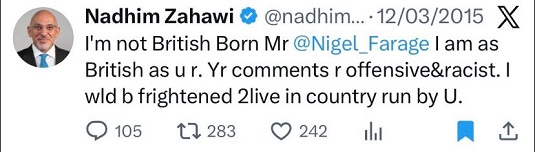
So frightened was Nadhim Zahawi, that 11 years on he shook Nigel Farage's hand and joined Reform. For Farage, bagging another (former) leading Tory is always a coup. It attracts favourable coverage in the right wing press, encourages more ex-MPs who'd like to have another crack at Westminster to think Reform is the better bet, and for everyone else it confers the impression that the momentum is still with them. The only time Nigel is likely to say no to a petitioning defector is if they're a big personality/loose cannon. Which is why the door remains firmly shut on Suella Braverman.

Zahawi though. He's always been a bit of a no mark. Serving for two whole months as the chancellor, he distinguished himself there for calling on Boris Johnson to go without resigning. And later he got sacked by Rishi Sunak for dodging tax while threatening to sue journalists for defamation. A pity it never went to court as the self-inflicted humiliation would have been delicious. Anyway, for a man even Keir Starmer mocked as a lightweight, the reasons for throwing in with Reform are predictably vacuous. The country needs a "glorious revolution" we're told, we're reeling under an avalanche of illegal immigration, and the Tories are likely to cease trading as a national party before long. One wonders when he reached these conclusions. Was it before or after Kemi Badenoch rejected him for a peerage?

Looking at the list of notable Tory-Reform switchers, they all have something of the second-rate about them. Nadine Dorries, Jonathan Gullis, Jake Berry, Danny Kruger, Andrea Jenkyns, all at best were side characters in the Tory dramas of recent years. Despite strenuous efforts at courting notoriety or having public tantrums. Legends in their own lunch times they undoubtedly were, but they are anonymous to the public at large. And Zahawi fits right in, a non-presence who'll be a stranger to most Reform members, let alone its more disengaged support. Which begs the question, does Farage actually benefit from providing a bolt hole for Tory mediocrities and failed politicians?

A lot of it depends on who's doing the pointing out. From a Labour Party perspective, the numbers show that Reform's claim on its 2024 voters is scanty indeed. For this marginal group of voters, highlighting how Tory faces from Boris Johnson's tenure are popping up in Farage's supposedly anti-Tory party might be supposed to be a killer argument. If Labour hadn't kicked off its first year in office with attacks on elderly people while unapologetically helping themselves to the spoils of office. For this layer, their perception of little difference between the Tories and Labour in power is unlikely to dissuade them from giving Farage "a chance", even if his party is fit to bursting with Tory turncoats. If the Liberal Democrats and Greens are going to talk about it, then perhaps they can stymie that small proportion of Labour's vote tending to the right, but it will be they who benefit from residual anti-Tory feeling attaching to Reform, not Labour.

But could the wave of Tory defections put off Reform's existing supporters? It's doubtful. The lack of big personalities, competence, or shred of intelligence between them means no one is about to upset the Nigel show. If a new arrival was to get into a pickle, like problems with taxes, too-strong racism, or a good old Tory sex scandal, it won't be a problem for Farage to shrug it off. Or them, if necessary. Charges of school boy racism, dodgy funding for his home, collusion with Russia, and buddying up with Trump haven't unduly damaged him. So difficulties involving next-to-invisible trophy minions won't either. He knows this, and so more defections are likely to come. And more of them will get nodded through.

Wednesday, 19 November 2025

The Uses of Farage's Schoolboy Racism

Have you seen the latest revelations about Nigel Farage? Brace yourselves. He was, apparently, a bit racist at school. According to an expose from The Graun, while a day boy at Dulwich he made no secret of his admiration for Adolf Hitler, happily capered about with antisemitic banter, to the point of making up a ditty called "Gas 'em all", and put at least one pupil on detention for having the wrong skin colour. What a charmer.

None of these allegations are new, having first surfaced in 2013 when teachers' letters at Dulwich came to light. One of them observing that Farage was "a fascist, but that was no reason why he would not make a good prefect." A flailing Keir Starmer happily seized on them at Prime Minister's Questions. "These are disturbing allegations and it is vital that Nigel Farage urgently explains himself", said the chief presser to the lobby hack huddle afterwards. Does it really matter what the Reform leader said while he was a kid almost 50 years ago? For Starmer and his team, as a recent convert to calling racism racism, they're hoping the label will stick. And if it does, it could cause the softer edges of Farage's coalition to think twice. Something that might have a stronger chance of working if the messenger bearing these attacks was held in higher regard.

However, the real political tell comes in the criticism of Farage. Or rather, its focus. Obviously, there's a link between racist young Farage and 61-year-old Farage who's done very well out of spouting anti-immigration drivel. His campaign was pivotal for helping Leave get over the referendum line in 2016. But dwelling on the past alibis the present. Starmer can't attack Farage now as a racist as, quite deliberately, Labour's attacks on refugees leapfrog Reform. Neither can Kemi Badenoch's Tories, who've also dabbled in overt racism - not that anyone cares enough to notice. The idea is to use whatever the press can dredge up about Farage, and then pin the racist label on him in a manner akin to the Anti-Nazi League's/Unite Against Fascism campaigning against the BNP in the 00s. And this, they hope, deflects from Labour's own scapegoating, its own racism, its own moral depravity. In other words, another cynical ploy unlikely to stymie Reform's support while doing nothing to rebuild Labour's own.

Image Credit