Showing posts with label NHS. Show all posts

Saturday, 15 March 2025

Labour's Enthusiasm for Artificial Intelligence

30,000 jobs are set to disappear with the closure of NHS England and its merging with the Department of Health and Social Care. Echoing the Tories, tens of thousands of civil service jobs are on the chopping block. And this planned massacre of livelihoods were presided over by a grinning Keir Starmer and Wes Streeting and presented to the media as unalloyed goods. This is set to cut down on duplication and save lots of money (£45bn, apparently). But something else is also on the cards: the replacement of jobs by Artificial Intelligence. In his enthusiasm at the prospects of jobless service provision, Starmer gushed that "No person’s time should be spent on a task where digital or AI can do it better, quicker and to the same high quality and standard."

This is the umpteenth speech in which the Labour leadership have espoused their enthusiasm for AI. For Starmer and his project of authoritarian modernisation, the technocratic attractions are obvious. A state that is neither bigger or smaller but works better is enticing, particularly when previous attempts at digitisation have been hit by delays and costly failures. Those long in the tooth will recall efforts at harmonising the NHS's IT systems, and the huge problems rolling out Universal Credit encountered. But the prize is the speeding up of the state's mundane activities, like answering HMRC inquiries and sorting out driving licences quickly. AI is part of Starmerism's answer to the crisis of government legitimacy. If the bureaucracy can be automated and the discharge of its functions be made as rapid as placing and receiving an Amazon order, belief in the efficacy of government and, possibly, the standing of politics could improve - to Labour's benefit. If only people could forget about winter fuel cuts.

Those are the good reasons. What are the real reasons? The PCS response argues that new innovations should be introduced and embedded in cooperation with staff and be used to enhance working conditions and job security. A position likely to have gone in one ear and out the other. This is because AI's promise speaks to the dominant pole of (right wing) Labourism: its relation to "working people" not as working people, but something far more passive and politically innocuous: as consumers. The ultimate aim is impeccably Blairite: the depoliticisation of politics, and the reduction of choice between the parties that offer the best value, best quality services. This alignment with Labourist assumptions is more a coincidence of congruence. As ever, it comes down to interests.

On plenty of occasions, Starmer has staked out his intention to transform the UK into an AI superpower. This does involve infrastructure like building the first reservoir for 30 years, which handily is earmarked for land not far from the planned expansion of data centres in Cambridgeshire. But more importantly, he's leveraging the state as the anchor customer for AI services and innovation. There is nothing particularly innovative about this. In the Blair years outsourcing, Public-Private Partnerships, PFIs, etc. were used to provide guaranteed markets for everything from cleaning companies to construction firms. The aspiration was to tie the interests of those firms to the largesse of New Labour ministers, thereby expanding the party's base among capital's exalted circles. When the crash came and Gordon Brown's government became a busted flush, they were happy to carry on accepting these sorts of contracts while transferring their allegiance to the incoming Conservatives - who continued with the same practice. Streeting's love-ins with far right tech oligarch Peter Thiel, the enthusiasm for using AI in patient-facing interactions, and the endless promises of using the private sector to "help" with the NHS are part of the same piece. This is the mood music designed to entice Silicon Valley and giving them a stake in the British state, while generating a home grown ecology of expertise around innovation and application. Something that could have the happy by-product down the line of sheltering the UK from Trump's tariffs, and making Labour - on paper, the political antipode to their brand of freakish authoritarianism - their preferred political partner this side of the Atlantic.

Everyone wins, right? No. Supposing AI can fulfill the grandiose claims made for it, the British state is being used as a test bed for, to borrow a recent phrase, feeding jobs into the wood chipper. The purpose of generative AI is not to make things more efficient, but to deskill and digitise as many of the properties of immaterial labour that are feasible. I.e. The social competencies that capital accumulation increasingly depends on can, after a fashion, now be separated from workers and therefore tip the balance of forces further away from labour. To all intents and purposes, as per previous waves of automation what the government are promoting is a power grab at capital's behest. If these schemes are successful, the next targets are millions of jobs across private industry for the benefit of shareholders. And Labour ministers who fancy themselves as future consultants on implementing AI "solutions" in large organisations when they're done with politics. Just like the Thatcher years, Britain could pioneer a new class settlement. And just like the 1980s, unless the left and the labour movement gets its act together it will be our class who loses.

Image Credit

Sunday, 17 November 2024

Hacking the State

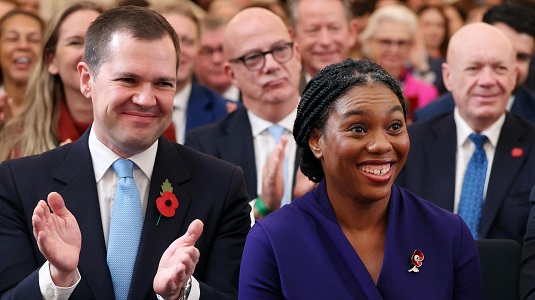
Writing in the Sunday Times, Kemi Badenoch has set out her vision of what government would look like if she becomes Prime Minister. The principles, which she calls "reprogramming the state" could be more accurately described as hacking it. Into smaller and smaller pieces.

In her argument, Badenoch does not attack the people who work for the state. Her target is bureaucratic process. Drawing on her time as business secretary, she says the inability to pay out compensation to the victims of the sub postmasters Horizons debacle in a timely fashion was symptomatic of the problems afflicting the state. Every decision has to be backed by x number of reviews, y gaggles of consultations, and z quantities of impact assessments. Attempts to abbreviate the process would find ministerial decisions subject to court challenge and, therefore, more delay. The risk averse culture afflicting the civil service, she concludes, is not a case of the mindset of staff but their experience of having to satisfy all the reporting requirements. These, Badenoch acknowledges, might have grown out of sensible concerns for accountability and transparency but in practice they only lengthen administrative processes and make them more opaque. The more laws that are passed, the more the state grows, the more the prospect of litigation enlarges, and with it the risk averse culture. A perfect doom loop.

If this is her problem ("I made this diagnosis the central plank of my campaign to become leader"), the solution is reprogramming the state. Government must stop rewarding managerialism among ministers, and every level of the state needs looking at afresh - but "box ticking" and "judicial review" must be avoided if the problem is to go away. In all likelihood improving "accountability", Badenoch style, will be the subject of suggestions churned out by the Tufton Street think tank complex. As well as the churn from Elon Musk's anticipated evisceration of the federal state in the US.

There are a few things of interest here. Or rather, interesting absences. If this is the culture of the state and it's so irksome, the Tories had 14 years to change it so why didn't they? Was it a symptom of talking conservative but governing left? Well, no. There were plenty of changes to governance over that period of time, and all of them embedded the Thatcherite settlement further. I.e. The counter revolution that started under her and was consolidated in the Major and the New Labour years, which saw bits of the state sold off, or forced into debt relationships with private finance, or forced to "compete" in internally constituted "markets" with one another. This was consolidated under the Tory/Liberal Democrat coalition. To put it another way, the proliferation of performance indicators, targets, "market intelligence", and the requisite legal expertise to go alongside them increased the amount of administrative work required. Neoliberalism is the bureaucrat's friend. But this was in the context in which the coalition government slashed at the state. Form filling multiplied as form fillers were laid off. More work was demanded from a shrinking workforce, and so the system was prone to seizing up. This is the first "inefficiency" Badenoch "forgot" to mention in her article.

The paradigm of this consolidation of neoliberal governance was the vandalism committed against the NHS during the first term of the Tories' long stint in office. Effectively, Andrew Lansley abolished the NHS as was and replaced it with a market, underwritten by state money, in which NHS organisations and "any willing provider" competed for contracts handed out by the hundreds of fund-holding Clinical Commissioning Groups. This meant huge sums diverted from health care to the maintenance of a wasteful and needless internal market, and rampant profiteering as private health concerns won contracts and subcontracted them to NHS organisations, creaming off layers of profit in the process. This was supposed to run autonomously of government and, formally, responsibility for the NHS no longer lay with the health secretary. As it happened, increasingly CCGs and NHS trusts found ways around the market and established cooperative relationships contrary to the designs of the legislation. With the immediate first wave of Covid out the way, the Tories belatedly discovered this and returned sweeping powers to the health secretary - then Matt Hancock - with unprecedented range to intervene and micromanage. The kind of model Badenoch seems to be hinting at. I.e. Ministerial direction unchecked by established procedures and remits to enhance accountability. And how has the NHS looked since this innovation was introduced? Yet another slice of pertinent recent experience from government the leader of the opposition chose not to dwell upon.

Lastly, completely by coincidence her "reprogramming" of the state is consistent with Tory efforts to wind down its capacity to do things. It bears comparison that Badenoch's view is a reskinned version of Jacob Rees-Mogg's planned civil service cull. In short, the state has not failed because of a magic theory of bureaucracy. It has virtually collapsed because under the Tories this was the policy objective. It has been starved of resources, saddled with extra responsibilities, and forced into a governance strait jacket that could only produce sub-optimal outcomes. And Badenoch's answer is to make this crisis of capacity the desired goal of the next Tory government. Her big idea is the regurgitated pap of the recent past, a programme and an agenda that saw the Tories crash to their heaviest ever defeat.

Image Credit

Sunday, 20 October 2024

On Wes Streeting's Weight Loss Injections

It sounds like a scenario straight out of Black Mirror. Unemployed people who are overweight are forcibly subjected to injections that will shed the pounds so they can get off the dole and make them. Unsurprisingly, Wes Streeting has been forced to deny this is the objective of his weight loss scheme that has exercised headline writers this week. On Sunday's Laura Kuenssberg, Streeting said no one was going to be forced to do anything. Instead, he was defending a five-year trial involving a sample of 3,000 people living in and around Greater Manchester. Participants will receive the weight loss drug Tirzepatide, and researchers will track the rates of obesity-associated conditions and the number of sick days they take. The impact on their employment status is but one measurement the project will be taking.

For once, Streeting is telling the truth. This is not an experiment in dystopic social engineering. The trial's plan wants to find out what care packages are most appropriate to those who receive this treatment, as well as tracking the drug's long-term effects. If it works as advertised then it could be beneficial and life-changing, and will have knock on effects where obesity-related NHS care is concerned. In other words, what concerns is less the trial and more the political uses to which this could be put.

For Streeting, there are obvious political benefits. Cutting the £11bn spent on obesity care by making it increasingly superfluous has its attractions. As he said, he hopes the success will speak for itself and encourage others who need it to take the drug, which ties nicely in with his vision of the NHS as a preventative as opposed to a care service. A couple of wins that will finesse his credibility when the inevitable run at the leadership comes. And there is the other side, of making the NHS a guaranteed market for Tirzepatide and other weight loss drugs. But more importantly, as a tool of governance. For Streeting, the Department of Health is really an economic growth department. He talked about this in relation to boosting the life sciences at his Tony Blair Institute speech a week after taking office, but the obvious implication is that he sees his brief as fixing people so they can be fed back into the labour market. This government's number one priority, heard ad nauseum, is growing the economy so decent public services can be provided for. Everything else is subordinate to the aim of our producing profits for other people.

But it's wider than that. Streeting has jumped on this in the same week Liz Kendall said job coaches would be let loose on the mentally unwell to get them out of clinics and into jobs. She argued that getting into work can improve mental health, which is something that Iain Duncan Smith used to often say when challenged about the axe he took to social security. In context, for Streeting, Kendall, and the rest of them, upping the conditionalities of social security and reducing welfare to an authoritarian instrument comes naturally to them. They (mostly) come from modest backgrounds and made it to the top, so why can't anyone else? Hence unemployment is a consequence of individual poor choices or, in this case, infirmities. Get them fixed and the benefits bill can come down. Never mind the fact unemployment is a structural issue and that the people out of work always exceeds the number of vacancies. Whether they're dealing with obesity or mental health difficulties, the onus is on them to sort themselves out and be available to employers. If they don't cooperate? There are sanctions available for that.

There are differences between Labour and their Conservative opponents. Keir Starmer wants to modernise the state. The Tories want to wind it down. But when it comes to the fundamentals of supporting the most vulnerable in Britain (or otherwise), they are one. Compassion and care are words in a dictionary to these people. But there's another C word that comes through loud and clear: cruelty.

Image Credit

Friday, 2 August 2024

Robert Jenrick's Missing X-Factor

I suppose someone on the left has to keep tabs on the Tory leadership contest. This afternoon Robert Jenrick took to the stage to launch his bid for the top job. And ... he wasn't very impressive. There is definitely something of the right about Jenrick, but his delivery is as dead eyed and clod-footed as anyone from the New Labour school of media training. And, most importantly for the defeated Tories, he hasn't a Scooby.

Because this is a Tory leadership contest, Jenrick was at least aware he wasn't addressing the country. With a crowded field, he's hoping a pitch to the membership will build a groundswell of Association-level pressure on enough MPs to get him into the final four in September, and then the last two for the party-wide ballot. As such, Jenrick's effusing of "hard working activists" and all the rest was almost embarrassing. But what might have made the Tories' diminishing support pick up its ears was his defence of members having the final say over who gets to be leader, and for good measure he said selections should be their preserve as well. Somewhat optimistically, he said the Tories can be a mass membership organisation and, because the Tories won among young people in 2010 (not 18-24s, by the way) they can again.

Official optimism bordering on the delusional, considering what's just happened. But it's okay, because Jenrick has some "hard truths" the party must learn. He said two thirds of Tory MPs lost their seats through "no fault of their own". Poor lambs. They did because, despite having an excellent record in government, the Tories didn't keep its promises. There might be a universe where those two points marry up, but it's not this one. The main reason for the defeat was that most faithful of right wing friends; not controlling immigration and failing to secure the borders. That's not the whole story, according to Jackanory Jenrick. They did not build a strong and resilient economy, and they never got to grips with the NHS. What's happened to the economy had absolutely nothing to do with them, but the NHS did. Jenrick argued that too much of the British state isn't working. It's riddled with waste and inefficiencies. Poor management is its hallmark, and it needlessly soaks up never ending amounts of money. This malaise causes the problems with the NHS (front line staff are "lions" led by "back office donkeys"), but tackling it was too hard. So it was ducked.

Jenrick has a cheek. It was Rishi Sunak who led opposition to Boris Johnson's luke warm efforts at addressing the country's long-term structural problems. And wherever his penny pinching touch went, departmental budgets were pared down, infrastructure projects scrapped, public sector wages forced below inflation, and a stated intention to reduce the capability of the state to do things further. This wasn't dogma or "ideology", though it's often dressed up in those terms. It was a class conscious effort to curb raised political expectations after Corbynism, Covid, and Johnson's pie-in-the-sky promises. Defund the state, preside over its decay, and erode popular perceptions of its efficacy. Labour are attempting a different approach that involves enhancing the reputation of the state and rebuilding its capacity, but Jenrick wants to take it a step further. He's blaming the state itself for what his party have done to it, and the medicine he's prescribing is more of the same. The "British system isn't working for the British people" is the logical consequence of Tory design. His party is responsible for the shambles.

There were a few swipes at Labour (dishonest for raising taxes) and, weirdly, the "far left" (anti-British!). But while both offer something different, depending on one's political tastes, like a true conservative Jenrick's solutions are the same old same old. People and parliament should be sovereign (no ECHR), fast track deportations, immigration in the tens of thousands "or lower", build more nuclear, more money for the army, cut welfare, a small state "that works". I guess you'd have to be a Tory member to find this exciting.

But there are two problems. The long term issue is none of this is appropriate to the situation the Tories have bequeathed their successors. The audience for reheated Thatcherism is literally dying, are not being replaced like for like, and even those who might move into opposition against the new government aren't likely to turn to the Tories because of that inconvenient thing called memory. But more immediately, how does this differentiate Jenrick from his competitors? As we will see when other candidates are profiled here, you'll be hard pressed to find substantive differences between them. Whether they are from the identikit right, like Jenrick, or the briefcase/sensible "centre". What has Jenrick got that Badenoch and Patel haven't? Likewise how does he present as a more capable "safe pair of hands" unifier than Cleverly? It's a mystery to me, and I expect the Tory membership will have a hard time differentiating him as well.

Image Credit

Sunday, 19 May 2024

What a Card

In the not-at-all-expected announcement that he was throwing his hat in the ring for Islington North, Paul Mason said something that rings true about the state of British politics. He argued the incoming Labour government has one chance to restore popular support in British politics by delivering on its programme. A point that was also echoed by Andrew Marr and has become an occasion for fretting among Keir Starmer's base in the state and among professional/managerial layers. On the one hand, Starmer expends a lot of energy about how things are going to change, but actual promises to do anything are thin on the ground. Labour is producing a set of contradictory vibes, with the result that expectations of what a Starmer government will do are south of rock bottom.

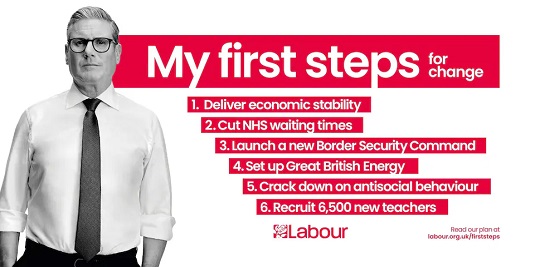
But there is an answer! The very clever strategy people in the leader's office were able to hog political coverage going into the weekend with a Blairite retread: the pledge card. As my wallet is a strange attractor for all the loyalty cards and bits of ID, I happen to have my 1997 original. Comes in handy for infiltrating Labour To Win meetings. These pledges were designed as quick policy wins to show Blair and Brown meant business. There was the punishment of the privatised utilities with the windfall tax. But New Labour meant changed Labour, so we also had "fast-track punishment for persistent young offenders" and "set tough rules for government spending and borrowing".

Starmer's leadership has never pretended originality, and so the resemblance between the 1997 and 2024 cards are more than coincidental. Our new fangled version, with its 'cut NHS waiting times' and 'crack down on anti-social behaviour' are straightforward lifts. The mix of the Milquetoast progressive with the authoritarian and the reactionary continues with 'set up Great British Energy' (which is always mis-sold as a publicly-owned company, when in fact it's a Blairesque Public Private Partnership investment vehicle), and 'Launch a new Border Security Command'. I wonder how many Tory-voting focus groups that went through. And, top and tail, 'economic stability' and 'recruit 6,500 new teachers'. How the leadership managed something less inspiring than Blair's 'New Life for Britain' is a real achievement.

Despite the obvious resemblances the real inspiration for these six pledges is ... Rishi Sunak. At the beginning of 2023, he set out his five promises for government. In case you have forgot, these were halve inflation, grow the economy, get the national debt falling, reduce NHS waiting lists, and stop the boats. An incredibly low effort list of priorities that barely required Sunak to do anything. Taking on board the then economic outlook, falling inflation, GDP growth, and keep tight rein on public spending so debt could fall (as a proportion of GDP) were easy because they would happen spontaneously. NHS waiting lists were a bit of a hostage to fortune, because no Tory government has exited office with waiting times lower than the one it inherited. Sunak might have met this pledge had he decided not to underfund it. And stopping the boats was pure amateurism in the sense he signed himself up to something he couldn't deliver. Hence the grim theatrics of the Rwanda scheme.

Because big brains are in charge of Labour, nothing has been left to chance. Border Security Command, Great British Energy, and anti-social behaviour policies can be brought into being at a stroke of a pen. Economic stability is also relatively easy seeing as Rachel Reeves, when she's not busy plagiarising other people's work, has no ideas of her own and will leave the regulatory frameworks intact and won't haphazardly chop and change the rules like the Tories do. NHS waiting lists are likely to start coming down at the point Labour enters government just as we're over the worst of the seasonal hospital admissions - and this before Wes Streeting's plan to use imaginary spare private capacity. And lastly, 6,500 new teachers works out at increasing recruitment by about 1%. Starmer's government would have to be spectacularly incompetent to not meet any of these aims.

The new pledge card is not the programme for the incoming government, and should not be judged as such. But by setting a low bar in what the Labour leadership takes to be the public imaginary, they can easily exceed their own expectations. On teachers and teaching, where the big challenge is the triple threat of underfunding, workload, and retention, anything on top of the extra teachers' pledge tick the under-promising and over-delivering box. On GBE and BFC, setting them up and branding them provides an illusion of forward motion. And on it goes. Starmer will be able to say his project of authoritarian modernisation, or mission-driven government as he styles it, is well underway.

The problem with this is the assumption the public aren't paying attention and can't smell bullshit. Just as talking about hope a lot does not call it out of the ether, most people won't notice a Labour government unless it materially improves people's lives and is experienced as such. Being able to get doctors' and dentists' appointments, seeing wages consistently rise faster than prices, experiencing the green transition in the form of lower energy bills, these are ways Labour could and should make a difference. And Starmer would be rewarded for enabling this with more future general election victories. But the actual chances for that are very slim. Why? Because of the alliances he's actively pursued with the right aligns him and his project with the interests arrayed against the people - the overwhelming majority - who would benefit a progressive prospectus.

Thursday, 11 April 2024

Wes Streeting and Ideology

Whenever Wes Streeting is in the news, it's usually because he's dumping on the NHS. Having said on several occasions that he wants more private sector involvement in the health service, he's reiterated this most unwavering of convictions in a piece for The Sun. His ire, as always, is firmly aimed at the left as he attacks us with a vehemence that never manifests versus the Tories. He wrote that "Middle-class lefties cry ‘betrayal’. The real betrayal is the two-tier system that sees people like them treated faster – while working families like mine are left waiting for longer.” What these people care about is not a better service or improved outcomes. Using private provision to get the NHS backlog down is common sense and is in the interests of "working people". Salt-of-the-earth types, like Sun readers, should not pay for the left's "ideology".

There's no point treating Streeting like a good faith actor. You can show him all the data in the world about how private health care undermines the NHS, drains resources, ponces off the skills paid for by the public purse, and is no better in quality or outcome beyond jumping the queue. You can also tell him until you're blue in the face that there is no spare capacity in private health, or that the idea waiting lists can be run down in double quick time is completely mistaken. He does not care. Streeting's job is to create more marketised opportunities for capital underwritten, as always, by state money. No argument is going to force him from this goal. He is not mistaken, he is determined.

What interests here is Streeting's use of 'ideology'. We regularly see it used in politics to refer to the more "exotic" elements of the Conservative Party. I.e. The Tories persist in cutting social security or peddling racist drivel because of their ideology. For reasons that are never explored, they are blind to the realities that intrude upon their dogmas. It therefore shows them to be irrational and therefore unfit for office. Or, if you like, fundamentally honest but completely clueless. It is, of course, nonsense. Persisting in the view that the Tories are driven by the wrong ideas gets them off the hook. It suggests that politics is a marketplace of ideas, and not what it really is: a battleground for interests.

Streeting's deployment of ideology has a different target, but is contrived to have the same effect. I.e. The opponents of his eminently sensible desire to let private health gorge itself at the NHS trough are zealots driven by inflexible principles and dogma. It denies the actual grounds of the left's criticisms of Streeting, one rooted in anticipation of the real world consequences of the policy he wants to ram through. He's taking the "what works" moral high ground, masking the interests he's very keen to serve at the expense of our class interests in a free, comprehensive, and non-commodified health service unbeholden to profit making and profit taking. Here, pretending his critics are opposed to him because of funny ideas denies the material stakes we have in the health service, as well as the rewards he and his backers can look forward to should they get their way. It's the game of depoliticising politics so the imperatives of capital are unquestioned and, presumably, the coming government shielded from political blowback. Because such efforts did John Major, Gordon Brown, and now Rishi Sunak so many favours.

Image Credit

Monday, 4 September 2023

Making the Counter-Revolution Permanent

A reshuffle plays to the absolute worst of political punditry. As if armed with a fantasy football score card, commentators delight in promotions and revel in demotions. Faces of old having spent eternities on the back benches are welcomed back, while gasps and shocks surround unexpected removals and resignations. And that's about the size of it. Which demonstrates the paucity of the lobby hacks who steal a living from writing on politics in this country. For Keir Starmer, as it is for Rishi Sunak, any other party leader, and every single council leader the cabinet is always about balances of power. A leader has to weigh their preferences and strategic direction against the strengths of the different wings of the party, and usually dishes out positions to the extent factional buy-in is secured. This basic truism was lost on Liz Truss, but not on Sunak who has locked in the right from the beginning.

Starmer might be (and in many ways, still is) limited about politics, but certainly not on this point. After the leadership contest his first shadow cabinet ranged across the entirety of the party. The soft left were the big winners while continuity Corbynism was given a few scraps. Very quickly, a pretext was found to get rid of the troublesome Rebecca Long-Bailey from Education and shifts right ensured her more junior colleagues resigned themselves away. When they were done, the soft left were evacuated from the Chancellery and Home Office shadows and in were drafted the horrors of Rachel Reeves and Yvette Cooper. Hilariously, Starmer tried removing Angela Rayner and was almost badly damaged when he found he could not. Yet , despite coming out of that episode strengthened, that has since been sapped by incessant anonymous briefings and her being powerless to get allies and supporters selected. That she couldn't save her significant other from the deselection axe shows how narrow her writ runs. Now, Starmer has moved to make his counter-revolution permanent. Blairites and Brownites dominate the shadow cabinet, and the soft left are relegated to a supporting role. In other words, Starmer feels the balance has shifted so far his way he doesn't have to bother with the big tent pretensions any more.

Still, it seems short sighted and unnecessary. His reshuffle demoted Lisa Nandy to shadow the non-existent international development portfolio, and in accepting it proves she's willing to eat any shit to remain, in her words, a "team player". It must be doubly galling to be junior to the foreign office brief she previously enjoyed, and especially having her loyalty rewarded with a bump down the ranks. Unlike nearly everyone else at the top table, Nandy can be a skilled performer when she dumps the dead-eyed wooden-top countenances mandated by front bencher media training. And she does have her own base, of sorts. You might recall that Nandy is commonly seen as being on the soft left - though she's done nothing to merit this positioning. And during the 2020 leadership contest, after Jess Phillips dropped out Nandy became the favoured candidate of the PLP right (Labour First weren't so stupid and constituted Starmer's back office from day one). Though she didn't win she showed a certain amount of across-the-party appeal - enough to be talked about as a future leader when a Starmer premiership hits the buffers. In a shadow cabinet of non-personalities, Nandy was at an advantage. She had to go.

The most serious miscalculation has been the ditching of Rosena Allin-Khan. In her resignation letter addressed to Starmer, she said "you made clear that you do not see a space for a mental health portfolio in a Labour cabinet." As such, she would not serve in any other role if that position - whose introduction saw Jeremy Corbyn receive a rare moment of universal praise - was scrapped. And so back to the backbenches she goes. The politics of her removal aren't too difficult to fathom, even if you don't have a line on the gossip about shadow cabinet meetings. As a still serving A&E doctor, she has been an annoying presence in leadership meetings raising awkward questions about the role for business in the NHS. There is also a school of thought that she's too close to striking NHS workers. Her presence in cabinet might lead to conflicts of interest and her being seen as the BMA's woman on the inside. And lastly, her A&E work confers an authenticity virtually all her colleagues lack. Within government, she might have been seen as an embodiment of the NHS and its values, giving her a popular legitimacy independent of whatever position was doled out by Starmer, and with that a potential platform for a challenge. After all, Starmer has known for a year that she covets his job. Better neck the paracetamol of removal now than risking a splitting headache later.

While not on the left of the party, Allin-Khan is obviously a coming power. By giving her no choice but to leave, she's now free to build up support in the Commons and in the country before and during the early days of the government. She has a justified grievance, and through her work on mental health has proven more in tune with medical need and popular expectations than her erstwhile boss. The second, more serious problem, is how Starmer has added to the problem of his divided base. Whether he doesn't understand who supports him and why, or simply doesn't care because polls and elections keep pointing to a thumping majority, the effect is the same. Among the professional managerial class there are serious jitters about Starmer's leadership. That the more he talks about authoritarian modernisation, the less it resembles a programme of renewal. The prevaricating over fixing crumbling schools is a case in point. That makes some susceptible to lend their affections and their votes to other parties that diagnose the problem and have their own programmes of modernisation, threatening to fragment Labour's base. And others, without any real choice, will be compelled to confront a Starmer government just as they have done the Tories. Who knows where that might all end up.

While the resemblance between Starmer's programme and the Tories are often overstated, he has already taken on their bad governing habits: to their shared authoritarianism, you can now add the propensity to short-termism. Whether Allin-Khan and, to a lesser extent, Nandy will enact some sort of revenge down the line is neither here nor there, it's the alienation of the constituencies in and out of the party that they represent that are going to do for Starmer if he persists with his do-nothing politics.

Image Credit

Wednesday, 5 July 2023

Tony Blair Vs the NHS

It's the 75th birthday of the NHS, so what better time for another rare intervention from Tony Blair. This morning his institute published a paper about the future of the NHS. In line with current Labour thinking that what public services need is reform, not funds (which, in turn, are informed by Tony Blair Thought of two decades ago), the report offers a number of technical and seemingly technical fixes to improve the health service. But the overall thrust is clear: bureaucratic centralisation is the chief opponent of efficient delivery, not lack of cash.

It shouldn't need saying that this corner of the internet rarely receives Blair's missives with open arms, but it would be churlish to file the report in the desktop recycling bin just because of its provenance. The report, authored by a health policy wonk and an academic, does make some good points. Yes, there does need to be an injection of capital so the NHS can fully utilise new technologies. Who would be against that? The report says this can be utilised to cut waste and introduce less labour intensive treatment. There should be local autonomy for what are termed 'integrated care systems' to treat and improve health outcomes in their areas, backed by the stability of multi-year budgets and incentives to innovate - which include keeping and reinvesting any savings made. A digitised 'Personal Health Account' - a souped-up NHS app enabling access to services and putting patients in charge of their own health data, which can be linked to secondary apps and wearable technology, would revolutionise and personalise our relationship to the NHS. Rolling health services out from GP surgeries and hospitals, which would reduce demand on those services through an expansion of provision is another floated suggestion. And making more use of personal-use genomic medicines, making sequencing available on a mass scale and integrating genetic susceptibilities it into one's personal data is another ambitious goal. If we absent social relationships for a moment, this is what a 21st century health service should look like.

But social relations aren't about to go away, and how the report frames this technologically enabled vision raises a lot of political questions. Firstly, the report says it wants to move the NHS away from a patch-them-up-and-let-them-go model of treatment to one more reflective of complex health needs. This is nothing new. In fact, the first NHS reorganisation in the mid-1970s was premised exactly on these terms. Of moving from treating disease to addressing the long-term health problems of a population that was living longer. Indeed, that is the main business of the NHS today. Therefore, the report's argument that we "must move from a health-care model set up to treat episodic sickness to one that prioritises continuously improving individual and population health" is an extension of what the NHS already does in part to the whole. A useful straw man if you want to exaggerate the case for reform though.

Then there are the rocket boosters these proposals have put under the so-called patient choice agenda. This is not an innocent idea of simply allowing patients more choice in their treatment, but was under Thatcher, Major, and Blair designed to introduce and bed down marketised relationships between different parts of the NHS. In the New Labour years, the idea was to allow patients complete choice of where they were treated. NHS organisations would compete with each other for patients, allegedly driving up standards and increasing efficiency. This was swept away by the Tories in 2012 for thoroughgoing marketisation, semi-privatisation, and outright scamming in which "any willing provider" was in with a shout of scooping up NHS money. What happened over Covid procurement and the missing billions was this writ large. The Blair Institute are proposing is something a bit more subtle. Through the use of personal health technologies, they want to bed down principles of individual responsibility for health - which can be monitored via the app. This builds on the individualist (and individuating) thrust of public health strategies in the Blair years, and one that attempts to evacuate politics from health altogether. I.e. You have the power to choose healthy outcomes informed by constantly updated metrics, and therefore what happens to you is (largely) in your hands. It's consistent with the modes of governance Blair enforced across the public sector, and one that proved (politically) effective quite recently. If you get ill, it's going to either be a case of 'pathogenic life factors' or bad luck. Never air quality, food quality, environmental despoliation, unhealthy work practices.

And then we have the private provider argument, because of course we do. There's the useless argument about "spare capacity" in private health that gets mentioned every five minutes by Wes Streeting. As an aside, Streeting often defends this saying he wants the NHS to get to the place where it can out-compete the private sector. Yeah, right. I'm sure the private health interests funding his operation do so because they want to be put out of business. The Blair Institute goes there, but they flag up more opportunities for private sector involvement. Remember the localised integrated care systems? "Freedom" of ICS chiefs would inevitably mean contracting in for-profit providers to meet targets, just as they did 20 years ago. Indeed, these organisations should "empower" patients to make "informed choices" about choosing between GPs and "secondary providers". On the dispersal of health services, the report is explicit that "high-volume, low complexity" services should routinely be hived off to "multiple providers". Again, it's all about patient choice. The patient data revolution the report envisages allows for more public private partnerships, and larger market for data add-ons to the key NHS app as well as "innovation". Undoubtedly encouraged by a generous system of state grants and inducements.

This, again, carries on where Blair left off in 2007. While there were plenty of New Labour true believers in marketised policies as drivers of best outcomes (the Tories, despite their well earned 'stupid party' monicker, are never daft enough to really believe this twaddle), the politics of this made sense because NHS outsourcing, PPPs, and Private Finance Initiatives tied - at least for a while - sections of British capital to what you might call the Blair Rich Project. By pouring state money into private pockets, this was one means by which New Labour was able to cultivate patronage and crony networks that helped ensure, for a brief window, that it was the favoured party of (most of) capital. It's entirely a matter of coincidence that ex-health ministers and certain MPs later enjoyed handsome consultancies and board positions advising private health and outsourcing giants. It didn't last, and when Labour was dumped out of office the Tories ramped up the openings through the total marketisation of the NHS. Here, the Blair Institute's programme for change is more than just about the future of the NHS. It is directly advising the incoming Labour government about how to use NHS reform to win over a section of British business, with the obvious consequence of diluting the popular pressures that will bear down on the party after such a long period of Tory rule.

Image Credit

Monday, 22 May 2023

Patients and Profits

In his famous address to the Albanian people, Enver Hoxha said "This year will be harder than last year. However, it will be easier than next year." Stirring words and ones Keir Starmer might have quoted while discussing the recurring winter crises in his much-trailed NHS speech earlier on Monday. As health is one of his "five missions", what was said here is almost guaranteed to go into Labour's next manifesto.

Starmer spoke about the scourge of health inequalities and the reversal of life expectancy under the Tories. He identified the "three big killers" and what Labour wants to do about them: reduce cardiovascular disease by a quarter, diagnose 75% of cancers while they're still stage one, and drive down the incidence of suicide among younger people. Also repeated was what he called the biggest expansion of NHS training in the organisation's history, funded by the removal of the non dom tax status. And the latest idea got an airing: the sharing of waiting lists so patients could opt to be treated at hospitals with shorter waiting lists. This would be underpinned by a more collaborative culture across the NHS, which was coming into being before Matt Hancock kyboshed it. This might help manage he backlog crisis around the edges, but is hardly a major policy announcement.

Indeed, that was not the point of the speech. Starmer wanted to hammer home the message that what the NHS needs more than money is reform. He identified the "three shifts" that would structure the remodelling of the NHS. The first would be moving care out of hospitals and into the community. What he called the 'neighbourhood health service'. This would entail improving GP access and make it more sustainable. This means moving away from the practice model and its gradual replacement by salaried GPs who would be deployed to serve all communities. In other words, a possible end to the GP shortages that particularly afflict inner city working class areas. Appointments would be "modernised" with an end to the 8am rush, and a pledge to bring back the family doctor. Clearing hospital backlogs by integrating health and social care would be a priority with joined up care in the community and a commitment to reverse the crisis in the care industry with a foundational fair pay agreement.

The second shift is movement away from treating sickness to prevention. This is a return to one of the objectives of the New Labour years with its keen emphasis on public health strategies. Starmer argued this had cost, or rather savings implications by taking weight off the NHS as well as heading problems off at the pass. He promised a revolution in mental health treatment, which would include 8,500 new community-based mental health professionals, dedicated support in schools, and four week maximum wait guarantee. The other new announcement, which was the placing of vaping, junk food, sugary snack advertising after the watershed and banning their marketing at children was lumped in here.

The third shift was technology, and specifically the rolling out of a digital service on a par with all the other digital services we take for granted. He condemned the wasted opportunity of the NHS Covid app and suggested he would like to see similar apps developed further to transform our relation to the NHS. Looking forward to using them to book appointments and making appropriate self-referrals, while ensuring patients had control over their data. This would enable us to make better choices and access faster care. He also spoke breathlessly of using Artificial Intelligence for the scanning of results, which are quicker and more accurate than doctors sifting through x-rays by hand. He wanted an agile NHS, one that had incentives to innovate but greater planning about the introduction of technologies.

In all, taken at face value this is the sort of thing you might expect a would-be Labour Prime Minister to be saying about the NHS. The main thing is a public service that works, and one crucial to Starmer's programme of repairing the popular legitimacy of the state. But there were a couple of questions for which there were no satisfactory answers. One got aired four or five times by reporters: what about the money? We know the Tories' refusal to pay the market rate for medical staff has the happy consequence of pushing the NHS toward becoming residualised. Strikes disrupt the service, people leave, everything gets worse and more opt for private treatment, leaving the queues and the exhausted, demoralised staff to those who are unable to pay. A boon for private health, certainly. Starmer said very little about pay, except for an approving aside on the New Labour years and how much nurses pay improved then. It's not that the Labour leader, Wes Streeting and the rest don't know pay need addressing, it's that they prefer a politically easy life. By being non-committal, the implacable Tory press can't use whatever figure to tie Labour up in knots over its spending plans and add to the narrative that the NHS is an unfillable money pit. Instead, that can is kicked down the road nearer to the election and all we hear between now and then are the new targets, the sexy technologies, and the overall direction of change.

The second issue is privatisation, which didn't get an airing today (apart from a vague gesture toward partnerships). That probably has something to do with how ill-received it was last time. And the small matter that using private providers to treat NHS patients is not really spare capacity as such. As is well known the likes of Streeting have received plenty of cash from for-profit health interests, but that doesn't mean the continued residualisation of the NHS is on the cards. During the Blair and Brown years, Labour became the preferred party of some sections of British capital because parts of the state were put out to tender and profits made from delivering government contracts. In line with Starmer's technocratic bent, these firms, in all likelihood, will be invited, or "partnered" into a reformed NHS providing some of the services the ambitious renovation demands. All under the likely guise of offering their "expertise". There is more than one way to skin a cat, and there is more than one way of making sure state money ends up in private coffers. Outright privatisation won't happen, but a new set of contracting-out relationships that provide firms guaranteed incomes and guaranteed profits will.

In all, Starmer will be happy with the reception his speech received. It is Labour-enough sounding to settle activist jitters of those worried his moves to the right include abandoning traditional Labour ground. It will have frustrated the Tories and their press because there are few angles from which this can be attacked from the right. Reading between the lines health unions can cut through the Starmerist cypher and glimpse the prospect of better pay deals, an end to the recruitment crisis, and less pressure, and those ever-so-philanthropic private health interests can see where they fit into the picture.

Image Credit

Saturday, 21 January 2023

The Tory Politics of NHS Charges

The Tories aren't about to introduce a charge for going to see the doctor or a call out fee for ambulances, but that doesn't stop some from wishing this was the case. Take Sajid Javid, for example. Having announced his departure before Christmas and with the bright lights of the front bench in his rear view mirror, he can now say what he really thinks. And among the very important opinions he's been repressing is that something has to be done about NHS waiting lists, and that would be making people pay for treatment. Seemingly unaware people already pay via taxation and National Insurance, Javid is arguing the best way for getting the waiting lists down is by denying treatment. What a lovely chap.

For a lot of Tories, the NHS has always represented a socialist Trojan horse in the British body politic. Free at the point of use on the basis of need? How grotesque. If health care is decommodified, what else might be next? But even more outrageous is the fact the idea of the NHS has remained stubbornly popular. It's no accident that The Tories, from its inception, have sought to hobble it. This has especially been the case since 1979 when the Tories declared open warfare on everything and anything that smacked of "socialism". Their governments have worn it down by denying funding, introducing internal markets, holding down staff pay, and conceding conditionalities around the NHS's margins. The aim, consistent with how the Tories have remodelled social security and public housing, is not the introduction of charges but its residualisation. It suits capital more to have one consumer of medicine underwritten by bottomless pockets of state money than the uncertainty of competition. Though driving more affluent people into private medical insurance is a bonus.

For the likes of Javid, there are other concerns. For most Tories having the state do anything is anathema. Indeed, Rishi Sunak has almost transformed it into performance art. Run institutions down, pretend everything is out of your hands, no one will look to the government to do anything and the Tories can pretty much do what they like. It's a strategy whose desired outcome is a depoliticisation of politics. As long as the NHS exists, however, there is an expectation on the state that it be funded properly. And when it doesn't work, like now, it becomes an axis of accountability the Tories would rather do without.

Despite his weird foray into anti-austerity politics, we know Javid is an avowed disciple of Ayn Rand and her "objectivist" horse shit. Which, like all right wing libertarianism is capital's collective whinge about having any responsibility for the people they exploit. Getting shot of the NHS is attractive because as soon as charges are introduced, the case for reducing National Insurance makes itself. And as NI payments fall on employers as well as employees, in the Javid/Randian imagination another burden on capital accumulation can be whittled away.

A day's worth of media about an exit-bound senior Tory wanting to do the NHS won't win the government points with anybody, including the eroding base. But there's still over a year of Conservative administration to run, and plenty of more opportunities for them to damage the institutions we depend on and, ultimately, us.

Image Credit

Wednesday, 18 January 2023

Divisions Among the Tory Base

As a broken clock tells the correct time twice a day, sometimes even the Daily Telegraph prints the truth. I'd extend that observation to 'interesting', because on Sunday it ran a piece fretting about divisions between two groups of traditional Tory voters: mortgage holders and homeowners. Economics editor Szu Ping Chan writes that the Tories are on the horns of a terrible dilemma. Reduce interest rates to keep down mortgages and homeowners lose out on savings' interest. Appease them by pushing them upwards, and payments to the bank go up with consequences for consumer spending. It's a zero sum game that cannot be triangulated. Votes are lost whatever the government does. And if anything, the problems will become more acute as the years wear on.

If we consider mortgage holders natural Tory supporters, that hasn't been true since at least the 2017 election. Considering the details from the last YouGov poll, we see the Tories trail badly among every age group who are working age. Even among the 50-64s, there's a 15-point deficit. Among the 25s-49s it's a 45-point difference. This is where most of the country's 7.4m mortgage holders are, and if Chan thinks this group can be won back by Jeremy Hunt instructing the Bank of England to cut interest rates before the next election, he's going to be disappointed.

The reasons why are obvious. As the article acknowledges, Liz Truss's blowing up of the economy terrified mortgage holders up and down the land. That, combined with stoking inflation has irreparably crashed the Tories' reputation for economic management, and no amount of briefcase burnishing or divide-and-rule can turn the situation around. People have memories. Additionally, for a good chunk of mortgage holders the Tory record in government have made life needlessly difficult, especially where a mortgage holder happens to be employed in the public sector. Millions of these people are never going to vote Tory, and it will be an antipathy they carry with them when they become owner occupiers and later retire. Assuming there will be such a thing as a retirement age when younger cohorts get there.

Having to choose between these and older voters shouldn't be too difficult for the Tories, because they've already lost this prop of mass conservatism. But what of the layers of owner occupiers? The advantage for the Tories resolves itself clearly among older people where concerns other than a percentage point on savings might be expected to predominate. Most notably, the NHS. It's in crisis don't you know, not that Rishi Sunak would ever admit it. And yet what do we see in the polls? Among the over 65s the Tories don't just retain a lead, but a 19-point lead. Admittedly, this is a sub-sample of a sample (397 out of 1,691) but is consistent with poll findings time after time. With the elderly uniquely exposed, why are they clinging on when everyone else has given the Tories the heave ho?

19 points might seem a lot, but it's nothing compared to what the Tories enjoyed one, two, three years ago. Some of the fall, at least according to YouGov, is thanks to the phantom threat of Reform UK. Others, it seems, either by direct experience of Tory chaos in public services or listening to their children, have fallen away. Enough, when combined with working age people, to administer an electoral massacre in the near future. Explaining why most of the elderly are proving to be outliers is partly thanks to an argument advanced by Chan. That, dependent on pension income, they are relatively shielded from the vicissitudes of the economy. Tory energy price inaction and dynamiting the British economy have seen prices rise, but - aided by the disproportionate influence of the right wing press - these are viewed fatalistically, as either matters out of the government's control, or because of the war in Ukraine. Truss might have been mistaken, but she was trying to do the right thing.

This shielding certainly helps, but what's missing is the appreciation of how 'pensioner' works as a structural location. As argued here previously as well as in the book, being retired and living off a fixed income, plus (where applicable) modest savings, shares and, in some cases, rents renders them analogous to the petit bourgeois in class terms. It individuates, privatises, and inculcates a certain anxiety. If something goes wrong, they can't seek extra hours, go out and work again, or easily get loans to cover emergency expenses. Being shielded against economic head winds does nothing to mollify an inchoate angst, and therefore just as the petit bourgeois have historically been the backbone of reactionary and populist movements, so the armies of the retired are the voting fodder for the Tories. Especially when led by someone like Boris Johnson, whose authoritarianism and nationalist/war-on-woke rhetoric offered an illusion of stability, a political salve to the itch of structural anxiety.

Yet the Tories and the NHS, why have the elderly refused to punish them politically for the public service they're most dependent on? It's because of decades of depoliticising the NHS as an issue. That it's always been in crisis since the Tories took over is true, but the pandemic and health service strikes has repoliticised it as far as the public imagination are concerned. But still, years of blaming hypochondriacs, health tourists, immigrants, self-inflicted illness, as well as immense amounts of waste arising from mismanagement have taken the sting out of how the Tories have handled the service. Their entirely conscious decision to not match funding to demand makes it appear as if the NHS is swamped and that there are too many demands on it. So right now, with A&E's bursting with Covid and flu, ambulances languishing around hospital entrances, it's just an unfortunate series of events. Okay, so my hip op or appointment with the specialist is delayed, but at best it's bad luck and at worst those grasping nurses are to blame. Unless the Tory press round on Sunak for what his mob are doing, it's unlikely his party's core support are going to see things any different.

What this means when it comes to the Tory base is one has pretty much gone, and the other has shrunk a bit but what remains shows no sign of abandoning a party that is helping many of them into an early grave. The Tories can't bring them back together, that ship has sailed. Instead we see our Prime Minister following through with a core vote strategy, presumably hoping enough of the blasted ship will weather the coming storm so it can set sail to new horizons of electoral victories in relatively short order. Given the long-term decline of the Tory base, it doesn't seem like a realistic hope. But in the mean time, having decided to carry on as they are, a lot more pain, damage, and unnecessary suffering is in our future, including where not a few elderly Tory voters are concerned.

Sunday, 15 January 2023

Labour's NHS Crisis "Solutions"

The NHS is in crisis. You know it, I know, and even though he won't say it so does Rishi Sunak. The Labour Party have had a lot to say as well, but there has been studious avoidances of certain issues. Consider Keir Starmer's article for The Sunday Telegraph, which pretty much repeats everything the criminally overrated Wes Streeting talked about before Christmas.

According to Starmer, there are "hard choices" to be made about NHS reform. Committing to doubling the number of graduating doctors and nurses, and massively expanding training places, splashing out the cash isn't the only string to the Labour leader's bow. There needs to be proper reforms, "a ruthless focus on ensuring patients are treated better and sooner." The nod to prevention is there, consistent with his critique of sticking plaster politics. And he knows about the crisis in primary care, with the loss of 4,000 GPs over the last decade just as demand is growing - a demand that leads to swamped A&E departments. What's the big idea for addressing this?

Rolling back what Nye Bevan conceded when the NHS was founded to get the British Medical Association on board, Starmer wants to turn GPs into salaried employees. At present most own or are employed by practices that, for all intents and purposes, are businesses contracted to provide NHS services (indeed, amalgams of practices bid for and won for profit contracts for other services under the marketised provisions of the 2012 Health and Social Care Act). And here lies the first problem that Starmer nor Streeting have thought about. Yes, phasing out practices is something that should be cautiously welcomed. But because of how both men like to use NHS talking points to bad mouth medical professions, this has little to do with saving money or freeing up GPs from practice admin duties (what do they think practice managers are employed for?) and more about bureaucratic fiat: of being able to impose whatever working practices they wish directly versus the relative autonomy they currently enjoy. And this undoubtedly means more unsociable working and longer hours. What a way to curry favour with a profession Labour could do with having on side.

The second problem comes out of listening to too many focus groups and not enough medical opinion. Starmer would like to see an end to "bureaucratic nonsense". Who wouldn't? But to tackle it, why can't patients self-refer to specialists? This would leave GPs for more primary care functions, at least that appears to be the reasoning. Except all it's doing is displacing queues from one section of the health service to another. Instead of GPs having to sift through patients and deciding if they need targeted treatment, that now becomes the function of the specialist - leaving them less time to practice medicine. What a genius idea.

There are two omissions. As new Starmer number one fan, Anna Soubry, highlighted on last Thursday's Question Time, the NHS can't attract and is losing staff because the government are holding pay down at below market rates. Where in Starmer's screed or anywhere does he acknowledge this problem, let alone suggest a solution? Instead, when challenged on it he talks about not wanting to say anything ahead of pay negotiations yadder yadder. Starmer might have a particular approach to NHS staffing in mind in line with his emerging position on trade unions, but he's terrified of making too many costed promises mindful of a monstering by the right wing press and the Tories. The second problem is the bureaucracy he doesn't talk about. How the NHS is organised is bewildering and far from sexy, but its marketisation, ad hoc cooperation between providers, and subsequent direct subordination to the health secretary has left an organisational mess. As far as I'm aware, nowhere has Starmer or Streeting addressed the blockages and burdens this places on the NHS. Nor have they said anything about legacy PFI debt - of which between £60bn-£70bn is outstanding.

When politicians are making promises but drawing significant silences over other outstanding issues then something is afoot. And where they say it is significant too. There aren't too many of the 200,000 or so readers of the Sunday Telegraph champing at the bit over GP contract renegotiation or specialist referrals. All they see is Starmer has a plan to increase primary care's capacity to see more people. An obvious boon for the mainly elderly readership. But electorally speaking, they are but a sliver. More important are the Telegraph-reading Tory donors looking at Labour and wondering whether any pecuniary interests they have tied up in health will continue to provide returns in a benign environment. By not directly talking about pay, by talking up roles for the private sector (which Streeting has claimed he wants to "out-compete"), and not mentioning anything about the market, what conclusion can you draw other than "your investments are safe with us, and there will be future commercial opportunities too"?

Image Credit

Wednesday, 4 January 2023

Rishi Sunak's Can't-Be-Arsed Speech

It turns out Rishi Sunak was keeping his powder dry re: the NHS crisis, because he had a major speech scheduled for today about his vision. We got a preview over night as several papers led on his big idea: force everyone to study maths up to the age of 18. There might be some merit in doing this, and some of the base would be clucking with approval and painfully demonstrating to their spouses that they still know their six times table, but it's not exactly the answer to the crisis-on-many-fronts currently consuming his government. Big problems require big answers, after all. Did the Prime Minister's speech address them?

No, it did not. Nearly all of it was pure piffle. Lots of stuff about "change", about having positive mindsets (did the speech writer read Matthew Goodwin's awful article?), of the importance of innovation. There were words about reinvigorating high streets, tackling anti-social behaviour, and strengthening education (maths!). Add in a dashing of family-focused policies and how the NHS is important to him - though he still refuses to be drawn on whether he uses it or has private health cover. Changing the country for the better requires hard work but, drawing a line under his disastrous predecessors, he pledged to be honest about the difficulties and that "I won’t offer you false hope or quick fixes, but meaningful, lasting change." Who could he possibly be talking about?

It was classic vacuity from Sunak, but wait! There were some concrete promises in there. Five to be exact. He promised to halve inflation inside a year, grow the economy, get national debt falling again, reduce NHS waiting lists, and tackle small boat crossings in the Channel. Pretty small beer stuff. Inflation, for example, has been forecast to fall whether Sunak goes full Keynesian or spends the next year playing tiddly winks. What matters here, which none of the establishment journos are picking up, is even if it does halve that is more price increases on what they are today. They will not drift back to what they were this time last year. Therefore the cost of living crisis won't be going away, and judging by the content of the speech there is nothing, nothing here suggesting Sunak plans to do anything about it. Likewise growing the economy and reducing debt, left to their own devices one will grow and another will shrink in due course. Though it's worth noting in real terms the latter is shrinking already: inflation, and particularly inflation spikes reduce the value of debt. So if the OBR's inflation forecast is correct, it follows that Sunak doesn't have to do anything to shrink it. Call me cynical, but these are very easy "wins" that don't require much in the way of effort.

How about hospital queues? Again, leave it long enough and the scenes of carnage and lines of ambulances at A&Es will reduce in time. As we move into the Spring, the flu will die down and Covid might recede (before the next inevitable wave of infections anyway). Imagine going into the May local elections and Sunak trumpeting about how the NHS is through the worst and that having to wait hours for an ambulance is so many percentage points down on its January peak. See, maths skills do come in handy. Again, this basically entails Sunak doing nothing. And lastly, one of the "people's priorities" is, apparently, stopping asylum seekers from reaching these shores from France. A Tory party priority, certainly, but not really anyone else's. Still, it fires up the base and gives them a wedge issue as they try and claw back some of that toxic Brexit populism. Which is exactly why Sunak reappointed Suella Braverman as Home Secretary. Getting the necessary legislation through the Commons shouldn't be much of a problem. There are definitely no Tory rebels on this issue. But if those boats keep coming, and they will, Sunak has set the Tories up for more pain and might offer an opening to the otherwise irrelevant Reform UK.

In all, this speech sounded like it was something to fill a hole in the calendar, to assure people that Sunak was still there despite ducking out of sight when there's trouble. But surely no one, not even the most loyal brief case Tory could be inspired by this slog of sound bite and slipperiness. Indeed, Sunak himself said the government will deliver on its promises ... or it won't. Convincing stuff. Without treading yet again on the Prime Minister's political strategy, paring down his programme to a dismal set of promises is consistent with his class politics of doing nothing. Except for that to work, it does require leading Tories to at least look the part and act concerned. Judging by this New Year address, it appears Sunak can't even be arsed to do that.

Image Credit

Tuesday, 3 January 2023

Crisis? What NHS Crisis?

At last the government have acknowledged something bad is happening in the NHS. With Accident and Emergency departments completely breaking down, the UK Health Security Agency has finally issued advice: if people are ill and need to go out, wear a mask. Health Secretary Steve Barclay said there is a £500m fund available so patients with nowhere to go can be discharged into the community. And now Number 10, please note not Rishi Sunak, have conceded that A&E waiting times are making for a difficult Winter but there is no crisis. "We are confident we are providing the NHS with the funding it needs, as we did throughout the pandemic, to deal with these issues" the Downing Street spox said. Tell that to striking nurses and ambulance workers. Or patients worrying whether they'll be among the estimated 500 excess deaths this week.

This is the culmination of the Tories' laissez-faire approach to public health. Since the removal of all Covid precautions, they have acted as if Covid did not exist. According to the ONS, the result in 2022 has been between 300 and 350 deaths a month with Covid on the certificate. Excess deaths are about a fifth above the five year average (excluding 2020). On hospitalisations, admissions have remained above average since the pandemic broke in March/April 2020. The Tories have left the NHS to run hot, not allowing staff breathers and recovery time between waves. The crisis has become the new normal.

Covid matters for several reasons. There are still risks of serious illness, especially for the elderly and the clinically vulnerable. This means hospitalisations and greater incidences of long Covid. The second problem is the long-term consequences of Covid. The disease is now well known, and it can - whether someone contracting it is ill or has a symptomless infection - erode the immune system, the body's ability to eliminate potentially harmful cell mutations, and increase the risks of strokes and cardiac arrest. Multiple reinfection leaves us prey to experiencing other illnesses more acutely. Such as the flu wave that is also putting thousands in hospital. What the long-term consequences this will have on the developing bodies of children is unknown. Instead, what messaging there has been is little better than vibes, suggesting infection gives us residual immunity and protection, as if Covid is a flu strain or a bout of measles. Instead of pretending everything is okay, the public health message should be clear about the risks of infection. It should recommend masks in crowded public places, especially enclosed spaces, for everyone - not just those who are ill. N95 masks should have been publicly procured and made freely available. The government could have rolled out its last vaccination booster programme to the under 50s. It could have undertaken a programme of air filtration fittings and UV light disinfection in public buildings. Instead, they did nothing.

The Covid crisis came on top of another crisis in the NHS. Since the Tories took office 13 years ago, hospital beds have fallen, and adult social care cut to the bone just as the ageing population were making greater demands of it. Successive governments deliberately let health spending lag behind demand, ensuring there was no slack in the system and making it look like the NHS was fundamentally broken. This was exacerbated by their further marketisation of the NHS, and an apparent enthusiasm to "take on" the medical professions. Nurses and ambulance workers are in the firing line now, but before them it was junior doctors and the British Medical Association.

What is the Tories game, then? Evidently, the Prime Minister and his lackeys don't care about patients and burned out NHS staff otherwise they'd have done something about it. There are two intertwined strategies at play. The first, which goes back to the Coalition years, is the effort at effectively depoliticising politics. This takes the shape of defunding multiple public institutions as well as the NHS, run it down to a level of decrepitude, and thereby reduce the state's capacity to do anything. This lowers people's expectations so they become cynical and sceptical about whether things can get any better, and the Tories - presenting this as inevitable and natural - escape (they hope) responsibility, or at least allows them to frame politics in terms of reduced expectations.

The second is the residualisation of the NHS. When people talk about the privatisation of the NHS, what is often meant is the introduction of charges and the removal of the free-at-the-point-of-use principle. The Tories would only ever do this around the edges, because they know how politically toxic treatment-by-payment would be for them. Especially for a party overly dependent on a shrinking, elderly voter base. But they are also keen on getting more private capital into the NHS. We saw how Covid procurement was a free-for-all for Tory donors (as well as, directly, some Tories). They would like nothing better than a guaranteed market, underwritten by state money. An arrangement that the pharmaceutical giants have enjoyed since the NHS's foundation. However, they want to run the NHS down to the point where those with means opt out and go for private medicine, strengthening markets there as well as generating new opportunities for medical insurance. Which they and their donors can also do well from. And it appears Labour's shadow health secretary is not that ill-disposed to some aspects of this.

The crisis in the NHS has been engineered through over a decade of neglect, and exacerbated by a pandemic the Tories took political advantage of. The government will have to be forced to intervene, be it by a bigger turnout for the next round of strikes, mass demonstrations, Tory MP post bags brimming over with complaints, and jittery backbenchers applying pressure on the (still weak) Sunak administration. The Prime Minister and the Health Secretary aren't going to do anything simply because something "must" be done. As far as they're concerned, the misery and suffering is their programme running according to plan.

Image Credit

Monday, 12 December 2022

Wes Streeting Vs the NHS

When the Sunday Telegraph emblazoned "Labour vows war on health unions", the shadow health secretary tweeted about it not being "the headline I expected." In that case, Wes Streeting is more stupid than I thought for supposing the Tory party's house journal would treat him fairly. Thing is, I don't believe his protestation. The headline was an accurate reflection of his comments about doctors and the NHS. And as the piece put distance between Labour's front bench and the militant mood of nurses, there will be Leader's office spinners satisfied with a job well done. Making capital unafraid of a Keir Starmer government remains Labour's main strategic objective, and the weekend's intervention on health matters ticks that box.

Streeting's interview had all the subtlety of a sad trombone at a wake. He attacked the British Medical Association and GPs specifically for voting to reduce their working day from 8-6.30 to 9-5. What he failed to mention was practices would flex their hours and schedule GPs to meet local demand. Nor did he address that the move intends to help the retention of doctors. If Streeting had bothered with his briefing notes, he'd know 45% of junior doctors were considering leaving the medical profession, which means a recruitment crisis for GPs. Someone might be "living on a different planet", but it's certainly not the BMA who are looking at stemming the bleed of doctors.

Pouring more petrol onto the fire, he said the BMA were "hostile" to his plans (what plans?) to increase GP access and enforce better standards. Streeting said he wanted to end the "something-for-nothing" culture, and this would be contingent on making extra cash available. There is indeed a something-for-nothing culture in the NHS. It happens daily in every clinic, walk-in centre, and hospital in the land - that is nurses and doctors come on shift and end up finishing long after their contracted hours. They donate something - their unpaid labour - in return for nothing to cover staffing shortfalls and budgets cut to the bone. This is very obviously not what Streeting is talking about. Instead he's playing to his audience, who imagine money is lavished on the NHS so nurses can dance around doing TikToks on the ward, and doctors nip off to enjoy long liquid lunches. And if Streeting-style change isn't accepted by the health unions, what then? Is he going to deny hospitals cash to speed up waiting times and securing more beds because health workers won't show the necessary subservience?

Ah yes, beds. Streeting did the Sunday round of politics programmes defending his plan to use private health capacity to ease the crisis in the NHS. This was him being "bravely" pragmatic, arguing that if people are in pain then using empty beds is the right thing. Patients won't care as long as they're treated and they don't pay a penny. Okay, in a pinch I could imagine any Labour government doing this as a stop gap. Including the one we never got led by Jeremy Corbyn. But to make a song and dance about it? After all, it wouldn't make much of a difference. Between 2001 and 2021, the NHS lost just over 80,000 beds with the steepest falls registered when Labour was in government. Meanwhile, with 6.8m who awaited hospital treatment in September, and the number of beds available in private health are just 8,000. It's but a drop in an ocean, suggesting Streeting's posturing on this issue is less about clearing backlogs and more to do with virtue signalling at wealthy donors and for-profit health interests.

Save perhaps Starmer and Rachel Reeves, the shadow health secretary is the most right wing member of Labour's front bench (putting aside this summer's dalliance with rail nationalisation and backing strikes). The only thing he can be reliably trusted with is ensuring capital finds more profitable outlets in the NHS, while continuing to underwrite it with state money and sustaining the ruinous role played by markets - so dysfunctional that NHS institutions had to find work arounds, until the government kyboshed their efforts. The NHS is in need of serious reform, but one that unleashes the creative power of its staff, throws off the strait jacket of commoditised relationships between its components, introduces proper democratic functioning and accountability, and enjoys budgets that meet clinical demand and staffing needs. This is diametrically opposite to Streeting's arrogant, briefcase-and-sharp-suit managerialism. And that is why when Labour win the next general election health workers and all who support them have to be ready to take on a Labour government as surely as they're fighting the Tories.

Image Credit