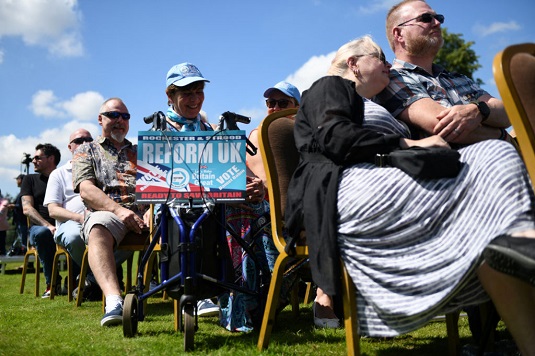
On the sentences meted out, 45% believed the severity was about right versus 27% who thought they were too lenient and 16% saying saying too harsh. What's interesting are the findings by voter intention. Labour, Lib Dem, and Tory voters are all more or less the same on 'not harsh enough' (27%, 27%, and 28% respectively), though there is more sympathy among the last saying they were "too harsh" (5%, 7%, and 20% - reflecting the ambiguity among the Tories themselves). But customers of Nigel Farage's Reform Ltd stand out a mile. Only 15% thought the penalties were not harsh enough, 29% "about right" (compared to the other parties' 58%, 57%, and 48%), but more than half - 51% - said the sentences were too much. This tallies with YouGov's earlier findings that 84% of Reform voters supported the idea of anti-immigration/anti-Muslim "protests", and 21% the violent disorder. Which seems at odds with right wing voters who generally like law and order. What gives?
Reform took votes from the Tories and allowed a slew of Labour and Lib Dem candidates slip through in July, but the bedrock of its support base, like the Brexit Party and UKIP before it, is somewhat different. Sociologically, Reform's voters are more male, whiter, and aged (though not quite as aged as the Tories) than the typical voter. Reform's strong political attractor is its authoritarianism, and not the flat tax/scrap the NHS drivel that passes for the party's political economy. People vote for it because it offers a certain aesthetics of politics that fetishises state violence as a "solution" to intractable "problems".
The political science literature on populist right and extreme right parties in Western Europe have all found similar features. Their supporters are more likely to have low to no trust in the prevailing political order, low to no trust in parties, and be sceptical about the efficacy of other institutions of state. One reason why they are attracted to 'great leader' personalities is because they offer a direct imaginary connection between the charismatic political figure, certain positions that are "not allowed" in the mainstream, and the (apparent) circumvention of the (lying, liberal) media, corrupt parties, and the other trappings of democracy. And those who find this politics most congenial are the petit bourgeoisie. As is well known, their lived existence could be snuffed out by the vagaries of the market, and are threatened by "unreasonable" wage demands, employees who don't pull their weight, and the costs demanded of businesses by local and national government. This makes for a very volatile force. They are predisposed to an authoritarian politics because it promises order and stability, as well as attacks on perceived sources of unease and threat. Of course, not all the petit bourgeoisie support populists but at their core this constituency is overrepresented.
What makes Reform's voters "special" is that this group was cultivated and persuaded to turn out for the Tories in 2019, and ever since Rishi Sunak tried desperately to keep them on side. It didn't work because, despite the populist messaging and posturing, the Tories didn't follow through with the brutal "solutions" their policies required. Rwanda didn't see the light of day. Setting aside the ECHR to deport refugees never happened. On these issues, which the Tories have relentlessly talked up with the aid of its press, they lost all credibility. Farage, however, has proved his outsider status by being the catalyst responsible for Britain's exit from the EU. He tells it like it is and has the track record to back this up.
Like all populist politicians, Farage is using "the people" against "the elites" for his own selfish ends, but pointing this out won't cut the mustard. Nor will Labour by appealing to these same people with its hard-on-immigration lines and aversion to confronting the racist right politically. It is, to be honest, pointless trying to win this constituency over. What is not is containing them. This requires taking on their arguments, debunking their myths, condemning Tory efforts to fish from these waters, and shifting politics away from issues that feeds the populist right's affected sense of injury. The chance Labour won't do this, seeing as it thinks everything will be fine if it delivers on GDP and has an efficient refugee removals system. And that means, as always, that it falls to anti-fascists, the labour movement, and others to do the job the Labour Party is unable and unwilling to do.
Image Credit

Before we go there, it's worth remembering that responsibility for the disgusting scenes and racist thuggery lies primarily with them. They made the choice to demonise immigrants and asylum seekers. They chose to present them as an existential threat to public services, security, and the British way of life. No one forced the Tories to slander Palestinian solidarity protests as hate marches, pretend Muslims are the enemy within, nor were they compelled to call the far right onto the streets. This is on them, their press, and the shit stirrers on their fringes. The question in front of our leadership hopefuls is how they turn a crisis, which Labour seems incapable of benefiting from politically speaking, into an opportunity that will net them their party's top job.
We already noted Priti Patel's surprising statement. Considering she was the architect of the Rwanda plan, and oversaw the most authoritarian anti-protest legislation seen in this country since the mid-19th century, the former Home Secretary made a splash by rounding on Nigel Farage's running commentary ("two-tier policing!"), and defended the right to protest, distinguishing between Palestine solidarity and fascist violence. That adds her to the ever-growing list of Tories Ian Dunt finds "impressive", but those of us somewhat less beholden to the delusions of liberalism will note there's a contest going on in which there is little to distinguish between our Tory Tweedie-Dees and Tweedie-Dums. She now has a selling point.
Contrast this with Robert Jenrick. Following a lacklustre launch, he's pitched for the fash-adjacent membership vote. On Wednesday he stoked tensions by saying Muslim demonstrators shouting "Allahu Akbar" should be arrested. Angela Rayner rightly replied that this was stirring up trouble, a point echoed by the contest's most anonymous entrant, Mel Stride. He said Jenrick's comments were "unhelpful and unwise", which is a very diplomatic way of saying reckless and stupidly self-serving. Still, none of this stopped Team Jenrick claiming they were responsible for ending the riots because their "hard truths" were like so many tablets of stone cast onto the fascist mobs from atop Mount Sinai. A joke response from a leadership campaign doubling as an unfunny parody of the Tory party itself.
Speaking of Mel Stride, following where Patel chose to tread he's attacked Farage directly for spreading conspiracy theories around the perpetrator of the Southport stabbings, and by linking this to an attack on an army officer in Kent stirred the pot further. "We need moderation, level heads, and very firm action" he concluded. That's the Reform leader told.
Last weekend, Kemi Badenoch made no bones about what she's selling on her stall. More racism. It was the repackaged moans about "integration" that are to blame for the riots. If such a problem exists, it's on the part of a tiny minority of lumpenised white men. But apart from her soft soap interview with last Sunday's Telegraph where she expounded her repugnant views without challenge, she hasn't commented further on the biggest issue in British politics at of the moment. This plays second fiddle to a social media feed is full of look-at-me photo opps and endorsements. A dereliction of duty by any reckoning.
What about James Cleverly? He's the only candidate to have ventured criticisms of Keir Starmer's approach to the riots. Zeroing in on the roving band of anti-riot specialist coppers the Prime Minister promised after Southport, Cleverly wonders aloud about what the unit is going to do when there are no riots, and it might take them a while to travel from London to trouble spots. Without wanting to defend Starmer, it's pretty obvious he was talking about a mobile intelligence unit and not hands-on crowd control cops. But this contrasts unfavourably with the money the Tories put into policing and the extra powers showered on them. And today, Cleverly has boasted that the policies he oversaw are working - visa application for work and study are significantly down. Well done that man for fuelling care industry shortages and chucking universities further into the red.
Lastly, where is wee Tommy Tugendhant? Before the riots, the leading "centrist" contender came out hard against the UK's continued membership of the European Convention, just so the government can be beastly to refugees in exchange for flattering headlines. Nevertheless, it's quite significant that - unlike Badenoch, Jenrick, and Cleverly - he at least issued a strong condemnation of the riots, albeit assuming an apolitical this-is-a-law-and-order issue stance. He later tweeted about these being "dark days" for our country, and urged Starmer to "get a grip". Why he attached a clip of young Muslim men in Birmingham and not any of the ample scenes of racist mobs attacking mosques, hotels, looting shops, and fighting the police is something for readers to make their minds up about.
We have then an interesting division among the contenders. You have Stride and Patel(!) who are offering the centrist and responsible establishment position on the riots. Cleverly and Tugendhat are in the middle and are trying to face both ways, and Badenoch and Jenrick throwing all caution to the wind and are overtly, crudely adopting the far right's framing of immigration and multiculturalism. It's a position that should see the pair of them drummed out of mainstream politics, but according to the unscientific but often accurate Conservative Home survey of members, these two are in pole position. They've decided that the party's route back is through consolidating the base and squeezing Reform, and at this early stage it seems the dwindling membership agrees. It's a strategy, I suppose, but one that's not going to get the party very far. The long-term decline of the Tories, which ate a banquet of Conservative MPs at the general election, is more or less guaranteed to continue unabated if they stick to this right wing path.
Image Credit

He was certainly quick to show off his law and order credentials. This afternoon the Prime Minister said 400 suspects had been arrested, 100 charged and sentencing will be carried out by the end of the week. Made easier by the abundance of evidence thanks to the far right's stupid reflex to share footage of themselves throwing bricks, egging on violence, shouting racist abuse, and looting gingerbread men from Greggs. Readers will recall that Starmer promised new powers for the police as well as a mobile specialist unit, which allowed the press to go all gooey about "supercops" over the weekend. But on the politics, Starmer's first instinct was to treat fascist mobilisation as a law and order issue. Until it became untenable. "I won't shy away from calling it far right thuggery" he said, despite waiting days to say this obvious truth. He acknowledged that Muslims were being specifically targeted, and for the first time Yvette Cooper acknowledged that the far right's attempted pogrom was motivated by Islamophobia. But that has been the limit of Labour's political response. Its MPs have been putting out more-in-common/kumbya statements, and none have been seen anywhere near anti-fascist demonstrations. Not even a token presence - following directives from the top.
Labour are missing a trick. As the party has a thin social base, these riots are an opportunity to assume that most Blairist of affectations - of presenting themselves as the political wing of the British people - by not just overseeing the prosecution and incarceration of racist thugs and their online cheerleaders, but showing empathy and solidarity with communities under siege. Obviously a difficulty thanks to the party's recent activity and long-term problems with institutional racism, but doing so would go some way of paying down debts that cost the party at the election (and could do so in the future), as well as win back those that by any measure should be in the bag. Doing the right thing now would provide the government some much needed social ballast, which would stop it from getting blown off course when the political weather gets rough.
Why is Labour not manoeuvring to capitalise on far right violence? It's alien territory for many of its MPs. The problem is the typical path to politics for most of the PLP is from outside the labour movement. The are not accustomed to and are even frightened by having to deal with masses of politicised people. It's a lack of fit between the Westminster-centred world view and skill set and a positive appreciation of an independently organised anti-fascist politics of the street. MPs are supposed to represent them, not treat with them as equals. The second is the investment in received wisdom, which has historically been driven by the needs of the Tory party. With the exception of when Jeremy Corbyn led Labour and Keir Starmer was in the running to take over, the party has always tailed the Conservative and right wing press framing of immigration and ethnic minorities as a problem to be managed. It's easier to go with the flow, especially when it's framed as the common sense of everyone outside of the M25, than to take on the myths and lies and actually lead on it. But worse than that, for right wing Labour it's not a question of capitulation for electoral reasons. Rather they too believe being seen as the best handlers of immigration - by deporting more and cutting numbers - is the route to keeping the Tories and the far right at bay. How's that perspective working out? And lastly, as per His Blairness Labour needs its own scapegoats. Taking on a political as opposed to a straight law and order approach to anti-fascism limits Labour's options in this regard, giving the government less room for manoeuvre when it thinks rightward shifts on multiculturalism and asylum are necessary.
In other words, Starmer's political timidity in the face of far right violence is conjunctural, but one consistent with the Janus-faced character of Labourism. And such reluctance now, an unwillingness and seeming inability to grasp the promise of the moment will cost Labour in the long run.
Image Credit
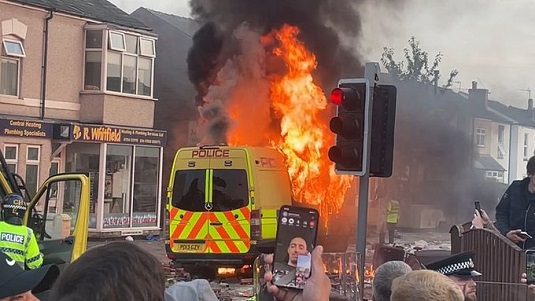
We've been here twice in 18 months. There was the riot at the Cenotaph, encouraged by Suella Braverman while she was Home Secretary. And then in February 2023, another mob - also mainly made up of people from outside the area - rioted in nearby Knowsley. Tonight, they're outside Downing Street scuffling with the police. The far right have grown in confidence and feel things are moving their way, thanks to the advances of the populist and far right on the continent, Donald Trump being in contention for the White House, and the election of five Reform MPs to the House of Commons.
About those MPs. Nigel Farage happily congratulates himself about the time he and UKIP (apparently) saw off the BNP. He presented the electorate with a respectable, non-fascist alternative to those "concerned" about immigration. And here we have this so-called safety valve claiming that the police were covering up the "terrorist motivations" - a dog whistle for Muslim if there ever was one - of the Southport stabbings. And in recent days we've seen his lackeys Richard Tice and Lee Anderson applauding a copper who stamped on the head of an incapacitated Asian man. This is not harmless shit talking for viral content. It's a call for their arms-length supporters to do what they do.
There have been calls for these three to face parliamentary standards investigations and, it's true, they should be open and shut cases if they happen. And the Daily Mail have reported that Yvette Cooper is considering banning the English Defence League. The first problem is the EDL doesn't exist except as lazy short hand for far right mobilisation. She would be banning a phantom. The organisation of the Southport racists is decentralised and distributed and doesn't have a formal structure with an HQ, bank accounts, and assets. There is no CEO or SLT, and no membership list. Just interlinked Facebook and WhatsApp groups, mailing lists, forums, and social media influencer networks. If Cooper wants a crack down she's going to have to take on the platform giants. And, as we know, Labour would rather shy away from confronting the powerful.
Politics is the easy and difficult answer to the far right. And that means pointing the finger at all politicians that have contrived this situation. From Theresa May and her crusade against immigration to the last three Tory horrors and their appalling Rwanda scheme to the new Tory leadership hopefuls banging on about the subject. Labour's is a straightforward contribution-through-capitulation to this hard right commonsense. The answer is building cohesive communities. Southport's reply has been exemplary in this regard through community clean up and local residents of all backgrounds helping repair the mosque. The answer is a politics that doesn't merely say refugees/migrants/Muslims welcome here, but takes on the lies of the politicians and the media by stating clearly and repeatedly that they are not to blame, and will not accept the scapegoat labels these elites are trying to paste onto them. And yes, as history has shown time and again, only mass mobilisation and confrontation with the far right can see them off.
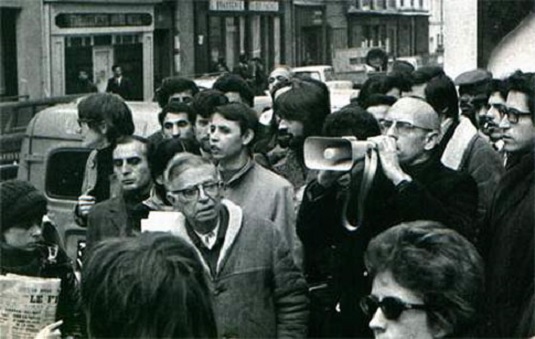
Certainly, something needs to be done about prisons. Proven reoffending statistics are in long-term decline, but this seems less an effect of being banged up and more a consequence of the secular long-term trend downturn in crime. Nevertheless, suicide and self-inflicted injuries have seen increases in recent years, probably as a consequence of overcrowding and the disproportionate incarceration of men - and it's mostly men - with mental health difficulties. Exacerbating matters has been a collapse in staff morale and an exodus of prison workers, a crisis so bad the Commons justice committee launched an inquiry. For the reform-minded, prisons are ripe for it.
The interesting thing is that the concern with prison reform is far from new. In Discipline and Punish, Foucault argues that as the prison system was born so was its critique and calls for reform. Commentary on the book talks about panopticism, discipline, subjection, and rehabilitation as signs that the economy of power in early modern societies moved away from the arbitrary, haphazard, but often spectacularly brutal exercise of power in the sovereign's name to something much more subtle. This for Foucault was coincident with the rise of capitalism, and enabled the significant multiplication of complex organisation in industrialising societies. The discipline of the barracks, the prison, the school, the hospital, and the factory all fed off and enabled one another. They trained people through the application of rules, surveillance, and were backed by systems of punishment and reward. Prison was designed to take in convicts, discipline them, and churn out reformed characters who would become productive citizens.
Foucault pointed out that prison is not just a spectacular failure that falls short of what its designers and supporters advocate for it, it has always done so. The criticisms of Foucault's day, of our time, and back at the birth of the prison remain fundamentally unchanged. The charges of prison reformers that crime rates are indifferent to rates of imprisonment, that high rates of recidivism persist, that it encourages reoffending and, in fact, instead of producing docile subjects what comes out the other end are delinquents have all been heard before. The problems of prison regimes, from corrupt wardens to arbitrary authority to forced labour to the stigmatisation attending former prisoners are well understood and have been high on the complaints list since the modern penitentiary emerged in the late 18th century. Foucault notes the critique of the prison falls into two types: that it is insufficiently corrective (broadly the liberal position), or that it is insufficiently punishing (the right wing position). He argues,
The carceral system combines in a single figure discourses and architectures, coercive regulations and scientific propositions, real social effects and invincible utopias, programmes for correcting delinquents and mechanisms that reinforce delinquency. Is not the supposed failure part of the functioning of the prison? (Discipline and Punish 1991, p.271)
Or to put it another way, if prison is such an abject failure why has it continued to play the central role in the criminal justice system? Even though, arguably, disciplinary power has become subsumed by new logics of surveillance and are, by themselves, obsolete technologies of power. Why prison persists is not for the elimination of crime or, for that matter, keeping the public safe. The object is not to deter offending but to distinguish them. In other words, it's an apparatus of subjection. Because disciplinary power is in the business of classifying and, through the application of discipline, developing knowledge about different kinds of human being. The transgression of the law might, in the abstract, be construed as a challenge to some normative aspects of social life but apprehension and imprisonment allows for the classification of, and therefore the truth of the convicted to be established and assimilated into the technologies of social control. The consequence is, like policing, we are all positioned in relation to prison, and the economy of incarceration and punishment can be extended at any time to bring more activities under its purview. That's why for Foucault the establishment solution to the problems of prison can only and always be more prison, whether extensive in building more or becoming intensive in more sustained, "scientific" rehabilitation efforts.
For Foucault, disciplinary institutions are the problem. They violently force people to fit into prescribed moulds. The model prisoner conjured up by penology is always the aspiration, but to get there discipline, surveillance, and force are individually applied to curb resistance to its demands. Building a free society means consigning such institutions and the modes of governance they foster to the dumpster of history. Their difficulty, ultimately, isn't that they are used to incarcerate criminals. It's that carceral logics work to imprison everyone.
Image Credit

The Trump camp, for one. When a far right conspiracy theorist broke into the home of former House Speaker Nancy Pelosi and attacked her husband, Trump mocked the attempt and cast doubt on whether it actually happened. For her part, Pelosi has joined in the official concern and well wishes showering upon the former president. And then we have the small matter of instigating an insurrection, which placed members of Congress in harm's way and led to a handful of deaths. Leading Republicans were also quick to blame the Democrats for their inflammatory rhetoric. The same Republicans who've been flirting with the fascistic - not a word to be used lightly - Project 2025 plan.
Joe Biden was quick to condemn the attempt and mumbled some homilies about political violence being bad. But this is a president who's done nothing to curb state violence at home. Along with attacks on peace encampments by pro-Israeli activists, Biden has sat on his hands as elementary democratic rights were trampled on. He said "order must prevail" as the police undertook mass arrests of students protesting against US complicity in the massacre of Palestinians. Political violence is always fine when it's dished out to dissidents outside permitted political discourse, and innocent people being bombed to bits by a valued and pampered proxy don't count either.
Here at home we've had our fair share of hypocritical hand wringing. On Laura Kuenssberg, Nigel Farage was invited on for his thoughts about the attempt on his "friend". And entirely predictably he wound up the rhetoric a notch blaming "liberal intolerance". He likened the events in Pennsylvania to the "persecution" he's faced. Persecution that involves endless press and broadcast media coverage, and lashings of sympathy whenever he has to have his suit dry cleaned following another milkshake incident. Never mind his own dog whistle rhetoric and scaremongering over mass immigration. But not to be outdone, new Leader of the Commons Lucy Powell linked Trump to the problems Labour MPs faced during the election campaign. Being fired at by a shooter with a grudge is, as per failed MP Jonathan Ashworth, exactly like walking down the street and being asked by elderly Muslim men to explain your stance on Gaza.
It's not difficult to understand why, even in Britain, MPs are touchy about their safety. We remember that Jo Cox and David Amess were murdered inside the last decade. But always, the condemnation of political violence is highly selective. Compare and contrast what's happening now with just under a year ago, when the then Home Secretary was egging on police and far right violence against entirely lawful Palestinian Solidarity demonstrations. Likewise, Labour MPs might have been called rude names while out and about, but there was deafening silence from the people making noises now when activists were attacked during the 2019 campaign. There was no collective outburst of concern when the son of the Workers' Party candidate in Sutton Coldfield was hospitalised while leafleting.
Assassinations are wrong and stupid. Violent attacks on politicians are wrong and stupid. The labour movement across the world have long understood this as it provides a pretext for authoritarian legislation and begets more political violence. Albeit in a police uniform with an official imprimatur. Seeing as this country has just elected a government with the thinnest popular endorsement since the advent of mass suffrage, politicians feel the anxiety of their shallow roots. The creep of imposter syndrome has its hand on their shoulder as they claim to speak for their constituents, and it's this sense of doubt that will make it easier for them to use the attempt on Trump's life for more repressive laws and clamp downs on free speech.

In the end, the figures speak for themselves. 92 arrests from the thousand or so fascists at the memorial, while the Met reported "no issues" on the Palestinian solidarity march. This was supplemented by some confrontations with a 150-strong group toward evening, but that's it. From a demonstration of between 700,000 and a million people. The biggest since Iraq, eclipsing the so-called People's Vote marches of several years ago. And whereas the Iraq demo was a mass, if sullen affair by all accounts today's marches in London, Glasgow, and Cardiff were more politically clued up and angry. The rarity of stupid and antisemitic signs, broadcast by social media's placard police as "proof" the whole demo was a racist endeavour, demonstrates the increased level of self-understanding as consciously anti-imperialist and solidaristic rather than simply being a "war is bad" mobilisation. No wonder it will continue to give the establishment the heebeegeebees.
But the immediate consequence is not only pressure on the government and opposition (after all, these are as much demonstrations against Labour Party policy as they are the Tories' backing of Israeli genocide), but a real falling out among the political establishment too. As last week wore on, more and more Tories and their allies were showing concern about the Home Secretary. When even Keir Starmer delivered a damaging broadside against Braverman and, by extension, Sunak too, he was speaking for plenty on the government benches who think the Pennywise clown show at the Home Office has gone on long enough. And yet where are the signs of her demise? In Sunak's statement put out this evening, he said there were bad people on both sides. Nothing, as you would expect, on Braverman's responsibility for the scenes in front of the Cenotaph.
Is he going to sack her then? The problem Sunak has got is while she is useful because she says the things he won't, it's obvious her perpetual campaigning has made her a liability. If the Prime Minister sticks by her, he's open to the not-entirely-accurate barbs that he's too weak to giver her the heave ho. And should he submit to the pressure, like his predecessors in the leader-centric game of Westminster politics, that invites further erosion of his authority. He's in a justly deserved position of exquisite political pain. No wonder she's apparently pleading with Sunak behind the scenes to call an election on stopping the boats. Her brand of toxicity would be indispensable for such a lurch into the gutter.
Unfortunately for Braverman and Sunak, her future is more than a matter of internal Tory politics and electoral strategy. Her week's worth of far right-enabling antics, on the streets and in the Jewish Chronicle's sheets, open insubordination, and unprecedented public criticism of the police is accumulating nothing but opposition among elite layers and opinion formers. If Sunak clings onto her, sooner rather than later he could face the kind of revolt he helped initiate against Boris Johnson.
Image Credit
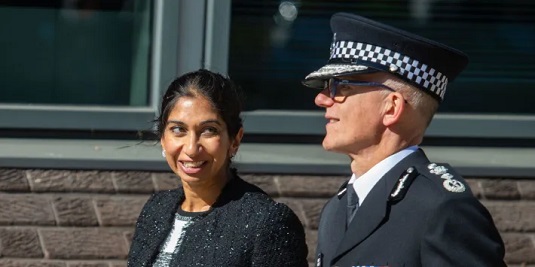
Leaked documents that made their way into Sunday's Observer showed how civil servants working under Gove's direction are looking to broaden the definition of "extremist" to anyone deemed to undermine the UK and UK institutions. The definition reads "Extremism is the promotion or advancement of any ideology which aims to overturn or undermine the UK’s system of parliamentary democracy, its institutions and values." This is so broad that 'extremism' could range from the advocacy of electoral reform to calls for abolishing the monarchy to the replacement of parliament by direct and participatory democracy. No one has had the chance to scuttle out to defend the expanded definition yet, but if they ever do they'll rule out it being used against "respectable" organisations and "decent citizens". Laughably, we're expected to take this government on its word. And should Gove see it through what are the chances of it getting vetoed by a Keir Starmer-led Labour government? Somewhere south of zero I'd wager.
This all adds to the atmosphere of drum banging authoritarianism since the Palestine solidarity movement threw the political establishment into a panic. The government's framing of the 7th October Hamas attack as some sort of year zero event, the official mourning the Tories and Labour colluded to enforce, the apologism for war crimes, and outright lying about protesters' character and intentions are not working. Even repeating the position in fluffier language, incorporating real concerns and taking a hand wringing approach hasn't convinced. And so as the rhetoric isn't demobilising anyone, they turn to the authoritarianism.
But there has been a curious reticence about it. Never one to mince her words, Suella Braverman is choosing her steps very carefully. She has straight up called the protests of the last few weeks "hate marches". Yet, if they really were hate marches and an occasion for anti-Jewish racism why has she not banned them? Instead, we're treated to a grim tete a tete where Braverman says she would look very favourably on any police application to stop demonstrations, while the Met Commissioner pleads ignorance about what a hate march is. Then we have her and other ministers arbitrarily designating "remembrance weekend" as something sacred and demand the police stop the desecration of the Cenotaph, when this Saturday's march starts well after the minute's silence and goes nowhere near it. And then earlier today the Met issued a request to postpone the demonstration. To which the organisers have said no. It's seems to be too hot an issue for anyone to handle.
Could the rumoured but seldom seen conservative conscience be kicking in? A case of not even Braverman or the cops wanting to be held responsible for an unwarranted attacked on liberty and freedom? Or, as is more likely, they haven't burned out all traces of political sense and realise that hundreds of thousands could well defy a ban anyway, leading to open defiance, ugly scenes, and the generalisation of a solidarity movement into something that calls into question wider issues: the authoritarian state, policing, the cosy establishment consensus. The growth and spread of Palestinian solidarity has shown the powers that be that, despite their hopes, not only is the left much stronger than Starmer's disposal of Corbynism suggested but that politics as a whole remains febrile. Authoritarianism is a reflex when the state is caught on the hop, but exercising it with relish could lead to all kinds of unforeseen consequences. The government are politically clueless, but they're not so far gone that they don't know when a crisis of legitimation could become a real possibility. And it's this that is staying their hand, for now.
Image Credit

The New Statesman's editorial argues the Met is beyond saving. It either needs breaking up or abolishing completely. It argues that the Met acts like a semi-autonomous organisation with its own culture, rituals, rules, and a strong sense of collective identity that closes ranks when threatened. It is more akin to the gangs they supposedly police than any law enforcement ideal type one can conjure up. This is undoubtedly true, and it's interesting this line of thinking is also shared by some establishment figures too. The recognition there's something rotten in New Scotland Yard is no longer the preserve of the far left nor the black communities that have suffered at the Met's hands.
But what is to be done? Key actors inside the police are already on the case. They know the force attracts people for whom police powers are a means to a criminal end. We're not talking Ryan from The Line of Duty, but they have actively sought to raise the calibre of the average copper. The on again/off again dalliance with requiring all new recruits to attend university and get a policing degree reveals an Eliasian faith in the civilising process of higher education that would turn out empathetic and more rounded officers. This, they hope, would short circuit the harrowing canteen cultures harboured by many a force. It would wheedle out the would-be predators, the boy racers, and the thugs, and create new constables equipped for conflict resolution and handling mental health crises, which has become increasingly common as the Tories have run the NHS down. This is the culmination of the bad apples/attracting the wrong people critique. Enlightened chief superintendents know what the problems are, and they're replacing the old guard with carefully curated new model coppers.
The problem, however, is less a matter of personnel. If for the next 20 years the Met exclusively recruited graduates, the same issues would manifest and not because there are plenty of the old sweats still about. It's a matter of what the institution is about, what the purpose of policing is. The police's raison d'etre is raison d'etat. They are the force for maintaining "public order", which is always the preservation of the state and, by extension, the rule of capital. It is the first line in the physical application of state authority with crime detection its secondary function. It is set up as an institution of disciplined violence with its militaristic command and control structure, its capacity for "undercover intelligence" (see the spy cops scandal, the targeting of trade unionists, and even the Met's spying on the Lawrence family), and its deployment against designated undesirables: activists, protesters, "illegal" immigrants. None of these are quirks of individual forces, but are characteristics shared by every police organisation not just in Britain but pretty much everywhere you look. They are systemic features. A repressive state apparatus, as Althusser pithily put it.
The toxic culture of the Met corresponds entirely with the organisation's toxic purposes. Discharging the state's monopoly on legitimate violence inculcates a dehumanising outlook. Even if it does not attract the absolute worst people, its framing of certain groups as public order problems encourages racist, sexist, and homophobic conduct and reiterates that as a norm. Even if it goes against regs and the occasional bit of diversity training. And it cannot be otherwise given the police's authoritarian purposes. Having a clear out, putting recruits through university, breaking up and abolishing forces aren't going to turn them into paragons of civic and legal rectitude. No matter how the institution is badged, the same old crap forces itself back up the pipe.
Abolish the police then? Why not? If the aim is the abolition of class society, what purpose for the police? They become entirely superfluous considering their primary role in capitalist society. Crime won't disappear in the future society, but that can easily be the property of some other agency that does not have the maintenance of minority class rule as its purpose. But that's all very well for then, what about now? Given how police powers are employed against racialised communities, and are used to abuse women and sexual minorities, the American call to defund the police can have resonance here, especially where "policing" is the by-word for harassment and curtailing meagre liberties. But this does not go far enough. Just as it's right to load down capital with obligations and regulations - something the workers' movement has long fought for - we should do the same with the police. This is not a call for more bureaucratic oversight as per key performance indicators of the Starmerist imagination, but rather more democracy. It recognises the limited accountability of the old police and fire authorities, and offices of Police and Crime Commissioners never challenged policing, and indeed were/are half-hearted sops to popular accountability. I haven't got a ready made model, but the aim of extending democratic control is about eroding policing and the policing function, of problematising the 'repressive' and the 'state' aspects of the repressive state apparatus, working to neutralise them, and refocusing it on crime detection and community priorities. Which, after all, is why a lot of police recruits join the police in the first place. The demand for democracy is about initiating a process, one moment of transforming/undermining a key prop of the state and empowering our collective strength.
Image Credit
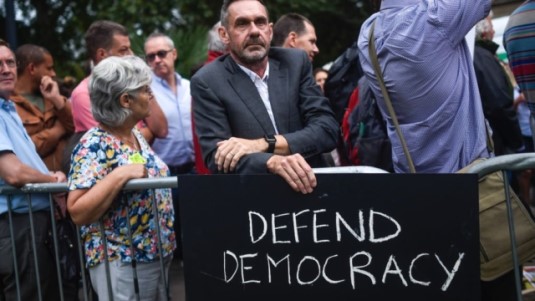
Paul Mason has seemingly approached Orwell's example from another direction: by looking to collaborate with the security services to take down his opponents and critics on the left. In a bundle of documents leaked to The Grayzone, we have emails and a crude network relief supposedly demonstrating the relationship between the Russian and Chinese states, websites, organisations and politicians, and the constituencies they appeal to.
This is obviously a grotesque smear, and one not without consequences. There are organisations that happily apologise for the Kremlin and Beijing, but there are plenty of people and outfits on the list that do not. Tribune, Young Labour, Jeremy Corbyn and the other named left MPs, and Novara are anti-Putin and opposed his invasion of Ukraine. And even for those who are Putin adjacent, do they not have the right to peddle their politics free from the interference of the state and MI5 cosplayers? The leaked materials are setting up leftists to be on the receiving end of potential vigilante action. And need we mention the recklessness and racist stupidity of linking the black and Muslim communities to the influence of outside powers?
How did Mason pass from his membership of Workers Power to the BBC and Channel 4 News to left celebrity journalist to apparently begging to be of service to this country's spook establishment? It's a spectacular collapse that puts other passages to the right to shame. Only having met him the once when we shared a platform with Chris Williamson (how times change) at Derby Transformed in 2018, I can only comment on the politics of his trajectory. What made Mason an effective broadcast journalist wasn't just a talent for making complex topics simple, as per his coverage of the 2008 crash and the aftermath, or his personal courage when he live broadcast from Gaza during the Israeli bombings of 2014, but the fact working mainstream outlets disciplined him. The tension produced by performing neutrality and impartiality in these circumstance were, for him, a productive one and helped Mason win a deal of respect in the left and labour movement. While not overtly leftwing, he did give due respect and fairness to those he interviewed and reported on. But this wasn't just a case of "one of us" making it big in a hostile environment. His books, particularly Why It's Kicking Off Everywhere and Postcapitalism were well received.
After C4 News he returned to activism, using his platform to promote Corbynism while pursuing his own journalism projects. This is where the problems started. Freed from contraints, the throughtful and nuanced Mason of old rapidly gave away to a forceful and bombastic character that enjoyed browbeating allies as much as opponents. The trolling of Progress conference in 2017 was good for a laugh. But the same uncompromising and often uncomprehending treatment was meted out to comrades too. As the contradictions within Corbynism sharpened, especially among the membership and supporters over Brexit, Mason dropped into the delicate tensions with all the finesse of a 100 lb bomb. He waged the war for remain in his characteristic manner. Aligning politically with a section of the establishment, I suppose it wasn't much of a shock when he came out for Keir Starmer in the post-Corbyn leadership contest, and has stuck doggedly to him since. As he memorably put it, "If you don't think KS will advance the class struggle you're possibly not understanding social democracy correctly from a Marxist viewpoint."
Since then, Mason's politics, which he maintains are still anti-capitalist, have merged seamlessly with the traditional positions of the Labour right on foreign affairs. The invasion of Ukraine has seen him elevate NATO to the status of a fetish and an organisation whose existence can no longer be questioned. The only difference between Mason and Starmer on Labour's position on NATO is Mason pushes it with the zealotry of a true believer. He sees Ukraine as the frontline in a tripartite world divided between Russian and Chinese imperialisms, and the NATO alliance of liberal democracies. The war in the Donbas is the war for liberty and freedom, and NATO our shield against the threats from the east.
Plenty of people have made not dissimilar journeys to the right, but seldom do they express a desire to turn cop and police the movement they've left behind. If you're looking to entertain a good faith explanation for this, Mason's superficial and shaky snapshot of international relations means the West are at war with two authoritarian rivals. No quarter can be given to those who might straight up support their machinations, equivocate, or even bring a bit of nuance to analysing tensions between the great powers. What is more likely is the logical culmination of a personal I-know-best politics desperately craving to put pay to his opponents by psyopping and using dirty tricks to drive them out of politics, leaving the field of "permissible" radicalism to decents like Mason. Or this is one hell of a differentiation strategy to show those on the Labour right he's desperate to court that he's one of them, and is happy to traduce, libel, and expose leftists to danger to prove this.
This is the final straw for Mason. There's no coming back from this. His passage from comrade to renegade is completed.
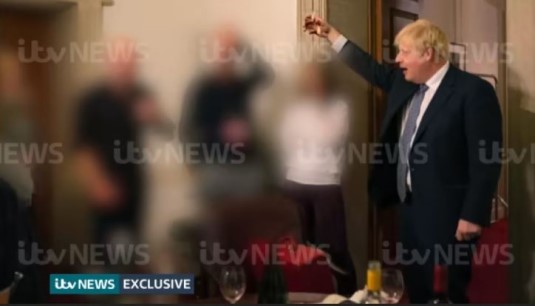
Here's a photo of Boris Johnson at the leaving party of Lee Cain, the former Downing Street head spinner, in November 2020. It took place when parties with people from outside of your household was banned. This shindig was also scrutinised by the Metropolitan Police for possible breaches of the rules and they issued several fixed penalty notices for some Number 10 staffers present. Who happened to escape the fine? The Prime Minister.
When the heat was really on Johnson back in January, he called in the Met so his egregious wrongdoing could, for a couple of months, be hidden behind the veil of "we can't comment while there's an ongoing police investigation." It was a high risk strategy, because everyone could read the reports in the papers and knew Johnson had very obviously trashed the regulations he expected the rest of us to live by. Getting a fine would, conventional wisdom suggested, force him to step down in disgrace. The months went by and when the notice was finally issued, Johnson muttered a non-apology in the Commons and that was the end of it. No resignation was forthcoming because there was no to force the resignation. Rebellion-minded Tory MPs had had their chance and they blew it in January. Another opportunity was passed up by the rapidly diminishing chancellor in April.
What Johnson did was play for time. His cunning calculated that the longer PartyGate could be dragged out, the more it would become background noise. Meanwhile the Tories would show how serious they were by concentrating on Vladimir Putin's invasion of Ukraine and (allegedly) tackling the rising cost of living. The fact he denied there were parties in Downing Street when he actually attended them wouldn't register up against the really weighty issues of the day and on he would carry. And so on PartyGate has rumbled on without causing Johnson too much bother since. Indeed, he and his new, apparently "tighter" Downing Street coterie would have anticipated the publication of his party snaps, And it doesn't change a thing. When he gets asked about this at Prime Minister's Questions, when some hapless minister is selected to do the rounds of breakfast television, the line will be that an apology has already been issued and the police were satisfied all the other gatherings were within the rules. If asked about the discrepancy between junior staff forced to cough up and Johnson getting away with a single fine, this will get batted away as a "matter for them". And lastly the old line about getting on with the priorities of the British people is about to get its umpteenth airing.
The danger, however, hasn't entirely passed for Johnson. The different political circumstances in Scotland means the Tory leader there gets to say out loud what a layer of Tory MPs are thinking. And so Douglas Ross has ostentatiously condemned the images. But he's not about to put his no confidence letter back into the 1922 Committee, and neither are they. Nor is there going to be a stalking horse leadership challenge: William Hague scrapped them in 1998 in case Michael Portillo re-entered parliament and came gunning for his post. It's to Johnson's preternatural luck that the danger he's in is tempered by the constitutional cowardice of his MPs. With no obvious alternative waiting in the wings, it's also a case of them sticking with the devil they know.
But there are other dangers too, dangers older, wiser Tories used to be alert to. Liberal democracy in this country acts as a political outlet, a means of peacefully channelling the interests (and frustrations) of the classes and strata of British society. Its legitimacy is imperilled if the system isn't seen to be working. After the Brexit referendum, the polarisation of politics reversed, to some extent, the idea the political parties were all the same. Before then low turn out and low interest was the norm. With Johnson's appalling behaviour, the lack of accountability and absence of contrition is less a moment of despondency and more a politicisation event, particularly among those who lost people and were prevented from seeing them by Covid restrictions. For many of these it won't be that they hold Johnson and his party in contempt, but the danger is it spreads to all forms of constitutional politics with who-knows-what consequences. Even worse for official society, because Johnson dragged the Met into the fray as his police shield of convenience, their failure to issue more fines despite photographic evidence of his rule-breaking sees the legitimacy of the force decline further. Not among those they police on the streets of London whose opinions don't count, but those middle class and some upper echelons of the establishment the Met does need to have onside.
Before this, the Tories were already in a bad way, but Johnson's lies and antics these past months threaten to spread discontent with the Conservative Party to the institutions of the state itself. If that doesn't give more intelligent Tories pause for reflection and cause for action, nothing will.
Image Credit
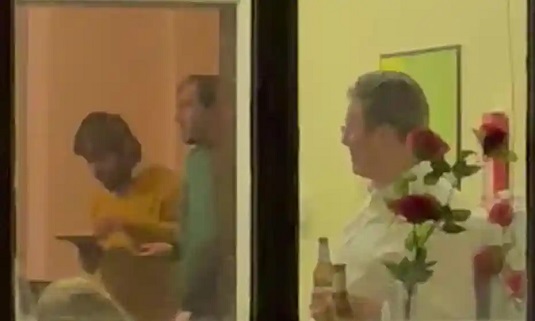
During his brief statement, Starmer positioned himself according to his usual contrivance: as a public servant honour bound by the principles of duty, probity, and integrity. Not just to put a clear distance between himself and the amoral vacuum of Downing Street, but because he undoubtedly believes it. There is perhaps profit in writing a short political profile that symptomatically sifts through Starmer's statements and speeches in which his silences and phraseology are reconstructed to form an internal narrative of honourable behaviour, despite lying to the members about his politics, returning Labour back to banana republic levels of petty authoritarianism, and reneging on a deal struck with Jeremy Corbyn to secure his readmittance to the parliamentary party. Alas, such an exercise has to wait.
But from the point of view of presentation aiming to get the average punter on side, Starmer did a good job of presenting his putative resignation as a matter of honour. A pledge Angela Rayner has signed up to if she's fined by Durham plod as well. It takes the heat off Labour, freeing Starmer and the front bench up to continue harrying Johnson from their moral high horse, and puts the Prime Minister on the spot. Just as it was always going to when the Daily Mail, other right wing outlets, and sundry Tory MPs joined in the crowing and demanding action be taken by the police. And regardless of the politics of onlookers, the hope is his willingness to put his career on the chopping block would win grudging respect across the political spectrum - which is good if your politics is primarily about rebuilding the legitimacy of state institutions, which Starmer's is.
It's not likely Starmer will cop a fine. Not just because of the details of the supposed breach, but also the huge pressure the Durham force are now under. Having been bounced by the Tories into reopening the case file on Starmer's beer and curry, being out on notice that the careers of two powerful politicians are now in their hands makes for a hot potato. This suggests fines aren't very likely. Going in Starmer and Rayner's favour is the reluctance the force has shown dishing out fines. They only issued 1,090 Covid notices between March 2020 and February this year. This is also the same police who did nothing about Dominic Cummings and his own restriction-breaking road trips. And so what might look like a high risk strategy for Starmer really isn't. The pain for Durham police is too awkward and inconvenient if fines are issued, therefore common sense suggests an institutional preference for the quiet life would eventually win out.
What about the politics? This is less certain. It's obvious Starmer's position is untenable if he's given a fine vis a vis his attacks on Johnson, and even if he wasn't inclined to pre-announce his resignation there are plenty on the right of the party, less than overwhelmed by Thursday's stellar performance at the ballot box, happy to enforce a premature retirement. It's unlikely to shift public opinion either. Those with their minds made up about Johnson's rule breaking will stay made up. Very few people are going to change their views by Starmer's example. But where it does matter is in the tete tete of Westminster shenanigans. There are Tory MPs discomfited by their grotesquerie of a Prime Minister and his utter disregard for parliamentary convention. According to their own twisted senses of honour, Starmer's move is audacious and principled. The unfavourable comparison between the Tory leader and Labour's demonstrates to them that decency is possible in politics, with the consequence of firming up their likelihoods of putting a no confidence letter into the 1922 Committee, or inducing a couple of others to follow Christian Wakeford across the floor. It also raises the morality stakes for Tory ministers. The opposition leader's pledge is now something the government can always be bashed with by its critics, and in Westminster where the avoidance of political pain is a chief concern, Starmer has gone some way of restoring the force of parliamentary convention.
Image Credit
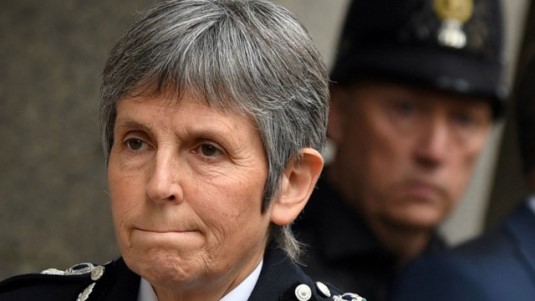
As it happens, I had a dream about a resignation last night. Chatting in the long-demolished Newcastle-under-Lyme branch of Sainsbury's, the canteen manager and I were discussing the departure of Boris Johnson, who had taken to the pages of the Daily Mail to exclusively explain his reasons for going. Alas, dreams seldom come true but the Met's Cressida Dick falling on her sword was an unexpected consolation. Her explanation is she "no longer enjoyed the confidence of the London mayor". It must have been bad for the otherwise establishment-friendly Sadiq Khan to want her out of the job. But has he inadvertently done us a solid as far as the Prime Minister's difficulties are concerned?
In all likelihood, no. But it's good to see Dick heading for the door anyway. This was a resignation long overdue. I'm not about to recapitulate her record in depth, but the lowlights of her career, which include overseeing the operation that killed Jean Charles de Menezes, throwing road block after obstruction after blockage in the way of the Daniel Morgan investigation, covering for institutional racism and, perversely, the culture of institutionalised misogyny that saw Wayne Couzens pass undetected in police ranks while dishing out beatings at the Sarah Everard vigil, and her studied refusal to investigate breaches of Covid rules in Downing Street until it was suspiciously convenient for Johnson, all point to a character who understood what policing is about.
As one rises up the ranks, each rung on the career ladder becomes increasingly political. It goes from banging up the bad guys and cracking heads on marches, to reach out activities that legitimate the police (what school assembly hasn't received a visit from a friendly, relatable copper?), to hobnobbing with local politicians and, if one's office warrants it, metro mayors and heads of governments. In addition to respective police forces, there is a growing and increasingly powerful constellation of institutional interests behind leading officers, which more or less reflects the three functions of policing. The National Crime Agency coordinates activity against trafficking (drugs, weapons, people), cross-border cases, cybercrime and complex fraud, and the "glamorous stuff" like serial killers and high profile crimes. This is the arm concerned with villainy, traditionally conceived. The College of Policing works at legitimating the police as a skilled profession, offering guidance on conduct, and is responsible for accrediting policing degrees at British universities. And the National Police Chief's Council is the political arm of the police, acting as a lobbyist of government (usually for more repressive legislation and better funding settlements) and advisor on policing and counter-terrorism matters. In the classical Weberian sense, they work together as a status group to promote the police in competition with other professional interests to improve their "market situation", as the old language has it. But the police aren't just another occupation looking for prestige and award, they are a key pillar of the state's repressive apparatus, the civilian-facing arm of institutionalised, organised violence.
Those who succeed in the police are the ones that instinctively or consciously grasp this fact. "Maintaining the peace" is, in the last instance, a class peace. Public order is a synonym for bourgeois order. The thin blue line is the ticker tape around private property, and happily wades into demonstrations and protests, batons aloft, regardless of the issue. If the Tories are hyper aware enough to clamp down on anything that offers a bit of political hope, the police know jumping on collective action with their size nines, and kettling protesters for seemingly no reason are techniques designed to have similar effects: a nipping in the bud of anything that might flower into mass mobilisation and challenge the status quo.
None of us know who Dick's successor is going to be, but they too will be a creature of this infernal machine. They will defend the Met by deflecting criticism, mollifying racism and sexism, papering over its failures, furthering the government's authoritarian politics and, in all aspects, carry on being the same institution it was before Dick handed in her notice. A change of face does not mean a change of purpose, but from an establishment point of view it draws a line under what went before and allows them to start afresh, as if the corruption, violence, cronyism and protection of privilege isn't a structural characteristic.
Image Credit
Gray drew attention to the Downing Street operation's at-work drinking culture ("excessive consumption of alcohol is not appropriate in a professional workplace at any time"), other behaviours not in-keeping when the nation suffered severe restrictions on its liberties, and most damning "failures of leadership and judgement" on the part of the Prime Minister and senior civil servants. We also learned Gray investigated 16 events between May 2020 and April last year, of which 12 crossed the threshold of criminal responsibility and are now the province of the police. One of these events was a private party in the Downing Street flat. In other words, the Prime Minister's residence. Even the most gullible cheerleader would have a job explaining away that one.
Even this massaged and watered down account would be enough to compel virtually any other PM to resign, and there were testier responses from the Tory benches when Johnson rose in the Commons to put his spin on the Gray statement. Backbenchers who, in previous weeks, said they were waiting for the full report before they made up their mind were either asking for assurances it would eventually be published (Johnson repeatedly gave no such undertaking), that among the changes to Downing Street would be a more collegiate Cabinet-based government , or that there would be renewed focus on Tory priorities post-investigation. Quite remarkable to see backbenchers setting out their price for continued loyalty, or at least indulgence of the government in front of the opposition benches and those watching from home. Andrew Mitchell (remember him?) was the latest Tory to withdraw his confidence in Johnson, and Theresa May made a cutting intervention. You could almost hear centrists pining for what once was.
Johnson has survived the day, but what about the coming weeks? He's probably safe for as long as the Met investigation does its work. But herein lies a danger. Conventional wisdom would dictate that nothing less than complete exoneration would save "Big Dog". That would be good enough for Tory MPs who are loathe to dispose of their leader under popular pressure, but would anger the public in the face of open-and-shut evidence. Even worse would be an outcome less damning than the Gray update. Such an eventuality runs the risk of another blow to the legitimacy of the government and the Met - two institutions whose reputations for probity are not peaking at present.
If the Met decide to impose fixed penalty notices, I'd like to think that would be enough for Tory MPs and they would trigger the no confidence vote, but the convoluted defences and cold feet seen this last fortnight means it's unlikely unless a senior Tory takes a lead - such as a member of the Johnson cabinet. But where is such a figure? Liz Truss and Rishi Sunak are too compromised by their leadership ambitions and cannot be seen anywhere near a plot, Sajid Javid by his desire to be a frontbencher in whatever regime follows the Johnson circus, and the Priti Patels, Nadhim Zahawis, and Jacob Rees-Moggs hobbled by their fortunes being tied to the Prime Minister. It's almost as if Johnson contrived a cabinet in which no one can ever be in a position to wield the knife.
It's looking increasingly likely that the denouement to this saga won't come until the local election results are in. Tory MPs typically care little for local government and senior Conservatives even less, but when these tend to favour the Tories (older people, among whom they have disproportionate support, are more likely to turn out than younger and working age people), and so if the results are catastrophic this will make many MPs fearful for their careers. In the choice between Johnson and a better chance of keeping the £82k salary, he stands no chance against the pull of their wallets.
Image Credit

As everyone knows, the main news of the day is the decision of the Metropolitan Police to launch an investigation. Launched is the new way of describing 'dragged kicking and screaming', because they have done everything in its power to remain aloof from what happened behind the shiny black door in the first year of the pandemic. Having been passed some details from the Sue Grey inquiry into Downing Street breaches of Covid rules, Met Commissioner Cressida Dick let us know there was evidence enough to warrant an investigation. Not great news for Boris Johnson. And yet, in the midst of another possibly terminal crisis an opportunity! With the police getting involved, Grey's findings could be shelved because the last thing the government would want to do is prejudice their inquiries. Happily, this means ministers and the PM himself have another line for the press pack: I won't be commenting on an ongoing investigation. Think about it as pressing the nuclear button of delaying tactics: Johnson cannot say anything because he's helping the police with their enquiries. The Met could (and probably would) take months to come to a decision, by which time the current crop of difficulties are going to be ancient history. Johnson and friends hope. Keep kicking the can down the road and everything will turn out alright in the end.
The main consequence of this would be government paralysis. On anything but foreign affairs and marginal areas of policy, Downing Street would grind to a halt. Which might be a boon, because at least the Tories would be unable to do anything damaging in the meantime. A question mark with a flashing blue light atop of it hangs over Johnson's authority, and therefore presents difficulties for getting its business through the Commons. If this Met intervention was anyway planned - Johnson reportedly did not tell this morning's cabinet meeting about it to avoid awkward questions - then it has unravelled pretty quickly. No sooner did Downing Street say the Grey report was over, the Met said they had no problems with the findings being put into the public domain. Apparently it's not in Johnson's gift to decide when it should be published, but Grey herself. Indeed, it could be available as early as Wednesday, just in time for Prime Minister's Questions.
As the day has worn on, all manner of absurd defences of Johnson have emerged. Nadine Dorries distinguished herself with the usual stupidities, saying Johnson's surprise birthday party was a work event. Conor Burns did us a solid by describing the Prime Minister's predicament as being "ambushed with a cake", and tonight courtesy of the New Statesman, news that the Johnsons don't think they've done anything wrong because what happens in Downing Street is part of a household bubble. You almost couldn't make this rubbish up.
Tory ministers in rare honest moments have said the public will make their mind up, and they have. Poll after poll shows they believe Johnson lied about the parties, that he broke the rules, and he should resign. It strikes a chord where 150,000 deaths haven't because experience of restrictions is something borne by everyone, and to know the boss rule maker was also the chief rule breaker very obviously takes the piss. It doesn't matter what Johnson does now, or even if he clings on. The damage to him is permanent, and the longer his stays in situ, the harder it gets for the Tories to come back from.

The appalling case of Wayne Couzens (who she performatively referred to as 'the monster') had forced her into announcing an independent (note, not public) inquiry into the police. Whether its outcome is a whitewash or not, Sarah Everard's murder, the gruesome negligence surrounding the killing of Bibaa Henry and Nicole Smallman, and the outpouring of reports of institutional misogyny cannot simply be wished away. The police, particularly in London, are facing a crisis in confidence seldom seen in this country - and the Tories haven't got a clue how to handle it. The government has been forced into pleading with the public to trust the plod, while issuing much-lampooned advice about what to do if a copper acts suspiciously. But it does put the Tories in a real bind. As the self-styled party of muscular law and order, shocks to confidence in the police cannot play out well for them. Given the strength of feeling to the point when even sections of the Tory press are calling for reform, this simply isn't an issue that can be kicked into the long grass.
Patel must have felt relieved when she moved into the main part of her speech, the real comfort zone stuff. Harsher sentences for violent offenders! More powers for the police, despite backhandedly acknowledging the problems with existing police powers. But these are directed against unruly and bothersome protests, so that's okay then. Speaking of protests, if anything annoys Tories as much as "green crap", as a former leader put it, it's groups like Insulate Britain taking to the streets and demanding more green crap. Patel promised tough penalties for road and rail blocking and the picketing of printing presses. Where, after all, where would the Tories be without their institutional props? Patel and her party have an interest to declare.
The refugee bashing had to come. According to the Home Secretary, we can distinguish genuine from bogus asylum seekers by the methods employed to get to these shores. People making the perilous journey through the Middle East or across North Africa and the Mediterranean, traversing the hostile frontiers of fortress Europe and, at every step, risking life, limb, and liberty, these are de facto economic migrants. Because those genuinely fleeing persecution would endure the privations of an officially-sanctioned refugee camp until their number came up and the British government invites a handful of them here to come and settle here. Cynical and self-evident bastardry designed to do nothing more than coddle the racist core of the Tory vote for whom refugees mean brown people. The only thing they want extending to the wretched of the earth is a smiting mailed fist. Previously pestering the bottom of the ConHome popularity rankings, the promise of gratuitous violence will surely recover them before long.
No matter how Johnson spins his address, Sunak yesterday and Patel today have demonstrated the core preoccupations of the Tories, as if anyone needs reminding. The Chancellor talked over an assault of living standards and brutally reinforcing labour's dependence on capital, and Patel pledged to carry on tooling up in case anyone gets uppity. An example of joined-up thinking, Tory style. Authoritarian economics can only work if there is an authoritarian state to back them up.
Image Credit
