I read Pavane by Keith Roberts last year, and it is among the greatest English novels of the 20th century. A beautiful work that is seldom known and recognised outside of sf circles. Here, courtesy of the Outlaw Bookseller, is a detailed and fascinating career overview.
Showing posts with label Art. Show all posts
Showing posts with label Art. Show all posts
Wednesday, 4 June 2025

Friday, 2 February 2024
Wednesday, 13 September 2023
Class Struggle in Science Fiction
A really interesting video from the Acid Horizon comrades. Worth watching even if you're not interested in SF.
Saturday, 15 April 2023
Gley Lancer for the Sega Mega Drive

All this struck me as I was playing though Gley Lancer, the 30-year-old Mega Drive shooter recently given a new lease of life on modern systems. As the system was, in its day, arguably the best console for scrolling shoot 'em ups, Gley Lancer stood out from the crowd for several reasons. Its play mechanics, the (mostly) quality graphics and decent sound engine and, a boon or a curse depending on your preferences, its difficulty - or lack thereof. This makes it somewhat unique on Sega's black box considering other entries into the horizontal blaster genre, like Hellfire and Gynoug pack a hefty challenge.
As games go, Gley Lancer brings two new mechanics to the party. The first is adjustable speed. Tradition up to this point had it that one's spaceship starts out as slow as a three-wheeled Lada and becomes zippy through the collection of speed power ups. Not here. The default setting is slow, but a press of the button allows the ship to speed up and slow down. Handy for later in the game when there are flying blocks and platforms to negotiate. The other are the options. At the beginning of the game you're given the choice about how your add-ons should fire. Should they automatically target the nearest enemy? Should they fire in the opposite direction your craft is moving? Should they circle the ship and fire forwards? There are more combinations, and inevitably everyone will have their own preferences. Interestingly, building on this gimmick is what the Switch and PlayStation 5 versions have done. Twin stick controls means the direction of fire can be guided by the second stick, and the patterns can be changed on the fly (along with other mod cons like rewinding the game, and sticking on the scanline shader).
Unlike other shooters, there's a strong focus on plot. For most it's a throw away excuse for framing an exercise in explosions and violence, but here it cannot be escaped. There are cut scenes galore done in the customary anime style in which you, Lucia Cadbrock, absconds with the Gley Lancer to rescue Dad from the evil, anonymous aliens. They can be skipped in-between intervals of levels, but the lengthy sequence at the end of the game cannot. For some reason, games with extensive cut scenes do command a premium on the retro market, and a copy of the original release will knock you back at least £200.
The rest, however, is fairly standard fare. Shoot the baddies, collect the power ups (spread shot, bounce shot, short range powerful shots, lasers, you know the drill), see off the end-of-level guardian. Rinse and repeat. It's very straightforward. Except for the first level, which shades into the annoying. Within seconds you're thrown into a shower of rocks and space debris that are indestructible, all the while the lovely parallax background of more asteroids clips along at a fair pace. This makes discerning objects very difficult. But apart from that, it's plain sailing from that point on. There are some nice-looking levels and stylish bosses, but it's all so very easy. Apart from the end-of-game baddy these bosses are the very opposite of a bullet sponge. If you so much breathe on them they expire, which is a shame as there is potential here for good, challenging confrontations with well-drawn and well-animated bad 'uns. All accompanied by a technically accomplished but a not very memorable sound track.
And this is where we get back to the issue we began with. Gley Lancer is an entertaining enough shooty romp across 11 levels. The two mechanical innovations make for an interesting experience (as well as being left wondering why more successive shooters didn't adopt them), and while not a technical masterpiece it is well-programmed, and the attention to detail is suggestive that it was a labour of love for some on the coding team. And if they've done a good job, why not show it off? The decision to make the bosses super easy, how the player is untroubled, and how higher difficulty levels are available if the game is completed suggests the production crew wanted to put everything they had created out on display. Or if not display, within reach of most players. Therefore, in playing Gley Lancer you'll get to experience all that it offers. The problem lies in whether you'd want to do it much after you've been through it once or twice.
Image Credit
Friday, 13 August 2021
The Left and the Party Question
Some of the greatest nights out I've had have been with comrades, but the left does have a dour, super serious, and dull reputation. Most of its publications are didactic boring reads, and the culture of activism and "work" frowns on "distractions" from the class struggle. But, as Jem Gilbert argues in his discussion with Novara's Ash Sarkar the left would do well to get over this sniffy attitude and embrace the things that make life enjoyable.
Tuesday, 13 July 2021
Juliet Jacques on Writing Trans Lives
In this excellent edition of Downstream, Ash Sarkar talks to friend-of-the-blog Juliet Jacques about her latest short story collection, Variations. Watch the video below and then get your copy here.
Saturday, 10 October 2020
Why do the Tories Hate the Arts?

Earlier in the year, dishy Rishi received criticism for leaving many cultural workers outside the scope of the furlough scheme because large numbers working in the arts are self-employed contractors living from gig to gig. With no employer or steady income, the system the Tories set up was blind to people in these positions. As the government initially refused to do anything, the Arts Council raided its reserves and stumped up £160m in emergency funding. They were able to distribute over £100m in grants before the government announced a £1.5bn package in July, but it was clear Arts council support was a drop in the ocean. In April, 42% of creative businesses had an income of zero, for instance. The later round of funding, which responded to some concerns, offered grants of up to £3m to arts organisations - though not before some went to the wall. Furthermore, of this package only £2m was set aside for freelancers. Some cracks were papered over as yawning chasms were eft unfilled.
And soon we come to the end of furlough. Those organisations able to avail themselves of the scheme are looking at a huge wave of lay offs at the end of the month, something Sunak's slimmed down successor scheme is primed to do little about. For instance, his announcement in late September to partially subsidise wages only counts if an employee can work at least a third of their hours, which are covered by the employer, and both they and the government will cover the unworked hours. At a stroke, live venues will be destroyed because workers can't work and firms can't cover their wages. Only if they're situated in a place where additional local Coronavirus restrictions are in force does something like the old system come into play. In short, the Tories are precipitating cultural desertification.
Why? As Tim Burgess points out, you would think the economic numbers the arts and creative industries do would have the Tories as their biggest cheerleaders. Almost 300,000 jobs in music, performance, and the visual arts and a turnover of £5bn. Creative industries themselves were worth £101.5bn in 2019, with export earnings of £13.2bn in 2016. Post-Brexit Britain needs those monies, no?
There's a rule of thumb when talking about Tory policymaking and statecraft. If one of their governments makes a poor decision but rectifies on the basis of evidence and representations by the people affected, then fair enough. But if they keep making harmful choices, or do/don't do something in defiance of the evidence, then something else is happening. We're talking about the interests the Tories represent. In recent days, we've seen how the chancellor's Covid strategy is guided by ideology, which coincidentally maps onto several overlapping and contradictory interests and stakes the Tories express. This is no less true with the arts.
For one thing, there's basic prejudice. As Dominic Cummings reminded us on a Zoom conference with Sam Mendes, he said "the fucking ballerinas can get to the back of the queue." We see it too with Gavin Williamson's preoccupation with "low quality courses" in universities, which always happen to be the arts and humanities. This animus comes from a suspicion art is idling and indolent, which is fine if mummy and daddy are picking up the tab, but not so if below stairs people are having a go. Why should they have the privilege of going from gig to gig, or from show to show when there are strawberries to be picked and potatoes to be plucked? The Tories have long wanted to shake down the labour market to force people into low paying but necessary jobs, and refusing adequate support is one way of doing it.
An economistic explanation is far from the totality of the matter. Old Adorno was onto something when he talked about the liberatory potentials of high art, but this is a property common to the creative process. Creating something, a piece of music, a poem, designing a game, abutts the possible and expands its horizon, transforming the author in the process. This taking place on a mass basis is utterly crucial for 21st century capitalism, but is corrosive of the political settlement the Tories defend. For them, artistic production is the preserve of the (preferably bourgeois) few, and are content for the many to be passive consumers of mass culture. The prospect of millions raising their cultural horizons can, and does, popularise an antipathy to the stultifying and boring character of work. It raises the prospect of mass critique and, as we're on a Frankfurt tip, the possibilty of mass refusal a la Marcuse. Furthermore, creativity on a mass scale is inherently collaborative and spurns the proprietory character and atomism of the governance forms the Tories have inculcated and interpellated for the last 40 years.
The Tories hate the arts because they fear the arts. It's a gut feeling, but their instincts are correct. The arts are critical and unpredictable, refuses the containment of boxes to be ticked, and can raise our collective gaze from what is to what might be. Art comments on and strains the disciplinary limits of their system, and offers a reflective means for perceiving ourselves and our societies. Sensibilities unsuited for a vision of Britain in which workers are drones, and endless wage labour is the best the many can ever hope for. Limiting art, cutting us off from it, reifying it is inseparable from a managerial problematic for the preservation of their settlement. This is why the Tories hate the arts, and why they're supremely relaxed to see the country's artistic and creative infrastructure die. It's never a matter of economics and numbers. It's always about the class politics.
Sunday, 26 April 2020
Twin Peaks: The Return

Then, following the prequel film, 1992's Twin Peaks: Fire Walk With Me it went away for 25 years. After all, upon entering the infamous Black Lodge, Agent Dale Cooper was told by the deceased Laura Palmer that he wouldn't see her for another quarter of a century. By fortuitous happenstance, 2017 was when the long-awaited season three finally appeared, giving the impression this was a plan long in gestation. Reflective of the darker tone taken in culture and politics since, Twin Peaks: The Return is violent, coarse, and disturbing. It thinks nothing of blowing people's heads off, running over a six-year-old child, crushing skulls, and littering the place with mutilated bodies. Swearing is in, sex scenes are in, psychological torture is in. Yet while moving with the times by accepting what is accepted in contemporaneous "serious" television, like its predecessor series Lynch employs tropes and devices that increase the weird quotient, making the whole thing more absurd, contrived, and compulsorily watchable. Its weird is a weird entirely appropriate to the interregnum between the economic crash and the global pandemic.
I'm not particularly interested in providing a plot overview. There are plenty available if a summary is what you require. Instead, I want to tease out a few themes (easily, The Return has enough goodies to fill several learned tomes). The first is its most jarring aspect: the male centeredness of the narrative. In a decade where virtually all the acclaimed TV serials have prominently featured female characters, as brilliant as this is it seems somewhat out of place. Agent Cooper (Coop), his doppelgänger (evil Coop),and secondary characters Gordon, Hawk, Sheriff Truman, Andy, Bobby, even the Fireman (AKA The Giant) and MIKE (stuck in the Black Lodge) are the ones who force the pace, make things happen, move on the plot. Women are so often accessories, showing no more agency than Mandie, Sandie, and Candie, the cocktail waitress attendants to the Mitchum brothers. Audrey Horne is foil for her husband's gaslighting, Tammy is on hand to accompany Gordon and Albert on their investigation, Nadine listens to Dr Jacoby's conspiranoid rantings and is convinced to let Ed pursue his much-frustrated relationship with Norma, and even Judy - the big negative responsible for BOB, evil Coop, and everything bad in the show, seldom features. Her host, Sarah Palmer, spends her life smoking, drinking, watching old TV, and having meltdowns. The only two points of decision she makes is killing a random in a bar seemingly determined to assault Sarah following a diatribe of misogynistic abuse, and spiriting Laura Palmer away when Coop travels back in time (yes) to save her from her murder. This is only partially contradicted by side characters. Janey-E has to care for a semi-comatose Coop/Dougie (of which more shortly), and is able to buy off a bunch of thugs looking to kill him over gambling debts. Lucy shoots evil Coop as he pulls a gun on Sheriff Truman. Even the addition of Diane as a supposedly heavy-weight (and canon-critical) character doesn't break the pattern. Going from the recipient of Coop's daily recordings in the first two seasons, we learn she was raped by evil Coop, turns out to be a Black Lodge construct designed to assassinate Gordon, and when the real Diane is retrieved her identity is erased by her and Coop's passage into the alternate reality (Linda to his Richard), and then altogether from the story as she flees his hotel room following the series' most unsettling sex scene. Only her absence makes Coop's mission to find this reality's Laura Palmer possible.
Since the breakthrough of Blue Velvet, Lynch has been hailed as the archetypal postmodern film-maker. Pastiche, unreliable narrative, the subverting of cinematic convention, over-the-top auteurship, The Return amps up the pomo long after becoming passé itself and yet deploys it so it becomes something postmodernism should never really be: fresh. Albeit a freshness that simultaneously, and paradoxically, invokes nostalgia for the original series and its multiple disruptions. With Twin Peaks you know you're getting a helping of American weird, but here we also get a lot of the mundane. Awkward pauses and silences are in. Sequences where very little happens without any dialogue. Eating, making breakfast, swatting a fly. And scenes that are deliberately uncomfortable and don't go anywhere. Audrey's arguments with her husband are overlong to the point of cruelty, as if to mark off the naive, lively teenaged Audrey of 25 years previously from a fatal outcome of middle-aged disappointment and neurosis. While incidental to the story, Lynch does place Audrey in the Road House to reprise her famous dance. Other stories that don't go anywhere are a persistent feature of most episodes too. The bar is usually the scene for conversations between characters who appear just for a chat, and then are never seen again. Their concerns and gossip are left hanging - a glimpse then into the lives of extras? However, this is Twin Peaks and the background, the unthought and tacit doxa of the everyday is as much part of the characters as it is for the fleshiness and sociality of real life. For example, whereas Shelly was plot critical in the original series here she's still working at Norma's diner and is regularly fleeced by her daughter to support her and her husband's drug habit. As we explore their troubled relationship, which apparently ends after he seemingly shoots himself under a tree, there is nothing outside of it. Their rows and implied domestic abuse is a foil for nothing. It simply is. The same can be said for the benign and hokey back and forth between Lucy and Andy, Nadine's appreciation of Dr Jacoby, and Ben's relationship with his new Great Northern's secretary, Beverley.
Small, unfinished stories hang from the Twin Peaks tree, but Lynch is no stranger to indulging a love for artifice either. Characters come and go whose existence is very obviously just to move the plot along. Freddie fits this device to a tee, and revels in his mysterious destiny. A new face, he's introduced in episode 14 as a security guard at the Great Northern Hotel. He also happens to wear a rubber glove. According to the story he relates to James, he was instructed (by the Fireman) to go to a store and purchase an opened pack and buy the sole glove therein. He does so, puts it on but finds he cannot take it off. It's also conferred him super strength, which he later uses to put two guys in intensive care and bust open his cell door. Freddie is also on hand after Lucy shoots evil Coop and the spirit of BOB emerges. They get into a fight and the glove lets Freddie smash him to pieces. Presumably, Frost and Lynch were wondering how they could kill off the town's nemesis. Why not via a very simple and very obviously grafted-on character?
Perhaps Lynch's most audacious move is what he does with Cooper. Having resided in the Black Lodge for 25 years, Coop falls back to earth and replaces another doppelgänger - the washed up Dougie Jones, an insurance agent in Las Vegas who was created for the express purpose of providing a place holder for Coop's return. The problem is Coop not only loses his memory in the process, as Dougie he is little more than an automaton. The irony, agent Cooper loses all agency. One of the key aspects of poststructuralist thinking is the decentering of the subject, of a stress on how personhood and individuality is an effect of the structures and discourses that flow in certain directions, discipline bodies, contain and channel potentialities and impose an arbitrary order as if it was the order of things. What then happens if you lay bare these minute determinations and put conceptual personae on screen as dramatis personae? The life of Coop for the majority of the season. Made incapable of most things save for repeating people's words and random scribbles, through a series of prat falls and slapstick Coop, now as Dougie, is able to be a better husband to Janey-E and a better father to Sonny Jim. By following prompts from MIKE he wins over $400,000 in the Mitchum Brothers' casino, mindless scrawls on his case files uncovers an embezzlement sting by a colleague and inadvertently ends up reversing a decision on a $30m policy originally denied to the Mitchums, which then see these mobsters shower gifts on Dougie and his family. At every turn, Dougie/Coop has to be prodded and pushed into doing something which, by pure happenstance, leads to positive outcomes but nevertheless sees him reap the credit despite his being a pure vehicle of other people's actions.
The real agent, of course, is Lynch himself who shared the writing credits with Mark Frost but directed every episode. He was also responsible for the sound design and penning several of the songs to have featured. Additionally, Lynch plays Deputy Director Gordon Cole, an affable and somewhat avuncular comic relief character in the first two series and Fire Walk With Me. In the return his character's stature grows as a leading light in the secret Blue Rose task force, formed after encountering a Black Lodge doppelgänger. Hard of hearing and having his aid cranked up to maximum, he frequently misses what people say and misinterprets. Lynch is also excellent in affecting a permanent bewilderment. In Gordon we have a character hot on the trail of the story and dependent on how events unfold, which belies Lynch's role as actual director and master of ceremonies. This little nod literally explodes in episode eight. For many the standout of this season, this was described as "mind-melting" by the Graun, "one of the greatest hours of television ever made" according to Vulture, and for the New York Times, "There’s nothing to point to in the history of television that helps describe exactly what this episode attempts." These are fair summaries. Most of the episode is a montage of abstract images and crashing, electrical screeching. It begins with the detonation of the first atom bomb, and the camera zooms into the mushroom cloud and subjects us to everything within. Eventually, it resolves to a faceless figure who vomits out a stream of globules, including one with the grinning face of BOB. In a lengthy sequence a convenience store is pictured with blackened woodsmen milling about it in a series of staccato cuts. These events are watched by the Fireman and a 1920s-styled Senorita Dido in their fortress. In a no less abstract sequence the Fireman reposes and levitates, sprouting an orb with Laura Palmer's face which is sent to Earth. Then we shift forward in time to 1956. A woodsman invades a local radio station and kills its inhabitants. Reciting and repeating a short incantation at length, townspeople listening to the show fall unconscious. One of whom is a young woman, whose mouth falls open and a creature - a moth with frog's legs, which we saw hatch and crawl across the New Mexico desert - crawls in.
Asked about this episode, Mike Frost said this was the nearest to an origin story for Twin Peaks we could expect. The furies unleashed by nuclear explosions is a well enough visited literary location, and the suggestion here is this is what birthed the forces of evil. Indeed, it's not spelled out but the young woman was likely Sarah, implying she is responsible for carrying the corruption leading to the abuse and murder of her daughter. The episode is also a signature mark of the Lynchian, having far more in common with experimental cinema and art house than anything mainstream. The black and white presentation heightens the comparison with the surrealist film makers of the 1920s and 30s. But it's also a statement of an artist at the height of their powers. As Bourdieu notes in his conceptual construction of the artistic and literary fields, there are sections of the field adjacent with and closely bound to the structurally dominant fields of the economy and of power. Works produced in this zone of proximity are concerned less with the artistic practice and more commercial reward. The blockbuster film, like Top Gun and its coming sequel, for example. Or the trashy novel, soap operas and sitcoms, the overwhelming bulk of popular music. The further one strays from the proximity of power the more one is concerned with the autonomous stakes of the field, of the cultural capital specific to it. Therefore, the further the trajectory is from the economic the more the disposition (habitus) pursues the profits unique to the art world and subscribes to the illusio of art's for art's sake. The modernist novel and symbolist poetry is emblematic of this: objects produced for niche audiences with culturally specific capital by authors (auteurs) whose works are explicit interventions in the politics and fashions of the field. What Lynch accomplishes with part eight is an act of disembedding. Twin Peaks's reputation is founded on its limited materialisation of postmodern themes: here the limited is freed from its bonds and the indeterminacy of the unsignified and unsignifiable is allowed full reign. Lynch confronts a mass audience with the dark creativity wreaked by atomic blasts, and the commercially repressed creativity of art and image usually the preserve of self-selecting audiences of distinction. And he can do this precisely because his considerable artistic capital is buttressed by a successful career. He uses the rare instance of the confluence of artistic and economic capital to produce something utterly at odds with every TV show convention.
Ultimately, for a many layered and complex show like Twin Peaks it is an episode, a front in the interminable battle between the unambiguously good and the outright evil. This battle, so characteristic of American cinema, kids shows, and its news coverage is the only simple thing about this series. The inevitable elemental conflict ensures there is no closure to the third season, and why a fourth might be in prospect. Even if a sequel is not forthcoming, it doesn't matter. The Return is a fundamentally open work with its many story lines left unresolved and turns inviting speculation and argument. There are any number of rabbit holes for the curious to bolt into. Why not join Twin Peaks fans down one?
Image Credit
Saturday, 10 August 2019
Cancelling Cancelled Culture
As far as Mark was concerned, the idea that the future could be different and would be different has been suspended. Despite the coming of the internet and the proliferation of social media, the gloomy prognosis is, effectively and culturally speaking, we're living the long 90s. The USSR fell, markets are everywhere and, to pinch Fredric Jameson's much quoted line , it's easier to imagine the end of the world than it is to imagine the end of capitalism. The permanent present is postmodernism on steroids. Everything has become utterly fragmented, our ontologies are centred on the individual, consequently meaning there is no point everyone can cohere around. Decentering and contradictory cultural flows are the moment. No wonder even Twitter tribes are identity anchors for some. Therefore in retrospect, the postmodernism debates of the 80s and 90s only identified the trends and tendencies that have come to fruition since the turn of the century. And so with the splintering of culture, so the broad characterisations that were possible in prior decades no longer pertain. The cultural conformism Adorno and Marcuse worried about has become something more insidious: the generalisation of individuated choice within a limited, market-driven purview.
Two very brief points. One confirming and inviting further investigation of the genesis and sustenance of capitalist realism and its culture without a horizon, and a critical, more hopeful note against overstating it.
One of the consequences of Thatcher's dismantling of the post-war settlement was the virtual liquidation of the industrial working class and the break up of its communities. Capital was relieved of its responsibilities to provide decent standards of living and acquired a footloose mobility that pulled manufacturing plant out of the UK and exported jobs to the low waged economies of the East, and got stuck into speculating for short-term profits. The production of socially useful use values did not offer the same rewards. The superficial dynamism of capital found its dizzying corollary in the hyper stylised cultural churn of the 80s: neoliberal yuppie culture with its wine bars and shoulder pads, the rise of the geeks and the nerds, the cultivation of the irreverent spirit, the mainstreaming of queer cultures and diasporic influences, these all grabbed (analytical) attention, but this movement masked the solidification of something else. While class was in ferment and undergoing the process of recomposition, in another sense it was grinding to a halt. Just as Thatcher's housing revolution bequeathed a crisis two decades after she left office, remodelling the social in capital's image and working to inculcate bourgeois habits meant class seized up too. Officially concerned politicians have made careers presiding over social mobility commissions and banging on about aspiration, almost as if the reason why the professions are dominated by the literal children of professionals is because working class people aren't ambitious enough.
The rest is for another time, but when it comes to cultural production the same applies. While the internet has afforded new outlets for music, entertainment and the ghastly "influencers", this goes hand in hand with celebrity culture and the gate-keeping roles still played by the big ents companies. And what do we see here? The former has also seized up, with either the offspring of the famous becoming famous or, increasingly, younger actors, singers, and screen writers getting disproportionately drawn from privileged, affluent, and bourgeois layers. This is partly thanks to the decimation of arts education in schools, but also the punitive work policies overseen by successive governments. As Tony Blair courted the cream of Britpop and desperately sought inclusion in the Cool Britannia moment, his workfare approach to social security meant budding working class talent were forced into jobs at the expense of perfecting their craft. In an ancient NME interview, Richard Ashcroft said in his experience the dole worked as a sort of arts subsidy and gave The Verve space to do their thing. New Labour in its pledge to eradicate youth unemployment ensured this avenue of social mobility was shut down. And the consequence? Fewer people from working class backgrounds are entering the halls of cultural production, which are becoming increasingly hallowed, and so the children of the well remunerated are filling it instead. The consequence is a certain narrowness in mainstream cultural production. If the privileged are telling the stories, certain tales will never get told. The future is cancelled because they, as beneficiaries of the system, cannot see beyond the eternal present.
What went before was no golden age as it came with its own sexual and racialised exclusions. Nevertheless, the post-war period and rising affluence did see real social mobility (often wrongly attributed to grammar schools), but no more. The upper echelons of all walks of life are increasingly restricted to those who start from positions of economic and social advantage, and this is as true of key figures on the left as anywhere else.
A reason to be gloomy then? No. I do wonder what Mark would have made of Corbynism's success at the last general election and the optimism it stoked up on the left. Because it is easy to overstate cancelled culture and negated futures. As I write, the left wing Labour Party is a mass organisation that reaches into every community and every social circle in the land. It is truly a beast which, when mobilised, is a factor in electoral politics in and of itself. And it has transformed consciousness. For the first time since the 1980s socialism is mainstream and even communism is abroad. A new generation of leftist thinkers and writers have broken through and built large followings, the sorts of strategic debates about class and identity politics that exercised many a dusty academic tome in the 1990s command mass participation, and there is an upwelling of working class youth movements. The inner city origins of dubstep, grime, trap and deep house predate Corbynism and, arguably, helped lay some of the groundwork for it. These are as much moments of cultural production from below as punk, the Chicago/Detroit house scene, and acid house were. This does not prevent its co-option and repackaging by big capital (after all, Wiley has a MBE), but it demonstrates the continued vitality of the subaltern and the impossibility of its horizons getting swamped and subsumed by the mainstream in all aspects. The experience of becoming the classed other to cancelled culture always carries the promise of its negating the negated future of capitalist realism to itself, and exploding its reach as the infrastructure of a generalised counter-hegemony and alternative to official cultural production.
The cancellation of cancelled culture? We could be heading that way. The increased reliance of capital on immaterial labour, the movement away from "classical" surplus extraction to new vectors of capitalist exploitation, and all in the context of the attention economy introduces a new dynamic of tendency in class relations. The growing dependence of capital on labour's cognitive and social capacities as opposed to the physicality of bodies, the fact the increasingly dominant force of production - the mass employment of human brains - is hired and not owned by capital, the skills and knowledge labour acquires in the immaterial "production" process exceeds work and effectively becomes part of the common social store, able to be deployed elsewhere for payment or enjoyment; and the intangibility and, often, infinite reproducibility of commodities makes warehousing - the control of supply - exceptionally difficult. Capital has to and is developing new forms of capture to hold all this down and sustain the class relations underpinning it: the production of neoliberal subjectivity, the dissemination of capitalist realism, the stripping back of workers' rights and inducing greater precarity into labour markets, are all effects and responses to the tendency to capitalist self-cancellation. Yet all this does is increase the bind - constricting cognitive labour has the knock on of reducing the capacities of the immaterial labour on which it depends, which knocks on to surplus extraction and profits, while letting it be increases the potentials of it becoming something other than a vector of capitalist exploitation.
Politically our job is to critique and contest the encroachments of capital and its logics, increase the possibilities of cultural production against the market and bourgeois culture, and organise to mobilise for our party, our institutions, and our ways of being and becoming. The cancellation of cancelled culture, of reclaiming, rethinking, and restating the possibility of a better future is entirely doable. After all, they need us. We do not need them.
Saturday, 13 April 2019
Glamorama by Bret Easton Ellis
The 'critique of consumerism' argument is as lazy and a superficial a take as the culture Ellis sends up. What species of criticism is this? Of the shopping sucks killjoy-leftydom variety? Or a wearisome conservative worry about materialism (in the conventional, bourgeois sense) displacing real meaning and connection? This is why, read in their context, Ellis's novels are so compelling. They eschew the earnest and the trite, and instead inhabit the spectacle of trinkets, branding and celebrity. Less a panorama of all that glitters and more a, ahem, glamorama. Ellis's (often clueless) characters inhabit a dimension of artifice, of lives consumed by the pursuit of fripperies, the casual encounter, and the endlessly (tediously) novel. In American Psycho yuppie anti-hero Patrick Bateman embodies the psychopathology of consumerist narcissism, the laughs mostly located in his disinterested connoisseurship of stuff. Thanks to Christian Bale's portrayal of Bateman, in one of the best remembered scenes he is anything but disinterested when his business card is trumped in the style and cost stakes by one of his fellow executives. But the novel is full of observations on brands and style, of women's body types, and sharp, sensitive career overviews of Phil Collins, Whitney Houston, and Huey Lewis and the News.
Glamorama's Victor Ward (AKA Victor Johnson, a bit-parter in 1987's The Rules of Attraction) is not dissimilar to Bateman. Whereas he has a cunning, semi-detached-but-appreciative relationship to the artifice surrounding him, Ward is totally immersed in this universe with barely a hint of self-understanding. Whereas it was all about the brands for Bateman, for Ward, as an upcoming supermodel, he goes where the celebrities go. The book opens with Ward planning a big club opening, and on the guest list is virtually every hot New York glam scene celeb from the mid 90s - pop and rock , fashion and film, the novel begins as it means to go on. As Ward takes a trip later on to Paris and London celebs keep popping up, including then-in Britpop bands that never really troubled American markets. And over to Paris an impressive roster of French celebs crop up. In fact, apart from a stint on the QE2 mid-novel, celebrities are everywhere Ward goes. Even later on when he becomes embroiled in terror plots to blow up Parisian hotels and cafes, we usually find celebs somewhere picking their ways through the carnage and rubble. Though, it has to be noted, no celebrities are harmed during the course of the narrative.
Like American Psycho, the tone grows darker as Glamorama wears on. Here, inconsequential razzmatazz is traded in for relationship breakdown and international terrorism. Ward is pressed into a cell of fellow supermodels and, against his better judgement, becomes complicit in the execution of a number of gratuitously described atrocities, and a party to a handful of murders. Why supermodels? Because celebrity gives them the best cover. As we now know in real life thanks to the exposure of several sexual predators and paedophiles on both sides of the Atlantic, hiding in plain sight is the best way of avoiding suspicion (interestingly, a certain Harvey Weinstein never makes Ellis's tally of the silverscreen notables who flit hither and thither across Glamorama's pages). Ward eventually tries to extricate himself from his predicament, but is hampered by the fact a doppelgänger has assumed his place back home in New York and is making a good fist of turning his scandal-addled life around.
Like Patrick Bateman, Victor Ward is an unreliable narrator. Bateman descends into madness and we're led to question whether he's a serial killer at all. Though he does have a cameo in Glamorama, and Ward notes weird stains on Bateman's collar. Ward undergoes a similar breakdown which invites a barrel load of side eye questioning. About a third of the way through a camera crew appears from nowhere as if they've always been in the background. As the intrigue, double-dealing and questions of motive are raised, so other camera crews appear filming other leading characters, talking over film scripts, discussing what's about to happen, and Ward and other characters getting freaked out and reacting when things start happening that aren't in any of the scripts. There's also questions about the terror attacks. The first, in London, is actually part of a film production with dummies, papier-mâché body parts and all the rest of it. After this, they are for real, or at least present themselves as such. People are vaporised, crushed by falling masonry, blown through windows, burned, dismembered, every kind of death is detailed and afflicted on passers-by. The purpose, however, is absent. Is it done for the benefit of one of the film crews, who are always on scene? The whys and wherefores, the cause is always up in the air. Is it to replace Ward with someone less embarrassing as his father, a US senator, contemplates a run at the White House? Do they actually happen at all? In the end, it doesn't matter. A downward spiral of despair and, when the cameras stop rolling, rejection and discard alls upon Ward as everything is lost. His character literally breaks apart with a flash back, a visit to the reformed character Ward's double is carrying off, and a moody contemplation of his future without the life he used to lead. Were the bombings, the murders, the fights, the doppelgänger, and the camera crews eruptions of delusion into a life without a real sense of self, effortlessly passing through a celebrity system lacking any centre apart from the craving of attention? It sounds like Ward's rocky road and miserably uncertain future is a narcissistic projection of someone who is noticed and addicted to getting noticed, even if that means leaving a bloody trail of bodies and atrocities.
And yes, the violence. As per American Psycho, when it happens it is gratuitous. Detailed descriptions of the torture and murder of people. Detailed descriptions of people blown apart. Detailed descriptions of the last moments of passengers on a jet blown apart in mid-air. Detailed and pornographic descriptions of sex, oral sex, and MMF sex. Detailed descriptions of interiors, fashions, and the ever-present celebrity cameos. Gratuity and excess is the hallmark of all Ellis's novels - something his mainstream critics don't really pick up. It's ceaseless and relentless, the repetition mimicking our over-stimulating consumer cultures and attention economies. Ellis seizes the pile-on and pushing them to absurd degrees. His characters are vain-but-empty vessels because they are carriers of these logics, a parodic collapse of use and exchange value whose lives are nothing but the means by which the accumulation of a particularly stunted symbolic and social capital is expressed. This is a world of objects, and Ward (like Bateman) is an object of objects.
If this sounds a bit Baudrillardian, it is - if the number of learned journal articles using Baudrillard as a way into Ellis's work are anything to go by. By pushing these logics to their ends, Glamorama, like American Psycho, are fruits not of a critical but of a fatal strategy. Agency is surrendered to the (commodity) flows of objects, the characters are buffeted along, and what we are left with is a novel of comic absurdity. It satirises consumerism through its affirmation, of taking vicarious pleasure from rubbing shoulders with luxury brands and exclusive people, not its denial. Therefore to be appreciated, the reader needs to be carried along the same fatal trajectories as Ellis's characters. Like life, the destination is always uncertain and is probably a let down, the journey dark, dangerous and repetitive, but there are always a few laughs and fleeting enjoyments to be had along the way.
Wednesday, 6 June 2018
Is it Okay to Like Morrissey?
Never a massive fan, but as a 90s indie kid I paid my respects. The Smiths put out great songs in their day and after they split up, Morrissey went through a purple patch (especially Every Day Is Like Sunday) which, in my opinion, he didn't reach again until 2004's You Are The Quarry. His material is as tuneful as it is well studied, coruscating, and appealing. How then can someone sensitive to nuance, someone who is an astute observer of the human condition regurgitate the kind of bobbins indistinguishable from a Daily Mail editorial? That one is easy. Different disciplines have different areas of competence. Match AC Grayling's noted oeuvre on moral philosophy with the cretinism of his Brexit pronouncements. JK Rowling and her Harry Potter preaching of tolerance versus her dreary transphobia. Accomplishments in one sphere don't automatically cross over into another, even if it is nearby. You'd think people like Grayling, Rowling and Morrissey would be better when it comes to politics because, after all, we are talking about human beings and relationships. Unfortunately, it doesn't work like that. Does it then follow that the behaviour of an artist or a scholar can sully and invalidate their work?
The answer can never be clear cut. Consider a recent case. In the realm of green political theory and radical citizenship you will come across the valuable contributions of Andrew Dobson, ex of Keele University. But because of the nature of his crime, he is understandably persona non grata. Similarly, Simon Jarvis and his contributions to 21st century poetry were trainwrecked by a child sex abuse imagery conviction. Both men were noted and important, and have inspired and encouraged the work of many others. Then again, you could equally say the same for Gary Glitter.
Art and theory runs away from its author. Just look at the monstrous uses to which Marx and Nietzsche have been put. Art and theory offer ways of looking, listening, learning, and have lives of their own. As social actors, we know how what we say and do can be misconstrued, and will in turn reflect on us well and poorly independent of our intentions and subsequent actions. We are less authors and more co-authors of our reputations. But as a rule, throughout our lives this tends to not have much of an impact beyond a small number of social circles local to is. When you produce something - a book, a piece of music, clothing - there is a possibility of it circulating beyond your immediate social environs. Already through the creative process it is imbued with a multiplicity of influences, and out there in the wider world, as it is (if it is) caught by other minds there is a possibility of it becoming all kinds of things: a diagnosis, an inspiration, an influence, a pleasure, a pastime. It is what Deleuze and Guattari refer to as 'becoming other' as it is conjoined with other ideas, other perceptions. Everything tossed into the social commons escapes intentionality. It can make creators notable people, but in these instances become monstrous and turn against their creators. The logic of the ideas Marx and Engels developed condemns the common or garden sexism and racism of their letters. The life affirming philosophy of Nietzsche rebels against his unashamed elitism and scorn for the herd. The boy wizard critiques his creator, and Morrissey's lyricism cast him the sort of miserable and pathetic character he might otherwise have sung about.
Art and theory can make new connections away from their parent, combine, recombine, and become something else entirely. On one level, their work remains all the things they were before their foibles, mistakes, utterances, and crimes also assumed life, were amplified and chased down past productions with their contemporary taint. Except, we know they don't. They are transformed. Carrying on as a Morrissey fan, or citing Jarvis favourably invariably signals something about you, a being okay with or indifferent to crude racism because the tunes are good, or finding the concepts and verse dandy and the sex abuse stuff irrelevant. Work can escape, but it never entirely escapes, and its taint can become your taint, something reflective of your character. Such are the ways of moral economies. It is recognising the social cost of stubbornness in the face of the unacceptable.
Should work be allowed to escape the author? There is and can be no one answer, though the passage of time tends to rehabilitate artists and thinkers, despite what they became. Does anyone boycott Ezra Pound because he was fash? Martin Heidegger and Carl Schmitt because they were literal Nazis? Is Louis Althusser off-limits thanks to murdering Hélène Rytmann, his wife? You'd be hard-pressed to find them ignored thanks to moral opprobrium, though there are plenty of other reasons some pass over their works. In the case of Morrissey, it's really up to those who like his stuff. If you want to listen but without conferring him royalties, remember, this is the 21st century and we're in the age of infinite reproducibility. And if you want to carry on as if his behaviour doesn't matter, well, just be prepared to - rightfully - get tarred with the same brush.
Wednesday, 5 July 2017
The Visibility of Ruling Class Reproduction

Last week there was a minor kerfuffle in the press and social media about a photography book. This doesn't happen very often because, well, in the age of Instagram and selfies who needs someone else's photos to make your coffee table look sharp? Beats me, but a market there remains nonetheless. What I See is, well, a compilation of photos by Brooklyn Beckham of what he, um, sees. Photos of family, photos of dinner, photos of friends, photos of holidays, it's all entirely unremarkable and what you'd expect any budding 18 year old photographer to try their hand at. Then why the interest? In case you hadn't noticed nor paid attention, our Brooklyn is David and Victoria's lad, the heir to the empire and, as such, a product of Brand Beckham. Therefore whatever he decides to do can only but generate interest. Here, I'm not interested in that per se, rather what is interesting is the interest and, ultimately, what this says about the reproduction of the ruling class in the 21st century.
Celebrity offspring can usually be found trying to cut singles of their own, getting into acting, or just providing the paps with Sidebar of Shame fodder, and so straight away Brooklyn has distinguished himself among his peers. However, as a person of interest decreed by his parentage, by dabbling with photography he is straight away positioned as an illegitimate outsider by the arbiters of art and taste in the field. After all, how many teenagers have a photography book to brag about? Therefore Brooklyn's celebrity capital has forced an entry into a field in which the requisite entry fee - years of work, networking, apprenticing, exhibiting - is entirely bypassed. For instance, arts editor for The I Alice Jones had a snarky look and Brooklyn's efforts that just about summed up the professional response to it. And yet there has proven no shortage of defenders, including no less a personage than the BBC's arts editor.
It would be easy to agree with the esteemed Gompertz and others who would defend him. As his publicist puts it, "What I See is a book for teenagers, by a teenager, which gives Brooklyn's fans broader insight into his world seen through his unique and creative perspective." A case of misrecognition by the photography community, then? This is common enough. Remember when Fifty Shades of Grey was the big cultural event? Ridiculously, you had literary authors and critics weighing in to attack it for being a sloppily written dull slab of porn pulp instead of an exquisite work of literary erotica. As if it was ever conceived to be anything other than trashy sex with light BDSM and dodgy gender politics.
A case of snobby gate-keeping here then? Perhaps not. In early 2016 Brooklyn was hired by Burberry to shoot its fragrance campaign. At the time, fashion photographer Chris Lloyd argued,
David and Victoria Beckham represent sheer willpower and graft. Especially her, she’s climbed that mountain all by herself. They represent hard work and then their 16-year-old year son comes along and it’s sheer nepotism. He hasn’t done it from hard work, which is counter-intuitive to what his parents represent.Joe Gorrigan, another photographer said,
It infuriates me because I learned my trade and other photographers learn their trade but he’s not learning his trade. I can understand why they’re doing it, getting the younger generation interested in Burberry. It definitely annoys me. Names sell, don’t they?They do indeed. Brooklyn represents a double threat. The first, of the traditional imposter muscling in on a field and flouting its conventions. Think the nouveaux riches getting marked down as vulgar upon their admittance into 19th century society, but could not be ignored because of the wealth they represented. The second, however, speaks of the anxiety gripping photography as a profession and as an art. The explosion of digital cameras and embedding them in smartphones threatens the field with devaluation, both in terms of status and the fees all but the most specialist photographers can command. Linked to this is the ubiquity of Photoshop and the filters that can be applied on Instagram. When everyone is a photographer, no one can be a photographer. Brooklyn therefore condenses the anxiety toward the outsider every field feels, and the fear of a deskilled future in which the techniques photographers take years to master are rendered obsolete. Who cares about lighting when the computer can sort it for you?
There is something else these Beckham junior episodes sum up, and that's the visibility of ruling class reproduction. In 21st century capitalism, so much of what used to be hidden is now explicit. Most crucially of all, the hidden character of exploitation that was hidden behind the wage relation is coming into the open. To demonstrate, in most occupations the wage hides the real state of affairs. It appears to be a private contract between equals: in return for working x number of hours, you shall receive y amount of pay. As noted here recently,
Capital employs labour power to make commodities, be they material, like the laptop I'm writing this blog post on, or immaterial, like knowledge or a service. The worker, or proletarian, receives a wage or salary for their time doing whatever their employer asks of them - an experience, ultimately, not without serious consequences. However, from the point of view of the worker a great deal of time spent in the workplace is completely unnecessary. Say in a five day week, our worker produces £2,500 worth of commodities and receives £500/week in wages, the value of their labour power has been generated on day one. Effectively, for Tuesday, Wednesday, Thursday, Friday they're undertaking surplus labour. Labour, that is surplus to their requirements. When these commodities are sold, that extra value, surplus value, accrues to the employer. Some of it is advanced to cover the next round of wages. Other bits pay off loans, rent, etc. Some is put aside for reinvestment, and what is left is squirreled away as profit.Basically put, workers in capitalist society are exploited because they are denied the full value of what they produce. They are compelled to sell their labour power or suffer the indignity of unemployment and the petty tyranny of the dole office. However, with the erosion of workers' rights, the weakness of the labour movement, and ongoing changes to class, we are seeing more gratuitous and overtly exploitative forms of wage labour become more common. Zero hours contracts renders naked the power differential between capital and (atomised) labour. Uber, Deliveroo, but bogus self-employment contractors like the poor sods who harass you on the high street can see the revenue their labour generates and how much of that is directly appropriated by the app/employer. And in both examples, their status renders them ineligible for most rights more "conventional" workers enjoy.
As the exploitative relationships capital depend are starting to light up like Christmas trees, the coupon snipping class who live off it sees their reproduction strategies move into popular view. Like many celebrities, the Beckhams are simultaneously a concentration and accumulation of capital. Certainly not capitalists in the Scrooge (or Scrooge McDuck) mode, their business model is basically identical to that of the big sportswear multinationals Naomi Klein covered and critiqued in No Logo. She looked at how Nike, among others, divested themselves of the trappings of a clothing manufacturer and shrank itself down to a branding operation concentrating on product design, image, marketing, advertising. If you like the cognitive functions were retained and almost everything else was contracted out. Brand Beckham and other celebrities work entirely alike. Victoria designs a new range for her label, David lends his name to a new cologne. The messy business of production and distribution is taken care of while they reap the lion's share of the rewards. Therefore everything they and the A-list celebrity set do, each bit of publicity in traditional and social media enhances their celebrity capital which, in turn, supports their economic capital. And that, in turn, feeds their status to the point where they are intertwined and inseparable.
To be a celebrity, to maintain one's capital means playing the celebrity game, and the cheapest, most convenient investment of keeping you visible is your Instagrams and your Twitters. The problem is that as you live your life out online, your relationships with the milieu in which you mix become transparent too. Usually what results are the preserve of the gossip sites and magazines, of who Calvin Harris is shacking up with, who Nicki Minaj is feuding with, you know it, you probably read it. Apart from this, however, you see how celebrities cross-promote one another and back each others' ventures through endorsements, or reach out to anoint someone else into their circle. This is pretty much what is happening with Brooklyn Beckham. He emerged into to world cradled by celebrity capital, and as part of the firm - whether consciously divined or not - it paved the way to his ambitions, whatever they may be. We know, everyone knows, not least Brooklyn himself, that he owes his position in the firmament entirely to this. The sorting of his Burberry job, the book, the celebs who drift in and out of his Instagram, the cognoscenti who defend his book, it's simply reinforcing the fact that talent plays second fiddle to who you know, and if you're part of a wealthy celebrity dynasty, people will want to know you.
It has always been thus. Public schools, the traditional gentlemen's club, the salon, Society, these were the private spaces where the well heeled got together, gave out jobs for the boys, sorted marriages, went into business, and so on. Not everything among our heavily mediatised celebrity class is on display, but enough of it is. How they police their boundaries, how they relate to one another, how they reproduce themselves as members of the ruling class and induct new members into it is there for the world to see. And this presents a problem for them and their system, because this cannot be dissociated from the increasingly stark modes of exploitation capitalism increasingly depends on. When social mobility is locked, and when large numbers of young people are socialised into graduate jobs that simply do not exist in sufficient numbers, the spectacle of someone like a Brooklyn Beckham, effortlessly settling into an enviable line of work by virtue of who is is and not what he's capable of doing helps keep growing heap of frustration and grievance keep ticking over.
Monday, 16 February 2015
Tetris for the Nintendo Game Boy
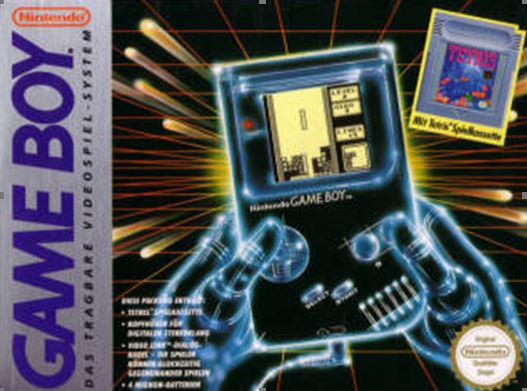
Our third game was conceived in the Orwellian year of 1984 in the dusty backrooms of Moscow's Academy of Sciences. Between the brain of its creator, Alexey Pajitnov, and the Western and Japanese markets where games were big business lay a tortuous path. After mucho shenanigans, court intrigue, and the like, Nintendo secured the rights and packed it in with their newest machine. I am, of course, talking about Tetris, the last game that arguably launched an entire genre of games console: the hand held.
I can still remember its playground debut. The gaming snobs with their PCs, Amigas, Atari STs, and MegaDrives did look down our noses at Nintendo's bland-looking box. A monochrome screen, naff name, and games that cost fifteen to twenty quid? It was like a throwback to a more primitive era instead of marking the dawning of a new one. If it had to be handheld, Atari's ill-fated Lynx and Sega's Game Gear seemed to have the right idea - both offered full colour graphics for starters. And how we larfed when a peripheral-producing firm called Nuby hit the scene. You see, 'Nuby' was a bit like nubby, which was a schoolyard term for crap. Yet for all the opprobrium and snarking the trash talk ceased when a Game Boy got passed around accompanied by Tetris. Whisper it, some of those snobs quietly invested in machines of their own.
It's not hard to see why. Tetris is an utter monster of a game. I didn't understand what the fuss was about until I took a Game Boy and played the bloody thing. Once you press start and the now familiar playfield comes into view with the irritating yet iconic music (which, forsooth, became a chart hit courtesy of Andrew Lloyd-Webber), the first set of tetrimino blocks float down the screen. You move it around this way and that before settling it at the bottom. Then the next comes and then another. All the time you're manoeuvring and cajoling your blocks into place so one complete line spanning the screen is complete and it disappears. Because that's the challenge if you've spent the last 25 years in a cave. You can complete multiple rows at once for megapoints, but the higher your pile of blocks rise the more likely the game will end. Oh, did I forget to mention that the more lines you put away the faster the rain of teriminos gets? Tetris is a game of pure playability, an utterly absorbing video game pathogen of one-more-turn syndrome. It's simplicity was its demon influence, the hook that lured in far more under-age kids than illicit drinking ever did. I haven't played it for years, but just writing about it makes me want to dig my aged Game Boy out and take the cart for a spin. Tetris taught the console-buying public and game manufacturers an important lesson, which has to be relearned time and again. What matters ultimately is not flashy graphics and kick ass sound. As nice as they are, good, memorable, classic games have to be utterly compelling to play. If a system has the best games, regardless of how powerful it is it will win out over its competitors. As the Game Boy went on to prove in subsequent years.
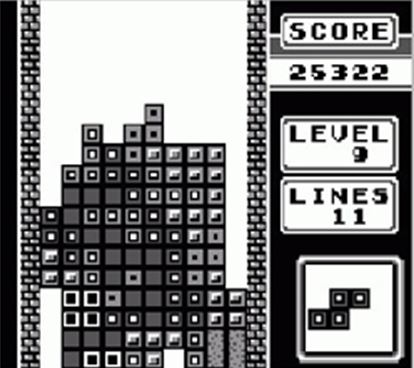
First off, Tetris can be read as an analogy of the state the Soviet Union had always been in since its inception. Stay with me. After the Bolshevik Revolution, the ruinous civil war, the reconstruction and organised chaos of the Five Year Plans and collectivisation of agriculture, and the do-or-die war with the Nazis, and the ever-present threat of nuclear stand off with the states, the USSR was always a square peg to the round hole of great power relations. What Tetris condenses is the anxiety surrounding the Politburo's ceaseless quest for peaceful co-existence in a US-dominated capitalist world. The random falling of blocks are the ceaseless froth of machinations at the UN, the fickleness of third world allies, opposition at home and in the satellite countries, relations with China. Every line made by the player is an accomplishment that temporarily stabilises the play field, which is immediately challenged again by an appearance of the next block. Unfortunately, it's inevitable that previous false moves raise the level of blocks ever upwards as they start falling faster. The contradictions left unresolved in earlier moves accumulate and conspire to sink you. The game emerged at a conjuncture when that was happening to the USSR, a process that had exploded out into the open by the time kids across the West were slotting Tetris into their Game Boys.
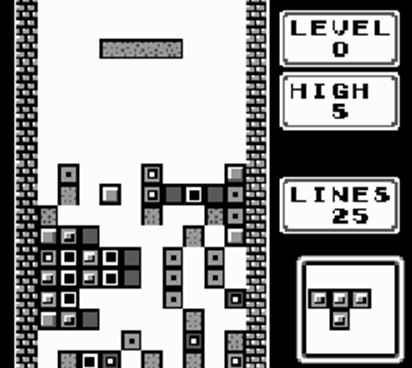
What is interesting about Tetris is its abstraction. You could make the argument that it is the first entirely abstract video game. Consider all that came before it. Nearly all video games before 1984 owed something to practices that existed outside in other media. Pong was abstract table tennis. Breakout involved a bat and ball that demolished bricks. Space Invaders spaceships and aliens. Even Qix (AKA Volfied) dressed itself up in pseudo-science fiction garb. Tetris, based on the manipulation and slotting together of abstract shapes from mathematics, completely eschews the conventions of in-game representation adopted by predecessors and contemporaries. The only concession made are high scores. Aside from that, it is to gaming what Jackson Pollock was to art: there is no reality or logics beyond the game or the work they depended on for meaning - it is entirely self-contained. To get on with Tetris demands you accept its own simple terms of reference and submit to the purity of its play. It's perhaps the nearest a game has ever got to a work of art, and has done so by accentuating its radical specificity as a video game.
Wednesday, 15 October 2014
UKIP, Symbolism, and Image

The first thing, perhaps what one might be tempted to overlook are the party colours. This leaflet from Northamptonshire is typical. Apart from the blatant "factually accurate" scaremongering, if anything the chosen colour scheme wrenches my guts more than the putrid politics. There's nothing wrong with purple or yellow in themselves. Design-wise the LibDem make okay use of their colour. And Progress combine purple with red and white to give their website and publication a pleasing pastel vibe. It's inoffensive without being twee. Which is exactly why UKIP have plumped for the opposite. The rancid colour clash is more than just a refusal to bow to good taste. It's brash, loud and uncompromising, exactly how the party likes to see itself. The bold colouring is accompanied by bold, spiky policies. It's also instantly recognisable. With the LibLabCon competing for space on your doormat, UKIP's rancid colour scheme stands out a mile.
Then there's the pound sign. A naff choice to be sure, but then again UKIP are not interested in appealing to reasoned debate, let alone electorates who prefer their politics progressive side up. As a nationalist movement it will annex everything and anything redolent of Englishness and Britishness. Can't use the royals because they're neutral (and, whisper it, not really British anyway). Can't use Westminster because it supposedly embodies everything UKIP is against. Putting aside sporting endeavour and iconic wartime imagery, there's not a lot left. A cup of tea? Chicken tikka masala? Not on your nelly. But good old sterling? Why not. It's quintessentially British and is instantly recognisable wherever you go. As symbols go we interact with it everyday, acting as a banal reminder that this is England/Britain and that our money remains our own. It symbolises economic might, certainty and sovereignty. Packed into what would otherwise be a nonsensical squiggle is the DNA of a nation - enterprise, hard graft, and independence. The pound is not stained by the blood of empire, tainted by lingering racism or the stuff and nonsense of the hooray henry classes. It's the one thoroughly democratic symbol all Britons have no problem acknowledging. And what's more the semiotics suggest that if this irreducibly British totem is sacrificed on the Euro's altar, it won't be long before our plucky national character follows the currency into an unnecessary grave. So yes, a naff choice. A canny choice.
Now to Farage. I think we've only got part of his appeal right. The plain speaking man in the pub, yadda, yadda, yadda. But leaving it at that underestimates the connection Farage has to his late middle age and elderly white male core vote. Dave Renton notes this core voter is someone who's worked all or most of their life, has acquired a modest to middling capital through savings and home ownership, were educated in the school of hard knocks and the university of life and feel a deep unease about the social change sweeping the land. While it counts some former Labour voters among the cohort, most are from that segment of working class/middle class men who don't vote Labour.
Enter Farage. His is a deeply reassuring presence for men so positioned. He's less the pub bore and more the hands-on company owner mucking in with his employees. He's well heeled, had every advantage moneyed birth can convey, but avoids condescension and patrician off-handedness. At some point in their careers millions of UKIP voters have met or become acquainted with an employer like Farage. Someone who knows it's a tough life, expects you to do the job he's given you and in return he'll level with you. Not for one to hide behind management suits, if he thinks you're crap he'll tell you. If you're shit he'll sack you. No verbal warnings or second written warnings. This is straight down the line you-know-where-you-stand-ism. Farage has a non-showy confidence in his self-presentation and what he says. Like the best bosses, he knows the score and is on top of what needs to be done. The boss of old might have won grudging respect, even if he was a bastard. But he gave it in return. What Farage has got going for him then is a masochistic nostalgia that speaks to senses of "how bad" kippers had it back in the day. Farage speaks to a band of bloodied brothers manhandled and battered by life, but who narcissistically revel in their tougher, more authentic, more certain past. That's why millions of older men are besotted and bowled over by his peculiar charisma. His like is already positively embedded in their life experience.
Loud and proud. Identity and sovereignty. Certainty and authenticity. These are concentrated in UKIP's art style, semiology, and person of their Gaffer. The fit between them is almost seamless. Decoupling them is one of the many things that need to be done to eradicate their poisonous presence for good.
Saturday, 31 May 2014
Stoke's Trip to the Chelsea Flower Show

Despite being the son of prize-winning gardeners, what I know about plants and gardens could fit on the back of a seed packet. But looking at the pictures the Council's garden looks very swish. In the socialist future all our cities will be adorned by horticultural displays of its like. And robots. Apparently, it represents Stoke as a renewed centre of advanced materials manufacture and, thanks to ambitious plans to exploit the hot rocks beneath the city, a coming powerhouse of a new green industrial revolution. The judges were very impressed. In a field of 12 showcase gardens, Positively Stoke was awarded silver, just missing out to Birmingham City Council's entry.
Not as impressed are local residents who follow the Council's comings and goings. The cost of the garden and a VIP reception lies between £250k and £450k, the majority of that picked up by the local authority's coffers. To rub it in Birmingham's costs were met mostly by sponsorship. The bill to the second city's taxpayers was just £5,000. In the context of £100m worth of cuts over the next four years, splurging on a glorified London soiree is taking the piss. Or is it?
Responding to objections, Council chief executive John van de Laarschot lays out the logic of the game the Council has to play. Because of the heavy cuts falling on Labour-run authorities, they are compelled to seek new sources of revenue. They can increase charges for council-provided services, and put up council tax. In both cases, there isn't much room to rake in mega money. And, thanks to Eric Pickles, from 2015 locally collected business rates will be returned to council as the pool from which local government presently share is abolished. As Stoke has fewer businesses in number and size terms compared with, say, Derby, that means another cut to revenues. There is only one precarious ladder out of the deepening pit the council finds itself in, and that is regenerating the local economy and increasing the numbers of people who live inside the city limits. More business = more business rates. More residents = more council tax.
This is where the perverse logics start kicking in. If the council adopts a strategy of fighting fires, of protecting budgets according to demonstrable need then it is a matter of buying time for those services. However, there will be nothing left for immediately intangible things like economic regeneration strategies. On the other hand, if the council applies cuts across the board but retains a budget to market the city to potential investors, and/or attempts to make the city more attractive through controversial developments, it opens up the possibility, the hope that it will pay off and put it on a better footing to protect services in the future.
Keeping this in mind, as unpalatable as it is, the council's decision to enter Chelsea should be seen as a speculative investment. Because it's not about the horticulture, it's about business. More politicians and business people attend the flower show than any other, outside of elite summits and the like. Chelsea is the number one networking event on the corporate calendar. Yes, unfortunately, if you're playing the regeneration game it means going where the potential investors are and spending money to catch their eye.
I don't like it. When the food bank queue is growing in our city, it is appalling that the council are spending and borrowing for things that do not address these problems. Yet that is the game by which it has to play. As those rules are unlikely to change any time soon, neither by new legislation or a mass movement challenging these logics, it's stuck. The council can do nothing and let the city's decline continue, or stretch every sinew to turn the situation around. It stinks. It's the stuff anti-politics is made of. Sadly, however, I don't think it or any other local authority in a similar position has much of a choice.
Subscribe to:
Posts (Atom)