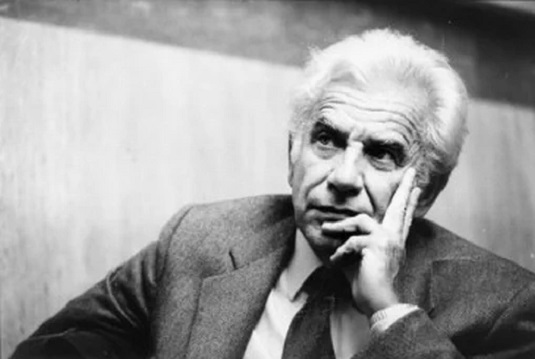
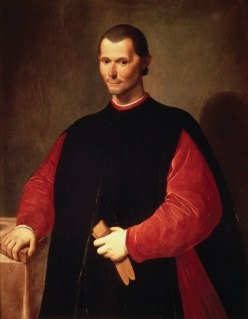
Farewell Mario Tronti, theorist of operaismo and a remaining source of inspiration for radical thinking and politics. But in an intriguing short interview given in 2015, he conveyed a message and a feeling entirely at odds with the optimism that infuses his best known work, Workers and Capital. That message was of his defeat, of our defeat, and ultimately his obsolescence and that of his politics. For a man who participated in some of the mightiest movements the working class in the West have ever seen, a movement that threw into sharp relief the question of "who rules" and came close to answering with "the workers do", the retreat from that high point to the gutter that Italian politics has become is enough to make a pessimist of anyone.
Tronti's pessimism speaks to us now because the left in this country has also been defeated. But is there anything we can take from his gloomy prognosis? Do these remarks tell us to give up, not least because Tronti talks approvingly of reading and studying reactionary thought? I would suggest not. He speaks of how operaismo and the workerist politics of Workers and Capital were situated in the moment of active and open class struggle, but that his error, and that of his comrades, was to mistake this for a revolutionary rupture. "The workers wanted a wage rise, not the revolution ... We saw red. But it wasn’t the red of a new dawn, rather that of the sunset." He says the experience taught him political realism and that the values of the left - progressivism, historicism, and Enlightenment - suppose too simple a set of solutions to the problems we face. As such, Tronti lately engaged with the world through the tinge of "serene desperation". Not least because what came of the revolutionary events of the 1960s was nothing that really challenged capitalism. Radicalisation (in Italy) led to some taking the dead end to terrorism, while for most it meant a generational turnover in the managerial class. Therefore we have two 20th centuries, the large and the small. The large was characterised by earth shattering events. The 1960s called time on that. And what came after was the small - a period of unoriginality, of low stakes politics, of (effectively) capitalism without class struggle. An endless present of stasis and decay.
Tronti does not rule out hope for the future, but just doesn't see it. He said,
This period is very confused. Everything carries on its own way. At the start of the twentieth century there was talk of a great crisis of modernity. Then it came. And now we’re up to our ears in it, we don’t know in what direction to go. So it’s stalled. You look without seeing.
This is what his realism tells him, but he also says that politics needs faith and passion. He said his communism wasn't grounded in science, but in hope. Implying that a new radical politics is possible through a fusion of the two, but without offering any direction to possible flashpoints. Tronti remarks that he's on a borderline, and like Walter Benjamin's angel of history with its eyes firmly fixed to the past his self-declared obsolescence suggested he had nothing more to say. "My father believed in a better world. He wanted to see it. Bless him. I say to young people: thank god I’m not your age. I’m glad that I’m going to see the back of this world. That’s what I say."
Not revelling in defeat, but a case of bluntly stating it. And a sense of how it put Tronti through the ringer. In the context of Britain, we've had our own defeats. The industrial losses of the 1980s. And more recently, the experience of Corbynism and its defeat from within and without. Tronti's diagnosis of a directionless society fits our predicament. There is no certainty about how to build a radical, insurgent class politics above and beyond the the defensive struggles foisted on the labour movement by the Tories and their deployment of inflation as a weapon. Stick with Labour, despite the dead hand of Starmerism? Go with the Greens and their limitations? Try and build something new? There is no guide to the way out of the impasse in Tronti, but maybe his warnings about faith and his (cautious) affirmation of realism offer a hint.
Thinking beyond Tronti, being resolutely realistic there are three observations we can make about the conjuncture in this country that suggests his rendering of defeat isn't entirely generalisable. Tronti's thought had to grapple with the decomposition of revolutionary consciousness, and later the political and industrial institutions of the working class in Italy. And then the seeming dispersal of our class as any kind of coherent actor. Like Italy, Britain underwent a similar process, but what differed was the Corbyn moment. Despite its problems, relative incoherence, and its structural tendency to compromise, it acted as a political magnet that, for an interlude, brought mass politics into the mainstream and came within a whisker of inflicting significant defeats on the Tories and the centrist/liberal establishment both. This didn't happen because people-in-general responded to the moral goodness of Corbyn and his politics, but because it spoke to the inchoate but consolidating interests of the rising class of workers. This had two aspects: a push back against the hostility shown working age people by the Tories and the neglect of the previous Labour leadership. And the political consequences of immaterial labour. The defeat of Corbynism, as painful as it was, took place at a moment of the continued consolidation and coming to consciousness of the so-called socialised worker. As such, despite Starmerism the left inside Labour, though muted, is stronger than it was before Corbynism. Street movements and mobilisations are more frequent and stronger. And the industrial battles of the labour movement are of a magnitude greater than anything seen since the early 1990s. The Corbyn moment has passed, but the return of socialist and communist politics has not.
Tronti was worried that latter day readers of Workers and Capital were wasting their time because the class organisation and class struggles it researched and reflected on were buried in the past. There were few lessons to learn in a context characterised by quietude. However, what links that work to the present are the contributions of Mariarosa Dalla Costa, Maurizio Lazzarato, and Antonio Negri - among others. The last's championing of immaterial labour, its embedding in new configurations of exploitation, and potentials for a new radical politics have been variously criticised as too hopeful and optimistic. An excess of Trontian faith, perhaps. But in the essentials, Negri is right. There are no guarantees in politics, only probabilities. His understanding of the reconstitution of the working class as immaterial workers and the consequences this has for the intertwining of subject, value, and interest formation has been borne out historically. His is not a hypothesis but increasingly a class reality his theory reflects and reports on. As such, where all Tronti could see was a messy and bewildering closure the increasingly strategic role immaterial labour plays in capital accumulation opens up new points of struggle and new directions for history.
This is why we need to think about our defeat differently to Tronti's defeatism. His was the mourning of a famous, epochal defeat. Our malaise, however, is the consequence of something that was and is significant, but not on the same scale. It was a bruise inflicted on something new, on a rising power pregnant with new potentials. As such our defeat need not be seen in Trontian terms. It does not have to be as debilitating. And, indeed, is proving itself not to be.
Growing up on a diet of Italian pop in the 1980s, a friend of mine once said it was all sub-Eurovision pap compared to the emerald mines that were the UK and US chart music of the period. This banger suggests she was very much mistaken.
Gloriously overproduced with bad hair and terrible dancing (check out the rhythm guitarist's rubbery legs), the release did better in Belgium than in Italy. But Ti Sento (I Hear You) matters where it counts - and that's in the choonage department.
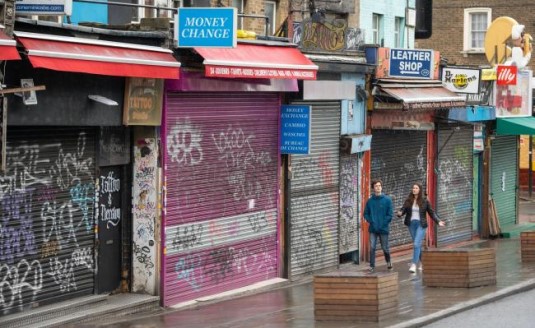
You've seen the numbers by now. Measured in GDP terms, the UK economy collapsed by a fifth between April and June. It would have been much deeper hadn't June in and of itself recorded a dead cat bounce of 8.7% growth. As Rishi Sunak says, this recession is unprecedented because the crisis precipitating it is unprecedented. True, true. Then riddle me this. Germany, down 10.1%. Belgium 12.2%. Blighted Italy, 12.4%. And even Spain, with a catastrophic a fall of 18.5%, fared better than us. The UK is the sick man of Europe again, both literally in the numbers of dead and people infected, and a far worse economic performance than any EU state. How might we account for this? We can be generous and note the UK's over-dependence on services, which comprise 81% of the economy. Germany's is just shy of 70%, Italy's is 74%, and ditto for Spain. Naturally, any country so dependent will suffer a huge contraction if social distancing is enforced. All the more reason why the Tories were loathe to take the Covid-19 threat seriously, and why they're keen to play down the crisis with jiggery-pokery over statistics, set arbitrary dates not at all informed by the epidemiology for lifting restrictions, and Gavin Williamson's outright denial of children as possible disease vectors to get schools reopened. Leaving aside the UK's relatively unique exposure to a biopolitical crisis, the next obvious (if crass) point is more excess deaths and people who are sick = fewer participating in economic activity. But when you compare the UK with Italy and Spain, we are talking relatively small numbers and certainly not enough to account for the performance gap. What gives? Firstly, timing. Going into lockdown later than most other European states did not confer the UK a brief competitive edge of any sort. Rather, it prolonged the formulation of the economic support package. The lockdown officially, and reluctantly began on 23rd March. Prior to this, on the Friday the government announced the furlough scheme, which did not go live until 20th April - almost a month later. For smaller businesses there were packages of loans and interest-free credit lines, but it was not enough and it came too late for some. Tens of thousands of businesses either shut up shop, or simply laid off staff to cut costs their much reduced operation. By tarrying, hundreds of thousands of people were left without an income and the Universal Credit hotline was duly overwhelmed. Other European states moved earlier, and so protected their economies better. The second problem was furlough itself. Paying up to 80% of staff salaries was a significant cut for many people, but there were also those excluded from the scheme, such as the self-employed and freelancers, and those who were caught between jobs. Most other schemes were more comprehensive. Thirdly, social security support. Remember, the six week wait to even receive support (reduced to five by caring, sharing Theresa May) was introduced when Iain Duncan Smith was at the DWP as a means of "encouraging" people to find work. Because, again, in topsy-turvy Westminster land there are MPs on both sides of the Commons who think welfare causes unemployment, not lack of jobs. And so a couple of million people were left with nothing while their claims were processed. And once they were? Universal Credit entitlements vary, but they're hardly generous. For instance, Jobseekers' Allowance tops out at £74.35 for the over 25s and £58.90 for 18-24s. Compare this with, say, Germany where 60% of your salary is paid up to a value of roughly £1,725/month. The Italian system is less generous, but more so than the UK's - 75% of salary up to the first €1,195, and 25% of anything over that to a maximum of €1,300, but with three per cent deductions each month after the fourth month. Spain runs a not dissimilar but more generous model. In other words, the spending power of the unemployed in each of these states is greater and therefore contributes to a shallower dip. Want more? Sick pay. Statutory sick pay is among the weakest level of support offered in any advance economy. If you're ill, you can get a princely £95.85/week provided you meet the conditions, and for up to 28 weeks. In Germany, for up to six weeks an employee is entitled to 100% of their salary. In Italy it's 50% of daily pay between the fourth and 20th day of illness, moving to 66% from the 21st day. In Spain it's 60% of salary. Again, the same observations apply. For most workers in the UK, a long-term period of illness means penury. Needless to say, the UK is the pits when it comes to redundancy payments too. It doesn't have to be like this, of course. The Tories particularly hate working people for all their flattery for them. The typical worker is needy, feckless, dishonest, lazy and, very occasionally, dangerous. Simply put, for 40 years the Tories - and New Labour - have designed a welfare system that punishes instead of supports, and reflects their real feelings about the employee class. All those decades using social security as a football to kick the most vulnerable in pursuit of votes (and labour discipline), combined with the particularly cruel turn policy took after 2010, and Johnson's own disastrous handling of the crisis is behind the crisis. The reason the UK is in the deepest depression, or rather a deeper depression than it had to be, is because of Tory policy, Tory incompetence, and Tory callousness. This is a crisis made worse by Downing Street, and it's Labour's job to pin this on them. Image Credit
As news filters through that the government have decided to ban mass gatherings and take on emergency powers, how have these measures fared in Italy - the European country by far the worst hit by Coronavirus? Living in Italy himself, Alex of Politics Theory Other interviews Antonella Serrecchia and David Broder about how the measures have been received, how the far right have seized upon the crisis to make racist political capital, and what pressures the lock down has put on the health services. The shape of British things to come?
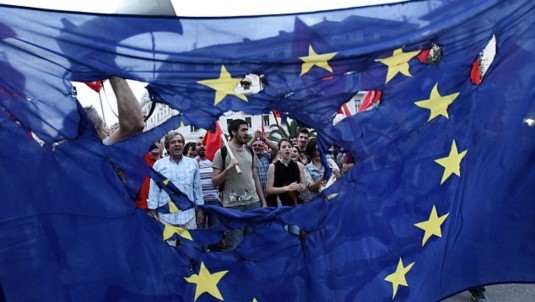
Consider the Italian crisis that blew up this last week. As the right populist Northern League and the Five Star Movement, perhaps the most pristine example of petit bourgeois radicalism seen anywhere, were negotiating the arrangements for coalition government, Matteo Salvini of Lega Nord couldn't resist the theatre of political grandstanding. He goaded the establishment by nominating Paolo Savana (a well known euro rejectionist) for finance minister, and was duly rejected by Italian president, Sergio Mattarella. Mattarella, it is worth noting, is as establishment as they come. Starting off with a social democratic-leaning section of the Christian Democrats, he has served as a trusted fixer and politician for a kaleidoscope of centrist and centre left coalitions ever since. And so he was always going to reject such a provocative move, political consequences be damned. Champagne corks must have popped in Salvini's HQ when Mattarella published the defence of his position, arguing Italy was integral to the Eurozone and that any such move would upset the markets. And, as if on cue, assorted EU figures piled in. Leading bean counter, Guenther Oettinger was forced to apologise after suggesting the bond markets would discipline Italian voters for supporting populist parties. Oops. Centrist pin up Guy Verhofstadt argued the economic difficulties Italy has experienced are because of a lack of reform. "Reform" here means - what else? - attacks on living standards, labour laws, and cuts to the public sector. It's almost as if Guy hasn't paid much attention to the way Italian politics have gone these last few years. And the Grand Poobah himself, Jean Claude Juncker suggested Italy depends too much on the EU to sort out its problems. "Italians have to take care of the poor regions of Italy. That means more work; less corruption; seriousness ..." as he helpfully put it. Good job support for staying in the Eurozone among Italians remains very strong, albeit tapering off disastrously among the young. Still, this is incredibly reckless behaviour. Is it a Eurocrat thing or a centrist thing? During the EU referendum campaign it was very easy for Leave to take the high road, because there is a significant democratic deficit at the heart of the EU. The European Parliament, the EU's sole democratic body, is not sovereign within the EU, and it is probably the most insulated elected body in Europe. Consider how UKIP MEPs have used the Brussels-Strasbourg roundabout to enrich themselves without having to do a day's work and got away with it just goes to show how distance and, well, lack of interest buffets the inhabitants of this most august of chambers from the vicissitudes of the popular will. Except twice a decade when elections roll around. Though without much in the way of power, the parliament is a clearing house for cross-continental debate and, as such, affords MEPs (well, at least those who engage) a certain perspective, a bubble of their own not unlike those inflated by Westminster, Holyrood, Cardiff and sundry council chambers. Except this bubble is largely divorced from national context, and barely followed or commented upon unless a big issue is brewing up. This isolation from national polities force MEPs into close approximation with employees of the EU, the commissioners and civil servants, who are also insulated from democratic pressures. Though there are sometimes significant political differences, there is fundamental agreement around the deepening of the European project from above, because they know best, and the acceptance of the four freedoms - unimpeded movement of goods, services, capital and people. Though, of course, none of these are as frictionless as their advocates say. The EU's predecessor organisations were conceived and set up as elite projects, and elite projects they remain. Small wonder we see a certain arrogance on the part of what passes for its best known figures. Though it's not that the EU is uniquely paternalist in its outlook. Contrary to the nonsense peddled by the Brexit right and those who would emulate them in Italy, the EU is run from the centre right. The core body is the Commission, which is comprised of appointees of each member state. It has the power to bring forward legislation, and is responsible for the EU's day-to-day running. Some powers are shared with the Council, which is comprised of ministers from each member state and is, therefore, only very indirectly elected. As right and centre right parties currently comprise a majority of EU governments, so Juncker is, unsurprisingly, from the centre right European People's Party (grouping of mainstream Conservative and Christian Democrat parties in the parliament) and Council president Donald Tusk, drawn from Poland's centre right Civic Platform. Why is this relevant? You just have to look at how the Commission has dealt with EU members in some difficulty. Greece is is the obvious example, but the same demented and enforced austerity foisted on the SYRIZA government has been imposed, albeit less harshly, on Portugal, Spain, Ireland, Cyprus and, of course, Italy. Ostensibly done to appease electorates in the more industrious and prudent countries - namely Germany - in reality it underlines not just the commitment of the right to market fundamentalism of the shortest-termist kind, but their political bankruptcy. They still have no answers to the crisis that has rumbled around the world these last 10 years. Like our very own Tories, their defence of class power and class privilege undermines the relationships that confer them authority and control. Those of us on the left who supported a remain vote in 2016 did so in the full knowledge of what the EU is. As an unaccountable elite project and international agent of austerity, nevertheless the emergence and deepening integration of European economics, culture and, well, society in general was and is an advance on strong nation states and closed borders. The left vote for remain was not because of the EU, but in spite of it. Brexit was always going to be a playground for right wing nationalism and the most backward sections of British capital, for whom the rising tide of xenophobia and further weakening of Britain's economy and position in the world stage is a price worth paying. But what is interesting is how the arrogance we see from the Commission and its minions finds itself replicated here among the so-called hard remainers. The utter idiocy of AC Grayling, marking his transition from court philosopher to court fool is one case in point. The attachment of so many self-identified centrists is more than a matter of pragmatism. It even goes beyond a Hegel-style worship of the EU as a Love, Love, Peace, Peace repository of reason. It is a deep recognition, a kinship between how they and the Commission approach politics. The EU is a living reminder, an ever-present nostalgia fest of when centrism (defined very broadly as Blairism-Cameroonism) ran the shop. With May in charge and socially liberal Toryism on the back foot, and Corbynism holding sway with a few centrist holdouts in the PLP and regional party structures, the EU figures as the time before establishment politics changed, when centrism's leading figures were feted, not scorned, by their party faithful and their words and opinions carried weight. As we have seen time and again they cannot and refuse to orientate themselves to the new situation, and so they cling to what's left of their past. It meant they were allies in the referendum, but are not and could never been any use for reforming and democratising the EU. Will the EU come out the other side of whatever else the crisis in Italy throws up? More than likely. But that's because of the deep roots of support the EU has sank in core sections of the European electorate. For as long as the commissioners and MEPs strut around, dispensing arrogant advice, for as long as the EU is seen and makes itself seen as the architect of austerity and economic stagnation, its legitimacy problems will keep bubbling up and there will be those on the right willing to exploit them for political capital.
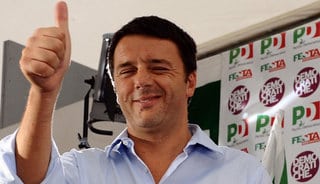
As someone who wasn't born into political radicalism (quite the opposite), relics of attitudes and ideas long abandoned sometimes clutter up the synapses. And one of these is a notion I used to hold about politicians. At the risk of making myself red faced, until quite late in the day I believed that climbing the greasy poll, to be a councillor, a Member of Parliament, and a minister you had to have something about you. Some level of intellect, a dash of charisma, the capacity to connect with people and, most helpful of all, nous. And a part of me is disappointed every time an elected representative falls short of these not-so-lofty expectations. The gentleman who's had my head a-shaking at the start of this week is Italian Prime Minister Matteo Renzi and the referendum he lost on bringing "stability" to government. As readers are aware, Italy's had almost as many different governments as there have been years since the Second World War. Renzi's ruling Democratic Party is the country's primary centre left formation, recently formed from a mishmash of the safely de-communised, social democratised former communist party, the Christian left, the greens and liberals, and a few others. These currents retain their distinct identities for the most part, with the several times diluted ex-PCI as the party's organisational backbone. Renzi for his part is described as half-way technocrat, half-way populist. He hails from a Christian democratic background and made a name for himself butting his head against the PD's leadership. He was also keen to portray himself as a moderniser in much the same vein as a certain someone, and for want of a better phrase has occupied the ground of liberal populism. Frequent targets of his rhetoric were the bankers and, in equal measure, the "privileges" secured by the trade unions (among which was protection from unjustified dismissals). How boringly petit bourgeois and, from the viewpoint of maintaining a healthy centre left, dumb. After the 2008 crash, Italy's long-term weakness was exposed. GDP growth is anemic, and the country remains a long way off recovery. And you thought Britain's GDP recovery was tardy. Unemployment is falling again, but is dangerously high, contributing its part to the erosion of the established parties and providing the relevant combustibles to our friends in the Liga Nord and Five Star Movement. As part of a package of measures he believed would pull Italy out of the doldrums, Renzi sought to inject stability into the notoriously fractious political system. Understandably thanks to 20 years under the fascist cosh and the unhappy experience of the Nazi occupation, the post-war constitution fashioned in 1947 balanced the powers of the Chamber of Deputies and the Senate. Presently a vote of no confidence in the upper house can dismiss a government, and herein lies the Italian party system's instability. With the lack of so-called strong government, opponents of the Senate's constitutional rights argue that parties have a very hard time thinking and acting in the long-term, as well as taking on challenging and controversial political projects. Renzi's referendum was about curbing these powers as well as introducing a new electoral system. This would retain PR but give a bonus number of seats to any party crossing the 40% threshold. After much wrangling and horse trading, including a pact with Silvio Berlusconi of all people, the measures cleared both houses but not by the margin deemed necessary by the constitution. Therefore the proposals had to be put to a referendum. Asking people to vote for a package of reform amounting to less democracy was never going to be an easy sell. Though, constitutionally speaking, Renzi didn't have much of a choice. But then he made the fatal error, and not one you'd expect from a politician proven to have nous enough to thrive in the rough and tumble of Italian politics. He committed a catastrophic mistake that not even Dave, the most politically inept PM of recent times was daft enough to make: by threatening to resign if the vote was lost, Renzi made the referendum all about him. There is a tendency in politics to simplify things. Policies can be complex and beyond the ken of legislators, let alone a public who cast politics the odd sideways glance outside of election time. Perhaps this was part of Renzi's reasoning. I can't imagine, for instance, that many people were fussed whether the Senate was elected on a region-by-region basis or not. But most people would certainly have had an opinion on the Prime Minister's record, which calls into question Renzi's reasoning. While not polarising or as dismal as the hapless Francois Hollande, yet, those attacks on the centre left's bedrock will have not done him any favours. While the Catholic-rooted Italian Confederation of Workers' Trade Unions backed Renzi, the Italian General Confederation of Labour (CGIL) - the main target of the earlier labour market reform package - did not and agitated for a no vote. It might not have attracted the publicity of Beppe Grillo's oh-so funny antics, but this is a union that had pulled a million people out onto the streets of Rome to protest the attacks on workers. They were an important factor, a five million strong factor and one typically overlooked by a politician unable to comprehend the political character of the parties they lead. Compounding the foolishness was allowing the populists to, well, consolidate their populism. Personalising the referendum explicitly framed the proposals as an establishment stitch-up designed to give the elites a smoother ride, and granted the awful anti-politics of Five Star permission to gain extra ground. Renzi's best bet at winning was to turn it into a snoozefest rather than a shitfest, and he completely blew it. Rightly, Italy said no to the changes. But in so doing, another Prime Minister says ciao - though no one should rule out repeat Berlusconi-style come backs for Renzi. And Grillo's movement has grown in strength and legitimacy. A good outcome with a pretty grizzly consequence, and yet another reminder why the centre left are on the retreat.
The 'Modern Prince' is among Gramsci's most important writings. Because of their significance, his notes on the modern prince (i.e. the political party) will be spread over a number of posts. In this short piece I will be concentrating on Gramsci's appreciation and appropriation of the early Florentine political theorist, Niccolò Machiavelli.
Machiavelli's had a bad press these past 500 years. Along with the Communist Manifesto and Mein Kampf, The Prince is regarded as a notorious tract of political pornography. Why? For dictators, careerists and climbers of the greasy pole, The Prince is *the* handbook for achieving and maintaining political power. Machiavelli is said to be responsible for exposing political calculation in all its naked cynicism and bad faith. For example, this piece is typical of the commentary on Machiavelli. Gramsci however had no truck with this sort of hand wringing and goes some way to rehabilitate him for Marxist political theory.
What did Gramsci want to recover from centuries of hypocritical commentary on The Prince? It was the fact Machiavelli and Gramsci were motivated by analogous political projects. Whereas Gramsci theorised the political strategy appropriate to socialism in an age where capitalism appeared exhausted (what is fascism if it is not an attempt to freeze historical development by state violence and dictatorship?), Machiavelli was concerned with developing an ideal construct/individual that could unite a "shattered people". In other words he was motivated by a political vision of a united and strong Italy that could compete on equal footing with the powerful unitary states of England, France and Spain. In this sense he was an enemy of the feudal land owners and the Pope, whose interests were served by the division of the Italian peninsular into petty states and fiefdoms. From the standpoint of the development of the productive forces, Machiavelli's project, had it been a success, would have set Italy firmly on the path to capitalist modernity centuries before Italian national unification actually occurred.
For Gramsci what made Machiavelli a modern political thinker as opposed to a utopian dreamer like Thomas More and Plato was the rooting of his project in the prevailing social conditions of his day. Gramsci argues Machiavelli knew that a movement for national unity would need to mobilise the mass of the peasantry, and the means for doing so lay in the emerging urban bourgeoisie. He favoured the reformation of militias - which were the preserve and playthings of aristocrats and princelings - into truly popular forces. And of course 'the Prince' of his work's title was to spearhead this movement. Therefore the hard headed advice Machiavelli dispenses is really a programme for building consent, winning power and consolidating a new nation-wide regime in 16th century Italy.
As far as Gramsci was concerned, Machiavelli's work was not written for those already 'in the know': it was addressed to the (would-be) constituents of the historic bloc for whom politics was not part of their complex of socialisation. In so doing he systematised the existing political practice of elites - an enterprise that may have seen the traditional classes in the centuries since reap the benefit, but also and more significantly he introduced the mechanics of political technique to those outside these exalted circles. For many commentators on Machiavelli's work, this is his real, unpardonable sin.
What was Machiavelli's relevance to Gramsci? In a very basic sense their respective political projects were similar, that is to forge a new collective will that could bring together an historic bloc of classes whose interests lay in a revolutionary direction. But that is where the similarities end. For Machiavelli, the movement he desired was personified by the prince: a figure who would act as a lightning rod for the popular social forces and who, in turn, would stamp this bloc with his personality. Under modern conditions the roles and functions of 'great men' are much more tightly circumscribed. For Gramsci it's only at specific conjunctures where politics allows decisive individual action, such as moments of crisis (cometh the hour, cometh the man is a political myth, but it contains a grain of insight by recognising individuals can exercise a crucial influence over the course of events). However the actions of the individual political leader are capable of "restoration and reorganisation", but not the major shift the supersession of capitalism by socialism would require. Therefore individual leadership is an improvisation that serves particular interests at particular times.
Instead of an individual standing at the front of the workers' movement we have (or should aim to have) the modern prince: the revolutionary socialist party. Only a collective actor is capable of the immense task of organising for socialism. As the harbinger of the socialist future and the expression of working class interests, of necessity it must address itself to the question of 'Jacobin' (i.e. insurrectionary) technique, but more importantly it is the chief agent for organising a new collective will from political and (seemingly) non-political moral, intellectual and cultural phenomena and promote the vision of socialism.
This is why Machiavelli was significant for Marxist politics. Just as The Prince stresses building the consent necessary for achieving and stabilising the prince's reign (while recommending violence be deployed when necessary), Gramsci emphasises the patient work of developing the collective will, putting off a violent confrontation with the ruling class to the point where the modern prince can pull the rest of society in its train.
Gramsci's discussion of Machiavelli raises a couple of points about the role of personality in modern politics. At first glance his idea that politics have rendered the individual redundant appears to sit uneasily with his own circumstances. If this was the case, how would he have explained the Mussolini personality cult of the fascist regime that jailed him? Furthermore the bulk of his notes date from the time when dictatorships were mushrooming all over Europe. By the time the second world war broke out, liberal democracies were thin on the ground. However if one applies Gramsci's understanding of the modern prince to the likes of Nazi Germany and Stalin's USSR, the qualitative difference between modern and late feudal/early modern politics is plain.
Most dictatorships regardless of their professed ideologies rest on a political party or a party-style organisation. This is no accident of history: parties provide the indispensable foundation for dictatorial rule. In liberal democracies, theoretically speaking parties link (mass) memberships and electorates to competing sets of political elites. The same can be said of Iraq's Ba'ath party, the Korean Workers' Party and Italy's Fascist Party, albeit the linking they performed was with a permanent leadership. While these parties possessed a monopoly on political power and enabled their figurehead considerable license to mould party and society in their image, this was only possible because of the organising capacities of their party. The party did not exist because of their leader: the leader existed because of their party.
Many may moan today about the dominance of personality politics, but this is a far cry from Gramsci's understanding of personality in the political process. Sure, personalities have become more important as the political differences between the main bourgeois parties in the West have narrowed, but it is very rare for an individual to utterly dominate their party. Whatever they like to pretend now, the Tories were never united behind Thatcher. Where personalities persist in having a 'prince-like' effects on their parties, this tends to be toward the fringes where social weight gradually drops away the further the distance travelled from the centre left and centre right (this helps explain why so many far left organisations are grouped around petty gurus, and to greater or lesser extents collectively project the personality of their comrade number one).
Returning to the main point, for Gramsci the modern prince was the revolutionary socialist party. Its task is nothing less than winning over the mass of popular classes (the working class, the peasantry) to a force (the historic bloc) is with the potential to make a revolution. Intertwined with this is the forging of a national-popular collective will that successfully challenges the hegemony of the modern day 'traditional class' (the bourgeoisie), overturns their legitimacy, and justifies the socialist transformation of society.
A list of posts in this series on the Selections from the Prison Notebooks can be found here.
The first two set of selections from Gramsci's Prison Notebooks discussed here were concerned with demonstrating how classes exerted their influence through groups of intellectuals. In the fragments grouped together in 'Notes on Italian History' Gramsci is demonstrates how the formation of the Italian state during the 19th century was the story of subordinate classes overcoming the domination of the peninsular by landed aristocracies, petty monarchs, Austria, and agents of the Pope while simultaneously negotiating the consent of the mass of the peasantry and nascent working class. As I'm no scholar of Italian history this contribution to the ongoing series on Gramsci's Selections will confine itself to a few (overly theoretical) points.
Gramsci begins by noting that classes do not enter the stage of history as unified actors: they are the outcome of particular social processes:
The historical unity of the ruling classes is realised in the State, and their history is essentially the history of States and group of States. But it would be wrong to think that this unity is purely juridical and political ... the fundamental historical unity, concretely, results from the organic relations between State or political society and "civil society" (Gramsci 1971, p.52).
Subaltern (i.e. non-ruling) classes belong to civil society: that segment of society not part of the state (in this definition the economy is part of civil society, whereas 'political society' is not). Nevertheless class histories are bound up with the state under whose auspices they developed. For example, it would be impossible to understand the making of the working class in these islands without reference to its relationship with the UK state.
To analyse non-ruling classes Gramsci recommends six methodological criteria:
1. Classes are 'objectively' formed by economic processes from the classes and strata of previous societies. Initially they have a non-conscious 'sociological' existence and to an extent their previous histories are preserved.
2. In their existence, classes have active/passive affiliations with a number of political actors of other classes. Their dealings with these parties influence them, condition political consequences of those interactions and in turn impact on the formation of the class.
3. As well as being influenced by the social weight of subaltern classes, parties and institutions belonging to the ruling class attempt to win control over them by seeking their consent to be ruled.
4. The above produces an organisational response within subaltern classes. The initial group of organisations are formed to press its own claims.
5. The second set of organisations lay claim to the interests of the subaltern class(es) in the prevailing social order.
6. Finally, organisations emerge that assert the integral, independent identity of a class as a class.
Applied to the formation of the working class in capitalist societies, these criteria can guide the study of the passage it makes from a class in itself to a class for itself (in Gramsci's guarded writing, the latter three criteria refer to the formation of trade unions, social democratic and labour parties, and revolutionary parties). Such an analysis must pay attention to the complex interplay of struggles, institutions, parties, etc.
In the second part of his notes on Italian history; 'The Problem of Political Leadership in the Formation and Development of the Nation and the Modern State in Italy', Gramsci demonstrates how the formation of the Italian bourgeoisie was bound up with the consolidation of their nation state. He begins:
... the supremacy of a social group [class] manifests itself in two ways, as "domination" and as "intellectual and moral leadership". A social group dominates antagonistic groups, which it tends to "liquidate", or to subjugate perhaps even by armed force; it leads kindred and allied groups. A social group can, and indeed must, already exercise "leadership" before winning governmental power (this indeed is one of the principal conditions for the winning of such power); it subsequently becomes dominant when it exercises power, but even if it holds it firmly in its grasp, it must continue to "lead" as well (ibid, pp 57-8).
By making the distinction between coercion and consent, Gramsci argues ruling and rising classes tend to use force for subjugating subaltern classes to its will while exercising 'intellectual and moral leadership' to speak with and bind potential class allies to it. Such leadership is the condition for winning power, but also it must continued to be exercised if a class is to retain its dominant position: class rule that depends on force of arms alone is a brittle thing doomed to early extinction.
This insight into the nature of class rule remains as keen now as it was almost 80 years ago. But as his discussion of the formation of the Italian state shows, a class must have reached a certain level of development before it can exercise intellectual and moral leadership. Looking at the revolutionary wars of Italian unification (the Risorgimento), Gramsci argued the orientation of the bourgeoisie could be summed up by two broad factions. The first was the Moderate Party, which was a 'pure' bourgeois party. Its anchor in Italy's capitalist class meant it was socially homogenous (its members were owners, managers and entrepreneurs - social locations forged by the capitalist relations of production), influential and, because of its class basis, not consistently revolutionary.
The other dominant faction of Risorgimento Italy was the Action Party. The group favoured Italian unification under a single republic and, to varying degrees, were hostile to the political influence wielded by the Vatican. However, its Jacobin pretensions were a symptom of the shallow roots it had in the Italian bourgeoisie. Without the anchor its leadership was unstable and vacillating, which in turn meant it couldn't seek to shore up its base. As such the moments the Action Party had in the Risorgimento were episodic and fleeting. Exacerbating this was its de facto alliance with the Moderates against Italy's petty states: just as the homogeneity and resources of the Moderates drew in their train intellectuals from other classes, it similarly conditioned the Action Party. If the AP was to play a similar role to its Jacobin counterparts in the French revolution, Gramsci argued it needed to separate from the Moderates and form its own 'national-popular will': it needed to build a base among the peasantry and nascent working class and become something more than the Italian bourgeoisie's arms-length revolutionaries. But it did not produce its own programme and did not go down this route. It meant the Italy what was to eventually emerge was one most in tune with the interests of its bourgeoisie: a constitutional monarchy and limited parliamentary government. But it also meant the exclusion of the working class from the revolutionary process meant it would form its own parties later on: organisations stamped by a high degree of class consciousness and a receptivity to revolutionary socialism.
Gramsci's examination of the Risorgimento period is much richer and detailed than what I've presented here. It recalls Marx's The Class Struggles in France in his grasp of the intermeshing of personalities, parties, factions and classes in the historical process.
Overall Gramsci's approach to analysing class can be most clearly seen today in the so-called Neo-Gramscian approach to study class relations at the level of states. But there are objections that can be levelled at Gramsci from within and without the Marxist tradition. The main criticism regards his analytical criteria: that a class, when formed, is on an irreversible path towards greater consciousness. Now some may take this as a teleological argument which was handed down to Gramsci from Hegel by way of Benedetto Croce, but it seems to me this criteria is the theoretical condensation of the concrete experiences of the workers' movement up to the 1930s. At the time Gramsci compiled his thoughts it was reasonable to argue the working class had risen from an amorphous mass and developed the means to become progressively self-aware and that only the brute force of fascism could set back this development in Western Europe. But from the vantage point of the early 21st century with its weaker labour movements and the massive reversals revolutionary socialism has suffered, of course Gramsci's argument appears teleological: the last 30 years has seen very significant retreats to the point where class consciousness, at least in Britain, is at an historic low.
Gramsci cannot be blamed for not anticipating socialism's current malaise. The legacies of the developments he charted are however still with us: the West European working class does retain trade unions, workers parties, and fragments of once mighty revolutionary parties. The logics of class struggle in a capitalist society means sooner or later these will again shape and condition the consciousness of the working class, but hopefully this time with a victorious conclusion.
A list of posts in this series on the Selections from the Prison Notebooks can be found here.
One of the points Gramsci emphasises in his notes on intellectuals (see the previous post) is the links between increasing intellectual specialisation and the division of labour. This is the starting point for Gramsci's brief notes, grouped in the Selections under 'The Organisation of Education and Culture' and 'In Search of the Educational Principle'. The piece begins:
It may be observed in general that in modern civilisation all practical activities have become so complex, and the sciences so interwoven with everyday life, that each practical activity tends to create a new type of school for its own executives and specialists and hence to create a body of specialist intellectuals at a higher level to teach in these schools (Gramsci 1971, p.26).
In the Italy of Gramsci's day, education had prior to Mussolini been divided by class. There was a distinction between vocational schooling, which to all intents and purposes were for proletarian and semi-proletarian layers of Italian society; and the classical schools which offered an undifferentiated and universalist education befitting the class born to rule.
As industrial capitalism took hold in the 19th century the demands of unceasing expansion and technological advancement required a new type of urban intellectual. As we saw previously these professionals tended to be drawn from the big city bourgeoisie and other urban middling layers. Furthermore, rather than benefiting from a traditional classical education these entered and graduated from new (non-manual) technical schools. While the end result of proletarian vocational education was to equip them with basic skills and habits to enter industry, the urban professionals learned how to organise it.
A consequence of this was to erode "disinterested" general education. What elements of it fed into the vocationally-oriented education of the many were put under pressure and gradually expunged. General education became even more a property of elites. This situation of course was not unique to fascist Italy - today it is increasingly difficult to defend academic disciplines not immediately connected with "usefulness" defined almost exclusively in neoliberal terms.
This link between education, class and capital is not the only one. There are other ties that bind too. In the first place, specialisation in the division of labour has a tendency to generate their own 'post-scholastic' institutions. These act as bearers of disciplinary culture, carry news about the latest developments, and are generally the public (expert) face to outsiders. These bodies are important for all forms of governance too. Gramsci reduces deliberative political bodies to two functions (whether they are democratic or not is immaterial). The first is their essential deliberative functions. The second are 'technical-cultural activities', that is complex and sometimes very technical issues they need to make decisions on. Often this is beyond their immediate competence and requires experts to analyse and make recommendations about the issues - which is where the professionals of the post-scholastic institutions come in.
It is difficult to see how this mediating role of expertise can be avoided - even the mass democracy of technologically advanced socialist societies will have to make use of specialist knowledge by 'lay' delegates and representatives. But in capitalism, this mediation is one means by which the system erodes the depth and quality of democratic decision making. Expertise, which is united by its informal disciplinary bodies, is in reality distributed across bureaucracies consisting of universities, think tanks, consultancies, enterprises, etc. Despite the disinterested, "free-floating" conceit of intellectualism, they are bound by a thousand and one bureaucratic links to public and private finance, which has the effect of defining/conditioning the parameters of expert scrutiny and the recommendations they make. Therefore when politicians turn to experts for advice, the latter's mediation helps align the (often unspoken) interests of capital with the outlook of politicians.
As an alternative to education geared around the needs of capital, Gramsci advocates a more comprehensive system drawing on vocational and classical education. He upholds a distinction between primary and secondary education. In the first phase of schooling it should provide information about rights and responsibilities and inculcate a basic world view at odds with folklorist superstition (which was still a live issue in early 20th century Italy, particularly in the countryside). Primary schooling should also be prefaced with pre-schooling. Gramsci notes that the cultural backgrounds of parents do matter - children of city dwellers come to school better habituated to the rhythms of education and school discipline (those with a background in the intellectual strata even more so). Pre-schooling can potentially "level-up" children without this background advantage.
In secondary education there is a renewed emphasis on 'humanism', which Gramsci identifies with the inculcation of the moral discipline and independent intellectual activity necessary for specialisation. Hence secondary education needs to be creative, but with limits placed on intellectual libertarianism. It must expand the individual personality and potential of its pupils appropriate to the demands of a technologically sophisticated society, but do so on the basis of a common morality. For Gramsci, the latter is inculcated in the primary phase - authority, instruction and discipline are important, but this form of comprehensive education will only really work if the result is 'dynamic' conformism.
In the second section of his notes on education, Gramsci returns to the education system prior to the fascist era (Italian education was significantly reformed by the 1923 Gentile Reform). The vocationalist education "enjoyed" by the working class and peasantry taught some of the basics of natural science, and some ideas around rights and responsibilities. For Gramsci the science was designed to prepare children for the 'realm of things', and the latter the state and civil society. Both helped move the child away from notions of natural philosophy and aimed to construct an appreciation of society - of understanding the world and how society has the power to change it. In other words, for Gramsci, the guiding principle of this education was work.
However, whatever model of education one favours Gramsci was fully aware it is not received in a vacuum - hence his argument for pre-schooling. But even then this will not and cannot engineer 'dynamically conformist' pupils. He explains:
The individual consciousness of the overwhelming majority of children reflects social and cultural relations which are different from and antagonistic to those which are represented in the school curricula: thus the "certain" of an advanced culture becomes "true" in the framework of a fossilised and anachronistic culture. There is no unity between school and life, and so there is no automatic unity between instruction and education (p.35)
Therefore hunting for an ideal method of teaching that will produce the right results (an assumption that undergirds most right wing grumbles about what's wrong with schooling in Britain) is as pointless as it is idealist. Bridging the gap between education and instruction can only be done by the teacher's practice, and for it to work they need to be aware of the gulf between their culture and society and that of their charges. The discipline and conformism necessary to imbibe formal education may (and often is) in direct contradiction with the life experiences of the pupils. As any teacher will tell you, there's nothing more difficult than teaching children who don't want to learn.
And this presents a fundamental problem socialist politics has to overcome. For large sections of the working class, there is a general lack of social competencies appropriate to the mores and discipline of formal education. And yet we need to build the capacity for intellectual work within our class to develop Marxist concepts AND the millions of organic intellectuals through which the class can become conscious of its interests.
Whether you can argue Gramsci's analysis of the situation in early 20th century Italy is appropriate to early 21st century Britain is a matter for debate. While it is true formal education is a complete turn off for significant layers of working class people, it is also true the workforce has never been more highly educated as at present. According to the 2001 Census, 30 per cent of the work force have no qualifications while 20 percent are university graduates or have a higher qualification. We may be a long way off Labour's target of 50 per cent, but undoubtedly the numbers have increased since this data was collected. So while the culture clash problem Gramsci identifies has not gone away, it would appear to be less of a problem now.
But of course, there is a related problem. Despite a highly educated work force class consciousness remains at an historic low. People are being educated, but not politically. The difficulty of propagating socialist politics, working class history, and suffusing our class with the confidence to act for itself remains - and is probably even more acute than it was in Gramsci's day.
A list of posts in this series on the Selections from the Prison Notebooks can be found here.
Gramsci's approach to intellectuals has been much abused in academia since the first publication of the Selections from the Prison Notebooks in English in 1971. In this piece I will set out as plainly as possible what Gramsci's understanding of intellectuals was and how he ties them in with the class relationships of capitalist societies.
Gramsci begins his short two-part piece, 'The Intellectuals' with a basic distinction concerning the class origins of intellectuals. 'Traditional' intellectuals are rooted in the classes that have hung over from pre-capitalist society, and as such express the interests of landed aristocracies, monarchs the church. Where these relationships have persisted into the modern era feudal classes, according to circumstance, have retained some ability to produce traditional intellectuals. But this is tempered by the ever-growing ensemble of social relations that is subject to capital. Where capitalist and feudal relations of production exist simultaneously there can be found battles that pit one set of intellectuals against another in a struggle for ideological supremacy. However, because of the greater dynamism of capitalism traditional intellectuals are onto a loser and either retreat and/or co-opted by the intellectual apparatus of the rising class - in this case, the bourgeoisie.
The other type of intellectual, the 'organic' intellectual is rooted in capitalism. They are produced by and serve the fundamental classes of that system i.e. the bourgeoisie or the proletariat (it is possible to have organic intellectuals who come from proletarian origins who go on to serve capital, and vice versa). As far as the peasantry are concerned, they do not produce organic intellectuals in the same way the bourgeoisie and working class do. Because of the historical division of peasants into semi-self sufficient households/families and their absorption by immediate concerns and interests, the peasantry has not been able to articulate its interests separately and distinctively from capitalism's fundamental classes. This isn't to say it cannot and has not produced intellectuals, obviously it has. But these have tended to be assimilated to the interests of the other classes. Therefore, Gramsci notes:
Every social group [i.e. class] coming into existence on the original terrain of an essential function in the world of economic production, creates together with itself, organically, one or more strata of intellectuals which give it homogeneity and an awareness of its own function not only in the economic but also in the social and political fields (Gramsci 1971, p.5).
So we have established the two different types of intellectual and how they are related to social class. But what *is* an intellectual? Gramsci notes "all men are intellectuals ... but not all men in society have the function of intellectuals" (p.9). Therefore an intellectual is defined by the qualities of their activities, but being an intellectual is more than just being involved in "brain work". In capitalist societies, the numbers and types of intellectuals and the ideas they employ are variously elaborated in conjunction with preceding intellectual activity and ongoing 'muscular nervous activity'. In other words, the specialist knowledge developed in conjunction with the ever-growing division of labour allows not only for the examination of the practice(s) of that division, and the suggestion for improvements/new practices. This existence as a specific form of intellectual practice forms the grounds for new ways of seeing the world. As far as Gramsci was concerned, these sorts of intellectuals are specific to capitalism and are therefore of a 'new type' that differs from the received contemplative connotations of the word 'intellectual'. He says:
The mode of being of the new intellectual can no longer consist in eloquence, which is an exterior and momentary mover of feelings and passions, but in active participation in practical life, as constructor and organiser, "permanent persuader" and not just a simple orator ... from technique-as-work one proceeds to technique-as-science and to the humanistic conception of history, without which one remain "specialised" and does not become "directive" (specialised and political) (p.10).
Therefore Gramsci demonstrates how intellectuals as organisers of capitalist production set in train a tendency that leads to the formulation of gradually more abstract ideas to the point where they are formally divorced from economic organisation altogether. That is, as intellectuals organise the class relations of production they have the effect of organising class consciousness too. As you might expect, because the bourgeoisie are the ruling class in capitalist societies and its interests are bound up with the creative/destructive chaos of capital accumulation, there is a great concentration of intellectuals of every conceivable specialism clustered around it.
It's at this point Gramsci introduces his famous notions of hegemony and civil society in order to bring out the significance of the functions of intellectuals. It's worth quoting what he has to say:
What we can do ... is to fix two major superstructural "levels": the one that can be called "civil society", that is the ensemble of organisms commonly called "private", and that of "political society" or "the state". These two levels correspond onf the one hand to the function of "hegemony" which the dominant group [class] exercises throughout society, and on the other hand to that of "direct domination" or command exercised through the state and "juridical" government (p.12)/
Hence not all the intellectuals at the bourgeoisie's disposal are of the technical/professional kind: there are intellectuals who to greater or lesser degrees (irrespective of subjective consciousness) organise ruling class hegemony, and therefore serve and defend the activities of this class. Academics, journalists, politicians and even celebrities define the parameters of public discourse, promote certain forms of common sense, provide spectacles (be they political or 'harmless' entertainment), and so on. This has the effect of naturalising existing conditions, co-opting radical grievances and protest, and seeing off alternatives through a mix of rendering them absurd/unthinkable/unworkable and/or crowding them out.
Just as the organic intellectuals of the bourgeoisie organise the hegemony of capital, hegemony (tautologically) justifies the existence of an education system appropriate to it. As one advances through modern mass education systems the degree of specialisation increases and multiplies into disciplines, sub-disciplines, and niches of sub-disciplines. The pursuit of qualifications legitimises educational hierarchies of prestige, as well as the intrinsic qualities of intellectual activity itself. Generally speaking, the more abstract a field is the more prestige accrues to it (this is certainly the case within Sociology - while careers can be made off the back of ground-breaking empirical studies, it tends to be social theorists who command lasting fame and influence).
Gramsci notes some strata tend to be 'traditional' producers of intellectuals. In the Italy of his day, middle land owners, the petit bourgeoisie and the urban bourgeoisie provided the bulk of capital's organic intellectuals. Some sons of land owners and rural/small town bourgeoisie ended up as state bureaucrats. The urban bourgeoisie found outlets for its offspring in the technical professions. Of course, the fate and growth of the latter is bound up with the spread of industry and the pace of technological change, and the further up the intellectual hierarchy you go the more and more it merges with the general business management staff of capital. Rural intellectuals on the other hand "belong" to the mass of the countryside in two senses. In terms of outlook, culture and standard of living they identify with the small town bourgeoisie. But in their everyday activity (at least in early 20th century Italy) rural intellectuals in the shape of teachers, lawyers and priests formed a contact point that bridged the gap between the peasantry and (local) state administration. They were pillars of the community and many a peasant family aspired to have their sons in these sorts of positions.
As we have seen, intellectuals are more than 'brain workers', they organise things. The bourgeoisie's organic intellectuals organise the production process and work to maintain its class hegemony over society. Proletarian intellectuals on the other hand seek to organise the working class in pursuit of its interests (more in a future post). As organisers, what is the relationship between intellectuals and political parties which are, at base, aggregates of certain interests of certain classes and/or class fractions that are pursued collectively? Is there a necessary cross over of parties and intellectuals? Gramsci thinks there is. He makes two points:
1) For the bourgeoisie, all members of 'their' political parties are 'their' organic intellectuals. The parties offer a way of training organisers and elaborating new ideas that can maintain bourgeois hegemony. Given the 'general' mass character of the political field, this is the only way they can be so organised. The isolation of technical intellectual activity from politics means this does not and cannot offer the requisite training.
2) For all classes, parties perform roles in civil society analogous to the position the state holds in political society. A bourgeois party tends to be an alliance of organic intellectuals and traditional intellectuals (where feudal relations have persisted in some form) and transforms them "into qualified political intellectuals, leaders and organisers of all the activities and functions inherent in the organic development of an integral society, both civil and political" (p.16). Regardless of the class character of a party, anyone who joins is submerged into a group of organic intellectuals and through it becomes linked to the class it represents.
In addition to these two points, regardless of size and political orientation all parties have a general character. The bourgeoisie has various associations, combines and industry bodies to tend to its immediate (economic) interests. The working class has trade unions that further its sectional interests. But only parties transcend this particularity and attends to (what it takes to be) the general interests of its class.
By way of a conclusion, intellectuals are organisers, and their activities - be they technical or political/social/ideological - are linked with organising one of the two main classes in capitalist societies, regardless of the level of abstraction they are working at (an abstraction that itself is an outcome of organising those classes in the production process). Gramsci is absolutely crystal clear about this - the bonds between intellectuals and classes maybe elastic but they are incredibly strong too. Which is why attempts to decouple hegemony and intellectuals from class, as so-called post-Marxists attempt to do are problematic. It supposes hegemony is a free floating object that somehow exists rather than being the result of elaborations an struggles in the real world. Post-Marxism is simultaneously seduced by the intellectual fiction that somehow intellectuals (or more properly, academics) stand outside and apart from actually existing historical processes.
Attending to Gramsci rather than his pomo epigoni, it could be suggested that nevertheless his understanding of intellectuals is problematic from the standpoint of socialist politics. Critics of Leninism have traditionally attacked Lenin's What Is To Be Done? for arguing that socialist politics needs to be brought to the working class "from without" by a vanguard party is elitist (the point Lenin made was actually far subtler than this, but that's for another time). Gramsci's treatment of the intellectuals could be similarly interpreted - that the working class "needs intellectuals" to organise and become aware of itself, that workers are incapable of understanding things and struggling for themselves, etc. However this position is only possible if Gramsci's understanding of what an intellectual is is twisted and pared down to its traditional meaning. It's self-evident that any class needs organisers in order for it to organise itself - and Gramsci's discussion of the part they play emphasises the importance of the left today needs to place on cadre building and training.
In the next piece we will turn to Gramsci's writings on education: how it sustains class relationships, legitimises itself, feeds into bourgeois hegemony, etc.
A list of posts in this series on the Selections from the Prison Notebooks can be found here.
On Thursday 22nd October eight million people watched Nick Griffin, the leader of the British National Party, appear on the BBC’s premier political debating programme, Question Time. The immediate reaction to Griffin’s appearance in the national press may have led one to believe that it was a complete failure for the racist right – on Friday 23rd October The Daily Express explained that ‘BNP Leader Nick Griffin is...A Complete Disgrace to Humanity’ while The Independent wrote that ‘The BBC gave him the oxygen of publicity. He choked’ – but my own reaction to his moment in the full media glare was not so certain.
It is true that Griffin’s appearance was marked by confusion, irrationality, and illogical statements. Even his racism was not logically worked out. That is to say that even Griffin’s abhorrent racist belief that Britain should be maintained exclusively for the benefit of some mythological British people, primarily made up of a mythological white working class, collapsed at various points. These points, when he made the effort to hide his racism behind the veil of a brand of ultra-nationalism able to tolerate minorities, but not displaced peoples seeking asylum, were telling because what they illustrate is what we all know only too well. That is that the BNP are well aware that their racism, the core value of their politics, is beyond the pale and must be hidden from view and never explicitly spoken about if they are ever to achieve any kind of mainstream support.
In my view it was this fact, the fact that BNP must engage in a politics of deception, a politics of deception that cannot possibly work, that rendered Griffin a comic figure on Question Time, a comic figure who had been pushed centre stage, and found himself in a situation he could not possibly cope with in the full glare of the mass media, primarily because he was forced to evade a truth everybody already knows.
However, I was also aware that Griffin’s comic appearance, his appearance as a fool, a clown, would appeal to a specific audience, simply because those already alienated from mainstream politics and turned on to the BNP were unlikely to be persuaded by a situation that could not help but show their man as a fool and the cynical discredited mainstream as a mocking audience, who were well aware of the truth their fool wanted to hide and therefore could not but appear to be to disdainful of their man. In this situation the mainstream parties really needed to resist the temptation to exploit the fool in order to confirm their own moral superiority, because this would, of course, only confirm their own bankruptcy rooted in recent events, such as the expenses scandal.
Unfortunately, I felt that this was a temptation that the mainstream parties could not resist. Herein, then, lay perhaps the main problem with Griffin’s appearance on Question Time and possibly the key factor behind the shocking result of a YouGov poll carried out hours after the broadcast that showed that 22% of British people would ‘seriously consider’ voting BNP in a future local, general, or European election and perhaps more worryingly that ‘more than half of those polled said they agreed...the party had a point in speaking up for the interests of "indigenous, white British people"’ (BBC News, Saturday, 24th October).
That is to say that the main problem with Griffin’s appearance was that the mainstream parties appeared to want to confirm their own superiority by moralising against Griffin, rather than defeating him through rational argumentation. From the point of view of Griffin’s politics this was, of course, totally unnecessary because he was already defeated by his need to hide the truth of his own position, which resulted in ridiculous statements pertaining to the tolerance of the Ku Klux Klan. Unfortunately, though, I believe that the mainstream parties could not resist exploiting Griffin’s comic persona in order to confirm their own moral righteousness, with the result that they only confirmed their own moral bankruptcy.
In my view this was the main result of Griffin’s appearance on Question Time. In other words, by over-playing their morality and tolerance and under-playing their arguments and policies, the mainstream parties have probably confirmed both their own moral bankruptcy and lack of political imagination in the eyes of those who were either alienated from or on the verge of being alienated from the political mainstream. But this begs the question, why would the mainstream parties adopt this approach to dealing with Griffin, the comedy fool?
I think that the answer to this question is that the mainstream parties wanted to simultaneously confirm, boost, or simulate their own tolerance, hide the bankruptcy of their own policies, and finally deflect attention away from the real nature of the political situation in Europe which, as sociologists such as Zygmunt Bauman and Slavoj Žižek teach us, is already closing in on a form of friendly fascism that cannot speak its name. The truth is that the BNP are amateurs and that they will be defeated if our mainstream parties engage them in reasonable debate over policies, rather than employing empty moralising about the ‘tolerant’ nature of British culture and British politics.
Unfortunately, this is likely to be a lot harder than it sounds, since the empty moralising of the mainstream parties over the blindingly obvious racist nature of the BNP has a very particular purpose, which is to confirm their tolerance and hide their intolerance regarding the flows of homeless, displaced, refugees, and asylum seekers created by the form of globalisation sponsored and advanced by the generation of neo-liberals, including Brown, Sarkozy, and Berlusconi, and the master builders of the immigration architecture of Sangatte and the Schengen zone.
For Žižek (See his ‘Berlusconi in Tehran’, London Review of Books, 23rd July, 2009), Italy, the new front line of the European battle to control immigration, is dominated by a new form of authoritarian capitalism. In Žižek’s view, the popularity of the offensive comedy fool, Berlusconi, who praised Obama for his suntan, is not coincidental, since what Berlusconi and the new Italy exemplify is a new form of state organisation that is more than happy to exploit the poor workers of the global south for their labour, so that consumers can have cheap training shoes, but not allow them to penetrate its borders, where they would become legally liable for the benefits their labour warrants.
It is the struggle against this situation, the struggle against exploitation based on racial and ethnic inequality, that must be understood as the real front line of anti-racism in Europe today. We know the BNP are racists. But we must recognise that they have, in many respects, already missed the boat. It is not that we are threatened by racism to come, but rather that the racist situation is already upon us. Given this reality, I think that we must resist the temptation to use the abhorrent nature of the BNP to affirm the mythology of the tolerance of contemporary globalisation and instead recognise the racist intolerance already pervading Europe and our own society. It is this situation that we must address if we are to really save our tolerant ideals, rather than simply use the comic fools of the BNP to kid ourselves that we live in a society that is free of racism.
One way to start to achieve this would be to break the popular support for the BNP by illustrating to the alienated white minority who have turned to them in times of need that the problem of contemporary society is not one relating to race and ethnicity, but rather one rooted in the new form of neo-liberal capitalism that plunges everybody, regardless of race, ethnicity, gender, or age, into a precarious world, where everything is uncertain. The effect of this approach would be to dismantle the mythological connection between precariousness and race that enables the BNP and other parties of the far right to scapegoat minorities, and turn popular attention towards the real problem, the form of capitalism that turns people against each other like never before.
However, this approach presents a utopian challenge. It presents a utopian challenge because such an approach would, of course, require that our political, capitalist, elite really want to do away with the BNP, that they really want to do away with the comedy fools who allow them to simulate their own tolerance and maintain the brand of authoritarian capitalism rooted in exploitation, and that they really want to found a society free of exploitation and racist intolerance.
While there has been an outpouring of media coverage in this country about last week's earthquake in central Italy, comparatively little has been written on the disaster's political fall out. Silvio Berlusconi was quick to declare a state of emergency but in recent days has reverted to clownish type, declaring survivors should treat their emergency accomodation as if it were a "camping trip", and joking with a doctor that he "wouldn't mind being resuscitated" by her. But this earthquake has done more than highlight Berlusconi's insensitivity to the suffering of others, it has exposed Italian capitalism's inability to properly prepare for disaster. Christine Thomas of the CWI's Italian section, Lotta has translated this piece from Marco Verrugio, a comrade with the Controcorrente platform of Rifondazione Comunista:
The tsunami which razed the coast to the ground like a bulldozer offered building contractors an opportunity they could never have dreamed of, and they moved quickly to grasp it. (Seth Mydans, Times Southeast Asia correspondent)
We have finally managed to clean up public housing in New Orleans. We didn't know how to do it but God did it for us. (Jim Baker, Republican congressman)
These quotes from Naomi Klein’s book The Shock Doctrine show clearly what the capitalists think of natural disasters. While all of the politicians in Italy are talking about 'national unity' and avoiding controversy (including Paolo Ferrero, general secretary of Rifondazione Comunista), it would be useful to reflect on what has happened in order to avoid the Abruzzo tragedy becoming once again a tragedy in two acts: the earthquake and the reconstruction.
Today the mood of people hit by the earthquake is despondent, in some cases distrustful of institutions (there are small towns which were only reached three days after the earthquake) and, above all, worried about their future because in Italy there are earthquake victims who are still living in prefabricated wooden houses 20 years on. But this mood could soon turn to one of anger.
Could it Have Been Foreseen? Immediately after the tragedy a controversy broke out in the press about whether the earthquake could have been predicted. For months, Abruzzo had experienced a series of tremors which led to the mayor of L’Aquila ordering all schools to be closed in the week before that fateful day. But in particular, there was discussion about the fact that a week previously, Giampaolo Giuliani, a technician and researcher at the Laboratori dell’Istituto Nazionale di Fisica Nucleare at Gran Sasso, had predicted the catastrophe. He had subsequently been accused of being alarmist and was called “an imbecile who enjoyed spreading false news” by Bertolaso, the head of Civil Protection.
The international scientific community intervened in support of Bertolaso, testifying that it is not possible to accurately predict earthquakes. While I do not feel qualified enough to get into a controversial scientific discussion of this kind, I would like to reflect politically on what a capitalist government in a country like Italy would do if prediction were possible.
L’Aquila has a population of 73,000. Obviously it would not be possible in every case to determine a priori how far the earthquake would spread, so the government would have to clear a much wider area, evacuating hundreds of thousands of people. If, for example, the cost per head of doing so was a minimum of €50 a day, to evacuate 300,000 people, it would mean spending around €15 million a day, probably for several days, because it would be difficult to predict exactly when the earthquake would begin. In addition it would be necessary to have a structure in place capable of carrying out an operation of this size 365 days a year, which would obviously be quite costly.
It would mean increasing public spending instead of cutting it as all governments have done in the last 20 years. We only have to consider the fact that the provision of hospital beds is based on ‘average occupancy’ so as to avoid empty beds, which means that with an ‘extraordinary’ event such as a ‘flu epidemic, heat wave or natural disaster the hospitals are bursting at the seams. (Recently, at the accident and emergency department of the San Martino hospital in Genoa, some patients had to wait to be seen stretched out on the floor of the hospital and similar incidents happen regularly). What is more, the government has recently drastically cut funds for safety, including for earthquakes.
All of that would be necessary without of course being sure that the earthquake tremors would be strong enough to 'justify' such expenditure, and risk being accused of alarmism and wasting public resources. On the other hand, intervening after the event reduces expenditure because only the damage is covered. Or rather, only part of the damage, because in reality finances compensate only some of the damage suffered by ordinary people, the rest goes to the companies which will be involved in the business of reconstruction. In this way, earthquakes and any natural disasters become yet another opportunity to redistribute wealth from below to above. Workers and ordinary people lose out while the banks and building companies in particular win.
So, can earthquakes be predicted? Or rather, if the government had had wind of the danger, would it have had the will or the capability of intervening to prevent it? In reality, from the capitalist point of view, it is not worth having a huge safety apparatus and applying all the safety norms to protect the population. It is more economical and, in some respects, more profitable to close the stable door after the horse has bolted. The same cynicism which oozes from the quotations cited earlier on can be applied to Abruzzo as much as to South East Asia and New Orleans.
The Building Business In a period in which the building sector is collapsing, an earthquake is one of those classic 'strokes of luck' which can 'relaunch the economy'. In Abruzzo some buildings collapsed while others just a few metres away remained intact. One building company had built 60 buildings in L’Aquila, none of which collapsed. Media interest concentrated on the San Salvatore hospital, a building which was completed in the year 2000 and was almost destroyed in the earthquake. Work on the hospital began in the ‘70s and, over the years, the cost of building it increased tenfold. Impregilo, a company owned by Benetton-Gavio-Ligresti, which is already involved in numerous scandals and had won the tender to build the bridge over the Messina Straits, worked on the hospital from 1991 to 2000. But it maintains that it merely “made it functional” and does not know who was responsible for the hospital’s walls.
Reconnaissance carried out at the ‘crime scene’ (because what happened was a crime) show that many buildings were not only built without complying to anti-earthquake norms, but without respecting the most elementary building rules - using out of date materials, building on unsuitable land and skimping on strengthening the cement. In particular, cement companies, which are usually subcontracted, use out of date material to mix the cement. Using sea sand instead of quarry sand can mean a doubling of profit margins from 30% to 50-60%. But because sea sand is full of salt, after a few years the metal of the reinforced concrete is corroded and becomes useless. If the percentage of sand is increased, compared to the cement and gravel, the costs decline further. Journalists wrote about blocks of concrete amongst the debris which had crumbled like sand. These kinds of irregularities have also been found in the new high-speed train lines in Italy, in some parts of the motorway system in the Veneto region and in the Genoa underground system.
It is well known that in Central and Southern Italy, and now also in many parts of the North, the cement market is controlled by the mafia-like ‘Camorra’. The subcontracting system allows companies at the top of the chain to entrust the dirty work to small companies and then wash their hands of them. It is also known that this system flourishes because of the links between the Mafia and politicians. In High Speed Corruption, ex-judge and ex-president of the anti-Mafia Parliamentary Commission, Ferdinando Imposimato, reveals how, in the 1990s, Romano Prodi, who was then president of the state company IRI, personally guaranteed work for the high-speed rail link in Campania to companies which had a whiff of the Mafia. Some had even been found guilty by the courts. Prodi was brought to trial and acquitted, but the magistrate who had conducted the enquiry was threatened. After the acquittal he transferred to another office before he could contest and appeal against the charge.
Now, having profited by building cardboard houses, these same companies (or other companies controlled by the same people) can see future rich pickings in the rebuilding process in Abruzzo.
As is always the case when there is a big cake to be divided, the employers call for national unity. The political parties have responded docilely and in unison. This includes the left which once again does not understand one of the golden rules of good politics: when you've got nothing intelligent to say it's better to stay quiet! Rifondazione Comunista has organised groups ready to go to Abruzzo to help, even though comrades on the ground say that this is not the main requirement. But it leaves the press to denounce those politically responsible for the massacre. The Pdci (Party of Italian Communists) is silent. Berlusconi on the other hand has said that “there was no malice” and the Italian president, after visiting L’Aquila, decreed that everyone is guilty - those who sold cardboard houses and those who bought them. In other words, everyone is guilty and everyone is innocent. He is sure to be well received at the next reception organised by the association of builders!
A Social and Political Response to the Tragedy People are anxious about the future. Everyone knows that reconstruction in Italy takes forever. Up until a few years ago in Belice, which was hit by an earthquake in 1968, 400 people were still living in shacks and reconstruction was not complete. The same is true for Irpinia, (hit in 1980), and for Umbria (1997). In Abruzzo, the government recently agreed to requests from builders to further delay any obligation to adopt anti-earthquake measures until 30th June 2010. It has waived payment of electricity and gas bills in the stricken area by way of compensation…but only for two months.
Some community organisations have already started to promote collective discussion and organisation. They have asked Italians to show solidarity with the earthquake victims not by going to Abruzzo but, for the moment, by organising initiatives and the collection of funds throughout Italy and depositing the money in local accounts until the affected community has set up its own representative organisations and projects. At the same time they have underlined the necessity of local control over reconstruction, explicitly banning companies which have previously disregarded building norms.
A left party should reflect on these initiatives, develop them and try to build a political campaign to denounce those responsible for the disaster and to promote a collective response to the needs of those who risk paying the highest price of the catastrophe - workers and small employers in the commercial and craft sector. All expenses should be frozen (bills, mortgages, taxes, charges) and everyone who has lost their house or their job should be guaranteed an income until normality is restored. Reconstruction should be immediately got underway under the control of organisations democratically elected by those who have been hit by the earthquake in order to avoid profiteering.
All building projects should be checked by law before building commences and anyone wanting to start a building company should have to meet specific requirements. At the same time, a more general proposal is needed aimed at finding those responsible for the disaster and avoiding another Abruzzo happening in the future. Large building companies like Impregilo should be nationalised with the aim of creating a large public building company with democratic control over what is built and how it is built.
Maintenance companies which have been privatised should be brought back into local authority control and building companies which have disregarded norms should be forced to pay compensation and be brought into a new public building system. Sub-contracting, which allows infiltration into the public system by small Mafia-controlled companies, should be ended. Illegal working, which in the building sector accounts for up to 40% of work, should be abolished. Workers who are deprived of basic rights are not in a position to denounce irregularities committed by the company they are working for.
A special plan should be launched to check and maintain the country’s buildings, beginning with those in the public sector. In L’Aquila it was not just the hospital and the student halls of residence which collapsed but also the court, the prefecture (from which the civil protection was supposed to have coordinated its assistance), the regional council building and the Land Registry office (where all the important data necessary for monitoring the situation and for reconstruction was housed). In addition it is estimated that around 800 schools in Italy do not meet safety requirements, as was tragically demonstrated a few months ago when the roof of a high school collapsed in a town near Turin killing one pupil.
Looking Back at the Regional Elections Until a few months ago the Italian Left governed in the Abruzzo region in alliance with the Democratic Party (DP) – known as the ‘cement’ party (or maybe it should now be the ‘sand’ party). Even after the arrest of Ottaviano Del Turco, regional president and DP spokesman, for a scandal linked to the health service, they continued participating in the alliance, covering this decision with the fig leaf of a ‘moral campaign’. On the day of the regional elections themselves the regional secretary of the PD was arrested, accused of corruption. The centre-right won the election in Abruzzo hands down. (Rifondazione Comunista alone lost 40% of its votes compared to the previous regional elections).
If the Left fails to represent the interests of workers and ordinary people when they come into conflict with the interests of the political and business lobbies, it will face self-destruction. In the regional elections in Abruzzo, 50% did not bother to vote. There did not seem to be a ‘clean’ political force. If voting were to take place today perhaps the abstention rate would be as high as 70-80%.
These are the ‘brilliant’ results of a ‘modern’ and ‘reasonable’ Left, without the ‘extremism’ which Controcorrente was accused of when we alone, at a local and national level, were saying that the Left should not ally itself with spokespeople of the ‘committee of builders ’ and a health service based on bribes and when we described the electoral agreement as an “unrealistic attempt at reviving a centre-left buried under its own rubble” (Ali Ghaderi quoted in Il Messagero, 1 November 2008). It remains to be seen whether, in the next few months, those who made that choice will examine their consciences, including at a national level, or whether once again we will be embroiled in another round of electoral alliances in the June local elections with the ‘party of crooks’, only realising the consequences of this when it is too late.