Showing posts with label Africa. Show all posts

Friday, 13 December 2024

A Sandwich Short of a Picnic

Of all the things to command politics attention on Thursday, it was Kemi Badenoch's remarks about sandwiches. In an interview with The Spectator, the Tory leader went on the record with gems like "lunch is for wimps", and decried sandwiches as "not real food". Always looking for opportunities to establish his authenticity, Keir Starmer rejoined, arguing that the sandwich is a "great British institution". Badenoch was later asked if she might indulge a turkey sarnie on Boxing Day, to which she replied "maybe a turkey pie". It's impossible to distinguish between silly season and the every day operation of mainstream politics.

This is another Badenoch gaffe. Though, remember, the Tory leader doesn't misspeak because she thinks carefully about everything she says. Which makes it worse. Obviously, a limp and alienating effort looking tough considering millions of people enjoy their lunch breaks as respite from the nonsense of the working day, and many of them will be chomping on sandwiches. Overpriced and misnamed "meal deals" or the lunch box with home-assembled fare is normal. Going out for a steak, like Badenoch apparently does, is not. For Starmer strategists bereft of ideas save tributing the right, Badenoch is the ghost of Christmases to come. Every time she says something, whether it's Prime Minister's Questions or in press interviews, she generously pours gifts down Labour's chimney. A Conservative leader who gives things away, what a novelty.

Have the Tories completely lost their minds? This place has long suggested that a lurch to the right isn't mad when they're in competition with an extreme right alternative that's breathing down their necks. But food wars, really? It only makes sense when you see what Reform have been up to lately. Their spokesperson for beating up women, Rupert Lowe, has has jumped on the conspiracy bandwagon about the cow feed additive, Bovear. A supplement that suppresses certain enzymes in a cows' gut to reduce methane emissions, he said he won't be consuming milk from Bovear-fed cattle because he likes it "natural". Someone give Lowe raw milk and see how he gets on. Nigel Farage followed this up with a TikTok where he attacked oat milk and skimmed milk, because they're left wing. Badenoch's attack on a lunch time staple, in this context, reads as a weird attempt at one-upping her Reform nemesis.

While this has been going on, her more significant and more sinister comments have got unremarked upon. Asked about her Nigerian origins, Badenoch said "I have nothing in common with the people from the north of the country, the Boko Haram where the Islamism is, those were our ethnic enemies and yet you end up being lumped in with those people." Perhaps she thought southern chauvinism and snobbery, transplanted from Nigeria to London/South East-centric politics, would delight the Tory base. Or felt her conference season "outburst" against "invalid cultures" required reinforcement via a bald stating her racialised antipathy to Islam. Or just the typical expression of an arrogance that speaks to her class privilege and hatred of the poor, combined with an animosity rooted in north Nigerians' rejection of and resistance to the southern-centric state. Some might be impressed, including Labour staffers who'll welcome another early present.

Have we learned anything from Badenoch's exercise in culinary cringe? Nothing new. She's reconfirmed her political flat footedness, cluelessness, and outright estrangement from the lives of millions of people. It's difficult even to see how this might turn the heads of the Reform-curious, so out there are her interventions. If she carries on as she has been doing, it's not only Starmer who'll have an easy time of it. So will Farage and his growing operation.

Sunday, 7 January 2024

A History of Settler Colonialism

A comprehensive overview from Sai Englert on the history of settler colonialism. In discussion with Alex, this instalment of the always-excellent Politics Theory Other looks at North America, South Africa, Brazil, and Algeria, the processes that drive different settler projects, and how Israel sits in this continuity of infamy.

If you can please help support Alex's work here

Friday, 15 April 2022

The Grotesque Rwanda Deal

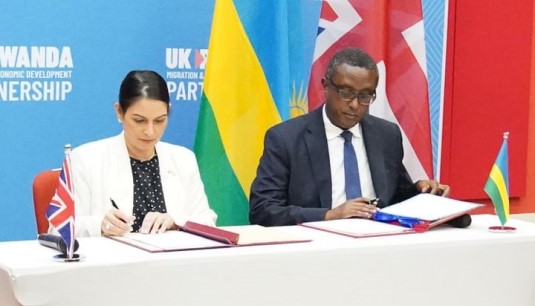
News that the Tories struck a deal with Rwanda to export asylum seekers there could not have been better timed. Priti Patel gets to play to her self-perceived strengths as a no-nonsense scourge of refugees, and Boris Johnson's "difficulties" recede into the background. And it has worked, for the moment. The coverage and the anger it has provoked is pretty much what the Tories were hoping for, though the prep work necessary to get the deal done suggests its conclusion directly after the first rule breaking fine for Johnson was coincidence rather than cunning.

The details of the agreement are grotesque. The key reasons why refugees want to come to Britain isn't because the economy is firing on all cylinders and people across the globe want a piece of the action, it's because English is the global language, there are established communities and, in some cases, family ready to welcome incomers from the most common origin countries - Afghanistan, Iraq, Eritrea, Iran, Sudan, etc. And believe it or not, despite the alacrity with which the UK has pursued wars in Africa and the Middle East, and how "our" capital remains a major extractive force in the global south, this country has a good reputation. It's safe, it's stable, there are democratic freedoms and the rule of law, and its cultural exports do an effective job of maintaining its good standing. Patel and the horrors who dreamed up the scheme know this, and their cynical thinking is geared around ending this pull factor and washing the UK's hands of its international obligations.

And it's perverse as well. Rwanda itself is not a safe country, something the UK itself acknowledged when the government recently criticised it for human rights abuses. Then there's memory, or lack of it. Building detention centres in an African nation recalls the imperial tradition of the concentration camp - the British invention that was founded on African soil during the Boer War, and used systematically against the Kenyan insurgency in the early 1950s. And there's the utter absurdity of it. An asylum seeker from Rwanda could and will be sent to Rwanda for processing.

Disgracefully, the official "opposition" fell at the first hurdle. Keir Starmer went after Johnson on money. "It's going to cost billions and billions" he wailed, before adding his customary "get a grip". This shows, once again, the abject cowardice of the Labour front bench, of refusing to challenge as the Tories set about framing an issue to their advantage. Despite polling showing that a plurality of the public oppose the scheme, the data demonstrates the most enthusiastic support for exporting refugees are among retirees. What a surprise. But rather than actually show some political leadership, Starmer is trying to skirt around the immorality of the issue by appealing to their wallets. It's a yellow bellied display that won't even work. Socially conservative voters aren't against public spending per se. They're quite happy to see money lavished on certain things, like the military, the police, and being beastly to asylum seekers. Sending people thousands of miles away from these shores satisfies their desire for punching down and and lets them sleep at night, knowing their fragile image of Britain is slightly less imperilled by the arrival of a few thousand brown people. How much Labour members' money is Starmer paying his advisors, again?

But what this also shows is Tory strategy ahead of the next general election. Having failed miserably to deliver on his modernisation promises, the only possible electoral opening for Johnson is to try and soldier on with the voter coalition that put him in office. Patel's Rwanda scheme is the centre piece of more war on woke rubbish, more promises of clamping down on undesirables, and following the war in Ukraine, a splurge on the military is in order to ward off Russian aggression. It will keep the right wing press on side and help the Tories define the issues that matter during the election. In short, an entirely regressive prospectus, but one that, despite calamity Keir, probably won't be enough to get him over the line again. The cost of living and PartyGate are exacting their toll, and even among loyal Tory voters the unease is setting in. It's just appalling that tens of thousands of refugees are going to be put through the ringer for Johnson's electoral stunt.

Image Credit

Sunday, 8 September 2019

If You’re Branding Corbyn a White Mugabe, You’ve Lost the Plot

A guest post from David Osland

Last weekend, The Sunday Times opinion pages carried an article arguing that comparisons between Boris Johnson and Hitler constituted ‘hysteria, hyperbole and mass bed-wetting’.

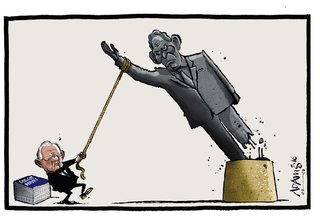
This weekend, the Sunday Times opinion pages carried an article arguing in all apparent seriousness that Jeremy Corbyn in office would seek to channel Robert Mugabe.

Double standards from the Murdoch press will hardly surprise anyone on the left. Some of us remember the routine attacks on the Labour Party from the very same publications back in the 1980s, known in the slang of the day as ‘monsterings’.

But at a time when an unelected Tory prime minister has just suspended parliament, and the salami-slice erosion of democracy in Britain is self-evidently emanating from the right, the gravity of the charges demands more than tenuous linkage on the back of a couple of anecdotes from any given journo’s student days.

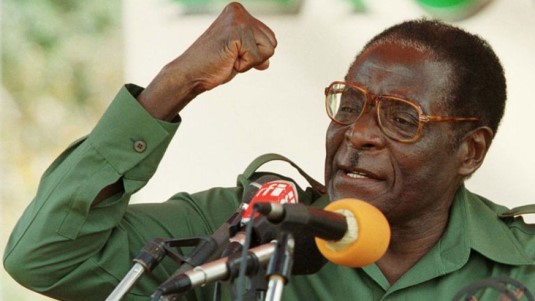
The recently-deceased Zimbabwean dictator may not have been in the same league as his German predecessor, of course. But the brutality of Mugabe’s crimes are beyond dispute.

Thousands of men, women and children — perhaps tens of thousands of them, because nobody knows for sure — were slaughtered in the Gukurahundi massacres of the 1980s, a bloody purge of political opponents who largely belonged to Ndebele ethnic group.

Operation Murambatsvina, in the following decade meant that around 700,000 shanty town dwellers and informal workers were bulldozed out of the country’s cities, often in the literal sense.

To the best of my knowledge — and I’ve known him for nearly three decades — Corbyn really is the mild-mannered bloke of widespread caricature, guilty of no offence more heinous than occasionally overrunning his allotted speaking time at Stop the War Coalition meetings.

Everyone will have their own opinion of his politics, and nobody is forced to agree with them. I’m a supporter; you might not be.

But it would surely take an unusually credulous undergraduate to fail to distinguish between a democratic socialist and an African nationalist whose bloodthirsty propensities were well known even when he took the helm of newly-independent Rhodesia.

Mr Murdoch’s stable of publications is not the power in the land it once was. But even so, it is sad to see The Sunday Times descend to the level of a slightly-more middlebrow Sunday Sport.

When newspapers that pretend to credibility come up with content that reads like a mirror image of some of the less intellectually-challenging alt-left websites, the boundaries of robust polemic or even reasoned debate are surely overstepped.

This is dumbed-down right wing propaganda, aimed at telling whoever is listening that a Labour government is the road to serfdom, and possibly far, far worse. The contention is every bit as fallacious as when first advanced, a damn sight more intelligently, after World War Two.

Since he became leader in 2015, Jeremy Corbyn has routinely been compared to every major dictator of the twentieth and twenty-first century, with Robespierre occasionally thrown in for good measure.

Unsurprisingly, those tiresome souls levelling accusations of elective affinity with Pol Pot or Enver Hoxha have never once shown where his policies have ever overstepped the ideological boundaries of traditional Labour left parliamentary socialism.

Indeed, in his defence of civil liberties — which includes opposition to such draconian New Labour bêtises such as ID cards, stop and search without suspicion and 90-day detention without trial — Corbyn can fairly be upheld as one of the few inheritors of the radical liberal mantle.

The Sunday Times knows all of this, of course. But once commentators have lost sight of the difference between the Labour Party and the ZANU-PF, they’ve lost the plot.

Image Credit

Monday, 13 May 2019

Worldmaking after Empire

A great new show in which Alex interviews Adom Getachew about her new book, Worldmaking after Empire: The Rise and Fall of Self-Determination.

As always, please support Alex's work here. More money = more quality interviews.

Monday, 23 October 2017

Guido Fawkes: Troll and Hypocrite

When do past misdeeds no longer matter? I ask because, well, this.

In the 1980s, we find a Westminster establishment regular trying to forge links with the then openly Neo-Nazi British National Party. As a luminary in the Federation of Conservative Students, he said there was a great deal of common ground between himself and the BNP, particularly with regard to "the elimination of Communism in Britain – the mass media, the trade unions, and the schoolroom."

A year later we see our hero flogging off UNITA solidarity shirts. For younger readers not au fait with this particular acronym, they began life as a Maoist anti-colonial guerrilla outfit in what was then Portuguese-occupied Angola. It then undertook an armed struggle against the pro-Soviet MPLA government and morphed into a right wing, anti-communist outfit as cash flowed in from Uncle Sam and apartheid South Africa. A truly charming organisation that was implicated in brutal atrocities and trade in blood diamonds.

Later reflecting on his youthful scrapes, he recalled "I was a fanatical, zealot anti-communist. I wasn't really a Tory, I was an anarcho-capitalist. I was lobbying at the Council of Europe and at Parliament; I was over in Washington, in Jo'burg, in South America. It was 'let's get guns for the Contras', that sort of stuff. I was enjoying it immensely, I got to go with these guys and fire off AK-47s. I always like to go where the action is, and for that period in the Reagan/Thatcher days, it was great fun, it was all expenses paid and I got to see the world." (Matthew Collin, Altered State, 1997, p.99)

Ah, the indiscretions of the young. Ah, but what do we have here? How about a forthright defence of Augusto Pinochet, replete with pig iron production figures and spin so crude they make North Korean apologetics look sophisticated. Likewise, looking back again at the small part he played in the Cold War, he boasts "I'm still pretty gung-ho. We were on the right side of history. I don't have any problem with having raised money to kill communists." Oh, and to bring matters fully up to date, our pillar of establishment politics shares the hard right's racist and sexist obsession with Diane Abbott.

None of this is news. But we have a very forgiving political class because none of the shilly-shallying with Nazis, excusing brutal dictators, and funnelling cash to and colluding with far right paramilitaries matters a jot. He's part of the scene and everything is dandy, all is forgiven. I mean, it's a good job he was hanging around with murderous thugs at the age of 21 instead of anonymously shit posting sexist and homophobic comments on the internet, otherwise he'd be finished.

Hypocrisy is a sickening thing, especially when people are happy to dog pile a new MP for saying daft things a decade-and-a-half ago, and doing so while caring nothing for the anti-social, beyond-the-pale, unrepentant doings of Paul Staines of Guido fame. It's time some perspective was had.

Thursday, 7 July 2016

Blair's Interventionism

Seven years in the making and the Chilcot Report confirms virtually everything said by the anti-war movement in the lead up to the invasion of Iraq. The conclusion was pre-determined, the intelligence was full of holes, the British military were ill-equipped for an adventure in the desert, it was known beforehand that chaos and terror would be the invasion's children, and last of all it was pointless and unnecessary.

As we know, our soon-to-be-ex-Prime Minister acquired a gambling habit that will cost us all dear. But in a way, Dave's deliberate positioning as the heir to Blair, perhaps unbeknownst to him, led him to ape "The Master" when it came to brinkmanship. Blair's desire to "sort out" Iraq came off a roll of foreign policy "triumphs". In 1997 part of Labour's success in weaning swing voters off the Tories was the party's business-as-usual pitch. There were to be no nationalisations, no splurging of the public finances. Just careful, competent management of the economy, a commitment to "what works" (i.e. privatisation and marketisation of services), and investment in crumbling infrastructure. Furthermore, as per the celebrated deal Blair had struck with Gordon Brown, the chancellor looked after domestic issues, particularly where matters economic were concerned, while Blair had a free hand elsewhere. One of these was the determination of New Labour's "ethical" foreign policy.

The West's view of the world in the late 1990s basked in the afterglow of the collapse of the USSR and its client regimes. Dictatorships in the East and Global South were giving way to nascent liberal democracies and a new world order of globalised capitalism. The West had won and now was the moment to impose a new settlement. Liberal internationalism, or "humanitarian" imperialism - depending on where you stand - was the foreign policy doctrine of choice in Washington and London, and was informed by two suppositions. The first was the "lesson" that military competition with the West destroyed the Soviet bloc and ushered in market and democracy-friendly governments in Eastern Europe - so standing up to tyranny pays. The second was the trauma of the Rwandan genocide. The so-called international community stood aside as about a million people were butchered in a state-sponsored blood rage. Victory in the Cold War showed what good interventionist policies can bring. What happened in Rwanda stood-in for the consequences of doing nothing. Therefore it had ready ideological cover to range where it pleased and was always already predisposed to meddling and intervention.

Blair was fully signed up to an interventionist foreign policy to try and solve the world's problems and make it safe for freedom and, whisper it, business. To his credit New Labour were committed to the peace process in Northern Ireland, which began under John Major, and Blair and his team deserve full credit for delivering the Good Friday Agreement. One intractable problem, solved. Contemporaneously, the conflict in the former Yugoslavia boiled over into the Kosovo crisis. Previous "humanitarian" intervention had seen the bombing of Bosnian Serbs - the "baddies" in media constructions of the conflict - and had the assisted ethnic cleansing of Serbian Krajina by Croatia in 1995. When the oppression of the Albanians of the Serb provoked resistance, a low-level conflict simmered up until the late 90s, when Milosevic set in what remained of the Yugoslav army to stamp out the Kosovan Liberation Army. Under the attempt by the Western powers to bomb Belgrade to the negotiating table, Serb forces managed to expel about a million Kosovars. Blair was an enthusiastic participant in the bombing campaign, and it appeared to work. The Serbs were no match for NATO air power, they withdrew, Kosovo became a Mafia-riddled UN protectorate, key figures - including the loathsome Milosevic - ended up in The Hague, and everyone could pretend it was a triumph for muscular liberalism.

Then came Afghanistan. After September 11th "something" had to be done about the Taliban. Cashing in the capital earned from the appalling attacks, the US pulled together a NATO coalition and started bombing Afghanistan barely a month after the fall of the towers. Providing air and special forces support for the Northern Alliance, the US and Britain helped drive the Taliban from Kabul in November. In early 2002 an interim government was formed out of exiles and anti-Taliban militias, backed up by American military power. A new liberal democratic constitution was ratified in 2004 and the first nationwide election since 1973 was held in 2005 on the basis of universal adult suffrage. Again, as a full participant in this war the ease with which the country appeared to be taken must have reinforced Blair's preference for interventionism. Remember, in the build up to Iraq the running sore of Afghanistan was not then apparent.

The lesser known 2002 British intervention in Sierra Leone makes a more convincing argument for liberal militarism than the Kosovan conflict. After 11 years of civil war, British forces were sent in to rescue foreign nationals as a hard won peace accord collapsed. But with scarcely any debate or media coverage, the British abandoned its mandate and defeated the rebel Revolutionary United Front, a peasant-based nationalist outfit noted for its thuggish cruelty and penchant for amputating limbs. It ended the civil war, restored peace and started rebuilding the country's shattered infrastructure. Blair was then, and is still regarded fondly by large numbers of Sierra Leoneans for the "services" rendered, and helps explain why Britain did much of the leg work during the Ebola crisis.

And one shouldn't forget the first Gulf War between the West and Iraq, which set the tone for the hegemonic foreign policy to come. The invasion of Kuwait by the million-strong Iraqi army, then considered the fourth largest in the world, and the subsequent coalition building and assault under US leadership had absolutely nothing to do with humanitarian concerns, but was dressed up and sold that way. Saddam Hussein wasn't removed from power, but it was a victory for democracy as the ruling Al-Sabah family scuttled back to Kuwait under Western protection. It was also in the name of humanitarian intervention that sanctions were applied and destroyed Iraq's economy, plunged its people into misery, and were occasionally bombarded under some pretext or another. This, obviously, was not Blair's doing but he inherited a set of foreign policy priorities that list Iraq and its grotesque regime the number one bogey. His toadying to Bush was as much continuity John Major as the Good Friday Agreement.

Of the four, Northern Ireland and Sierra Leone have been the most enduring of Blair's accomplishments. Kosovo is still an impoverished proto-state going nowhere fast, but at least the spectre of ethnic cleansing - of Kosovan Albanians at least - has gone. And Afghanistan? Well. But for someone at the time sold on liberal interventionism, each in their way could have been read as mission accomplished. If you wanted to believe and were prepared to suspend your critical faculties, there was ample grounds for those beliefs.

I don't think Blair should go to The Hague. I've never been convinced about the legalistic and procedural arguments around the invasion of Iraq, especially when the grounds for opposing it were ample. But what Blair is guilty of is criminal negligence and recklessness, and there is a 2.6 million word judgement to back that up.

Sunday, 25 January 2015

Why Labour Should Adopt the Citizen's Income

I'm all for nicking good policies, and one Labour and the labour movement should half-inch is the citizen's income from the Green Party. Of course, the Greens don't own it, it has been knocking about for a good many years. But they are the only ones pushing it as a key plank of their commitments. Here is the short section from their policy website, and is likely to have similar wording for the 2015 manifesto:

EC730 A Citizen's Income sufficient to cover an individual's basic needs will be introduced, which will replace tax-free allowances and most social security benefits (see EC711). A Citizen's Income is an unconditional, non-withdrawable income payable to each individual as a right of citizenship. It will not be subject to means testing and there will be no requirement to be either working or actively seeking work.

EC731 The Citizens' Income will eliminate the unemployment and poverty traps, as well as acting as a safety net to enable people to choose their own types and patterns of work (See EC400). The Citizens' Income scheme will thus enable the welfare state to develop towards a welfare community, engaging people in personally satisfying and socially useful work.

EC732 When the Citizens' Income is introduced it is intended that nobody will be in a position that they will receive less through the scheme than they were entitled to under the previous benefits system. Children will be entitled to a reduced amount which will be payable to a parent or legal guardian. People with disabilities or special needs, and single parents will receive a supplement.

EC733 Initially, the housing benefit system will remain in place alongside the Citizens' Income and will be extended to cover contributions towards mortgage repayments (see HO602). This will subsequently be reviewed to establish how housing benefit could be incorporated into the Citizen's Income, taking into account the differences in housing costs between different parts of the country and different types of housing.
At £3,692/year for over 18s, we're hardly in the territory of a weekly lottery win for everyone. But it is not without cost. The Telegraph think it will cost between £240bn-£280bn/year. Where they get this figure from I don't know. Providing an income for everyone over 18 would cost £185bn. That includes people currently in receipt of the basic state pension. Remove the 10.4m currently drawing one knocks off just over £38bn. The Greens favour funding it from a wealth tax and savings from a largely obsolescent welfare state. Extra payments for housing, the disabled, and some form of child benefit would remain.

It's not beyond the realms of possibility. It can be done if the political will and popular support is there. Two possible objections come to mind first, however.

1. It undermines the incentive to work.
2. It would contribute toward inflation.

Let's look at some evidence.

Between January 2008 and December 2009, a coalition of mainly-German aid organisations sponsored a basic income grant pilot in Otjivero-Omitara in Namibia, a small town of about a thousand people located 100km from Windhoek. Everyone under 60 was paid 100 Namibian dollars/month and the results were interesting. While the data was skewed by family members from elsewhere migrating into the town once the pilot was underway (making it look like household income actually fell for the duration), nevertheless poverty was reduced within a year from 76% to 37% of residents. For those not homing migrants, it crashed to 16%. Within six months of its introduction, underweight children fell from 42% to 17%. School drop out rates fell from 40% to 0%, debt declined from N$1,215 to $772/per person, reported crime collapsed by 42%, and the number of adults involved in "income generating activities" increased from 44% to 55%. The pilot notes "the grant enabled recipients to increase their productive income earned, particularly through starting their own small business, including brick-making, baking of bread and dress-making. The BIG contributed to the creation of a local market by increasing households' buying power."

Very good work though five years after the pilot concluded the Namibian government have not implemented the policy. However, that's Namibia, a country dominated by a huge desert, low population, and lop-sided economic development. In effect, one might argue that the period of the BIG pilot helped round out Otjivero-Omitara's local economy. Is this of any use to wealthy, Western nations? A series of US and Canadian government pilots with Negative Income Tax delivered results that were repeated by the Namibian experience. These were slightly different in that a basic income was paid only to those who fell beneath a certain threshold - think of them as a form of today's working tax credits. The Namibian effect on schooling was presaged here: attendance and attainment up, drop out rates down. Low birth weights disappeared and, in the Canadian experience, falls in accidents, and physical and mental health problems pushed hospitalisation rated down by over eight per cent. Nor was there any evidence of recipients giving up work to live off the grant. Some secondary earners - mainly women - scaled back their work hours, and there was some evidence that if a primary earner lost their job they spent a few weeks looking for a suitable replacement (pp 9-10 here).

Still not convinced? Let's take a trip to Alaska, home of the Klondike, Ice Road Truckers, and Sarah Palin. Since 1976 the state has taken a slice of oil revenues and invested the proceeds, building up a sovereign wealth fund worth around $50bn. Since 1982 the Alaska Permanent Fund Corporation has paid out a dividend to the 700,000 or so resident Alaskans of varying value.

In recent years, the value has been all over the place. I expect it will be a historic low this year, depending on the performance of its non-oil assets. While it is true prices in Alaskan shops are higher than the US heartland, this is because of import costs rather than any inflationary effects. Furthermore in November 2014 unemployment stood at 6.6% vs the national average of 5.8%. Evidence of bone idleness or the fluctuations in the oil economy? As the Department of Numbers site indicates, unemployment rates have been relatively stable since 1990.

These experiences show a citizen's income can be done, but should it be done? Of course, and as a matter of urgency: it is a simple measure that can dramatically improve the living standards of millions and, as the evidence suggests, have very beneficial knock-ons in terms of education, health, crime, and community cohesion. That's why the Greens and increasing numbers of Labour people endorse it. From a labour movement point of view, there's another compelling reason.

For 35 years business has had the whip hand over the global economy. Capital freeboots its way across the planet subject to few checks, and playing one region off against another. David Harvey made the compelling case in his A Brief History of Neoliberalism that capital in its neoliberal phase is decadent and regressive. Profits have not come from the expansion of the productive forces, as Marxists would put it, but rather by an 'accumulation by dispossession'. The forced enclosures of land, the selling off of publicly-owned assets, the export and deletion of jobs, the introduction of markets into public services, and the erosion of progressive income tax regimes has redistributed wealth from the poor to the rich. It's a global power grab that's only been possible because labour movements have been defeated in far too many countries far too many times.

From a British perspective, this has meant that many millions of people are not covered by trade union protections and are subject to overwork, pitiful pay rises, job insecurity. And that's the full-time workers. As the government talks up the economic recovery and trumpets jobs growth, a simple look at the figures shows that 24 out of every 40 new jobs are full-time, yet in 2008 the F/T rate stood at 64%. And today? 62%. We have a job market increasingly bent toward part-time working in which many people can't make ends meet. With unemployment high and competition fierce for what full-time jobs there are, its bent far too much toward the purveyors of temporary working and zero hour contracts. A citizen's income would change all this. If people entering the job market know they have a regular weekly payment providing a little bit more security, the market incentivises good employers. No longer will workers have to cling to a low paid job with an awful boss. A basic income will keep the wolf from the door, changing entirely the balance between employers and employees, and offering new political opportunities our movement can capitalise on.

This is the other reason why I support the basic citizen's income. It's a bold step toward securing the interests of our people and changing society permanently for the better. We need to take it up, turn it into party policy, and win it.

Thursday, 9 October 2014

Ebola, Complacency and Crisis

Health emergency in West Africa? Who gives a shit. Until the last month or so, that pretty much summed up the attitude in Western newsrooms and policy-making circles. After all, when is there not some kind of health crisis blighting the people of Sub-Saharan, central and southern Africa? HIV/AIDS is an ugly shadow cast over the fate of entire nations. According to the UN 1-in-20 live with the disease, with over 15% of 15-49 year olds infected in some countries. As awful a social disaster and human tragedy this is, it pales next to Malaria where, despite falling infection rates, it kills a child every minute. Meanwhile, diarrhoel infections carry off approximately 1.5m African kids every year. So yeah, there's been outbreaks and rumours of outbreaks before but as long as it never threatened our green and pleasant, few but concerned journalists and far-sighted public health experts were banging the Ebola drum.

There's politics too. Successive governments make big deals about protecting the overseas aid budget. While Dave's parading of development cash smacks more of "not all Western governments!" posturing, there is precious little the department has done to challenge lazy journalism and the festering little Englandism it stokes. This is a politics that says Britain has no place helping the poor in developing nations when states there are building infrastructure and investing in future proof industry. This silence has helped engender an utterly toxic politics around aid questions paralleling home grown scrounger discourse. In the early stages of the Ebola outbreak, intervening decisively across Liberia, Sierra Leone, and Guinea required the kind of mobilisation we're only now seeing. The difference then, of course, that a great deal of political capital would have been staked without an obviously tangible outcome. No one is thanked for curbing a small-scale outbreak, especially where African lives are concerned.

And now, it's almost too late. The experts say our posse of barely-functioning states, Western military and medical personnel, and transnational NGOs have 60 days to get the outbreak under control before the contagion runs amok. With many blighted communities going "off-grid" and refusing to cooperate with what limited authority there is, and the drip, drip of infections outwith the region - including a likely Ebola death in Macedonia - it all smacks of the TL,TL syndrome (too little, too late). Given the scale of the disaster unfolding and the historical debts France, Britain and the US owe Guinea, Sierra Leone and Liberia respectively, more resource and more volunteers should be poured into the region.

Meanwhile at home, there is very little governments can actually do to face down Ebola. The much-vaunted screening splashed across the evening's bulletins are more about reassurance than public health. Remember, the disease takes 21 days to incubate before entering its most infectious - and lethal - phase. There's no breathalyser, no tricorder, no bloody speak-your-tropical-disease machines. It's just going to be an infrared scanner and medics with multiple choice questions. As the government flag up these "robust" protective measures, it's also emphasising how "well-equipped" Britain is to deal with Ebola infections. We have the procedures, the beds, the infrastructure and the expertise to deal. If it turns up on these shores? Nay problem. We are not Liberia.

All that might be true. If the government says it, of course it is. But beware unintended consequences. Sensibly we are being warned to seek medical advice/attention as soon as we present symptoms. Unfortunately, initial symptoms are fever, headaches, joint and muscle pain, and a sore throat. Last week I had the dubious pleasure of contracting freshers' flu. Guess what symptoms I was exhibiting? It's not beyond the realm of possibility that a few more confirmed Ebola cases in the UK could spark a stampede at walk-in centres, doctors' surgeries, A&Es of people suffering nothing other than the seasonal sniffles and shakes. Better-to-be-safe-than-sorry could touch off an almighty winter beds crisis, complicated by a decreased lack of capacity to catch Ebola sufferers. What a shambles.

And there we have it. Western complacency and the toxic politics of overseas aids has, in Britain's case, raises the possibility of an entirely avoidable health care meltdown. It's the kind of situation the word 'omnishambles' was invented for, but one in which misery will be reaped. Not laughs.

Thursday, 5 December 2013

Mandela the Revolutionary

"Mandela may or may not be forgotten, but he will certainly be distorted, starting now." As I write, the obituary portraits are being updated and given the requisite spin. For official politics it will be Saint Mandela, the liberal hero. For the hard right it will be Mandela the terrorist, the man who waged a brutal war against the authorities. And for the far left, it's Mandela the sell-out - the leader who oversaw neoliberalism in South Africa and the supplying of arms to anyone who could pay. The figure of Mandela is contested because he is, perhaps, all these things. And more.

One aspect that will be glossed over is Mandela's period as an underground revolutionary just prior to his capture and celebrated, if that's the right word, imprisonment. It was Mandela who convinced the ANC leadership to wage armed guerilla struggle. It was Mandela who worked closely with South African communists and co-founded the paramilitary 'Spear of the Nation' (MK) organisation. It was Mandela who sourced weaponry for MK, and led bombing campaigns - albeit with the express intention of minimising civilian casualties. And once at Robben Island, Mandela became the head of a cadre school for ANC and SACP revolutionaries, not many of whom passed on to legalistic, non-violent political action.

And yes, this revolutionary activity was entirely justified. At that particular time, in that particular place, when change couldn't be carried by peaceful social movements and the ballot box there was nothing else left. Politics will always find a way. As such, the ANC's resistance to the apartheid regime is a chapter of history written in the anguish of the tortured and the blood of the fallen. But it was this intense struggle that kept Mandela as its figurehead, and his own incarceration as its example.

The crisis of the apartheid regime was bought by the blood price the ANC paid. It was the revolutionary struggle that forced the government around the negotiating table. Then was the right time for the ANC's strategy to switch from armed confrontation and insurrection to winning political and cultural hegemony around a post-Apartheid project. The subsequent truth and reconciliation process, which saw some of apartheid's worst criminals escape justice, has proven its worth by consolidating the transfer to majority rule. Like any good revolutionary, Mandela knew 'by any means necessary' meant just that.

Like all revolutionaries, Mandela was a flawed human being forced by event and circumstance to fall short of of his ideals. But his work and the movement he led opened South Africa up to democracy and tolerance. It is not paradise, far from it. The 'rainbow nation' is beset by political tensions and economic problems - but the path of achieving permanent progressive social change is much smoother than it would be were it not for his efforts.

Wednesday, 14 August 2013

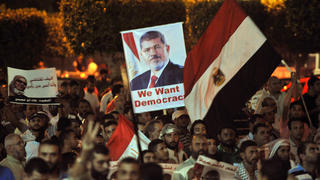
Egypt's Day of Terror

Egypt's day of terror has been brewing for a long time. 18 months ago, Mubarak's regime suffered a mortal body blow on Egypt's Day of Rage as millions poured onto the streets. Approximately two weeks later Mubarak had been swept from power by an alliance of convenience of ancien regime opponents, and a military presenting itself as a neutral arbiter and guarantor of stability. The problem then became one typical of the fall of all authoritarian governments. They are brittle things, despite the varying levels of repression they mete out during their life time. Yet the whole apparatus of secret policemen and stupid brutality can temporarily keep a lid on the contradictions building up. Following Mubarak's overthrow there was less a carnival of the oppressed and more a maelstrom of political antagonism, looting and violence, and it could not be otherwise.

Then came Egypt's brief foray into liberal democracy. For a country as volatile as Egypt and with many of "tasks" of the revolution unfulfilled, rushing headlong into the model of a winner-takes-all presidency similar to the United States was probably not the most thought-through of constitutional moves. It works in the US because the main parties are qualitatively the same. It works in Britain because the cleavage along which the two main parties line up has long been rendered stable and institutionalised. It's almost as if a US-style presidency was chosen because it was bound to fail. But even had a less adversarial system been arrived at, governing post-revolutionary Egypt would have been a tough thanks to the protests, disputes, pogroms against Coptics, economic crisis, and Islamist incursions in the Sinai. More seriously from the point of view of the new government's viability was that the  state was shot through with dual power, of sorts.

In Marxist accounts of revolution, dual power has a very exact meaning. It refers to a fleeting moment in the revolutionary process where the traditional classes retain their grip on the old state machinery, but running in parallel and institutionally opposed to it is a state form in embryo: the network of directly elected representatives of working people organised into councils or soviets. This cannot remain the case indefinitely, one has to win out at the expense of the other. But I'm going to muddy the categorical waters. Egypt throughout Morsi's tenure was subject to dual power of a different kind. You had the civilian administration enjoying, at least on paper, the legitimacy of the country's first elected presidency. But opposed to the Muslim Brotherhood's president was the military that, in 2011, acted in a Bonapartist fashion to prevent revolutionary "excess". The state for the last year was, in effect, the site of an institutional civil war. Of manoeuvres of place and position, of hirings and firings. Unfortunately for the Muslim Brotherhood, while they were disadvantaged in this game from the moment Morsi took office their man was far from an astute player. Dishing out decrees is not the way to negotiate a delicate situation, for instance.

When popular forces opposed to Morsi took to the streets time had run out for the government. It was an opportunity for military hawks to remove a movement from power they had repressed all their careers. However, historical necessity also came into play. Just as in 2011, Egypt's armed forces were no institutional island. Rank-and-file personnel come from families directly affected by unemployment, falling wages and poverty. The revolutionary pressures that brought the millions out onto the streets affected the troops like a virus. Had the top brass set their face against it, a split in the armed forces was likely - as we have seen in other Arab Spring revolutions - or they would have been swept away by a junior officer takeover. The army can act like a Bonaparte, as a 'third force' rising above when contending classes and class fractions are balanced out and unable to shift one another. But this too is conditioned by and subject to those ebbs and flows.

The military were pressured on pain of a second, perhaps more uncertain and bloody revolution to make their move. But in resolving one set of contradictions several more, hydra-like, sprung up in their place. Morsi now "enjoys" the protection of the army but what to do about the Muslim Brotherhood who, despite occupying a spectrum of Islamist opinion and representing neither rising nor progressive social forces, nevertheless command massive support and millions of votes? Governments of whatever stripe facing an insurgency typically have two options that don't necessarily exclude one another: co-option and repression. Unfortunately for the military and their puppet civilian administration, their promised transition to democratic rule "as soon as possible" forestalled as soon as they removed Morsi from office. The Muslim Brotherhood is not an homogenous lump, but bonds of solidarity and collective experience have continually been reinforced over decades of underground existence. Barely one year into democratic rule in "ordinary" times it would be horrendously difficult to split and co-opt parts of such a movement into a power sharing arrangement. But impossible when the army and its allies in the state machinery had stymied and resisted the Brotherhood from the day of Morsi's inauguration. Getting them to engage with the reconciliation/power sharing process, in whole or in part, was never going to happen.

Yet the relatively peaceful permanent protest camps could not be allowed to stand either. In and of themselves they were not disruptive despite what government spokespeople say, but they weighed on the military's brains like an Alp. In Egypt's febrile conjuncture each camp was a reminder that not only did a mass Islamist opposition still exist, but also that - despite the popular support the military can command - it faced an equally popular movement, and one that could capitalise on economic and political discontent and grow further. It could not stand and today the military have tried to drown this possibility in blood.

Where now? The Brotherhood are back underground and the declaration of a state of emergency signals a return to dictatorship. And so the wheel appears to have turned full circle. The revolution is stalled and democracy, as stilted as it was, is dead. At least for the moment. By acting in this way the military now puts itself in the firing line. The antagonism between it and the Muslim Brotherhood cannot be resolved institutionally, but it too will be unable to meet the hopes of the millions who begged it to take power. As a new underground war against the Brotherhood starts smiting other perceived enemies of the new regime, and for as long as Egypt's protracted economic problems go unresolved the generals sitting very pretty tonight could find arrayed against them the bulk of the nation's population in a short space of time. And what then?

Saturday, 6 July 2013

Egypt: Why Morsi Fell

Oh, hello again Mr ElBaradei. It's been well over two years since I last wrote about Egypt. Since then, there's been a lot of changes. But in a rather peculiar way, things are the same again. A heavy-handed and out-of-touch presidency is toppled by a de facto alliance of a millions-strong insurgency and the military, and once again the mercurial Mohamed ElBaradei is prepared to act as an interim figure until things die down and elections are called. The only difference between this time and last is, unlike ElBaradei and his military friends, his predecessor - the hapless Mohammed Morsi - actually had democratic credentials he could brag about. Oh, and that ElBaradei actually made it into the interim's chair on this occasion.

The scenes that have played out on our screens again this last week are inspiring and deeply worrying all at once. Millions taking to the street is enough to stir any socialist, regardless of how cynical they may have become. But seeing it mobilise, agitate for and support a temporary military takeover is something else. That will require a post of its own, so the question I want to confine myself here to is how Egypt found itself convulsed by a revolutionary crisis two short years after Mubarak's departure, and one year since Egypt's first properly democratic - at least by internationally-recognised standards - presidential election. Let's begin with the basics.

As a rule, while not adept at fomenting them Trotskyists nevertheless have a good understanding of the dynamics of revolutions, and the standard frame of Trotsky's permanent revolution stands up well in this case. Egypt has a growing but still subaltern presence in the global economic order. Its healthy GDP growth figures (5.1% per annum before the revolution, 1.8 and 1.5 per cent each year since) belies chronic unemployment, poverty wages and spiralling prices. While the state was a significant factor in the economy - a legacy of Nasserism - Egypt's development has also been held back by Mubarak’s grotesque dictatorship. While undoubtedly resting on a measure of popular consent (as all dictators do), one of its key props of support was the United States. In words that ring true for Mubarak as they did for Somoza, as Harry Truman put it "he's a bastard, but he's our bastard". As the declining but still dominant global hegemon, it has long been in the USA's strategic interests to maintain a friendly regime in Egypt as both the most populous and potentially powerful Arab state; and as home to the vital Suez Canal. Control of this arterial waterway is absolutely paramount to any who seek to dominate the Middle East. Unfortunately for the ancien regime Egypt’s economic problems could not be untangled from the dead hand of political authoritarianism and economic subordination. Hence when it came to the crunch, the antagonisms arising from mass unemployment and the absence of basic liberties were too much for Mubarak to keep a lid on. And off to the dustbin he went.

The problem is, from the viewpoint of Trotsky’s theory, the Arab Spring in Egypt stopped well short of solving the country’s problems. For the fetters placed on Egyptian capitalism by dictatorship and foreign domination to be swept aside and the long-term issues of its underdevelopment to be addressed, their resolution depends on the revolution being socialist in character. It might have been a while since one of those has come along, but the point stands. The ‘indigenous’ capitalism of a state in Egypt’s position is incapable of consistently addressing developmental issues because the domestic bourgeoisie are compromised by the immediate interests they have in the present set up. Hence rounded out development of a nation like Egypt depends on the working class via its revolutionary party taking into ownership the commanding heights of the economy. And in so doing, the question of the development of Egyptian capitalism becomes one of the development of Egyptian socialism.

However, one would need a magnifying glass to identify the influence revolutionary socialism has in Egypt at this juncture. Therefore the assumption of revolutionary leadership by the Muslim Brotherhood some time after Mubarak was deposed would likely store trouble up for itself. They did not have a programme to address Egypt's underdevelopment. They did not have a programme that could satisfy the aspirations of the street. Nor did they have a programme for the modernisation of the Egyptian state apparatus. As a movement whose core constituency was the petit bourgeois, sections of the urban middle class, landowners, and what remains of the peasantry all it could achieve, at best, was a fudge. It wasn't that Morsi's leadership had 'failed'. It was always doomed to do so because the Brotherhood was structurally incapable of satisfying the revolution's appetite. The social forces it represented, ultimately, were tied too much to the prevailing state of affairs. And when revolutions go hungry, they have the awful habit of consuming their children.

But, of course, Morsi's leadership did fail. Just because history's cards are stacked against you doesn't mean your actions have zero bearing on the outcome of the game. And by all accounts, his presidency was a disaster. To be fair, and as you might expect, inheriting a state apparatus stuffed with Mubarak place men found Morsi at a disadvantage from day one. Nor were things helped by having to fight turf wars with the army. It's in this context that his November decree that exempted his decisions from judicial or any kind of oversight must be viewed. With the army temporarily sidelined and any incoming legal challenges to his summer purge of the top brass headed off, Morsi's decree was a provocation to others involved in drawing up Egypt's new constitution. Denounced as a "new pharaoh", liberal and secular elements quit the constituent assembly and violent street scenes manifested. The decree was later reversed, though peculiarly maintained the effects of the decree stood. When is a withdrawal not a withdrawal? Nevertheless the constitutional referendum, held on December 15th, passed it into law - including controversial sections on Sharia-derived jurisprudence. Perhaps more interesting was the constitution's attempt to ameliorate the military to the new system of governance. They enjoyed a special self-appointed committee that dealt with "military matters" and controlled the defence budget. They also retained the right to try civilians for crimes of harm against the armed forces, however that may be so defined.

Unfortunately, for Morsi, while this was a clever-clever piece of politicking it did not wash with the masses outside. From the resumption of protests in Tahrir Square that December a febrile mood had the nation gripped. Dozens lay dead after clashes with the police. Matters definitely weren't helped by a perceived softness toward a crackdown on Hamas influence in the eastern Sinai, or turning a blind eye to sectarian murder. Perhaps most stupid of all Morsi's decisions was the appointment of Adel el-Khayat as governor of Luxor. Presumably, this attempt to shore up his support among the ultra-reactionary phalanx of Salfaist politicians blinded him to the small matter that he was associated with a group that killed 58 tourists in 1997. I'm sure the bulk of his Muslim Brotherhood base would be okay with that. Wider sections of society less so.

Among the list of manoeuvring and front-and-back stage battling you will be hard pressed to find anything approaching a social programme. Instead, what Morsi's one year in office represented was an attempt to consolidate an authoritarian presidency in a volatile situation, albeit one that allowed the contradictions to build and, on occasion, taking a stick and stirring them up some more. Ultimately, he tried to rule in the old way when the masses were not willing to be so ruled. And despite his undoubted mass support the Brotherhood, or the bulk of its sociological composition, do not represent Egypt's future.

Morsi may be gone, for now, and the Brotherhood on the receiving end of the military lash once more. But even the army won't be able to keep a lid on things. They may enjoy popular support right now, but in one, two, three months time? I'll return to this in another post.
Sunday, 6 February 2011

Statement of the Revolutionary Socialists of Egypt

The statement below was first posted on Socialist Unity by johng here. The Revolutionary Socialists are a current unaligned with any international tendency but are influenced by and have friendly relations with the SWP's International Socialist Tendency. For an overview of how they have related to the thorny issue of the Muslim Brotherhood, see here. And John Rees of Counterfire has recently returned from Tahrir Square in Cairo - you can view his talk here.

Statement of the Revolutionary Socialists Egypt:

Glory to the martyrs! Victory to the revolution!


What is happening today is the largest popular revolution in the history of our country and of the entire Arab world. The sacrifice of our martyrs has built our revolution and we have broken through all the barriers of fear. We will not back down until the criminal ‘leaders’ and their criminal system is destroyed.

Call to Egyptian workers. Statement from the Revolutionary Socialists, Egypt:

The demonstrations and protests have played a key role in igniting and continuing our revolution. Now we need the workers. They can seal the fate of the regime. Not only by participating in the demonstrations, but by organising a general strike in all the vital industries and large corporations.

The regime can afford to wait out the sit-ins and demonstrations for days and weeks, but it cannot last beyond a few hours if workers use strikes as a weapon. Strike on the railways, on public transport, the airports and large industrial companies! Egyptian Workers! On behalf of the rebellious youth, and on behalf of the blood of our martyrs, join the ranks of the revolution, use your power and victory will be ours!

Form revolutionary councils urgently.

This revolution has surpassed our greatest expectations. Nobody expected to see these numbers. Nobody expected that Egyptians would be this brave in the face of the police. Nobody can say that we did not force the dictator to retreat. Nobody can say that a transformation did not happen in Middan el Tahrir.

What we need right now is to push for the socio-economic demands as part of our demands, so that the person sitting in his home knows that we fighting for their right. We need to organize ourselves into popular committees which elects its higher councils democratically, and from below. These councils must form a higher council which includes delegates of all the tendencies. We must elect a higher council of people who represent us, and in whom we trust. We call for the formation of popular councils in Middan Tahrir, and in all the cities of Egypt.

Statement of the Revolutionary Socialists, Egypt, on the role of the army:

Everyone asks: Is the Army with the people or against them?
The army is not a single block. The interests of soldiers and junior officers are the same as the interests of the masses. But the senior officers are Mubarak’s men, chosen carefully to protect his regime of corruption, wealth and tyranny. It is an integral part of the system.

This army is no longer the people’s army. This army is not the one which defeated the Zionist enemy in October 73. This army is closely associated with America and Israel. Its role is to protect Israel, not the people. Yes we want to win the soldiers of the revolution. But we must not be fooled by slogans that ‘the army is on our side’. The army will either suppress the demonstrations directly, or by restructuring the police to play this role.

Tuesday, 1 February 2011

Egypt: Revolution, Democracy, and Stability

As I write hundreds of thousands of people have poured into Tahrir Square in Cairo to demand the resignation of the increasingly beleaguered and pathetic-looking Hosni Mubarak. When a people have lost their fear there are few things more wretched than a tyrant clinging on to power while it crumbles away beneath his grip. With over a million out on the streets across Egypt and a pledge by the army not to intervene, surely even Mubarak has to realise the writing's on the wall. Things just cannot carry on as they are. With mass mobilisations, an army refusing to follow presidential orders, a general strike crippling the country, and international calls for him to step down in the name of stability, something has got to give. If the army aren't backing the regime the only social forces with a direct interest in the dictatorship - big business, police (both overt and secret) and other dependents of the security apparatus - appear to lack the weight necessary to drown the uprisings in blood.

Unsurprisingly there has been some talk of what comes next. Assuming Mubarak and his regime are swept away by the end of the week (protesters have given him until Friday to leave power), who will fill the vacuum? While there are reports of the formation of neighbourhood committees, a development ironically spurred on by the random violence of National Democratic Party thugs, we are not in a situation of dual power. Yet. As the movement continues to grow and the labour movement revives off the back of strike action, these community defence organisations could put on more flesh as they organise to meet food shortages and make up for the collapse of local governance. Clearly for the revolution to assume a socialist colouration leftists on the ground will likely be doing everything they can to participate in them and encourage their development further.

All this represents a massive headache for the US and the main European powers. They neither want Egypt to fall to the Muslim Brotherhood in a latter day repeat of the 1979 Iranian revolution (which doesn't look all that likely anyway given the character of the protests so far and a
certain reluctance by the Brothers to get stuck into recent social struggles). Nor a prolongation of the stand off between the Mubarak regime and the people. The more it carries on, the greater the likelihood of civil war and/or the return of the spectre manifesting itself in embryo in the neighbourhood committees.

Egypt is, of course, home of the strategically crucial Suez Canal. An Egypt opposed to Western interests, be it Islamist, nationalist or, (dare we say it?) socialist, would represent a major defeat of their geopolitical strategy as it would restrict access to Middle Eastern oil and the markets of India, China, and South East Asia. I imagine there's been a few sleepless nights at the US State Department.

Amid much handwringing and the semi-ritualised "Egypt's government is a matter for the Egyptian people" (an oft-quoted principle that got stuck down the memory hole in the lead up to the Iraq war),
Hillary Clinton and Alistair Burt have been singing from the same hymn sheet. They of course "deplore" the violence and call for the return of stability.

It's stability that's the key here. Political revolutions against corrupt and authoritarian regimes are not a rare occurrence in the era of declining American hegemony. They come with the geopolitical territory. Provided they're relatively quick and don't challenge US and Western interests, the State Department has learned to live with them (how different it was before the collapse of the USSR). But the longer the Egyptian uprising goes on, the more worried the US will be. This is why it is very keen to encourage an "orderly transition" from the
ancien regime to some form of democratic governance.

One of the key lessons the global ruling class have learned is liberal democracy remains the best and most stable forms of government for the continued rule of capital. Over a century's experience in its heartlands has demonstrated its effectiveness incorporating and blunting radical challenges to the prevailing order. In Western Europe and North America liberal democracy in the post-war period has more or less successfully contained religious, regional, racial, and class contradictions. Dictatorships on the other hand are very brittle. They're good for a short sharp fix, like seeing off mass communist parties or other undesirables, but ultimately instability will return to haunt them. This maybe a reality the US has learned to live with, but it is also one they'd rather do without. Hence Western powers' warm words about democracy and human rights aren't just ideological window dressing for resource and market grabs in the developing world. They're also about propagating the political, institutional, and cultural underpinnings that can sustain the rule of capital over the long term.

With this in mind, it's perhaps a little bit more than coincidence that a lot of media attention has been showered on Mohamed ElBaradei (
this report is typical of the coverage). Of all the leaders of the domestic opposition ElBaradei is a known quantity to North American and European foreign ministries. As a former Director General of the International Atomic Energy Agency and recipient of the 2005 Nobel Peace Prize, he is a safe pair of hands. And his intransigence in the face of the US case for Iraqi WMD is a boon for those who wish him to oversee a transitional government. Despite making his career outside Egypt, that episode demonstrates he's no American puppet.

ElBaradei however appears to have few supporters in Egypt - there is no social movement as such with which his name is associated. The 'National Association for Change' of which he is head has a minimum
programme for democratic change but is itself an umbrella organisation set up by various opposition leaders and civil society actors. He is therefore a figurehead nominated by social movement organisations and parties rather than a leader in his own right. That said this could be his strength in any post-Mubarak carve-up. Without a firm base of his own he could be seen as a neutral figure above existing and emerging political factions. Ahead of presidential elections his person is the perfect stop gap acceptable to Islamists, liberals, and sections of the left.

While the importance of ElBaradei to a slow transition scenario (outlined
here) is obvious, I very much doubt the revolution will accept nothing less than Mubarak's resignation with immediate effect followed by the formation of a provisional government. That outcome, which seems most likely at the moment, could still see the West-friendly ElBaradei play the role outlined above.

After Egypt the question is whether revolution will spread. Given the pivotal cultural and economic position Egypt occupies in the Arab world it's hard to see how it cannot. North Africa and the Middle East are almost exclusively ruled by dictators and self-styled monarchs, and frustration and anger from below is in anything but short supply.
Some have taken action to head revolution off at the pass. Others are sitting and waiting to see if the fire catches their countries. It will also be interesting to see if it spreads northwards into a European Union being forced fed a diet of unnecessary and ideological cuts. This isn't to say the likes of Ireland, Greece and Britain are staring revolution in the face. But I would be very surprised if numbers taking to the EU's streets aren't swelled by hundreds of thousands inspired and encouraged by the scenes from Suez, Alexandria, and Cairo.

Friday, 28 January 2011

Egypt's Day of Rage

You wait years for a revolution, and then two turn up at once. With the revolutionary process at an earlier stage than Tunisia, Egypt nevertheless stands on the brink.

At the time of writing Hosni Mubarak's regime is looking very shaky indeed. The excellent coverage on Al Jazeera this evening has broadcast images of the National Democratic Party's Cairo headquarters being looted and then torched without any kind of intervention from the security forces (simultaneously, protesters are apparently protecting the the priceless artifacts housed in the Egyptian Museum, making attempts by the BBC to portray them as "a mob" look lazy and unsustainable). Evening news broadcasts on terrestrial channels have shown footage of protesters and riot police squaring up and fighting running battles earlier in the day. But now, Al Jazeera is saying the police have left the streets and been replaced by the army. Again, like Tunisia, the army were welcomed by some sections of the uprising as a power that will protect them from the regime. On the other hand, as troops approach strategic infrastructure (TV and radio stations, security apparatus ministries) the protesters are giving the military's an increasingly frosty reception.

Again, as with Tunisia the army can play a Bonapartist role in the Marxist sense of the term. According to Ibrahim Arafat of Qatar University, the army and the rest of the security apparatus are institutionally separated in the Tunisian and Egyptian dictatorships. Because the military played no overt role in the day-to-day repression of the two regimes it could appear as an entity standing above and apart from the rest of society, in a manner analogous to Britain's constitutional monarchy's relationship to mainstream politics. Therefore it can pose as the repository of all manner of hopes and illusions - as guarantors of the constitution, as protecters of the nation, and so on. This institutional separation is the basis of an ideological cloak that hides the fact the military top brass are as much a part of the
ancien regime as Ben Ali's and Mubarak's secret police henchmen.

Nevertheless the army is not immune from the forces demolishing the regime's foundations. The army is overwhelmingly working class in composition. The military brass value their own necks. This underlines the main question: which direction will the army swing? Will they dampen down the protests and obey the president's increasingly desperate decrees, or refuse to carry out his orders? And if so, what role will it go onto play in a post-Mubarak society?

With any luck, Hosni Mubarak will
follow the footsteps of his son and hightail it out on a plane. I wouldn't be surprised if an underling's already been on the phone to the retirement home for washed-up despots in Saudi Arabia. In the mean time not only will other North African and Middle Eastern dictatorships and monarchies be biting their fingernails, the USA itself will be concerned for its strategic interests. Along with Israel and Saudi Arabia, Egypt is the third key US regional ally. The protesters are fully aware the self-proclaimed champion of democracy and universal human rights have been training and supplying the security apparatus for many years. And US planners know one mistaken step could see their carefully-crafted geopolitical strategy unravel as quickly as Mubarak's legitimacy.

NB: Excerpts of a translated Egyptian protest manual are available
here, and follow the uprising's Twitter topic here.

Sunday, 16 January 2011

Tunisia: A Domino Falls

There are moments when history speeds up, when mighty events are compressed into and play themselves out over a matter of hours and days. So it has been with the ignominious collapse of Zine al-Abidine Ben Ali's 23 year rule in Tunisia. No long and drawn out process. No gradual assumption of the president's power by parliament. The Tunisian masses took to the streets in the face of brutal repression and toppled Ben Ali's gang from high office. And now the dictator has fled to Saudia Arabia, long the Costa Brava of forcibly retired tyrants, Tunisia's remaining political and military elites struggle to funnel the uprising down the constitutional road.

Ben Ali's regime is the first to meet its end by revolutionary means since the onset of the economic crisis in 2008, and it couldn't have happened to a nicer fella. Bu while the events in Tunis and elsewhere are inspiring is there a possibility Tunisia could be a retread of Eastern Europe's colour-coded revolutions? These were, to dust off a Trotskyist concept, political revolutions. Corrupt and authoritarian governments were swept from power by concerted mass action from below, but capitalism generally and the oligarchical spawn of mass privatisations particularly retained their class power and class privilege. They were very much a case of meet the new boss, same as the old boss - albeit punctuated by a revolutionary interregnum.

The Tunisian revolution however significantly diverges from this "model". The Ben Ali regime was prepared to use violence, torture and repression against its own population to a degree not seen in Eastern Europe. This meant grievances and contradictions accumulated without outlet for a long period of time to the point where all of society was a tinderbox. What passed for liberal democracy was even more transparently fraudulent. Both meant the upwelling of anger was stronger and more self-sustaining than the colour code revolutions. And once the revolutionary tide rose and swamped the security apparatus, the military point blank refusal to put down the uprising.

This point is particularly interesting because of its possible strategic consequences. While the military are currently occupying key parts of Tunisia's infrastructure the agencies directly responsible for attacking demonstrations and murdering protesters have more or less dissolved. The head of Ben Ali's secret police has been arrested by the army-backed interim government, neighbourhoods are organising their own self-defence squads and, according to the Tunisia Scenario blog, all that is left of the police are the murderous elements most associated with the regime. Indeed, it appears the military has acquired some prestige because it appears to stand above society, helping push out Ben Ali when the writing was on the wall and making half-hearted efforts at protecting the people from death squads and other regime detritus.

If the latter interview with a CWI correspondent is accurate and no revolutionary opposition exists that can deepen the process at the moment, it seems unlikely the political revolution will pass over into social revolution. The stance of the military, whether by the general staff's deliberate design and/or
fear of a rank-and-file revolt may have the effect of dampening anger toward it and the Tunisian ruling class because of its disassociation from Ben Ali. But it is too early to say. Rising food prices were responsible for touching off a conflagration of the accumulating contradictions and were in turn amplified by Ben Ali's stupid brutality. At present the interim government have announced an election within the next 45 days but crucially the underlying grievances - spiralling prices, a slowing economy, mass youth unemployment - remain unaddressed.

Elections are traditionally a tool used by ruling elites to diffuse a revolutionary situation, but if underground parties like the Workers' Communist Party or legal but hitherto supine left opposition parties such as the ex-communist Movement for Renewal can merge with the masses and make their demands their own there's an opportunity a blow could be struck for democracy and the road be opened to a socialist future. If the nascent and ad hoc neighbourhood self-defence groups remain, the trade unions - driven from below - continue to press their claims, and the people carry on flooding the streets with protests and demonstrations the coming election could be a moment in the revolution's consolidation, not its dissipation.

Tunisia could light a touch paper that spreads like revolutionary wildfire across the Arab world and beyond.
Jordan, Algeria, Morocco, and Egypt can already feel the flames licking at their feet. Even Saudi Arabia has experienced a rare protest! The overall balance of forces are beginning to shift across the region. With sustained struggle and determined action, the dictatorial obscenities of the Middle East could be entering their final days. Let despots everywhere tremble as the revolutionary gale howls about their ears.