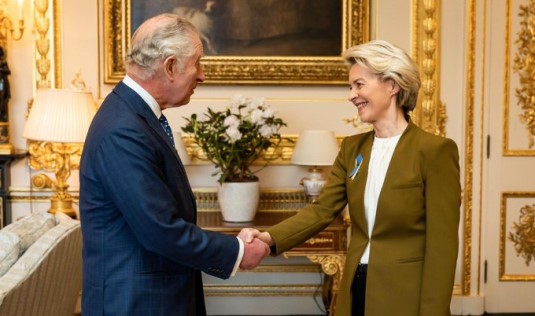
The second was a bit too much on the nose, even for Sunak. We noted yesterday the aborted weekend meeting between the King and EU president Ursula von der Leyen, and how Brexiteers and the DUP cried themselves a river over it. Associating the King with the deal was an obvious attempt at emotional blackmail against two political tendencies who define themselves in relation to the Crown. It was therefore not enough for the tea and tiffin to actually go ahead this Monday afternoon. To almost dare them to vote against the deal it has now been christened the 'Windsor Framework'.
What a clunker of a strategy, but it seems to have worked. Most of the Brexity voices have made emollient noises, with the ERG promising to look carefully at the text of the deal. Even the DUP aren't united in intransigence. Boris Johnson, who kept the running sore of the Northern Ireland Protocol open purely for political posturing purposes has kept a low profile and chose to stay away from the Commons. He's decided not to lead an assault on the deal. With Labour and the Liberal Democrats, and perhaps the SNP all backing the Prime Minister, the Tory right, who've been flexing of late might not choose this as their hill to stand on either. Sunak, therefore, has the first genuine triumph of his premiership. And one that, ultimately, will do nothing to save his government.
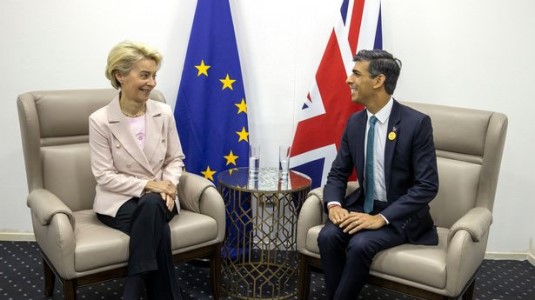
Nevertheless, news of advanced talks and the seeming likelihood of a resolution marks a clean break with Boris Johnson's handling of the mess. For starters, he was primarily responsible for it. Recalling the turbulent parliamentary year of 2019, after making a song and dance about Theresa May's efforts to secure a deal with the EU, Johnson was able to cobble something together that bore more than a passing resemblance to the document he resigned from May's cabinet over. The UK would leave the EU's customs area in its entirety, except the small print said that while an EU/UK land border lies along the line between the north and the Republic for the purposes of the deal it would move into the Irish Sea. This customs frontier meant goods from the UK mainland passing into the North would be liable for customs charges if they carried a risk of heading south. Bear in mind this deal was supposed to be an insurance policy, the terms of which the UK and EU would default to if a proper trade deal between the two was not secured. In typical slapdash fashion, Johnson didn't care about the detail of the deal. It was done, he could slap "oven ready" on it, and worry about it after winning a general election.
31st January, 2020 comes and we're outside the EU. The UK immediately moves into the transitional period where little to nothing changes. It's the holding pattern until a new trading partnership is negotiated. However, in February the Tories signalled they would be approaching the coming negotiations as a zero sum game. Having seen how Brexit brinkmanship benefited their electoral fortunes, talking up the talks as a battle of plucky Britain versus the combined might of Europe was yet more cynical games playing. While outlines of a draft trade deal were quick to emerge, by the summer talks had stalled and the UK was threatening to walk away if the EU persisted with the Northern Ireland Protocol. Indeed, the government announced it was introducing a UK internal markets bill which, while sounding dry on the surface, amounted to unilaterally altering the withdrawal agreement. It conceded it was preparing to break the law in a "very specific and limited way". This was the usual Johnson theatre, and therefore Downing Street greeted the election of Joe Biden with some dismay. Johnson believed the promise of a quick trade deal with the United States would give him leverage in the talks, and that was on the cards if Donald Trump had won re-election. Furthermore, given the pro-Irish component of American politics, Johnson was aware brinkmanship and threats towards Ireland were no longer consequence-free.
The talks were not looking good, and in December Johnson was talking about an Australian as opposed to a Canadian-style relationship with the EU. I.e. A euphemism for a no-deal scenario. Yet a deal was finally struck on Christmas Eve. It was a poor agreement that erected more bureaucracy, and particularly hammered the UK's efforts at selling services into the EU. A disaster considering the sector comprised 80% of GDP. The language about regulatory divergence covered for the fact £650bn of annual trade with the EU was bound up with conforming to its standards. As far as Northern Ireland was concerned, the new trade deal looked an awful lot like the withdrawal agreement. The UK still could not freely sell goods into one part of its territory, and the new rules governing UK/EU trade solidified it. Disruptions to the flow of goods under this arrangement were described by Johnson as "teething troubles", and the long and interminable negotiations about the implementation of the Protocol started in earnest after it came into force. Matters weren't helped by the DUP and their unwillingness to make it work. They boycotted talks, attempted to use the courts to block the Protocol, and shrugged their shoulders as loyalist areas erupted with violence. The resignation of Arlene Foster and her replacement by Edwin Poots gets off to a great start as he threatens to suspend checks on goods coming from the UK, making the agreement unworkable. This proved to be an empty threat as within two months of Foster's departure he was gone.
For the remainder of the year, EU threats of legal action and Downing Street threats of unilateral action meant the unsteady status quo persisted. Fast forward to the Assembly elections, and because of Northern Ireland's peculiar status its economy was actually outperforming the rest of the UK. Johnson's hasty approach to deal making was laying the material basis for unification, and loyalism was stuck on an existential cliff's edge. Remaining in the UK is its raison d'etre, but how can it retain mass support if loyalty to king and country means making its community poorer? Small wonder they fractured and we're in the absurd situation of having Sinn Fein's Michelle O'Neill in position as First Minister-in-waiting. As far as Johnson was concerned, the moment demanded more brinkmanship and on 13th June the government published its Northern Ireland Protocol Bill, which in UK law would grant ministers powers to set aside the treaty and implement new rules. Never mind this would contravene international law, jeopardise trade with the EU, and undermine the UK's ability to sign future deals with other countries. The passing of the Bill into the committee stage saw the EU begin legal proceedings. But with the departure of Johnson, things start cooling down. When Liz Truss enters office she says she looks forward to a reset of UK-Ireland relations. This carries on when Sunak takes over, and slow progress turns into real progress, to the point where we are today with resolution in sight.
What the Brexit ultras and the DUP fear, and what is likely to be struck with the EU, is some sort of confirmation of the status quo. A characteristic Johnsonian fudge has now governed UK trade into Northern Ireland for two years, and the relatively light touch controls have suited both sides of the border ensuring the disruption of Brexit has been mitigated. Affirming what is with a new range of oversight mechanisms, scopes for further talks and so on, locks a part of the UK into the EU, which limits the prospects of regulatory divergence. It makes a nonsense of the entire Brexit prospectus and will underline the argument frequently made by the remain camp, of the UK's transition from a rule maker to a rule taker outside the EU. It will make the UK look weak, and where the responsibility for this state of affairs lies is very clear. And, like the DUP, the Brexiteers worry what it's doing to the union. For Johnson it's just another issue he can use to remind the media that he still exists and will do politics in between his busy, lucrative speaking schedule. But for Sunak, it would be a real coup. With nothing much going for the Tories in the polls, a victory for sensible briefcase Toryism might turn some floating voter heads - especially those who like their "grown ups". The problem he has if should he get this through, the right of the party are going to become even more ungovernable. Especially if it only passes the Commons with Labour votes. For once, Sunak is doing the right thing. And it could prematurely end his premiership.
Image Credit
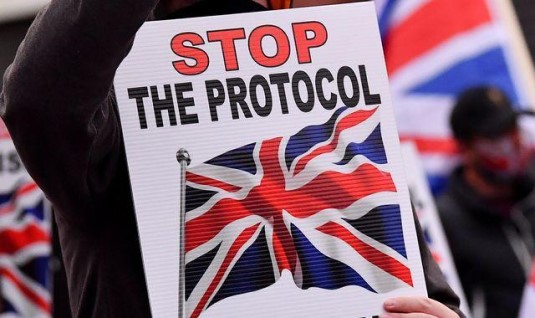
One of the unalloyed goods of last week's elections is what happened just over the water. Thanks to a fracturing unionism, the DUP vote was gouged by their would-be successors in biblical-tinged extremism, Traditional Unionist Voice. And more of their natural vote went to the cross-community (in actual fact, post-unionist) Alliance party. This left Sinn Fein the largest party and Michelle O'Neill the First Minister-in-waiting. A remarkable result. As night followed day, the DUP showed the 'democratic' in their name was mere window dressing as they refused to take their places on the Northern Ireland Executive. Their excuse? The continuation of the Northern Ireland Protocol.
We have been here before. It offers a convenient excuse for the DUP to grandstand, and affords the Tories much the same opportunity. We have Liz Truss, for example, talking loudly about dumping the protocol and sponsoring legislation to undo it. The problem, as they see it, is the European Union are proving too zealous in its enforcement. You see, when Boris Johnson tore up Theresa May's Brexit deal ... only to reintroduce it, no one was meant to take it seriously. Despite saying there would be a border down the Irish Sea "over my dead body" after already signing up to this arrangement, for Johnson erecting a customs barrier was a stop gap, a ruse to make the seemingly intractable Brexit problems disappear for a future Johnson to deal with. The Tories never accepted the protocol they formulated, negotiated, and fought an election on in good faith, so it's jolly unsporting that the EU do. This is the rub.
The victory of Sinn Fein and the crisis of unionism means Johnson has to take it seriously now, simply because it's putting the union under intolerable strain - and Johnson doesn't want to be the Prime Minister known for overseeing the UK's break up. But these real reasons for wanting to wind back the protocol can't be stated publicly by any government minister, so instead we get waffle about standing up for the Good Friday Agreement(!) and the imposition of intolerable barriers to trade, barriers Johnson denied would be necessary if the electorate backed him and his Brexit deal.
What Johnson got through with bombast in 2019, he now pushes with charm. In his lengthy essay for the Belfast Telegraph, the government's intervention to restore power sharing imposes settlements on issues that have divided the Stormont parties - the languages package, which the DUP have vehemently opposed, safe access to abortion (ditto), and an end to blanket amnesties for past deeds. But his remarks on the protocol itself is coded with Delphic tones about a community feeling ill-at-ease with its place. Its "aspirations and identity are threatened by the protocol." He's right, up to a point.
Last year, loyalist mobs took to the streets to protest the economic disruption caused by the Johnson protocol. As Northern Ireland was in the EU custom's area, goods entering it from the rest of the UK had to jump through expensive bureaucratic hoops to square the Brexit circle of ensuring no hard land border reappeared in contravention of Good Friday. The political parties of unionism were on the chopping block too, because they campaigned for Brexit and pushed the same lies as Vote Leave and the Prime Minister during the referendum. The disruption, such as the supermarket shortages, were as much the responsibility of official loyalism as they were the Tories. But a year on and things have changed. Embarrassingly, the north is now economically outperforming the rest of the UK. Manufacturing jobs are growing four times as fast, food is eight per cent cheaper, and while trade with the UK has shrank thanks to the red tape Johnson imposed it has grown with the Republic and the rest of the EU. In a development that could be seen coming a mile off, economic integration across the border has deepened to the general benefit.
And this is a problem for unionism. Its traditional material base among the loyalist community were the marginal benefits it offered around housing, access to jobs, and wages versus the nationalist minority. Its tie to the UK, as per the Scottish base of unionism originally lay in empire and after the war, the industrial compact between labour, capital, and the state. Once deindustrialisation got under way, its foundations began sublimating. All that was tangible were the cultural divides, but because their root was shrivelling the trappings of unionism, its Orange Order bigotry and anti-Catholic zealotry found its grip slipping. It's still slipping. Hence the 50-year rise of the Alliance Party, which grew out of and mainly appeals to unionist communities for whom the old sectarian divisions are past embarrassments. This was the case before Brexit, and now loyalism is in a race against time. The people of the north, republican and unionist alike, are beneficiaries of closer economic ties to the Republic and EU. There is an economic rationale for leaving the protocol unchanged. To protect itself and its political standing, the DUP have gone on strike to make the people of the province poorer - a position of political pain that might stymie the TUV's support, but is guaranteed to lose more to the Alliance and, horror of horrors, Sinn Fein.
The DUP can carry on with their sulk, and Johnson can fiddle with the protocol some more, but the behaviour of both are bringing forward the day when a majority shakes off the six county statelet and unifies with the republic. If the hard Tory Brexit has a silver lining, this is it.
Image Credit
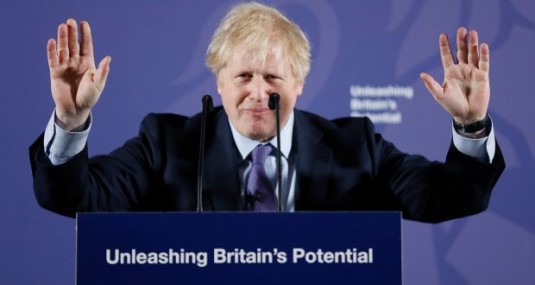
Therefore, Tories reflecting on the Tories is a genre of writing that repays studying, and David Gauke is one such Tory who has reflected on the whats and wherefores of his (estranged) party. Part of the "nice chap" school of conservatism along with Rory Stewart, a fellow exile, Gauke is one of those with an attachment to the constitution, to probity in public life, and a sense of what is right. Not that any of this prevented him from nodding through acres of repressive and vindictive legislation as a backbencher and minister. But like many inhabitants of Westminster and, for that matter, the watchers of its comings and goings, Gauke believes in the rules of the place. He's a fully paid up member of the game. And, as we've long known, Johnson is anything but. How he clings on in the face of scandal that would have brought down any of his predecessors offends the spirit and the conventions of the place. How then does Gauke explain the position the Tories have got themselves into, from what he would describe as the moderate governments of Dave and Osborne and Theresa May, to the immovable blimp wedged in Downing Street?
Unfortunately, while his latest piece for the New Statesman promises to offer an explanation, like Johnson's levelling up promises it never materialises. Gauke acknowledges the oft-made take that Boris Johnson was known as feckless, lazy, and lacked integrity among Tories when they elected him their leader. He was put there to solve the Brexit logjam, and this is what he did - even if it meant bulldozing his own parliamentary party to pave the road to the famous election win. While the forces broadly aligned with remain or the second referendum were divided among themselves, Johnson united the leave vote by ostentatiously demonstrating his seriousness about putting Brexit to bed - even if it mean rhetorically thumbing his nose at the law, packing off Tory grandees, and basically having nothing to say on any other topic apart from getting it done. This most untrustworthy of politicians established trust through demonstrable seriousness and commitment - two words never associated with Johnson before. Or since, come to think of it.
Considering the political novelty of the truncated period between 2016 and 2019, Gauke suggests that for some Tories Johnson is the aberration tailor made for our aberrant times, and who can now safely be disposed of without any lessons learned nor any need to reflect much on what has happened. It's all water under the Brexit bridge. This, in Gauke's opinion, would be a mistake.
Just at the moment, this prospect is somewhat tempting for many Conservatives, but it would be a misreading of events. It ignores the causes of the Brexit impasse, it ignores the political risks that faced the Conservative Party in 2019 and it ignores the political opportunity which Johnson seized at the last general election and which the Conservatives are likely to want to replicate.
And does the Gauke uncork on these causes? Unfortunately not. Instead, he centres a particularly egregious example of Johnson's light-minded approach to governing and detail: the border issue in Northern Ireland. Gauke argues May became unstuck because her negotiations with the EU had to square an impossible Brexit circle: reinstate the Irish border and undo the Good Friday Agreement and risk two decades of progress made since the end of the Troubles, place the EU custom's barrier in the Irish Sea and compromise the UK state's sovereignty over its territory, or stay aligned to the single market with the possibility of future divergence - in other words kicking the can down the road, and potentially nullifying the point of Brexit. As a consummate ditherer, and in the best traditions of Tory statecraft she went for the last. Delegate to the future what might otherwise be done today. Readers will recall Johnson's own fanning of the backbench insurgency against May, and when he ascended to Number 10 he promptly forgot the earnest arguments about sovereignty and went with the internal border, which he has dishonestly tried unpicking - and failing to - ever since.
Not that Johnson has ever been held to account for this. While an internal border was a non-negotiable as far as May and the rightwing European Research Group were concerned, the ERG kept mum about Johnson signing it into law. Curious. Or perhaps because they had bound their fortunes to each other. Johnson adopted the Brexit ultra rhetoric while they happily gave him their blessings, and when he came up short all concerned would look stupid if there was an honest accounting of the mess. Still, that didn't wash with the Tories' erstwhile partners in the DUP, but by the time they let their displeasure about the danger Johnson's deal represented Northern Ireland's status in the UK, it was too late and the Westminster media was more consumed by their frenzied attacks on the Labour Party.
Okay, but none of this is new. Yes, the complexity of the Brexit negotiations were simplified by Johnson's insurgent populism, and it did see Jeremy Corbyn off while exorcising the Faragist spectre to the Tories' right, but what of it? This is where the essay shifts gear away from not answering "how we got into this pickle" to "what does this mean for the future of Tory politics."
For Gauke, a section of the parliamentary party is, effectively, beyond reason. They live in a world of absolutes bounded by the culture wars and beholden to their obsessions - the war on woke, against public health, and bow to sovereignty as their most sacred of shibboleths. Gauke rightly argues they see Brexit as an extension of their Thatcherite instincts ("We have not successfully rolled back the frontiers of the state in Britain, only to see them re-imposed at a European level ...", as she put it in her famous Bruges speech). And, f anything, despite the failures of Brexit and Johnson's promises to launch state-led regeneration in deindustrialised parts of the country, the Tories' wingnut wing of the vicious and the stupid will emerge from the Johnson years strengthened. Gauke doesn't spell it out, but whoever comes next, be it Rishi Sunak whose instinct is to put clear distance between him and them or Liz Truss, who is politically adjacent to the mainstream fringe, they have to be reckoned with.
The second is the seeming closure of politics to the Tories' right. The party would care not to have a UKIP/Brexit Party fright ever again. Gauke notes how Johnson doesn't so much govern but is in permanent (media) campaign mode. He doesn't spell it out, but the political advantage of this is keeping alive the right wing populism that powered Johnson's election campaign so there isn't space for a Farage to make a scene. If the Prime Minister is dumped from office, by no means a foregone conclusion, how is this to be managed in the future? As Gauke notes, the dinghies in the channel is the stuff from which anti-immigrant moral panics are made. If Tories sense there is a space opening to their right the next leader isn't filling, there will be more pressure on them from the backbenches to keep with the present politics and all that entails.
And lastly there is the realignment of British politics, which is so obvious even right wing politics profs are talking about it these days. Gauke writes,
Whereas once the economically secure voted centre right and the economically insecure voted centre-left, voting behaviour has become increasingly influenced by cultural matters. The way in which a particular constituency votes increasingly depends not on income levels but upon population density, ethnic diversity and education levels.
Cynical or ignorant empiricism when every poll shows the economics of voting remain unchanged? You decide. I suppose one should be encouraged that the Tories misrecognise the basis of their recent successes, because it locks them into a strategy that can only have diminishing returns. The old age/propensity to vote Tory is largely a consequence of asset ownership, and for as long as millions of working people remain locked out of it while the growing layer of petty landlords snap up properties unabated the Tories are unbeknownstly, if not cheerily undermining their future viability. The advantages the Tories presently enjoy here - the greater likelihood for their support to vote, their more efficient distribution of voters across constituencies, and the coming gerrymander, their refusal to do anything about this situation cannot shield them forever. Gauke suggests the Tories' present coalition rules out a return to the social liberalism of the Dave years, and yet polling shows it's Sunak, not Truss or any of the other horrors, who polls least worst in the seats won from Labour in 2019. As a result, his perspective is entirely skewed. Gauke thinks the future is bright for social conservatism, just as Tory support is collapsing among those who lent them their votes.
Writing as a liberal Tory, Gauke's insights aren't original or profound. He forecasts where Tory politics are likely to go in the immediate future, but there is no grasping of the dynamics that made Johnson possible. This is precisely why he couldn't offer an explanation of the situation. While the effects of Johnson can't be shrugged off by the post-Johnson Tories, the fact he was there in the first place wasn't an unlucky happenstance. He is the culmination of an authoritarian politics pushed by the Tories for over 40 years. His personality and prominence a product of celebrity and media overexposure, and his 2019 victory the consequence of the class - refracted through age - polarisation set in train by the 00s property boom, the crash, and a decades' worth of austerity politics and debasement of public discourse. Gauke doesn't mention it perhaps because he was a willing participant in making the Johnson moment possible, and would rather not face up to this realisation.
Image Credit
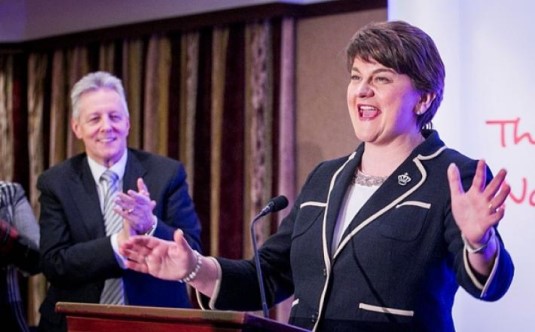
I'd put the house on the latter. According to the News Letter, not one but four round robin letters were in circulation calling for Foster's head. The contents make interesting reading. She's carrying the can for Westminster's imposition of abortion law on the North, a policy one letter changing hands between the DUP's councillors says must be "overthrown". Sorry guys, if you want to remain part of the United Kingdom then there are no special opt outs. There's the hullabaloo over the border in the Irish Sea, which Boris Johnson created, denied it existed, and still affects to only half-believe its presence. And somehow Foster is responsible for Sinn Fein ministers turning up at an IRA funeral last year, the ostensible catalyst for recent loyalist riots. As boss and First Minister of the six county statelet, Foster is formally responsible. But substantively? She's more a pawn of larger forces than the author of hers - and unionism's - destiny.
It was funny then to read Robert Peston's shot-from-the-hip as he speculated about the DUP after Foster. It could continue its path toward the centre of Northern Ireland's politics(!), or lurch to the right and spurn voters who might turn to Sinn Fein(!!). It's embarrassing. But perhaps the real reason for Foster's jaunty farewell was relief. The DUP are hemmed in by intractable problems. For some DUP players, they know the party's standing is menaced from the right - particularly the aggro-loyalist Traditional Unionist Voice - who've started chomping into their starboard flank. Having seen how Brexit ultraism did the business for the Tories, dumping Foster and taking a hard position on abortion, gay rights, and the Irish Sea border is, they think, the way to restore the party as the uncontested hegemon of official loyalism.
Peston might have showed his weak grasp of politics in the province, but his instinct is correct. With the DUP poised to heed the siren calls of Orange Order certitude, they are bleeding votes not to Sinn Fein but the centrist Alliance. Having emerged from within the loyalist community at the height of the Troubles, they spoke for the layer fed up with the overt sectarianism of the old Ulster Unionist Party and wanted to avoid the descent into civil war. More recently, it has successfully established itself as a break with the past, supporting remain during the referendum and providing an alternative to the unionist parties that doesn't go the whole hog into outright republicanism. If that wasn't bad enough, the Alliance's voters tend to be older and therefore more likely to turn out. It's not beyond the realms of possibility that come the 2022 elections, they and Sinn Fein could emerge as the largest parties and the so-called mainstream of loyalism is left out in the political cold by voters. The sectarian statelet without the sectarian forces having a say on the Executive, a bizarre eventuality just a few years ago is now a real possibility.
Whoever takes over from Foster has an incredibly difficult job to do. Writing snarky letters and talking the big man down the lodge is one thing, but facing up to the crisis of unionism is quite another. The Irish Sea border's not going anywhere, the party is pressured by electoral dangers to its left and right, and the political and cultural continuity of loyalism is visibly rotting. Unfortunately, as is usually the case when long-established movements are in decline, they tend to cling onto the fundamentals regardless of the wider damage this causes. With unionist mobs on the streets, historically high levels of support for a united Ireland, and an electoral eclipse just over the horizon, the consequences of the DUP's weakness are not going to be pretty.
Image Credit
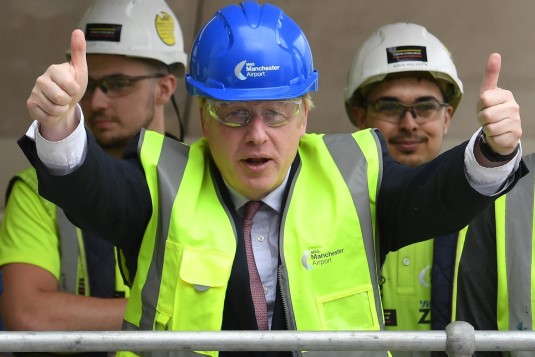
It is the case Johnson delivered on his main pledge and secured the most ruinous Brexit he could, there are side issues where promises were made and barefaced lies were told. The border in the Irish Sea currently reminding official politics of a past it would rather bury isn't supposed to exist, if you recall Johnson's selling of his deal 18 months ago. We've had promises about "levelling up", which so far means relocating a couple of hundred Treasury jobs from London to Darlington. He promised a pay rise for NHS workers, and then rowed back. And his commission on racial inequality was so appalling the UN were moved to condemn it.
The making and breaking of promises is usually the making and breaking of government, but Johnson and the Tories have got away with it so far. Yet why do they do it, and how has this persistent say-one-thing-and-do-another become such a feature of their politics? Well, there's the approach to Tory statecraft Johnson inherited from Dave and Theresa May. For the coalition years, the Tories lived from headline to headline, as obsessed about what the editorials were saying as Blair, Mandelson, and Campbell were in their day. For May, her approach to Brexit was driven by one overriding priority: keeping the Tories from disintegrating completely. Her twists and turns, painful defeats, repeated self-immolation, and eventually her resignation at least reflected the imbalances and shifts in the parliamentary party itself. Cirumstances imposed themselves. But what of Johnson? With an 80-seat cushion, all the institutional advantages, and a badly trailing opposition, why is he acting in a similar way and throwing out promises he has no intention of keeping like confetti?
Well, his record as London Mayor didn't depart from the formula, so you might put it down to personality as well as political inertia. But equally, there's a general paralysis. With Brexit done and the vaccine programme going well, the ghost of Tory futures is menacing proceedings and rattling its chains. For example, Johnson has his (on paper) programme of Tory modernisation with research budgets and tunnels to Ireland, but actually moving on his much evoked "priorities of the British people" is easier said than done. Consider some of their priorities, like developing an economy not over-reliant on low paid jobs. Or ensuring people can eat if they become unemployed. Or ending to evictions during the pandemic and action on landlords. Or the acceleration of house building, including freeing up councils to invest in building new stock. The Tories are absolutely nowhere because these harm the perceived and actual interests of their coalition, and so we're reduced to Johnson saying a lot while delivering very little. This is almost entirely politics as artifice, of policy produced for rhetoric's sake instead of the other way round. Of promising action in lieu of action, and hoping the overrepresented core support carry on voting Tory as they have done.
One of the advantages of this is the impression of busywork, even if it keeps kicking the can down the road. Contrary to the charges often levelled at the Tories for living in the past, they completely inhabit the moment, of preserving serenity now at the price of strife tomorrow. May's and Johnson's Brexit negotiating tactics were entirely subordinated to immediate concerns, and any problems arising can be dealt with later. And Johnson can now promise firm action on rebalancing the economy and committing the UK to ambitious emissions targets knowing it isn't likely he'll be the one doing the detailed work and negotiation of interests this requires. It's almost like there's a low-level war between present Tories and future Tories, of putting off and fighting shy of the inevitable. This cannot be ducked forever. There will come a time when they can no longer rely on their present coalition to get them into office, and as this support is purchased at the price of alienating everyone else, their viability as a party of government comes into question. For the moment, they're content with letting the long grass hide what lies in wait. And in Boris Johnson, the most dishonest, lazy, and most cynical Prime Minister in post-war British history, they have settled on a figure completely equal to their political procrastination.
Image Credit
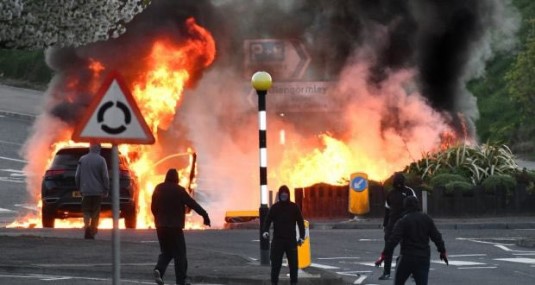
"Policing is a devolved matter for Northern Ireland", said Matt Hancock after getting quizzed about another night of loyalist violence. The non-too-subtle subtext being this is nothing to do with the government nor its grandstanding and reckless approach to Brexit. For his vanity and the electoral interests of the Conservative Party, Boris Johnson at first courted and then betrayed the Democratic Unionist Party and its wish to keep the UK internal market together. And what do you know, since Brexit happened we've seen supermarket shortages and the perception the government in Westminster have washed their hands of all responsibility for the province. The Tories have also made the DUP look like a right bunch of mugs.
This is the background, and knowing there is trouble at the mill Arlene Foster has tried her damnedest to ride the wave of disaffection rippling through unionist communities. Making a big deal of Sinn Fein ministers' attendance at a funeral last year, she made it clear on Wednesday evening how this was more objectionable than torching a bus. Ham fisted and equivocal by the standards of Westminster boilerplate, Foster is actually in a great deal of political trouble. Not only is the Brexit the DUP campaigned for proving damaging to their raison d'etre and making a united Ireland more likely, the most pressing concern are the threats gnawing at Foster's position as First Minister and the DUP's standing.
The latest poll from January reports the surreal result that Sinn Fein is the most popular party in Northern Ireland. The DUP however are now scraping second place with 19%, down nine points on the 2017 elections and one point ahead of the third placed Alliance. They are proving especially threatening as the party emerged from and bites deeply into moderate unionism, despite punting itself as a non-sectarian party. And to the DUP's right, Traditional Unionist Voice has been egging on street opposition to the Northern Ireland Protocol and, by extension, the Executive Foster leads. Boxed in and seemingly giving up on tacking toward the moderates, she has decided to ramp up the rhetoric against SF and virtually giving loyalist riots a free pass to bring back the extremists. Unfortunately for her, the DUP's doey-eyed participation in Brexit and having led unionism into the current impasse doesn't bode well for the party's political future.
Yet the predicament the DUP find themselves in isn't entirely their own doing. As per conservatism and Tory Britain generally, loyalism itself is in long-term decline. This year 42% polled in the north said would back a united Ireland, declining slightly from 45% when asked last year. In all, by far the most popular party among the under-44s is Sinn Fein, and by a very healthy majority Northern Ireland voted to Remain. The unionist community split 57/43 to leave, but like elsewhere younger people were most likely to support remaining with the EU. As we also saw recently, the DUP were on the wrong side of Northern Ireland's abortion debate, leaving them saddled with a sectarian social conservatism increasingly at odds not just with younger people's values, but their everyday experience. As the most vocal champions for the union and the UK, the British state could do with better cheerleaders.
Unionism's decline is more than value change and the recomposition of the working class, but an erosion of the sectarian character of the Ulster statelet itself. Active discrimination in housing, jobs, particularly public sector jobs, and policing had been in decline prior to the Good Friday Agreement and has continued since. Politics has a tendency to lag behind economics, and as the material basis for a particular cultural location evaporates so clinging to its identities and rituals can become stronger and, in some instances, extreme among a significant minority, Even as, especially as its wider influence diminishes. Given the alacrity with which the DUP opposed the decriminalisation of abortion, here we have a particular case of trying to uphold the social conservatism unionism identifies with. This is also the root of their embrace of Brexit too. There is no loyalism without the Irish border, and so withdrawing from the European Union, they calculated, would remphasise their difference and distinction from the rapidly secularising republic and secure their continued political relevance. What they weren't expecting was Boris Johnson hanging them out to dry by moving the border into the Irish Sea and, if anything, accelerating their appointment with marginalisation.
The problem is what happens next. If a group feels under threat, thanks to Northern Ireland's history this could step up from property damage and play itself out as attacks and murders. And given loyalism's record of butchery during the Troubles, this everywhere and always means political opponents and ordinary civilians. There is no popular appetite for a return to violence, but this is unlikely to stay the hands of would-be terror gangs. As Ulster unionism comes apart, there's every chance its final chapter could be blood-soaked and violent.
Who doesn't love some blue-on-blue action? Having been deprived of the Tory party tearing lumps out of itself since before the general election, there were at least some laughs to be had this morning as a cluster of careers met a deserving end. Andrea Leadsom, whose rise has long baffled Tory watchers, has gone back to the obscurity that becomes her. Esther McVey, she of the tedious Tory "working class" shtick was likewise offed. No longer will we hear the sonorous majesty of Geoffrey Cox bellow forth from the front bench either. Theresa Villiers is gone and Nicky Morgan, who sold out her remainy principles and anti-Johnsonism for a couple of months company with the culture brief has now curled up into a foam of ermine. What terrible, crying shames.
All told, two sackings were politically important. The removal of Sajid Javid, one time Boris Johnson rival holds the distinction of being the only former chancellor never to have delivered a budget. And the sacking of Julian Smith from the Northern Ireland office. Let's get Javid over and done with, as his departure is the most eye-catching. Speaking to the cameras this afternoon, he said demands Boris Johnson made of him - the sacking his special advisors - were too much for any self-respecting minister to bear. This follows on the heels of a row in the Autumn when Dominic Cummings sacked a previous Saj spad without informing him. Ever since rumours of slanging matches between the pear have been picked up by many a lobby hack.
Let's not kid ourselves here, far from a blow to Johnson's reputation this departure actually turned out quite nicely. It's not like he woke up this morning intending to get rid of Javid. If that was the case he'd have simply sacked him, instead of constructing an elaborate ruse to manoeuvre him into resignation. As a fanatic who treats Ayn Rand's work with reverence instead of toilet roll, from the point of view of parliamentary cohesion it's best to have a true believer in free market fundamentalism in the tent pissing out than the other way round. Plus Javid overseeing a boost in public spending, not least the eye-watering price tag for HS2, provides Johnson with right cover against the neoliberal true believers who get sweaty over breaks with their esoteric dogma.
Understandably given their recent animosity, having a new set of spads spying on the chancellor and reporting back to Cummings was intolerable. But with Javid gone and the totally unconvincing Rishi Sunak installed in his place, Number 10 and 11 Downing Street now speak as one. At least until we encounter the unlikely circumstance of Sunak evolving into a vertebrate. And that univocity is looking like an economic strategy big on boondoggle projects and a few scraps aimed at rebalancing the regions. However, until Johnson stops the Tory attacks on local government and transferring funds from poor authorities to rich councils in the south, he's going to have a hard time passing off commitments to the north as anything other than spin. But unless the government start ploughing investment into the UK's infrastructure, the rougher the fall out from Johnson's flavour of Brexit is going to be. With an economy totally flatlining he can't pretend matters are fundamentally sound forever.
Ah, Brexit. This brings us to the second item of significance - the booting of Julian Smith. As holders of the Northern Ireland brief goes, he was much better regarded than all his Tory predecessors. In just over 200 days, he was able to break the deadlock and get power sharing restored, and foster good relations with the Republic. Why did he come unstuck? According to the BBC's Northern Ireland reporter he dared challenge the blond ambition in cabinet, and agreed to an open accounting of the recent past. Something the Tories are not overly keen on, thanks to the history of the security services being up to their elbows in blood. Smith was also too remainy for Johnson's liking, and as we head into the next round of Brexit negotiations he didn't want someone who might appear to be too close to the Republic and, therefore, sympathetic to the EU's position sat round the cabinet table contradicting his self-serving bullshit.
And there's an opportunity here too. Following Sinn Fein's stunning showing in the Irish elections at the weekend and thanks to their being identified with the IRA in the popular British imagination, replacing Smith with Brandon Lewis - someone more pliable to Johnson's bidding - was a must. If the Tories can be seen pushing back at Sinn Fein to the point of reneging on commitments already made, this will play well both among the red-faced faithful and so-called patriotic voters. This negotiating pitch would provide a helpful poll boost when Brussels is framed as colluding with former terrorists by Johnson's ever-helpful press friends. With an empty manifesto to deliver, there's plenty of vapours for nationalistic shit stirring. And it could cut across any initial poll bounce Labour's new leader could ordinarily expect.
We can then see the naked Johnson body now taking on governmental flesh, An overly centralised government in which Cummings ranges across all things, a brittle authoritarianism brooking not even mild opposition within the cabinet, and laying of the ground work in Northern Ireland for point scoring pettifogging. This brings in to sharp relief the big disappointment with Tory infighting and sackings. It doesn't matter who fights or, for that matter, who emerges victorious. Because a Tory wins, and with a general election years down the line with a by no means certain outcome, it's the likes of you and me who stand to lose.
Image Credit
The summer seems like a million years ago now, but of Boris Johnson's no deal bombast I remember writing that if he does manage to get a deal with Brussels, it would be a respray of Theresa May's efforts. Well, Johnson has indeed struck a deal. And he managed to plagiarise chunks of the previous deal, but making it much worse. We've seen the outline of of what he was aiming for, but what did he get?
In the new text, the entirety of the UK leaves the EU's customs union. This, readers will recall, was one of the big draws of Brexit: the idea we could be free to swashbuckle our way around the world piling up lucrative trade deals and leaving our former EU partners in the dust. In reality, it's the effective subordination of the country's economic health to electorally expedient photo opps. However, one part of the UK - Northern Ireland, naturally - only appears to be outside of the customs union. In practice, it remains within it. Effectively, the new customs border between the north and the republic is a fiction because the border moves into the Irish Sea. Goods coming into the north will be checked, and duty paid on anything at risk of ending up in the Irish republic. The BBC has a helpful explainer. Effectively, the UK has turned itself into the border guard for the EU, under EU supervision and subject to the European Court of Justice. Taking back control, you say? These arrangements, including the north's alignment with the EU single market on some VAT rules are still subject to periodic vote by the Northern Ireland Assembly, but between Johnson's proposals and these negotiations the veto wielded by any community has been done away with. Continuation with or reversion back to UK rules is now by a simple majority vote of Assembly members. Everything else from May's deal is kept.
Therefore, it's still awful. Remember, this is an insurance policy if these arrangements are not superseded by the coming trade deal with the EU, but whatever we end up with it's not going to be what the UK has now, and it is the Tories who are negotiating it. Therefore the hard Brexiteer's dream of a tax haven off the north western coast of Europe walks the earth again. Their enthusiastic welcome of regulatory divergence only means one thing: the considerable costs of Brexit are due to get offloaded onto us. Behind the legalese and boring technocracy, there is a plan, a class war plan to make us pay - and the EU, that nice Mr Barnier and the nicer Mr Juncker, are complicit. Keir Starmer gets it, and Jeremy Corbyn has announced Labour's opposition to this tawdry document. Despite this, what are the chances Johnson can rely on opposition votes to get it through the Commons on Saturday? If scabbing on the interests of our class and opening Britain up to a deregulation bonanza doesn't move would-be rebels, perhaps remembrance of Jo Cox will. It is less than a month since Boris Johnson mocked MP's concerns about their safety and tried annexing her to the hard Brexit cause. As voting for the deal means empowering the most disgusting and morally bankrupt creature to have occupied Downing Street for decades, we'll soon see how well her memory is kept. And if after all that, if even a residue of solidarity and compassion doesn't do the job, the threat of the removal of the whip might. Now is not the time for prevarication. The moment requires steel.
And everywhere else? Andrew Bridgen, the hard Brexit bell wether (readers might be tempted to substitute 'wether' for another word) tendered his capitulation live on Channel Four. "It looks like Brexit and smells like Brexit - that's Brexit for me" chuntered this pathetic hobbit. With leading ERG supporters in the cabinet, and their "principled" opposition of the last year, the speechifying about the sanctity of the union, and attacks on May's deal for detaching Northern Ireland now forgotten, all of this was for absolutely nothing. Well, not entirely nothing. Their unhinged opposition has successfully transformed the Tory party into an English nationalist outfit and it's the cracked priorities of the hard right now hegemonising matters. The split in the core Tory constituency is resolving in favour of the complete rout of EU-oriented business and finance and the consolidation of the most backward and socially regressive sections of capital.
Yet, mark my words, most of the ex-Tory "rebels" are going to submit to this. There are significant differences between the factions of the boss class, but few if any of our independent Tories are troubled by the bonfire of the regulations this shoddy document promises. Dismantling the pathetic workers' protections we have, opening the NHS to more profit-taking, the tearing up of food standards, Johnson's Trump-first Brexit doesn't alter things for them. As long as the old class relations keep chugging, they'll reconcile themselves to the new set up eventually. Johnson might even give them the whip back as a thank you for publicly demonstrating how thin their opposition was.
The only schadenfreude to be had here is about the sorry position the DUP are in. Understandably, Johnson's deal is unacceptable to them. They are unionists after all, and the disappearance of their veto means the disappearance of their reason to exist. There's stitching up, but the DUP's erstwhile allies on the Tory right have filleted them like a kipper. The DUP were too willing to confer the Bakers, the Bridgens, and the Moggs a patriotic fig leaf only to find their concerns now fall on deaf ears. Johnson has reasoned, and it might well turn out to be the case, that he doesn't need their votes any more and we can get back to Westminster business-as-usual in forgetting about Northern Ireland and its politics. However the vote falls, may the DUP's slide into marginalisation be lingering and painful for all concerned.
And there we have the state of play. Brexit on a knife edge, the making and breaking of Boris Johnson in the balance, the possibility of heading off a new tranche of attacks on our people. What happens on Saturday could set the tone and the character of our politics for a generation. Time for some serious thinking and for would-be Labour rebels to examine their consciences, and make their mind up about what side they're on.
Image Credit
Were it not for the fact Boris Johnson is the Prime Minister and the leader of the Conservative Party, he needn't have bothered with his speech at his party's conference. It was certainly the most vacuous pitch any leader has made on the eve of a much-expected election, ever. Policy announcements? There were none. But we heard about a battery factory and the way Johnson's mum voted in the EU referendum, so that's okay. Also missing was virtually any detail about the government's new positioning on Brexit. Yes, we know Johnson can be economical with the actualité, and facts have a tendency to breeze through his brain like recollections of hands a-wandering under the dining table, but come on. He stood there under a slogan of "Get Brexit Done" and it almost entirely passed him by. Good job our fearless press and broadcast media were on hand to take him to task.
What then are Johnson's new proposals about? Well, for a moment let's suspend the politics surrounding it and assume his is a serious and genuine attempt for arriving at deal, and could plausibly persuade the EU27 and enough parliamentarians to give it a tick. Folks who've followed the finer points of toing and froing under Theresa May will recall her approach involved treating Northern Ireland and the UK mainland differently. Goods and people would, theoretically, continue to flow between north and south unimpeded, and the rest of the UK could and would diverge if it decides to go its own way while the north remains within the EU's economic orbit. This, and our coughing up £39bn (not all at once, it has to be added) to cover the UK's liabilities and obligations to the EU were enough to get rebellious Tories, not least the hedge fund elite of the European Research Group, all in a lather. Why was this a bad deal? Part of what May advocated were greater restrictions on state aid than what the EU currently allows, the regulatory divergence was a recipe for driving down protections of workers as well as standards for goods and imported foodstuffs, and gave the UK the dubious freedom of striking trade deals with whomever it pleased. In other words, Johnson is playing catch up when it comes to a Trump-first Brexit. Also, for sovereigntists of all political hues, including within Corbynism, the idea a state's control over and regulation of part of its territory is ceded to another state or supranational actor is anathema. Nothing says 'reduced status' quite like a constituent (half) nation of the UK lopped off and effectively run from elsewhere.
Contrary to what the BBC says, Johnson's plan does not get rid of the backstop. The backstop is whatever deal we end up with. What May proposed and Johnson is now proposing is a particular form the EU and Ireland's insurance policy should look like. Assume we leave with this new deal on time on 31st October. As the sun rises on 1st November, nothing will have changed. The UK would be outside of the EU and the MEPs will bid adieu to their parliament, but everything else is going to carry on as normal. This is because we have a transition period between the date of actual Brexit and the enactment of the new permanent relationship struck between the UK and EU - the much advertised but short-on-detail trade deal. As The Graun observed back in April, the problem is May's Article 50 extensions have eaten into the 21 months set aside by both parties to come to an agreement about this relationship. If, nevertheless these negotiations go fine and we have a new deal, then everything is tickety-boo. If not, extending the transition until an agreement is reached is possible, but it would likely cost the UK extra dough. And if that isn't extended the backstop governs the relationship between the two sides in perpetuity. Well, until it is replaced by a comprehensive trade deal or, lol, the UK rejoins the EU.
Given the farcical and lackadaisical approach shown by the Tories since Article 50 was triggered, I have zero confidence they'd negotiate a deal in time to prevent the backstop from coming into play. And, in all likelihood, the EU must be thinking the same. And so what does Johnson's deal have to offer? The UK as a whole will leave the customs union, which means the setting up of a border, um, away from the border. Cross border traders would require special licences based on existing trusted trader schemes, and exemptions for smaller businesses. And the actual checks themselves would take place in either special facilities physically situated away from the national border, or even in the premises of the firms concerned. Despite the customs border, Northern Ireland remains within the EU's single market and is tied to its regulations concerning food safety, food production, and manufacture whereas the rest of the UK leaves. Just like May's deal, mainland UK retains the freedom to do its own thing. Also, unlike May's deal, Stormont has a veto over the deal - every four years it will be asked whether it wishes to stay within the EU's orbit, or move back toward the UK's regulatory regime.
You can see the issues here. While it does advance a proviso for the north so it won't be "trapped" in the EU indefinitely, most criticisms made of May's deal apply here. The border in the Irish Sea is expanded, which would trouble a few of the sovereigntist squad. And it means a job creation scheme for some as a new layer of officialdom is added to police these arrangements. There are new problems too. It violates the agreement May signed in December 2017 guaranteeing no border infrastructure, and as Jeremy Corbyn noted in his Commons response, it stops the free flow of goods across the frontier. Indeed, the proposals are silent on the movement of people. Can Irish people from both sides nip back and forth across the border as they do now for work, shopping, family visits and the rest? And, given Priti Patel's blood curdling immigration speeches, how are the movements of non-Irish EU citizens going to get policed? Not technically insurmountable problems all told, but politically tricky.
Nevertheless, it was interesting to find our friends the ERG and DUP are supportive of the Johnson plan, despite replicating many of the problems they had with May's deal. Could it be their opposition was motivated by her catastrophic stumble at the last general election, the burning resentment at how she strung them along with talk of a hard Brexit, or even by simple sexism? I'm sure each of these have a role, but with polls now consistently giving remain a slight but stubborn lead, and opposition to their no deal dreams so firm it commands a substantial Commons majority, for them and the interests they constitute and represent getting a (still) hard Brexit across the line is crucial as backsliding looks ever more probable. Even if, as Stephen Bush has argued, it means making every Stormont election into a referendum on a united Ireland and one that, sooner rather than later, will see the unionists sink to a permanent defeat. Likewise from Johnson's point of view, if a deal is done his team have calculated that enough of the "ex" Tories (perhaps with the promise of restoring the whip), and recalcitrant Labour MPs are going to support any deal and give him the Commons majority that so eluded May. Indeed, not everything has to be worked out, goes the reasoning. The finer points of the backstop could be discussed and prepped for behind the scenes while most eyes are focused on the trade deal negotiations.
The EU, at least, were smart enough not to dismiss the proposals out of hand with some going so far as to welcome them as the basis for a new round of negotiations. Politically, it would suit Johnson more if Brussels was outlandishly noisy in their rejection of them - not just people vs the parliament, but the UK vs the EU would see the Tories mop up great swathes of the Brexit Party vote with ease. However, as the EU is much cannier than most British political pundits, they're not about to make it easy for Johnson to blame them for the failure of his scheme. Likewise in the Commons this afternoon, while setting out the terms of the plan he took an uncharacteristically conciliatory and calming tone, almost entirely as if he wanted his calm countenance to get assailed by insults, shouts and the rest. If he fails, Johnson can at least pretend to seriousness, and try and hang the no deal albatross on the opposition parties - to much, he hopes, electoral reward.
Where do we go next? Ireland aren't too keen, but we'll see what the coming rounds of "intensive talks" throw up. Either way, Johnson thinks he's played a blinder. The right are now on side, and he gets the kudos for piloting the UK out of the EU with a deal, something no one thought possible up until now, or it falls due to EU opposition and/or Labour-led Commons chicanery and he gets the plaudits for someone standing up against foreigners and traitors. The only thing preventing him from manoeuvring his way to this position is the lock down of the Article 50 extension by law. The game now is winning back the "ex" Tories and getting Brexity Labour on board. Can the opposition to Johnson remain firm, or are we about to see chunks of it fall through cavernous openings of their own timidity?
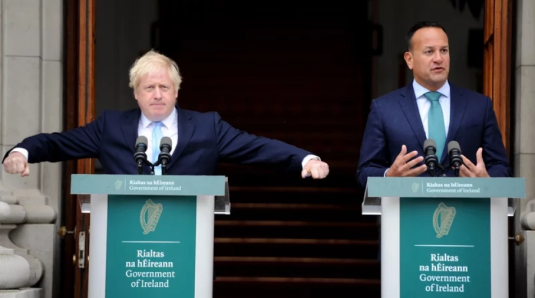
By now, it's become almost customary to write about Boris Johnson using words like 'shambles', 'disastrous', 'incompetence' and phrases that convey a sense of permanent and deepening crisis. Not wanting to follow the press pack as they herd around these tasty morsels, one cannot help be struck by how bad the government's final day before prorogation was. We know from the beginning Johnson set the bar pretty low, but he keeps on confounding us by sinking further into the mire. Following what was probably the worst week any government of my lifetime has suffered, Johnson bombed at his press conference with the Irish Taoiseach, Leo Varadkar, and he bombed twice in the Commons last night - one for his utterly doomed attempt at dissolving parliament and securing a general election, and the other concerning the release of text messages, WhatsApp messages and the like from Dominic Cummings and the Downing Street back office operation. Neither the press conference and the Commons shenanigans are not without political significance.
Yes, there was weird body language enough to power a thousand memes, but Johnson's comments that a no deal Brexit was bad and would represent a "failure of statecraft" certainly got my ears standing up. Testing the waters of a climb down ahead of a hasty, last minute bargain with the EU? Well, it didn't sit well with Nigel Farage, who days earlier was lavishing the Prime Minister with praise and boasting about a Brexit Party/Tory pact that would secure them a majority of triple digits. More interesting, however, is the shape of a putative deal condensing out of the Johnson hot air. And ... it looks a lot like Theresa May's deal. As forecast on day one of his premiership, the realities of his position would compel him to reach to the ready-made deal cooked up by May and the one, lest we forget, he resigned from the cabinet over. Except his preference appears to be the proposal May quickly abandoned; of solving the problem of the Irish border should the backstop come in to play by moving the custom posts into the Irish Sea. In effect, Northern Ireland remains in the EU's economic jurisdiction while the UK mainland is (self) excluded. If this is going to be Johnson's deal, if this pig's ear is what he brings back to the Commons when it reconvenes then expect to see fireworks on the right of the party, with well-known Brexiteers jumping ship from cabinet and one or two resigning the whip and signing on with the Brexit Party. If there is any justice ...
Moving onto the evening's double defeat, the motion from Dominic Grieve that called on Downing Street to publish all communications regarding prorogation and documents on no-deal planning, the heirs to the notorious Operation Yellowhammer leaks, went through 311 votes to 302. Yes, some of the so-called Tory rebels the Liberal Democrats are desperate to strike an electoral pact with preferred to vote with the government. As the deadline for publishing is tomorrow, seeing what the government does next is going to be interesting. Expect a few days of headlines about the rather frank language, to put it euphemistically, Dominic Cummings uses to describe Tory colleagues. Their cynicism exposed, the clueless Johnson desperately grasping for advice, and their plan to lie to the Queen over the reasons for prorogation is sure to be great theatre. Grab the popcorn and the chocolatey treats, it's going to be entertaining.
Yet there is something that doesn't sit right about this. Yes, it's another thing for the Johnson government to panic over. And if they hadn't been so reckless and stupid perhaps this withering friendly fire would never have left the barrel. Leaving aside the no deal preparations which are fair game, surely politicians have the right to seek advice and have private, strategic discussions away from the media glare with their lackeys and spads. I'm mindful of this because now Grieve has established that this, in principle, can happen, what is to prevent the Commons from tying up and hamstringing the decision-making processes of a future Corbyn-led Labour government? How, for example, might the new left wing Treasury team work out strategies for overcoming opposition of senior civil servants as the government moves to take on the overweening power of the City if, in less than a month, communications can be commandeered by a simple majority vote and published for all to see? It sounds like a recipe for paralysis and timid government that never tries to change anything. It would behove the leader's office to think about the consequences of this, how it can be used against us, and what can be done to evade similar traps.
And so, as parliament shuffles off for five weeks its final day simultaneously reveals the even stickier position of the Prime Minister, and a device that might give Labour a headache. A blast from the past and a warning for the future, the last day was a preview of calamities and challenges to come.
Image Credit
Who hasn't looked over the edge of a tall building, a cliff, a canyon, or a hole and found themselves filled with a vertiginous feeling? Well, a a week into Boris Island and we find this discomforting sensation is the basis of the new Prime Minister's Brexit strategy. Consider the developments that have taken place since we last expended some words on Boris Johnson. He's visited the regions and the nations of the UK, bringing with him everywhere his boundless optimism and booing crowds. He met with Nicola Sturgeon in Edinburgh and revealed to her his Brexit plan was, well, keep your fingers crossed. He went to Wales and said a no-deal Brexit will be the EU's fault. And his visit to Northern Ireland was less than a roaring success, with attempts to get Stormont talks moving again falling flat and Sinn Fein raising the prospect of a unity referendum in the event of no deal. For those of us who'd like to see a united Ireland, every cloud.
In no uncertain terms it has been made clear to Johnson that, as plenty of people have said all along, a no deal Brexit could lead to the break up of the UK. And, of course, he has seen the confidential Whitehall briefings - like the one just leaked to Sky News talking up all kinds of problems, such as consumer panic, shortages, civil disorder. For someone who definitely isn't a details man with a cabinet full of ideologues, this is a nightmare scenario for the Johnsonian feather weights.
Want more bad news? While the PM stalks the land playing down the prospect of no deal, it turns out some of the backbenchers are unhappy and will vote down any withdrawal agreement, regardless of whether the Irish backstop is retained, modified, or scrapped. Not great when your majority, according to bookies and by-election watchers, is likely to be reduced to one come Friday morning. According to Mark Francois, the ornery ERG vice-chair and self-styled combat veteran, some 60 MPs are prepared to prove as much as a headache to the new regime as they were to the old. Excuse me for an aside, but it's almost as if Brexit for the ERG was never about the specifics of Theresa May's withdrawal agreement and something else was in mind the entire time.
Even worst news is the latest coming from the United States. Donald Trump's warm words for Johnson were very helpful from Number 10's point of view - not that Trump is going to win the Tories any votes, but because he reiterated the desire for a trade deal that would increase the volume of trade "four or five times". This is the holy grail for UK finance capital and the disaster capitalists, and is why the ERG are proving so intransigent. Who cares if agriculture and manufacture take a body blow, animal welfare standards are reduced to the non-existent, and the NHS becomes a tax-payer backed cash cow for American insurance companies if the City have unimpeded access to the US property, domestic credit markets, and becomes the offshore banking centre for the US capitalist class? And it comes with a hefty political bonus too: the perpetual disciplining of UK governments by the protocols of a free trade agreement. Wave goodbye forever not just to Corbynism, but also the possibility of mildest social democracy, digital wealth taxes, and state aid. Unfortunately, this cracked vision has, um, a crack in it. Regardless of what Trump says a trade deal can be blocked by Congress, and given the huge amount of capital the US political establishment sunk in getting the Good Friday Agreement signed, understandably many are horrified by Johnson's cavalier attitude to it. And so if Johnson's Brexit interferes with the Irish border, understood as unimpeded commerce and movement back and forth across the border, there will be bipartisan house backing for blocking a free trade agreement. Not what the Brexiteers want.
And how has Johnson responded to these raft of difficulties? By barely acknowledging them. In the dawn of Britain's new golden age, there cannot be room for negativity. So today's announcement from Sajid Javid, that extra money is available for addressing the exigencies of a no deal Brexit, as if this sum - pitiful in the grand scheme of things - can insulate the country from the shocks coming our way. Nevertheless, while doubling the cash is a tacit acknowledgement by the government that the previous preparations were not enough and it's going to be rough, this will still play well to the Brexit/Tory crowd. Here we have a Prime Minister doing what it takes to shore us up before leaving. The demonstration of seriousness of intent, if you like.
Yet it's a gamble. Johnson and friends have long pedalled the line that the UK has to be serious about no deal to strengthen its hand in negotiations with the EU. The justification for this stance is utterly nonsensical, if not farcical. When a supplier enters into contract negotiations with a supermarket, do they say "you'd better give us the contract otherwise we're laying off staff and not selling as much in the future"? No. Johnson's hope is the EU will be alarmed at the damage such an act of self-harm will cause Ireland and the heartland EU countries that somehow Brussels is going to ride to his rescue. He'll take the credit for his hard nosed approach, while effectively a new deal is sub-contracted to the Commission to draw up. Who thought this is what taking back control might end up looking like.
The stakes are high then, and like his predecessors Johnson has bet the house on a whim. He might not personally intend to take the UK out of the EU without a deal. Indeed, he's said it enough. But by ramping up no deal preparations while, in the mean time, effectively waiting for the EU to sort Brexit out for him is reckless in the extreme. And any deal anyway looks doomed thanks to the Brexit irreconcilables on the back benches. In sum, it doesn't look like giving Brussels a dose of vertigo is going to work. Johnson, by his laziness and career-before-country opportunism isn't so much offering a way out of the impasse, but contriving a situation where a deal is next to impossible. And for what? Like Dave, it's to ensure the political threat to the Tories' right, then UKIP and now the Brexit Party, is neutralised and they remain a viable party of government. What a pathetic state of affairs.

It's not only Theresa May who's preparing her departure from the political scene. At the time of writing, the Socialist Party is on the verge of the most damaging split in its history. On the one side you have Peter Taaffe, the organisation's general secretary of 55 years and counting. Backing him is the majority of the membership in England and Wales, the Scottish "section" and, um, precious few others. Arrayed against the loyalists are the majority of the international organisation - the Committee for a Workers' International - including its most successful section, the Socialist Party in Ireland. And as with all splits in politics, which Change UK have recently reminded us, there are good reasons and there are real reasons. If you care to avail yourself of the leaked documents the different players have exchanged (and leaked), for Taaffe and his comrades this is the struggle between proletarian politics, as uniquely elaborated by the SP's particular brand of Trotskyism, vs petit bourgeois contagion and the importation of identity politics into the organisation.
The full gist is a critique of recent successes achieved by the Irish organisation in the women's movement. This is elaborated in more depth by Coatesy and the Weekly Worker here and here. One can't help but be struck by the coincidence of Taaffe's critique of an organisation that has made political headway, versus the almost total collapse of the SP's position in the Public and Commercial Services union where, in a very short space of time, they've gone from virtually running the shop to a couple of seats on its executive committee. And that's before considering the significant losses of cadre and possibilities for recruitment to Corbynism, that has been the SP's lot these last four years. You might be tempted to think Taaffe should account for his leadership's blunders before attacking others for not having the right kind of success as per his Marxism-by-numbers.
The politics, however, are an excuse for a reassertion of authority against other sections in the "international" showing too much independence of thought from the London mothership. And so we have declarations of ludicrously wordy factions (Taaffe's, as it is formally a minority in the international, is 'In Defence of a Working Class Trotskyist CWI'), a roughshod disregard for the procedures of the organisation, expulsions, departures of entire sections and, interestingly, the declaration of 127 England and Wales comrades - approximately a third of the activist membership - signing a protest letter. Woe betide any full-timers who dare disagree with the eternal general secretary or they will find their "careers" disappeared, as has happened to the editor of the ever-dreary Socialist.
As night follows day, their former comrades around Socialist Appeal have weighed in. In their open letter to current and former members of the CWI, they argue the bureaucratic thuggery dispensed at Taaffe's behest is reminiscent of their own departure from Militant (as was) in 1992. For those not around at the time or for the not terribly interested, the Taaffe-led majority wanted to decamp from the Labour Party for the sunlit opportunities that they thought existed outside, whereas the minority around their guru, the unimaginative and plodding Ted Grant, argued that they should stay the course. The minority went on to publish Socialist Appeal, hence the name, but nevertheless retained and built a fairly substantial international (in Trotskyist terms) roughly comparable in size to the CWI. Its highpoint was having the ear of Venezuela's Hugo Chavez, and its low was its own catastrophic split at the turn of the decade. Nevertheless, they suggest the degeneration of the CWI lies in their rejection of Grant's work and Labour Party entryism. Though, to be fair to the Taaffe position, being burrowed in Labour has barely increased Appeal's membership nor brought it influence over the development of Corbynism. They are just as isolated from where the socialist action now is as the SP themselves, despite being embedded in Labour like a limpet.
The real crisis for the SP is exactly the same reason why all self-styled Leninist organisations around today are in crisis, and that's because they are engaged in sect-building projects. Even at its height, for all the trouble and sleepless nights Militant caused Labour Party bureaucrats, even following its initial period of success at Liverpool City Council and the role played leading the Anti-Poll Tax Federation - achievements the SP ritually trumpets some 30 years after the fact - it amounted to no more than 8,000 members. And most of these vanished in the blink of an eye. These are issues shared with the disgraced Socialist Workers Party, who once boasted of having 10,000 members, and other moderately sized sects elsewhere. The SP and SWP are the lucky ones. Much smaller outfits never take off, despite differing politics and strategic orientations. Anyone been troubled by Workers Power since they wound themselves up and entered the Labour Party en bloc?
The biggest difficulty all revolutionary socialist projects face is pushing what are essentially insurrectionary politics in societies in which workers' organisations have long been institutionalised, pacified and integrated into the smooth(ish) running of things. And where democratic habits of mind have been the common sense, at least as far as the UK goes, for well over a century. Yet the UK remains a capitalist state overseeing a capitalist society, class struggle hasn't gone away, and still Trotskyist outfits are sidelined and irrelevant. The problem the SP has specifically is the class subject they orientate towards and seek to shape is completely obsolete. It's more than an issue of the SP's notorious economism, of its dismal reduction of class struggle to saving jobs, stopping cuts, and protecting services, but of an old hat approach to what class is.
This is inadvertently highlighted in Taaffe's recent and dishonest article, In Defence of Marxism, ostensibly about Trotsky's posthumously published In Defence of Marxism. Dishonest because this is less a commentary on the book and more another tedious big-up of Militant's record. Indeed, you might say Taaffe is the Nick Cohen of the Trotskyist movement. Regardless of the occasion or the subject, the same article is always produced. Rather than take on his opponents directly in open political argument, we get this:
At the same time, we have to combat and defeat all ideologically petty-bourgeois political trends which seek to divide, to introduce separatism into the workers’ movement. Under the signboard of ‘identity politics’, the US bourgeois first use their ‘ideological factories’, the universities, to spread their pernicious doctrines in order to divide mass opposition to them and their system on separatist lines – race, gender, caste, etc. While Marxists support the rights of all oppressed minorities, we always emphasise and strive for the maximum unity of the working class.
If Marxism was a programme of research and a guide to action for Taaffe as opposed to, say, a dreary justification of his six decades of political activity, this kind of nonsense - a left spin on Jordan Peterson-style anti-PC ranting - would not pass muster. As explained on a number of occasions, what is often misnamed as identity politics is a central characteristic of contemporary class politics. Not because of bourgeois conspiracies but because it is a property of capitalist political economy, and one that is increasingly important. As the production of intangibles - knowledge, services, experiences, care, subjectivities - depend on human brains and our social being, the character of exploitation changes. The vector of surplus value extraction in the advanced countries has grown more off the back of rentier-style relationships, vs the "classical" and "invisible" production of surplus value as the difference between the value of labour power vs the value of goods it produces. It means that, in the long-term, capital is less able to deskill workers as it has done historically because it cannot replicate or own the brains cognitive capitalism requires. Instead, capital now tries harnessing the spontaneous creativity of masses of networked but largely atomised workers to sell stuff, to surveill behaviour, and to try and generate the kinds of human beings more likely to accept the prevailing state of affairs as normal and natural.
Ah, but how does this explain the absurdities identity politics can descend into, where one identity is valorised and used to exclude other identities? Well, just as Lenin once observed that in and of itself everyday trade unionism was the bourgeois politics of the working class, limiting what, for the sake of brevity, you might call identity questions to issues of representation and recognition is the equivalent. Without a critique of capitalist political economy, trade unionism tends toward accommodation and reformism. Ditto, minus an understanding of the production of identity in intangible production, identities can appear to be off-the-peg cognitive structures, and exclusive spaces - even if their root is in oppression. Without grasping the relationship between identity production and capitalism, it naturally tends toward a liberal pluralism, which is a million miles away from intersectional politics: the only class politics worth the name.
I suppose this is beyond Taaffe, for whom Marxism stopped when Trotsky's book - probably his worst book, incidentally - was published. But it nevertheless demonstrates the hiding to nothing his politics is doomed to pursue. The SP's politics makes certain assumptions about the workers they address: that they are trade unionists, are motivated primarily by economistic concerns, and see themselves as workers above all else. This sounds suspiciously like a liberal identity location that claims a special privilege for itself, while dismissing other experiences of capitalism as ephemeral and in some way inauthentic. The SP used to talk about how the labour movement was in crisis in the 90s and 00s, and how consciousness had been thrown back. All true, but its solution was and remains an attempt to jumpstart a class politics of a simpler, easier time. Of when industrial workers commanded the field, workplaces were huge affairs, and a basic class consciousness could be taken for granted. Taaffe's template of class is not what it is, but how he wishes it to be: the so-called mass worker that dominated the labour movement imaginary of the 1950s, 1960s, and 1970s. Small wonder the SP aren't going anywhere. They're chasing the past.
The same, however, cannot be said of the Socialist Party in Ireland. While also wedded to a sect building model, which has limited their development over the years and will no doubt present more difficulties in the long run, their more sophisticated understanding of class and identity politics - if not in thought at least in practice - has enabled them to build influence and intervene in the struggles around abortion and reproductive politics. Issues, in case Taaffe and co need reminding, that are crucial to how the system reproduces itself.
Sadly, a reckoning between the SP's antiquated politics and the realities of 21st century class politics are overdue, the result, as with all splits, will see dozens of socialists give up on politics altogether, their fingers burned by the hothouse pressures of sectarian struggle. I sincerely hope that is not the case. Plenty of former SP members made the leap into Corbynism while their former organisation pratted about on the fringes of the labour movement and, in some instances, tried sabotaging it. If you happen to be in this position, don't give up and retire into private life punctuated by occasional Twitter ranting. Corbynism is an expression of the new class politics, warts and all. Its importance cannot be overstated, which is why we need your experience and your commitment.