It's a close run thing. Just who will come out top in the 2010 AVPS poll of the UK's worst political blogs? Can a Tory or so-called libertarian grab the prize? Will fratricidal warfare on the left see one of its own take the crown? Could the LibDem blogosphere get noticed for once? We've seen some fierce battles for the title here and many a blogger has pleaded for the support of their following, and now the competition is nearing its climax. The anticipation is making me go weak at the knees ... and I know you too, dear readers, are on the edge of your seats. It's almost all over. There are now less than 24 hours to go before the polls close at midnight, so here's a reminder on how to make your voice heard!
* Rank order the ten blogs you love to hate. Number one will get ten points, number two nine points, etc.
* Only one set of votes per person.
* No anonymous voting.
* Nominate at least three blogs. Votes with less will be discounted.
* Votes can either be cast in the comments box or confidentially at top100worst at yahoo.co.uk
As I've said before a conflict of interest prevents me from taking any votes for this blog ;) Still, there's plenty more crap blogs readers can choose from.
Results and analysis will be posted on September 1st.
Wednesday, 11 August 2010

Tuesday, 10 August 2010
Socialism and Space

The argument is often made - as it was during the Apollo Moon landings - that it's criminal to sink resources in technologically sophisticated circuses while so many are for want of bread. That's an argument that can't really be contested: there is something morally abhorrent about packing people off to space when society cannot meet the basic needs of those at the bottom of the pile. But then, this could imply that if capitalism dumped its space programme it would suddenly convert itself into an altruistic social system. For instance, since that nice Mr Obama dumped Bush Jr's ambitious Moon and Mars landing programme we have not seen the US evolve toward a gentle, Scandinavian-style social democracy. Under the new management American capitalism remains as rapacious as it ever was.
As far as socialists are concerned, it's infinitely desirable monies be directed toward stuff like space probes and rockets than lining the pockets of the rich in tax cuts or, worse, feeding military budgets. Like any other form of state-directed economic activity, space programmes have their multiplier effects. They provide skilled jobs and drive high-tech innovation. Of course, you could say military projects do the same thing. But then again, space technologies provide the sort of use values that could be genuinely useful later on. Whatever spin you like to put on it, military is only good for war, and we know what that's good for. But we shouldn't forget there is overlap between the two sectors. Our friends the Neocons would love to see the planet ringed with orbiting missile platforms to maintain American supremacy and, since becoming a viable option, no US administration has ruled out weaponising space. So while its okay to cheerlead NASA's efforts in mapping Mercury and pinpointing ice deposits on the Moon, such dazzling technological achievements should never blind us to the militaristic uses space programmes can be put.
Then there is space exploration as ideology. Generally, non-dystopian science fiction hasn't moved on from Jules Verne's day. This is best exemplified by Star Trek. Set in a socialist society that dare not speak its name, we are presented with a technotopian realisation of progress and Enlightenment values. Kirk, Picard, Cisko, Janeway and Archer used a combination of wits, diplomacy and gadgetry to overcome problems, resorting only to force in the final instance. The idea of hope through technology is rammed home in the cringeworthy opening credits to Star Trek: Enterprise. NASA doesn't mind this romanticisation, and the US networks and Hollywood are only too happy to oblige. Whether exploring the solar system, destroying threatening space rocks or whatever, space ideology promises a better tomorrow today.
What is interesting is how space demarcates the (very blurred) political boundaries between the Republicans and Democrats. It was a Democrat who committed the US to the Moon, and a Republican who cancelled the programme. Since the 80s the positions have reversed. Reagan and Dubya were mad keen about all things space related. Clinton and Obama much less so. One doesn't want to read too much into what the former represented, but there is something about the final frontier that appeals to bootstraps/self-reliance conservatism that doesn't connect with the managerial liberalism of mainstream Democrats. Absurdly the party of intelligent design and climate change denialism is also the party of space colonies and interplanetary flight.
Returning to Stephen Hawking's interview, the chance of a meteor smacking into the Earth and causing mass casualties is ridiculously low. But the ecological damage capitalism is wreaking unfortunately isn't. Climate change may not spell the end of our species, but in what sense can we speak of human civilisation if capitalism condemns billions to a brute existence of starvation, water shortages and turf wars over scarce resources? As far as I'm concerned, the starting point for securing our future involves moving beyond this antiquated and irrationally destructive system, and unless we get rid of capitalism we run the risk of taking the same old crap to the stars.
Friday, 6 August 2010
How Labour Can Win Again

You could be forgiven for thinking Demos were attacking the Labour manifesto of 1983, not that of 2010. While it may not have been to the taste of the Tories, for whom the deficit and the Big Society are foils for bombing Britain's welfare provision back to the stone age, by any measure A Future Fair For All was no radical break with the status quo. It was an amalgam of Brown's late conversion to Keynes-lite, a dose of creepy illiberalism, interesting stuff on arts, communities, and the environment, and rounded off with a superficial dusting of mutualism.
Nor could the election campaign be described as leftist (or even leftish). I did not imagine Brown's defence of Trident or competition with the Tories to see who could be most beastly to immigrants. I *wish* I had hallucinated Alistair Darling's claim that cuts under a re-elected Labour government would be worse than Thatcher's, but I didn't. For all intents and purposes this was a campaign fought on the centre ground of the neoliberal consensus, which is a terrain far more congeal to the Tories and LibDems.
My intention however is not so much to pooh-pooh the Demos recommendations, but pre-empt its reception among the more right wing elements of the party. You can almost hear the arguments now as triangulators and technocrats fall over themselves offering leadership contenders (and anyone who'll listen) the same advice that has seen party membership, standing and support tumble over the last 13 years. This is the worship of accomplished fact at its most stark, of the (contradictory) flipside of New Labour's arrogance and elitism, that ultimately we must bow to the wisdom of the crowd.
I don't accept this for one second. Beatrice Webb is said to have noted "there is no such thing as spontaneous public opinion. It all has to be manufactured from a centre of conviction and energy". Even if we accept the Demos findings as gospel (and I do not), it also means acknowledging this is the product of the social and political changes of the last 30 years. It rests on the realisation that public opinion can be changed. Setting out alternatives to the cuts, renewing the trade unions, active campaigning at the community level, attacking the Tories' 19th century agenda, rebuilding, reorganising ... all of these things and more is what we need to do for Labour and the labour movement to win again. Labour shouldn't follow public opinion: it should seek to *lead* it. That's the path back to power, not pandering to prejudice or tailing received wisdom.
Tuesday, 3 August 2010
Weird Science
Something very wrong is happening in Japan:
David Cameron denies he's already acquired one to stand in for him during Prime Minister's Questions.
David Cameron denies he's already acquired one to stand in for him during Prime Minister's Questions.
Monday, 2 August 2010
2009 Party Accounts
Every summer the political quiet time begins with the Electoral Commission's release of party accounts for the year previous. For political anoraks it's an opportunity to pick over the financial standing of one's opponents during the previous year, and for those of us specialising in the ultra-niche domain of the leftist trainspotter, it provides a chance to see how the Trots and Tankies who've embraced bourgeois legality are doing in terms of members and funds.
2009's accounts continues the established tradition of fining the BNP for late submission, again. Unfortunately it means income and expenditure for their "breakthrough" year remains clouded in smoke until the Commission have finally received them. You could be forgiven for thinking something crooked's going on ...
Before the main course of far left party accounts, I know some readers will be interested in the starter: the incomings and outgoings of the three main parties and the 'major' minor parties:
Conservative Party Income £41,984,000 Expenditure £37,154,000
Green Party Income £813,841 Expenditure £813,382
Labour Party Income £26,798,000 Expenditure £24,732,000
Liberal Democrats Income £6,497,013 Expenditure £6,679,089
Plaid Cymru Income £798,805 Expenditure £768,982
Scottish National Party Income £1,842,127 Expenditure £1,737,609
Sinn Féin Income £1,177,727 Expenditure £1,183,693
Ulster Unionist Party Income £392,868 Expenditure £357,430
UK Independence Party Income £1,221,422 Expenditure £1,201,617
You can compare previous years at a glance on these charts. There's nothing really to note except the Labour party were in dire financial straits - but we knew that already. And I see the LibDems had to sell some of the family silver to fight the European elections.
But anyway without further ado, let's look at the far left's accounts. All +/- are on 2008 figures.
Alliance for Green Socialism Income £11,864 (-£658) Expenditure £12,582 (+£4,226)
Alliance for Workers Liberty Income £63,856 (N/A) Expenditure £65,544 (N/A)
Communist Party of Britain Income £102,499 (-£84,034) Expenditure £149,073 (+£10,853)
Left List Income £15,967 (-£87,806) Expenditure £3,040 (-£81,513)
Respect Income £32,852 (-£3,385) Expenditure £40,277 (+£126) (Members 1,085 (+591))
Scottish Socialist Party Income £72,228 (-£5,939) Expenditure £69,258 (+£324)
Socialist Labour Party Income £11,705 (+£2,450) Expenditure £9,466 (+£3,342) (Members 3,194)
Solidarity Income £38,424 (-£8,285) Expenditure £37,494 (-£8,814)
The major decline in the CPB's income isn't as bad as it appears. In 2008 their monies were temporarily boosted by a one off legacy of 70-odd grand. However, going over the accounts show an absence of Halpin's millions. Of course, it's up to her how she spends her cash, but she could afford to give the party she's been a member of all her adult life a nice wadge of dosh. It begs the question, why ever not? Is it because she has no confidence in the dozy old outfit?
SSP folk gearing up to refight the fratricidal battles of the Scottish left ahead of Tommy Sheridan's court appearance will find welcoming ammunition in the accounts. The SSP and Solidarity finances have more or less stabilised and neither are looking down the barrel of bankruptcy. Well, financially at least. I was struck by a particularly stupid and arrogant comment in Solidarity's accounts. Quite why they had to boast to a faceless Electoral Commission bureaucrat that they are the biggest force on the Scottish far left is beyond me. Especially as a comparison shows their income is approximately half that of their erstwhile SSP comrades. For those surveying the scene without sectarian blinkers fixed, it is entirely reasonable to assume the members' base is half theirs too.
The SLP's submission tickled me. It claims to have 3,194 members in total - 150 affiliated and 3,044 individual. I'm pretty sure the comrades are being a little economical with the truth. Swapping the individual for the affiliated figures around is closer to the mark. Long-time sect watchers will remember how Arthur Scargill wielded the 3,000-strong bloc vote of the North West, Cheshire, and Cumbria Miners' Association to see off pesky oppositionists. It's fair to assume this is now clumsily being used to give the impression the SLP has a sizable membership (by far left standards) rather than being the hollow shell it actually is.
The accounts give Respect some cheer. Despite a minority who were switched onto No2EU in last year's European elections (incidentally, no No2EU accounts were filed), 2009 was a period of consolidation. Finances have stabilised since the catastrophic split with the SWP and its membership more than doubled over the course of the year. Now Labour are in opposition I wonder if Respect can maintain this momentum under the coalition government? I doubt it.
This brings me to the Left List, the SWP's electoral front that contested the London Assembly elections in 2008 as an anti-Galloway spoiler. Its accounts make confusing reading. For all intents and purposes the front ceased to be after the elections. The Left List didn't rear its head in the European elections nor at any time since. So what campaigns did it spend £3,040 on in 2009? Also included are a number of general office costs - again, for what? And lastly, some £13,600 came in as individual members' donations (this is put under the 'donations below £200' category'), implying there was a Left List appeal of some sort. But there's been nary a mention of it in Socialist Worker since the 2008 contest. What's going on?
Sunday, 1 August 2010
New Left Blogs
It's time for the regular round up of left and leftish blogs, and again this month sees a bumper crop.
1. Big Chief Tablets (SPGB)
2. Beyond the Transition (Unaligned)
3. F For Philistine (Greens) (Twitter)
4. Huntingdon and St Neots TUC (Unaligned)
5. Red Iron (Labour)
6. Tamworth Alternative (Respect/Socialist Resistance)
7. a thousand things I want to say to you (Unaligned)
8. Ron's Blog (Labour) (Twitter)
9. Teacher Talks (Labour) (Twitter)
10. Chameleonchat's Blog (Unaligned) (Twitter)
11. The Hooleys Blog (Labour) (Unaligned)
12. Quiet Riot Girl (Unaligned) (Twitter)
13. The Great Unrest (Unaligned)
14. Genii Cucullati! (Unaligned) (Twitter)
15. A Most Curious Planet (Unaligned)
16. Bookling (Unaligned)
17. Levenshulme Green Party (Greens)
18. Mark's Blog (Labour) (Twitter)
That's it for July/August. If you know of new blogs (a year or less old) that haven't been featured before, drop me a line via email, the comments or on Twitter. The new blog round up is posted on the first Sunday of every month.
Saturday, 31 July 2010
Ed Miliband Visits Stoke
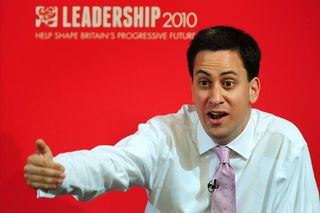
His stump speech was framed in terms of the familiar nostrums. He ably ticked all the boxes: politics can make a difference ... politics should be about more than management ... Labour needs to listen more ... the leadership election provides us with a blank page ... etc.
Ed said Labour did some things in government we should be proud of, but it didn't do enough. On the economy, he believed the party came too late to the idea of having an industrial policy. The experience of government had taught them markets alone cannot be left to create jobs because it never will in sufficient quantities, therefore the state has the responsibility to fill this gap. He also knew millions of working class people were turned off from Labour because of its chummy relationship with business. Ed acknowledged this was a less a relationship and more a case of business's lording it over the party. In a New Labourish rehtorical flourish, he said if workers can expect fairness not favours from Labour, then it should be the same for business.
Warming to his theme, he thought New Labour was an overreaction to the 1980s. The managerial style, the centralised leadership under Blair and Brown, it was all top down. The new leadership must learn to listen to its members to avoid the heavy handed mistakes of the ancien regime. This means a proper party conference with serious debate, members' input into policy making, and the inculcation of a sense that members have influence on the party's direction. Part and parcel of this is rebuilding of the trade union movement. He said he was proud to be nominated by so many unions, but thought it was a real tragedy not enough people were in them. If he was voted leader he would work with the rest of the labour movement to make them more relevant.
The meeting then moved to questions. I won't bore readers with the ins and outs of every query, but will stick to the main points.
On the coalition, he said when the Tories are in government, they behave as if they own the place. When Labour are in, they feel like squatters. But the situation now is different to the 80s. Back then Labour were relatively powerless to stop the Tories. But because Cameron governs in coalition, the LibDems are particularly vulnerable. Our job is to make them feel like an endangered species. They've got to feel as if deposing Nick Clegg is the only way to save themselves from electoral oblivion. If we are successful in keeping up this pressure, the coalition will fall.
On parliamentary selection (obviously a controversial issue in Stoke), because it demotivates members and can drive them out of the party, he was asked if he would give an undertaking to stop the imposition of candidates by the central party? Ed replied the impositions happened because the 'special rule' period had been applied for longer than usual. To avoid this happening again, CLPs need to select their candidates earlier. If MPs are going to step down, they owe their CLPs the courtesy to give them plenty of time to organise a selection process.
On the deficit, the questioner felt the Tories had enjoyed a free ride at the despatch box and they were using the debt to railroad though an ideologically-driven cuts agenda. Ed replied that when the Tories have completed their spending review in the autumn we have to be ready with an alternative to their draconian cuts. We have to challenge them on their rewrite of history: this was a crisis of the banking sector and not the public sector.
On foreign policy, though he avoided direct discussion of Iraq, Ed said that under Blair New Labour mistook the alliance with the USA as the need to agree with Bush's on everything. Britain needs to disagree with America when necessary, and also be more willing to criticise Israel for its actions (in fact, he went as far to say Britain and the EU should not upgrade its relations with Israel (whatever that means) until it has made real progress on Gaza).
As a trade unionist I was particularly interested to hear his opinions on workplace rights. I got the impression from elsewhere that Ed more or less supported the status quo. If he did hold this position, then he's recently moved on it. He believed all industrial legislation needs to be reviewed: he thought the labyrinthine rules on strike ballots were utterly absurd. He was also for union access to workplaces as of right, a strengthening of rules on unfair dismissal and redundancy, and get away from how the rest of the world views Britain: as a country that hires and fires in cavalier fashion.
Lastly, Trotskyist readers of a certain pedigree might be interested to learn Ed was fully in favour of Young Labour having more independence and the right to take its own positions on things. This is necessary if we are to build a culture where the party can trust itself, and a movement fully in touch with the concerns and struggles outside of parliament.
This meeting pleasantly surprised me. In contrast to gloomy comment on other blogs, I thought Ed Miliband's stall was solidly labourist. For example, whereas Ed Balls combines a Keynesian orientation to the economy with a near-Powellite view on immigration, Ed Miliband eloquently argued that immigration was a lightning rod for discontent. An economic programme that places jobs and house building at the core of a coherent industrial strategy would undermine the antipathy large sections of Labour voters feel toward immigrant workers. Sure, it's not the solidly socialist programme some demand as the condition for taking out Labour membership, but it's a clear social democratic break with the Third Way/neoliberal claptrap that went before.
Speaking to various folk afterwards, more than a few members said it reaffirmed their decisions to back Ed. It's fair to say he picked up some converts too. Speaking to a local leading trade unionist, he said if Ed Miliband won his (sizable) branch would join the party en masse. Of course, they should join now to help make sure he does. And again, the atmosphere was convivial, friendly, and there was plenty of time after for socialising.
Whether one supports him or not, if Ed Miliband wins the leadership contest Labour will be a more interesting, more gratifying place to be. Why not come aboard?
Friday, 30 July 2010
Friday Business
No time for a proper post tonight, so just a couple of things.
First up, nearly everyone who follows British politics will have heard about the brouhaha concerning the blocked Sheffield Forgemasters loan from the treasury, and Nick Clegg's despicable role in doing nothing about it. And, as Jimmy Cricket liked to say, there's more. According to this Tribune piece the Tories were told in no uncertain terms by a Sheffield-based donor to veto the Forgemasters loan. What was that, a wealthy businessman dictated a course of action to a Tory government, and the LibDem leader just sucked it up? Surely not. As Denis MacShane says in his piece, had something like this happened on Labour's watch the press would have been all over it. And its true. Remember Bernie Ecclestone? The Hinduja brothers?
Seeing as everyone else has been doing reminders ... don't forget to vote for your favourite left blogger from Stoke-on-Trent in the annual Total Politics beauty contest. Polling closes midnight tomorrow!
1. You must vote for your ten favourite blogs and ranks them from 1 (your favourite) to 10 (your tenth favourite).
2. Your votes must be ranked from 1 to 10. Any votes which do not have rankings will not be counted.
3. You MUST include at least FIVE blogs in your list, but please list ten if you can. If you include fewer than five, your vote will not count.
4. Email your vote to toptenblogs@totalpolitics.com
5. Only vote once.
6. Only blogs based in the UK, run by UK residents or based on UK politics are eligible. No blog will be excluded from voting.
7. Anonymous votes left in the comments will not count. You must give a name
8. All votes must be received by midnight on 31 July 2010. Any votes received after that date will not count.
While you're at it, give the worst blogs poll your votes too. At the moment right wing blogs are racing out in front!
Lastly, when did this happen?

I'm talking about the phenomena of nursery graduations. Sounds like something southern softies or yanks would be into, but no, apparently it's a worldwide thing practiced even by pre-schoolers in Stoke! I blame ZaNuLieBore.
First up, nearly everyone who follows British politics will have heard about the brouhaha concerning the blocked Sheffield Forgemasters loan from the treasury, and Nick Clegg's despicable role in doing nothing about it. And, as Jimmy Cricket liked to say, there's more. According to this Tribune piece the Tories were told in no uncertain terms by a Sheffield-based donor to veto the Forgemasters loan. What was that, a wealthy businessman dictated a course of action to a Tory government, and the LibDem leader just sucked it up? Surely not. As Denis MacShane says in his piece, had something like this happened on Labour's watch the press would have been all over it. And its true. Remember Bernie Ecclestone? The Hinduja brothers?
Seeing as everyone else has been doing reminders ... don't forget to vote for your favourite left blogger from Stoke-on-Trent in the annual Total Politics beauty contest. Polling closes midnight tomorrow!
1. You must vote for your ten favourite blogs and ranks them from 1 (your favourite) to 10 (your tenth favourite).
2. Your votes must be ranked from 1 to 10. Any votes which do not have rankings will not be counted.
3. You MUST include at least FIVE blogs in your list, but please list ten if you can. If you include fewer than five, your vote will not count.
4. Email your vote to toptenblogs@totalpolitics.com
5. Only vote once.
6. Only blogs based in the UK, run by UK residents or based on UK politics are eligible. No blog will be excluded from voting.
7. Anonymous votes left in the comments will not count. You must give a name
8. All votes must be received by midnight on 31 July 2010. Any votes received after that date will not count.
While you're at it, give the worst blogs poll your votes too. At the moment right wing blogs are racing out in front!
Lastly, when did this happen?
I'm talking about the phenomena of nursery graduations. Sounds like something southern softies or yanks would be into, but no, apparently it's a worldwide thing practiced even by pre-schoolers in Stoke! I blame ZaNuLieBore.
Thursday, 29 July 2010
The Worst of All Worlds

Okay, I'm being a bit facetious. But I did come away with the impression the real story of the post-election negotiations between Labour, the Tories and LibDems is yet to be told.
For the LibDems, ultimately a deal with Labour couldn't be done because of Gordon: the real reason, it turned out, had more to do with Clegg's volte-face over spending cuts. The official ConDem narrative claims the LibDems changed their minds once they saw the books. In fact, as Clegg says in his interview, he had changed his mind because of the Eurozone's sovereign debt crisis. Curiously, he couldn't bring himself to mention this while the campaigning was in full swing, making his attacks on the Tories particularly hypocritical.
I was of the view the best we could have hoped for in the election, given Labour's standing in the polls, was a coalition with the LibDems. That didn't preclude Labour fighting to win. In fact, given the balance of political forces, every single vote would have strengthened its hand in any negotiated settlement. Neither was it a result I desired. But it was a sober assessment eventually borne out by the election results. So what did come as a genuine surprise was how little prepared the Labour leadership were. In his interview, Peter Mandelson said Cameron's public offer to the LibDems was met with genuine bemusement and scepticism by Brown and the rest of his team (the Dark Lord had already divined a coalition between the two was more than possible, of course). If this is true, if they did expect the LibDems to spur the Tories' advances, why weren't the leadership already preparing for serious negotiations? Asking Ed Balls and Mandelson about their first meeting with the LibDems, their admission that there was no briefing document or even a discussion beforehand damns Brown's team as criminally complacent.
It seems the prospect of a deal was more or less fluffed by Labour before negotiations begun. But it was not all the Brownites' fault. At the second formal meeting between the two parties, the LibDems dropped Clegg's cuts bombshell, a position all wings of Labour would have found unacceptable. In truth, while the voters on May 6th didn't know it (nor, for that matter, the vast majority of LibDems), the yellow party's policies were already in alignment with the Tories.
A rather softer portrait of the Tories emerges from the documentary. Apparently Cameron had originally decided to go for a minority government if the Conservatives had won over 300 seats but were short of a majority. But then, we're told he woke up on the Friday morning thinking "a coalition [with the LibDems] seemed the right thing to do." In other words, the coalition began life as a whim. This explanation of its origins were reinforced by William Hague's contribution - he said apart from some idle musing before the election, no one thought about forming a coalition. I know the Tories are not-so-affectionately known as the Stupid Party, but surely there was some hard political calculation going on.
Returning to the LibDems, Clegg, David Lyons, et al. all emphasised how accommodating they found the Conservatives. Reporting on conversations with his party's negotiators, Paddy Ashdown said they were amazed at the speed Tories were conceding key points on their brief. He paraphrased their positions as "Would you like this? We've been trying to get rid of this for some time." More evidence Cameron calculated a tie-up with the LibDems would marginalise the moonbats on the hard Tory right. What I'd like to know is just what they conceded (apart from the AV referendum) considering the coalition's programme is barely distinguishable from the Tory manifesto.
We know the rest. The Tories and LibDems tied the knot and their grotesque offspring weren't slow to materialise. They have set about dismantling what remains of the welfare state. The cold dead hands of neoliberal dogma is driving economic policy. And Nick Clegg is overseeing the sorts of constitutional gerrymandering he would have roundly denounced in the past. Of course, the Tories were always going to do this. But as Andrew Adonis points out in his interview, the LibDems chose to align themselves with a right wing agenda. So much for social liberalism.
One thing Ashdown says in Five Days That Changed Britain stands out. On the hung parliament result, he said "The electorate had invented an excruciating instrument of torture for the LibDems." Going by the policies they are now promoting, you could say they're returning the favour.
Wednesday, 28 July 2010
Economic Vandalism and the UK Film Council

Which makes the abolition of the UK Film Council an even more curious decision. This particular move will save the treasury a whopping £15m/year, and was probably chosen because "it's the arts" and apart from liberal/luvvie-types, no one will give a toss. But this is a stupid decision from the standpoint of building on the economic recovery AND securing tax receipts.
Since the UK Film Council was set up in 2000, some £160m of government money has been invested in film production. This money has been unevenly spread across approximately 900 pictures, which, according to the UKFC has generated £700m in worldwide box office receipts.
Of course, the total number of receipts cannot be considered the return on the government's outlay. The UKFC oversees the distribution of lottery money too, and it is very rare to find a film funded solely by this and tax monies. To borrow a phrase from other areas of government, UKFC-funded films are public/private partnerships to varying degrees.
So permit me this small *unscientific* exercise to illustrate the kinds of damage the coalition government's short sightedness is about to inflict.
Suppose all 900 films received an equal slice of public money. Of the £160m, each receives approximately £177,778 as a subsidy. If we treat this as capital, from the state's point of view profit is defined by the increased tax returns over and above the initial outlay.
The table below lists a dozen well-known films that have received UKFC financial backing of some sort, with their budgets, worldwide box office takings, and gross profits:
| Film | Budget | Box office | Gross profit |
| St. Trinian’s | £7.11m | £12.89m | £5.78m |
| Happy-Go-Lucky | £1.41m | £8.77m | £6.22m |
| Man on Wire | £1.20m | £9.00m | £7.80m |
| The Wind That Shakes the Barley | £4.20m | £12.05m | £7.85m |
| Bend It Like Beckham | £6.00m | £50.00m | £44.00m |
| The Last King of Scotland | £3.16m | £25.45m | £22.29m |
| In the Loop | £0.61m | £1.50m | £0.88m |
| Streetdance 3D | £4.50m | £11.59m | £7.09m |
| This is England | £0.79m | £4.30m | £3.51m |
| The Constant Gardener | £13.90m | £45.81m | £31.91m |
| Gosford Park | £14.14m | £62.68m | £48.54m |
This yields a total gross of £185.87m
Calculating the tax payable on this is a difficult business. The government taxes the companies that own the films, not the individual pictures themselves. Cinemas take a slice on ticket sales too. But for illustrative reasons I will suppose each film is equivalent to a discrete firm taxable at the 28% Corporation Tax rate.
Applying that rate to total gross profits gives us £52.04m that goes to the treasury. That works out as an average of £4.34m per film, or a return of £24 for every pound of taxpayers' money the UKFC invested (assuming the subsidy is constant).
There's more. Let us estimate the wage bill of these films account for 70% of their budget. Their total budget was £57.02m, of which £39.91m was expended as wages. Assuming all staff were basic income tax rate payers (which, of course they're not, but some actors and production staff are foreign nationals and/or not domiciled in Britain, they do not pay tax on earnings here - it serves as a rough equaliser), a further £7.98m makes its way back to the treasury.
That's £60m tax off just 12 films. And that's without counting the multiplier effects all this economic activity has had in terms of supply chain, VAT take, cast and crew's spending, etc.
Nor does it account for future multipliers. Take Keira Knightley, for example. Bend it Like Beckham catapulted her into the A-List and helped her become a big box office draw. Not only does the treasury benefit from the large fees she's able to command, but also the cut it gets from the stardust she's sprinkled on monsters like Pride and Prejudice, Atonement, and Love Actually. Her case shows the return on the UKFC's initial Bend It investment will pay dividends for as long as Keira makes films, and beyond. The same is true of other actors, directors, crews and studios whose pictures have received tax payers' assistance, whether they meet the short-term criteria of returning a profit to the treasury or not. As their reputations are built, so is their bankable value and with it their taxable pay. And returning to the short term, even if all the other 888 UKFC-funded films were commercial failures they too had their multiplier effects by virtue of their economic activity.
This may be an unscientific experiment, but it illustrates how the government's decision to scrap the UKFC is not just an act of artistic philistinism. It's a case of economic vandalism too.
NB All figures are taken from Box Office Mojo and individual wikipedia pages. Where the only available figures have been given in dollars, they were converted to sterling using the exchange rate pertaining at the time.
Subscribe to:
Posts (Atom)