Friday, 24 December 2021

Local Council By-Elections December 2021

This month saw 36,958 votes cast over 30 local authority contests. All percentages are rounded to the nearest single decimal place. Overall, 19 council seats changed hands. For comparison with November's results, see here.

Party
Number of Candidates
Total Vote
%
+/- 
Nov
+/- Feb 20
Avge/
Contest
+/-
Seats
Conservative
          30
12,211
    33.0%
 +5.7
      -5.5
    407
  -13
Labour
          27
 9,056
    25.0%
  -6.7
      -5.0
    336
   +3
LibDem
          19
 6,144
    16.6%
  -3.0
     +1.1
    323
   +6
Green
          17
 3,876
    10.5%
  -0.3
     +8.0
    228
   +3
SNP*
           2
 1,364
     3.7%
 +3.7
     +3.7
    682
   +1
PC**
           1
   82
     0.2%
  -0.8
      -0.7
     82
     0 
Ind***
          14
 3,272
     8.9%
 +2.6
      -3.3
    234
     0
Other****
           7
  953
     2.6%
  -0.9
     +2.5
    136
     0


* There were two by-elections in Scotland.
** There was one by-election in Wales
*** There were two Independent clashes this month
**** December's Others consisted of the Rotherham Democratic Party (15, 6), TUSC (32), Whitnash Residents' Association (835), Workers Party of Britain (10), Yorkshire Party (35, 20)

Local council by-elections are often laws unto themselves. What's going on locally, unsurprisingly, tends to bear on their outcomes. Occasionally national events impinge on and determine the outcomes of these contests. Between 2010 and 2015 the dark deeds of the Liberal Democrats and the rise of UKIP to national prominence were reflected at a local level. And now, with strong performances since the resumption of by-elections in March the Tories' fortunes have suddenly nose dived. What we saw in North Shropshire appears to be playing out locally. I.e. Whoever is perceived as best placed to see the Tories off finds votes clustering around them. Because of this, December was the worst set of results the party has experienced since this site started covering by-elections. Here's to hoping new record breaking losses can be look forwarded to in the new year!

2nd December
Adur: Hillside, Con hold
Breckland: Hermitage, Con hold
Highland: Fort William and Ardnamurchan, SNP gain from Con
Lancaster: Bare, LDem gain from Con
Lancaster: Upper Lune Valley, LDem gain from Con
Newport: Victoria, Lab hold
North Norfolk: Stalham, Con gain from LDem
Warwick: Whitnash, Oth hold
Wealden: Hartfield, Grn gain from Con
Worthing: Marine, Lab gain from Con

9th December
Bracknell Forest: Old Bracknell, Lab gain from Con
Rotherham: Anston and Woodsetts, LDem gain from Con
Rotherham: Aughton and Swallownest, Lab gain from Con
Tonbridge and Malling: Castle, Grn gain from Con
Tonbridge and Malling: Kings Hill, Con hold
Tonbridge and Malling: West Malling and Leybourne, LDem gain from Con
Torridge: Northam, Con gain from Ind

16th December
Argyll and Bute: Lomond North, Con hold
Ashford: Highfield, Grn gain from Con
Bridgend: Caerau, Ind gain from Lab
Horsham: Roffey South, LDem gain from Con
Lichfield: Armitage with Handsacre, Con hold
Medway: Rochester East, Lab hold
Middlesbrough: North Ormesby, Lab gain from Ind
Northumberland: Hexham East, LDem gain from Con
Telford and Wrekin: Dawley and Aqueduct, Lab hold
Walsall: Pleck, Lab hold
West Berkshire: Tilehurst South and Holybrook, Con hold
West Lindsey: Nettleham, LDem gain from Con

23rd December
New Forest: Bransgore and Burley, Ind gain from Con

Thursday, 23 December 2021

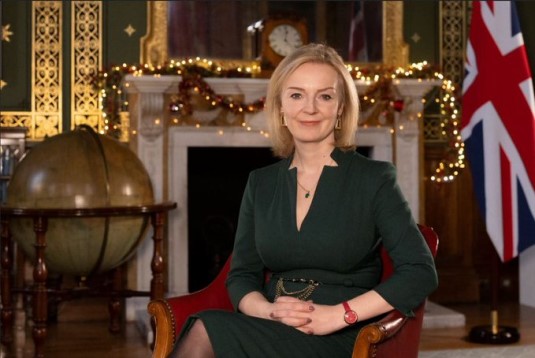
Liz Truss: An Anti-Profile

The Conservative Party is the sworn opponent of the labour movement, but this doesn't mean the qualities of leading Tories can't be appreciated from a distance. Margaret Thatcher, for instance, was able to consolidate a dominant bloc of interests and hold it together while smashing the trade unions and pushing through privatisations and marketisation not supported by the public. A ruinous and sectional programme in the service of her class to be sure, but carried through with conviction and strategic nous - even if then, as now, the Tories played politics on easy mode. One can make similar observations about John Major without subsequently whitewashing and lauding him. When he came to office, the economy was in the toilet partly thanks to the former chancellor of the exchequer ... a certain John Major. The Tories were facing the Poll Tax rebellion that had already seen violent disorder on Britain's streets, the consequences of negative equity and record home repossessions, a simmering internal civil war over European matters, and a not terribly popular war in the Gulf to fight. Yet within 18 months these issues were diffused or put into abeyance and the Tories won their largest vote ever (remember, fact fans, it's the 1992 general election and not the 2016 Brexit referendum that is the biggest democratic exercise this country has seen). Major would not have accomplished this if he was bereft of political skills, nor how he bedded down Thatcher's counterrevolution in the public services even as his party fell apart.

Among the notables and prominents in the contemporary Conservative Party, one would be hard pressed to find politicians of a similar calibre. Boris Johnson's barrelling of Brexit through his party and the subsequent election wasn't an act of genius, more like a realisation there was only one way the Tories could resolve Brexit on their terms. The adroit political handling of the coronavirus crisis, at least until recently, would not have been possible without a supine opposition and supportive media. But, politically speaking, Johnson's a galaxy brain in a firmament of pinheads and dim bulbs. Considering the times Dominic Raab, Jacob Rees-Mogg, and Priti Patel have been found out we're not talking about a cabinet bursting with talent. Then again, as long as a would-be leader gives the disappearing party membership the feels, do they need any more?

It's a situation tailor-made for the not overly blessed Liz Truss. The latest hagiography published by The Times was conceived to warm the cockles of Tory hearts, and cosy the paper up to the frontrunner in the race to succeed Johnson. Indeed, it reads like a checklist so those at home can tick off their priorities. Thatcher affectations? She's done them. Taken on the woke mob? If one believes Truss's "reframing" of her memories, she's been doing this since her school days. A desire to make her way in the world is code for more market fundamentalism. Prefers going with her gut instead of thinking about decisions? Sure, her first instincts are liable to be correct. And the old Thatcherites tunes are there: "freedom", "liberty", the tried and tested Tory doublethink for less freedom and tighter liberties. Just as well, we learn, she's a fan of 1980s karaoke.

On her background, which is from the comfortably off and vaguely left wing middle class, The Times spares no efforts describing how she broke with the politics she grew up with. Entering student politics as a Liberal Democrat, apparently what made her right wing was a dose of the hard stuff - economics. We're told she genuinely believes left wing people are brainwashed (which is fair enough, because there are plenty of (wrong) leftists who say the same about the right), but that she's simultaneously ideological and wears her ideas light. She reads a lot, apparently, the pseudo political-scientific guff beloved of the Washington Beltway. And, like her peers, the obligatory biographies. But she's also quite impulsive, has come to value her gut instinct, and apparently has a work ethic that inspires the best from among her subordinates. All good big C Conservative stuff. However, what she can't run away from is her remain positioning during the EU referendum - the sort of reality-based arguments Brexiteers at the time called project fear. True enough, but her personal ratings on Conservative Home have found these remarks already forgiven if not forgotten. As trade supremo, foreign secretary, and now chief negitator with the EU over Brexit matters she has not only presented herself as the face of every new and/or rolled over trade deal going, following the departure of David Frost she gets to capitalise on the dreary sabre rattling and grandstanding this useless government is happy to indulge to keep the base frothy.

But Truss is not an ice cold Labour-slaying machine. Her quirks and awkwardness are talked up as strengths. Her speeches might be stilted and far from florid, but this puts her close to where the Tories think their base are. Especially the red wallers, who she had made an effort with and who, in turn, have reciprocated. She's au fait with social media too, but befitting her unaffected naturalism it output comes without the polish Sunak has poured into his online efforts. The Times also notes there isn't any big money behind her directly, which might be a disadvantage in the short term versus money bags opponents but when the rest of her party is stuck in the mire of corruption, that will endear her further to a membership also exasperated by the money grubbing at the top of the party.

There are two things that interest us: what would her leadership mean for the Tories, and would Labour (presently constituted) be able to defeat her in an election. From the off, Truss is most likely to win a post-Johnson leadership contest - assuming the parliamentary party don't block her path to the final two - because she exemplifies their prejudices and relative estrangement from wider politics (i.e. the anti-woke stand against social liberalism), the refusal to countenance the realities of Britain's situation following Brexit, and the decrepitude of British capitalism - which Johnson's overhyped but underwhelming economic regeneration agenda at least tries to address. When a party disengages from social life, the remaining activists and representatives are bound to find voluntarism attractive - as any alumnus of small political groups would tell you. Truss's Thatcherite cosplay offers the promise of handbagging the world and making it conform to a reheated Thatcherism. Problem is, the economy needs this like a hole in the head. Cutting? There's nothing left to cut. Privatising? The big ticket items are long gone. Clamp down on workers' rights? Neoliberal governmentality can't deliver docile subjects indefinitely, because their system isn't delivering the goods. As soaring food bank use confirms. To escape the spiral whereby their name is mud among most people of working age, the Tories must seize Johnson's half-arsed modernisation agenda and go full throttle, while building more homes, not attacking social security any more, abandoning stupid and wasteful market experiments, adopting social liberalism and ditching the overt and dog whistle racism of anti-woke crusading. The chances of them doing this are next to nil because of the character of interests they articulate and organise, and the small matter of most Tory MPs being of the view that doubling down on Conservatism is the path to take. What a Liz Truss leadership says about the Tories is that they're exhausted, bereft of ideas, but would happily weaken the system they defend by re-cementing narrow commercial, finance, and property interests as the hegemonic bloc of interests within capital as a whole.

And Labour? If Truss tries to generalise her Thatcherism 2.0 pitch out from the membership to the wider electorate, she's likely to do so under the rubric of tackling the debts the Tories have unnecessarily wracked up during the pandemic. After all, it worked well enough for Dave and Osborne back in the day. The other string to her bow will be, sorry to say, yet more tiresome culture war posturing with trans women and "gender ideology" the scapegoats of their campaign. Assuming Johnson is gone by 2023/4, the only realistic short-term chance the Tories have is if they cobble together the 2017 and 2019 coalitions again (aided by their jerrymandering of constituencies) before victories on this basis become more difficult as the decade wears on. How might Labour respond to this? It's not about to contest the Tories on culture wars, Keir Starmer has been pretty clear on that. Given how the party has frequently pitched its critique of the government to the right, if past behaviour is any indicator its not likely to contest a Truss move onto the terrain of Covid debt but rather portray themselves as more responsible custodians of the public purse. A bidding war it can never win when the terms of debate are readily conceded to the enemy. Labour's hope lies in being able to mobilise the 2017 coalition with enough Tory voters coming its and the Liberal Democrats' way, a new alliance that is looking possible presently. But one cannot rely on anti-Toryism alone. This coalition must be cemented so it can weather the inevitable Tory and press attacks. Pitch it too far to the right then the provisional bloc leaks. Get it right and the Tories can be defeated.

All things considered, Liz Truss is the answer for a party that has run out of answers. She would make Tory members and supporters feel good about themselves, and she would firm up their core vote. But beyond that, it's difficult to see how her reinvention of the Tories - really a reiteration of years gone by - can build a coalition to get her party over the finish line first. Which means the political initiative passes to Labour, should this scenario come to pass.

Tuesday, 21 December 2021

Conquering the World, Pixel-by-Pixel

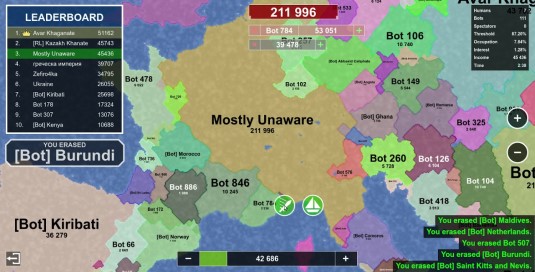
The long-awaited Winter holidays are here! A few weeks of mince pies, tinsel, miseltoe (if you're lucky), and a bit of time to waste. Yours truly is catching up on some reading with Rebecca and What is Philosophy? providing the book-bound entertainment. And for those moments where the brain needs a rest and something less cerebral, there is the new web-based game Territorial.io, by David Tschacher. If there's 10 minutes going spare, why not conquer the world?

Territorial.io is just about the simplest and most straightforward realtime global warfare simulator there is. You pick a spot on the map and your job is to grow out from your pixel to the point where you rule the world. Or enough of it to meet the victory conditions. There are up to 512 others trying to do the same too, so a bit of skill and a lot of luck is needed to fulfil your manifest destiny. By clicking on the map you expand your land holdings. The more pixels under your control, the more rapid your population grows and therefore your army. The latter is controlled by the percentage bar. Expand with low numbers and the more people stay at home to reproduce, but less land is taken in. The higher the numbers committed, the slower the growth in the short term and the greater one's vulnerability is to attack. The same applies when attacking enemies, which will quickly surround you. If you commit large numbers to take out an opponent, you'll have no juice left in the tank to fend off attacks from others. This isn't a problem in single player mode below harder difficulty level. The bots are limited and are easily squished. On very hard though, the bots will attack whoever is the weakest. And as their numbers aren't nerfed like they are at lower difficulty levels, they're going to win. Repeatedly. The trick is to go after the weakest bot on your borders (usually) and make sure you don't expend too many troops, because as soon as your population count goes below a neighbour - particularly in the late game - you're toast.

Single player is good for practice, but multiplayer is where the fun is at. Again, up to 512 human players can descend on one of 14 maps with the numbers made up by bots, and battle commences. The AIs here are uniformly weak and purposely designed to provide population fodder for the humans. Alliances of convenience can then spring up to take down big players, or persistent annoyances or, on several occasions I've seen, players who take on racist or Neo-Nazi monickers (what is it with wanting to cosplay the Third Reich in war games?). There are also team modes in addition to the standard battle royale that allow players to gift troops to one another to help out in fights over far flung corners of the globe, which adds a new layer of strategy. And there are now semi-permanent teams that have emerged on Reddit, and a clutch of YouTube channels going heavy on Territorial.io content. Not bad for a free game that's only existed for a blink of an eye. It is a fiendish game where blunders are shown no mercy, and one cannot believe how stupid other players can be.

Ultimately, games of this sort disproportionately attract Hitler enthusiasts, empire nostalgics, and hardcore nationalists is because the logic of play plugs straight into a key aspect of their imaginary. Just as children up until the 1960s were taught to be proud of the territories shaded pink on the class world map, this helped inculcate a decontextualised, abstract notion of greatness. This elided power with the amount of land a country claimed, so infant patriots might have fancied Britain as the best and most powerful nation because its imperial land area outstripped everyone else. Extrapolated into adult minds, empire maps fixed one's place in the world. Britain is best and therefore I am better than other peoples.

Territoriality plays a similar role in all nationalisms. On the white nationalist far right and its identification with Nazism, the empire Hitler briefly ruled - found on ten-a-penny war maps of Nazi Germany at its fullest extent - speaks not only to the military prowess of the regime, but also the (imagined) historic viability of their rotten politics. If it could happen once and nearly succeed, it might happen again. It doesn't matter that their atrocious view of the good society was utterly crushed by the combined militaries of politically inferior governments and racially inferior communists, the deterritorialised territory lives on in their brains as an inspiration. Squiggles on maps out of time, out of context, and completely divorced from the brutalities that made thoes lines briefly possible.

Territorial.io is an excellent, diverting casual game. Just remember to crush racists and neo-Nazis when you spot them in-game.

Monday, 20 December 2021

The Tory Class Politics of Covid

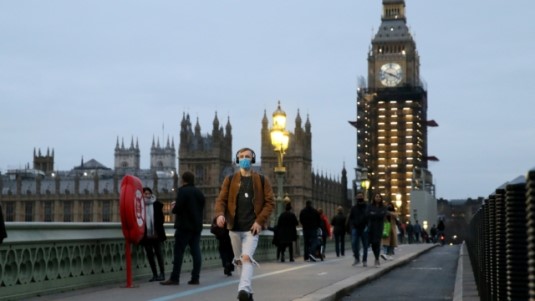
The wisdom of social media has it that the government are on the cusp of announcing new Covid precautions from 27th December. These would include the current advice of working from home if you can (the presumption workers can simply choose not to come into work remains), a closure of higher education and the move to online teaching, no indoor socialising, and no heading off to sunnier climes. This comes off the back of the relentless spread of the Omicron variant and, as the past tells us a great deal about the future, yet more Tory dithering about what needs to be done.

Unfortunately, because of the government's handling of the pandemic we've become inured to the stop-start cycle now. The irreversible freedom Boris Johnson declared back in July was just a prelude to future restrictions. The public, always well ahead of the government on Covid avoidance, would dig in for another round of not seeing anyone and not going anywhere. Polling ahead of last week's Commons vote on mask mandates and covid certification found 58% of respondents supported everything that was proposed. Masking up in shops enjoys strong support, and over half support a fortnight-long lockdown over Christmas to stymie the variant's spread.

Meanwhile, the government are content to sit on its hands. After a week of record rises in infection, once more SAGE's advice to act quickly to prevent the problem from getting worse finds itself brushed aside. More dithering brought on by political reasoning - resistance in the cabinet from superspreader Sunak, and threats of unrest in the parliamentary party. If the Commons returns in late December to approve another round of emergency measures, Johnson's authority is set for a battering as the promised backbench rebellion means he's forced to rely on Keir Starmer. Again.

This cycle of opening up and shutting down did not have to happen. These are the fruits of very deliberate choices the Tories made about what their priorities were during the pandemic. As the labour movement left have approached the crisis with our class interests in mind, so the Tories have done so with theirs. The decision to keep schools open was not a concern for children's mental health, but ensuring their parents could go to work if required. Allowing students back to universities just as infections were on an upward trajectory had more to do with serving the rental interests and property speculators dependent on them for income than securing the "student experience". Raising and then cutting Universal Credit was an effort at ensuring social security was an unpalatable option for riding out the pandemic. Tying the Job Retention Scheme to employers on reduced wage payments kept businesses and workers on life support, but it had to be ended as quickly as practicable to avoid the risk of raising expectations about what else the state could do. Combined with inadequate sick pay, both acted together to affirm our collective dependence on the wage relation as the primary means of making a living. Even Sunak's preference to borrow by issuing gilts instead of getting the Bank of England to stump up the reddies was a class conscious move: increasing the debt now means the state would, down the line, have to pay it back, which is amenable to future Tory austerity politics and disciplining an incoming Labour government. Taking these in the round, it's easy to see why the Tories have put all their hopes in the vaccine basket: it doesn't raise political horizons, and it doesn't suggest alternative ways of doing things are possible. Their boom and bust public health policy is driven entirely by their defence of class relationships, as per the rest of their politics.

Except now, Johnson's barefaced lies have caught him out, which have severely damaged his standing and ability to bounce back. But should he be replaced while the pandemic rages, their public health strategy will be more of the same: relaxation of the rules, and then ramping up as a new infectious wave hits.

Sunday, 19 December 2021

Was North Shropshire a Labour Disaster?

Having considered the Tories, what about Labour's result in the North Shropshire by-election? It looks like nothing short of disastrous. At a time when discontent with the Tories is running high, conventional wisdom suggests Labour would benefit. Especially in a seat where the party was positioned second between 1997 and 2019. Yet instead we saw its vote plummet by over 12 points while the Liberal Democrats surged from third to first in an even more stunning victory than June's Chesham and Amersham contest. Not good.

Is the straightforward reason that Keir Starmer isn't any good, and disgruntled Tories find his affectations unappealing? Perhaps, but on this occasion I'm not convinced this is the case. It seems obvious the leadership did not fancy Labour's chances from the start. Money was held back, Dear Keir didn't condescend to visit North Shropshire, and apart from a handful of shadow ministers dropping in there was little sense of urgency or enthusiasm for the campaign. If one was of a conspiratorial turn of mind, it might be suggested stitching up the selection and causing unnecessary local bad press was an evil genius move to concede the field to the LibDems.

But as the party was second placed last time, why throw in the towel? One of the arguments doing the rounds is the LibDems came second in this year's county elections so they're the natural repository of the anti-Tory vote. That's certainly the case for Shropshire as a whole, but the picture in North Shropshire is mixed. They were not uniformly runners up in this part of the world, but of the opposition parties they were the ones who made more of an effort to stand. Whitchurch, Wem, and The Meres were wards typical of the constituency as a whole: pretty much a Labour-free zone as far as candidates were concerned. Though, as recent general election votes showed the Labour votes are there. If the Great Satan Jeremy Corbyn could find them, that might suggest a good basis for a by-election insurrection? It would normally, and so we're left with something of a mystery. Unless a behind-the-scenes secret handshake had taken place between the two parties - the LibDems scaled back campaigning efforts in Old Bexley and Sidcup so they could have a clearer run where, according to Starmer's and Ed Davey's "feels", the LibDems stood more of a chance of winning.

Whatever the case, the message got out that a LibDem vote was the best way to punish the Tories and the good people of North Shropshire responded with alacrity. Therefore, given tactical voting was in play this was not the disaster the voting numbers suggest. But it still raises two issues Labour needs to address. First, as suggested in my Tribune piece, it is concerning Labour has so far not benefited from tactical voting anywhere near to the same extent. The tiny LibDem vote dipped in Old Bexley, and it seemed absent from the Hartlepool debacle. As Labour had an equal claim to North Shropshire beyond the "feels" of the hacks and Westminster wiseacres, when will it emerge victorious off the back of protest voting?

The other problem might seem minor but could store up trouble for Labour in the future: the Greens. As argued previously, the Greens are, sociologically speaking, an alliance of the petit bourgeoisie and the emerging new working class of immaterial/socialised workers. This is a problem because the latter are the core constituency of the Labour Party these days, a process of composition Corbynism accelerated and Starmer and friends are seemingly oblivious to. As such, the repeated feints to the right on public spending and immigration, for example, won't curry favour with this constituency and some of them can get peeled off by the Greens. At a local level, this is seen in the Greens' slow but steady growth in local government, but with the possibility of taking more support in the future. This could make the difference in the swing seats Starmer needs to win back. But interestingly, in North Shropshire - just like Old Bexley - the Green vote stayed stubbornly still. While not a lot to shout about to begin with, the fact these voters stayed put when tactical voting was understood by the electorate is, at least, interesting and worth keeping an eye on.

Not quite the disaster it seems at first glance, but not really good news for Labour beyond there being one less government vote in the chamber.

Saturday, 18 December 2021

Mown Down by Moderna

Sad to report your blogger is dealing with the mild side effects of his Moderna booster, and as a result a new post won't be forthcoming this evening. But there is something we can do to fill the gap, so here's an unseasona summery offering from a long time ago.

Wednesday, 15 December 2021

Capitalism Vs Covid Shutdowns

Give this excellent discussion with Adam Tooze a listen. And if you're able, please help support Alex's work here.

Tuesday, 14 December 2021

Tory Anti-Mask Libertarianism

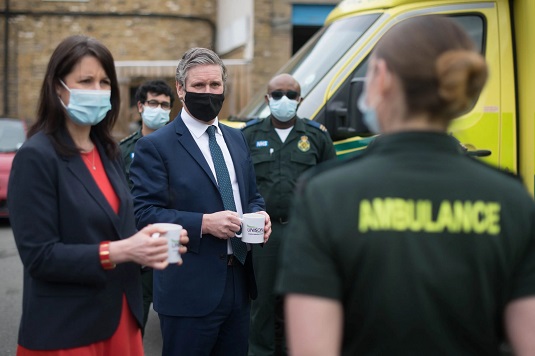
It was worse than Boris Johnson feared. The Tory plan for Covid passes got through the Commons only with Labour's help, as 99 Conservative MPs rebelled against the government. Not since the excruciating days of Theresa May's Brexit votes have we seen rebellion of this magnitude, except on this occasion the PM's blushes were spared by Keir Starmer's patriotic/responsible opposition backing. It's a twitchy time for the whips, and all eyes are going to be on Graham Brady's postbox in case the no confidence letters fall onto his mat with the frequency of takeaway menus. 63 Tories also voted against Johnson over compulsory vaccinations for NHS staff.

Covid certification and mandatory vaccinations, most people can understand opposition to these measures even if they support them themselves. Channelling our old friend John Stuart Mill, there's always a balance to be struck between liberty and security. But these are in a different league to face masks, which saw 38 Tories oppose this inexpensive, low effort, and relatively effective means of mitigating Covid infections. Explaining their opposition, Graham Brady, Mr 1922 himself, described it as "mission creep. Because PPE is next to gulags in the chain of repression. The dependably stupid Steve Baker, the former (self-identifying) hard man of Brexit, said the Prime Minister need to have a grip on his party and "start driving it in the direction of freedom and personal responsibility." Personal responsibility is a funny way to describe one's indifference to exposing others to the risk of infection. And ramping up the rhetoric, Marcus "Clown" Fysh was angling for attention when he carped on about anti-Covid measures not being out of plaice in Nazi Germany. What can you say, anyfin goes on the backbenches these days.

Large numbers of people have pointed to an apparent contradictions in their arguments. You can have the parliamentary wing of Right Said Fred wibbling about freedom, and how putting on masks violates fundamental liberties and the sovereignty of the individual. Fair enough. Libertarianism is a pretty daft belief - the social is the condition of the individual, after all - but it is a coherent system of philosophy and could be interpreted as a wrong but a principled stance. But hold on a moment, what do we have here? Trawling his voting record, we discover Marcus Fysh has cast votes for mass surveillance of private communications, abstained on same-sex marriage, and supported Priti Patel's disgusting Nationality and Borders Bill. Steve Baker's record is little different, including supporting significant restrictions on the right to protest. It doesn't take a genius to work out there's a tension here, and one we find repeated across virtually all the anti-mask Tory MPs. Righteous champions of liberty when it comes to wearing a piece of cloth across one's face, and grubby authoritarians happily empowering state coercion and literal infringements of individual privacy. How to explain away this obvious hypocrisy in their own terms?

Easy. Libertarianism is probably the most infantile of bourgeois ideologies. It expresses capital's desire to be free of any social responsibility. Its nature, its impulse is the monomania of accumulation. Woe betide anything interfering with that (workers' rights, health and safety regulations) or "unjustly" takes a cut out of their cashflow. I.e. The state and its battery of taxes. Consumed by an overweening self-obsession, it purposely, symptomatically forgets that the piling up of cash, that capital itself, is a social relationship and can only be accumulated by a cooperative effort. This is much easier to ignore when the process of accumulation for a significant section of the bourgeoisie immediately appears to be the pay off from wise investments in stocks, hedge funds, and money markets. It's not an accident that libertarian capitalists drawn from manufacturing backgrounds are thin on the ground.

Sublimated into the limited imaginations of Tory MPs, this common sense of a class fraction becomes the common sense of a political faction. Anti-mask whinging is their dressing up opposition to a simple public health measure as high principle because it mildly inconveniences them. The same applies to repressive legislation. They have no problem empowering the police and spooks, and putting meatier sentences on the statue books because these instruments defend their freedom. Banging up Extinction Rebellion protesters is justified because road blockages disrupt the freedom of our high-minded defenders of liberty to go about their business. The hypocrisy is there and baked in because the subject of libertarian discourse is entirely bourgeois, and its identification of the individual and individual interests are one and the same as capital's interests. It is a naked demonstration, in all its duplicity, of class rule in theory.

It's pretty obvious anti-mask Tory MPs aren't acting in the interests of capital or, for that matter, the collective class interest their party serves. But the logic of their position is entirely within this terrain, and are therefore prepared to see potentially millions suffer and thousands die to defend the political relevance of their class habitus.

Image Credit

Monday, 13 December 2021

Keir Starmer's "Prime Ministerial" Address

Define "prime ministerial". It's an ability to speak authoritatively, appear as if one knows what they're doing, and not look like a sack of spuds in a suit. This most nebulous of countenances was something Dave had. In fact, looking the part was arguably his greatest political skill. Theresa May had it too. She was very much the "grown up" in the room until her authority was shot. Jeremy Corbyn didn't have it because politics. And neither does Boris Johnson because Boris Johnson. But how about Keir Starmer? He has the nice hair cut. He's reasonably telegenic. You can imagine him carrying a briefcase and wouldn't look out of place flicking through a filofax, if they were still a thing. The Labour leader and his media people think so too, which helps explain the framing for his Monday night national address.

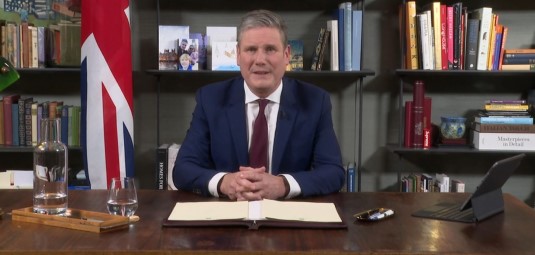
Let's consider the setting. Yes, of course the Union Jack was going to be there. Starmer handed over too much members' cash to managerial consultants for their advice to be ignored. Is anyone going to rush out and vote Labour because of a patriotic prop? I doubt it, but the aim is to dampen any Tory attacks about his and Labour's lack of national pride. It looks synthetic if Starmer starts painting his face in the colours of St George, but a relatively unobtrusive flag here and there, just like how the Tories do it, adds to the ambience. Going back to the opening few seconds is also interesting. The desk is quite vintage looking. Indeed, everything to the left of the flag is a bit redolent of the second world war. The old books (obviously none from Gollancz's Left Book Club) and the interesting tray the water rests on is all a bit olde worlde, a subtle nostalgic nod. Move to the centre and there's Starmer himself, picture of the family prominently displayed at the back with a few Christmas cards and sheets of parliamentary paper in front of him. And then to the right of the screen, there's the laptop, a selection of middlebrow art books and, in case FBPE liberals were spooked by the patriotism talk, the non-too-subtle Obama: An Intimate Portrait is conspicuously lodged with other non-threatening lifestyle/coffee table titles. The overall affectation is Starmer as someone flanked by past certitudes and liberal modernity, a politician who knows where he's come from and where he is going.

This speech itself was straight forward Blue Labourism, shorn of its more radical moments. He discussed our "shared national duty" to stand by NHS workers as they battle through the Omicron wave. He linked the protection of the NHS to "Britain's interests", establishing a relationship between a traditional Labour strength to overcome (LOTO believes) a key Labour weakness - on sticking up for the country. Other nods to a soft social conservatism included referencing Her Majesty's opposition, "our nation", and to reinforce Labour's responsible responsibleness, Starmer said "we are a patriotic party and it is our patriotic duty to ensure these [Covid restrictions] go through. In doing so, we are supporting our NHS and supporting our country." He made a point of wishing everyone a happy Christmas from his family, and inbetween repeated standard public health messaging. His criticism of the Tories was blunted and implied ("we need leadership ..." and breaking off to say everyone has to do their bit). He said Labour's patriotic duty was to critique the Tories, and took a dig at them for being woefully unprepared.

Taking the contrivance of the setting together with soft ball criticisms, we are seeing a subtle shift in Starmer's opposition strategy. From even before he became Labour leader, he signalled that his idea of "constructive opposition" was to do nothing except back the government and make process criticisms when there were obvious failings. This, one might argue (and indeed, his supporters have) was because Labour shouldn't "play politics" in times of crisis and no one was interested in what the party had to say anyway. Except some people were very interested, and that was the Tories. Starmer and friends would rather pretend the Jeremy Corbyn interlude never existed, but it's a matter of public record that the suggestions he made in the dying days of his leadership were incorporated into the Tories' approach to Covid mitigation. Had Starmer done the same thing, he might have taken the initiative on Coronavirus and introduced himself earlier to the electorate as a serious figure with something worthwhile to say. Unfortunately for him, the Tories brushed aside his criticisms and accused him of playing politics anyway, while constructing the politics of the crisis to suit them and their interests.

Now, in fits and starts, Starmer is finally contesting their leadership. It is a weak challenge. The critique is muted and couched in the mildest terms, but tonight's attempt at prime ministerialism opposed stability and strong government with Starmer to chaos with Boris Johnson. To coin a phrase. In recent weeks Labour has rediscovered the utility of making suggestions for dealing with the pandemic, and is manoeuvring to position itself as Covid's most determined adversary. And here, the Tories are providing them a gift. The prospect of 70 plus MPs voting on Tuesday against the government's latest round of - broadly supported - precautions against the new variant makes them look like a bunch of idiots. Meanwhile, despite there being significant problems with the vaccine passport scheme, Labour gets to play the responsible party card. They are the ones putting public health and protecting the NHS first. Hence why they've attached no conditionalities to backing Johnson on this. The strategic thinking is let the Tories immolate themselves over a politics that appeals to the tiny anti-vax/Covid denialist movement. Plus getting this through on the basis of Labour votes erodes Johnson's already tenuous authority further, without Starmer having to risk an iota of political capital.

Turning back to the address, the newspapers will be happy with it. The bosses will be happy with it. And LOTO are hoping there was enough to introduce him to sceptical Tory voters as someone they can imagine on the steps of Number 10, and would do a better job of handling the responsibilities of office better than Johnson. Undoubtedly it's going to get focus grouped to death, but overall Starmer and his supporters are bound to be happy with the broadcast. For the first time in a long time, it appears politics is going their way.

Sunday, 12 December 2021

On Calling for Johnson's Resignation

Unfortunately, Boris Johnson's address to the nation this Sunday evening wasn't to say sorry and announce his departure from Downing Street. Instead, he urged viewers to get their booster shots while announcing an expansion of the vaccination programme. Nothing about protecting schoolkids, but the army are getting called in to assist with strategic health planning so everything's okay. That he's the worst possible advocate for new Covid restrictions didn't ruffle his delivery, but probably explained why he plumped for a pre-recorded statement. That and the handy absence of reporters.

Given his record in office Johnson ought to be grateful he's only facing calls for his resignation and not arrest and prosecution, but resign he most assuredly should. But why? If Johnson goes, the Tories are still in power. His possible successors, whether the current frontrunners or some other horror are going to carry on with the same policies. They will oversee tens of thousands of unnecessary deaths and even more incidences of long-term illness, and like Johnson are going to try their damnedest to ensure our people pay the cost of their failures. Is calling for the Prime Minister's resignation a waste of time?

No. The class character of the Tories must be kept in mind, as well as the limitations of calling for a change of personnel. But pressing the resignation button is politically useful if the timing is right. First, when the majority of the public - according to recent polling - think Johnson should stand down, it offers a door through which wider political arguments can step through. For instance, because Johnson's lying about his Christmas parties matters because he's thumbing his nose at sacrifices everyone else had to make, other aspects of the government's handling of the crisis - the deaths, the corruption, which remain largely abstract for most - are open to being looked at afresh. As well as who is making this call.

The second is the importance of the unwritten moral codes and their effects on ministerial behaviour. This is a bit like asking "what do you think of parliamentary standards?" and the reply coming back "They sound like a good idea." Easy to scoff at, but Johnson has played fast and loose with the Ministerial Code since coming to office and has repeatedly protected his lackeys from accountability, in outside of parliament. It's only when the media heat on one of Johnson's subordinates has got too much that they've been let go, as was the case with Matt Hancock. Forcing Johnson's resignation establishes the importance of probity in public life after its erosion over decades.

This doesn't mean governments of the past were honourable and gentlemanly affairs, but the strength of the unwritten rules then ensured there were costs attached to decisions, blunders, and getting caught with one's hand in the till. In other words, standards of decency and constraints make it more difficult for ministers to bulldoze through without regard to the law, conflicts of interest, and their oft-noted hypocrisies. With a Tory government for whom corruption is second nature, an affirmation of standards through a Johnson resignation opens up scrutiny of their recent record, raise expectations about the conduct of senior politicians, and might stay the hand of Johnson's successor when it comes to future murky deeds.

This doesn't mean abandoning class politics or class analysis for the constitutional fetishisms characteristics of "good Tories" and their liberal retinues, but making it more difficult for bourgeois politicians to act in their naked class interest without suffering political pain for it. This is why calling for and getting Johnson's resignation is important - it moves politics in our direction by just a little bit.

Image Credit