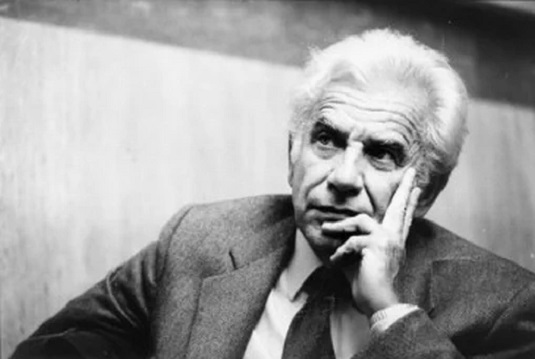
Tronti's pessimism speaks to us now because the left in this country has also been defeated. But is there anything we can take from his gloomy prognosis? Do these remarks tell us to give up, not least because Tronti talks approvingly of reading and studying reactionary thought? I would suggest not. He speaks of how operaismo and the workerist politics of Workers and Capital were situated in the moment of active and open class struggle, but that his error, and that of his comrades, was to mistake this for a revolutionary rupture. "The workers wanted a wage rise, not the revolution ... We saw red. But it wasn’t the red of a new dawn, rather that of the sunset." He says the experience taught him political realism and that the values of the left - progressivism, historicism, and Enlightenment - suppose too simple a set of solutions to the problems we face. As such, Tronti lately engaged with the world through the tinge of "serene desperation". Not least because what came of the revolutionary events of the 1960s was nothing that really challenged capitalism. Radicalisation (in Italy) led to some taking the dead end to terrorism, while for most it meant a generational turnover in the managerial class. Therefore we have two 20th centuries, the large and the small. The large was characterised by earth shattering events. The 1960s called time on that. And what came after was the small - a period of unoriginality, of low stakes politics, of (effectively) capitalism without class struggle. An endless present of stasis and decay.
Tronti does not rule out hope for the future, but just doesn't see it. He said,
This period is very confused. Everything carries on its own way. At the start of the twentieth century there was talk of a great crisis of modernity. Then it came. And now we’re up to our ears in it, we don’t know in what direction to go. So it’s stalled. You look without seeing.This is what his realism tells him, but he also says that politics needs faith and passion. He said his communism wasn't grounded in science, but in hope. Implying that a new radical politics is possible through a fusion of the two, but without offering any direction to possible flashpoints. Tronti remarks that he's on a borderline, and like Walter Benjamin's angel of history with its eyes firmly fixed to the past his self-declared obsolescence suggested he had nothing more to say. "My father believed in a better world. He wanted to see it. Bless him. I say to young people: thank god I’m not your age. I’m glad that I’m going to see the back of this world. That’s what I say."
Not revelling in defeat, but a case of bluntly stating it. And a sense of how it put Tronti through the ringer. In the context of Britain, we've had our own defeats. The industrial losses of the 1980s. And more recently, the experience of Corbynism and its defeat from within and without. Tronti's diagnosis of a directionless society fits our predicament. There is no certainty about how to build a radical, insurgent class politics above and beyond the the defensive struggles foisted on the labour movement by the Tories and their deployment of inflation as a weapon. Stick with Labour, despite the dead hand of Starmerism? Go with the Greens and their limitations? Try and build something new? There is no guide to the way out of the impasse in Tronti, but maybe his warnings about faith and his (cautious) affirmation of realism offer a hint.
Thinking beyond Tronti, being resolutely realistic there are three observations we can make about the conjuncture in this country that suggests his rendering of defeat isn't entirely generalisable. Tronti's thought had to grapple with the decomposition of revolutionary consciousness, and later the political and industrial institutions of the working class in Italy. And then the seeming dispersal of our class as any kind of coherent actor. Like Italy, Britain underwent a similar process, but what differed was the Corbyn moment. Despite its problems, relative incoherence, and its structural tendency to compromise, it acted as a political magnet that, for an interlude, brought mass politics into the mainstream and came within a whisker of inflicting significant defeats on the Tories and the centrist/liberal establishment both. This didn't happen because people-in-general responded to the moral goodness of Corbyn and his politics, but because it spoke to the inchoate but consolidating interests of the rising class of workers. This had two aspects: a push back against the hostility shown working age people by the Tories and the neglect of the previous Labour leadership. And the political consequences of immaterial labour. The defeat of Corbynism, as painful as it was, took place at a moment of the continued consolidation and coming to consciousness of the so-called socialised worker. As such, despite Starmerism the left inside Labour, though muted, is stronger than it was before Corbynism. Street movements and mobilisations are more frequent and stronger. And the industrial battles of the labour movement are of a magnitude greater than anything seen since the early 1990s. The Corbyn moment has passed, but the return of socialist and communist politics has not.
Tronti was worried that latter day readers of Workers and Capital were wasting their time because the class organisation and class struggles it researched and reflected on were buried in the past. There were few lessons to learn in a context characterised by quietude. However, what links that work to the present are the contributions of Mariarosa Dalla Costa, Maurizio Lazzarato, and Antonio Negri - among others. The last's championing of immaterial labour, its embedding in new configurations of exploitation, and potentials for a new radical politics have been variously criticised as too hopeful and optimistic. An excess of Trontian faith, perhaps. But in the essentials, Negri is right. There are no guarantees in politics, only probabilities. His understanding of the reconstitution of the working class as immaterial workers and the consequences this has for the intertwining of subject, value, and interest formation has been borne out historically. His is not a hypothesis but increasingly a class reality his theory reflects and reports on. As such, where all Tronti could see was a messy and bewildering closure the increasingly strategic role immaterial labour plays in capital accumulation opens up new points of struggle and new directions for history.
This is why we need to think about our defeat differently to Tronti's defeatism. His was the mourning of a famous, epochal defeat. Our malaise, however, is the consequence of something that was and is significant, but not on the same scale. It was a bruise inflicted on something new, on a rising power pregnant with new potentials. As such our defeat need not be seen in Trontian terms. It does not have to be as debilitating. And, indeed, is proving itself not to be.
Image Credit