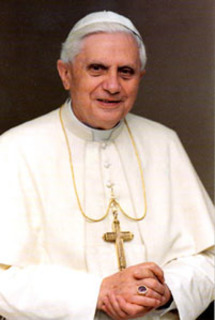
Unlike many of my internet-travelling contemporaries who flit around the liberal left, I am not that exercised by the Pope's visit to Britain. Yes, the Catholic Church can hardly be placed on the side of reason and progress (let alone situated in the camp of the working class). Yes, the church has systematically covered up child abuse. Yes, the church has given succour to mass murdering dictatorships. Yes, its regressive stance on contraception, reproductive rights and sexuality supply ammunition to misogynists and homophobes the world over. Yes, the former Joseph Alois Ratzinger is famous for nudging Catholic theology in a more conservative direction. Yes, the Pope was daft to recently liken atheists to Nazis. And yes, the purported £10m cost of the state visit could have been spent on better things.
But there has been something deeply unsettling about the chorus of criticism that's met the Pope's trip. I have absolutely no problem with polemic and critique. For example, last week's Peter Tatchell documentary was absolutely right to shine a light on the murky corners of the church and its "infallible" head. But what I am not comfortable with, and neither should any socialist, is the *glee* with which sections of the commentariat and their cheerleaders in blogland and Twitter have been attacking Catholicism. It might be a cliche, but if you can substitute Catholic for Muslim or Jew in these diatribes and have it come out sounding Islamophobic, anti-semitic and downright racist, chances are you have anti-papal bigotry decked out in fashionable modern dress. Just look at these examples from today's protest.
Much of the recent round of criticism directed toward the Pope and Catholicism generally is framed in terms of the so-called 'New Atheism' as propounded by Richard Dawkins and a cohort of sympathetic (minor) media personalities. As we have seen before, Dawkins' The God Delusion suffers from the ideas delusion. In the name of philosophical materialism, Dawkins believes religion can be combatted and neutralised by reasoned argument. It's just a matter of everyone be converted to logical thinking and hey presto! All that's left is a (holy) ghost of religious belief.
This is plain dumb. The appeal of religion is deeply rooted in the alienation and atomisation consistently and systematically produced by capitalist relations of production. It is not a matter of being brainwashed or too thick to pierce the sacred aura of His Holiness. As I clumsily put it a few years ago, "when people are atomised, individuated and powerless, the belief we are only feathers buffeted by a divine wind can make more sense than salvation lying in our own self-activity as beings capable of consciously making history." Polemicising against religion makes for jolly interesting and entertaining debates, but it does nothing to erode its place in capitalism's ideological pantheon.
Not that this matters to some. For many among the most vocal, atheism has become the new identity politics of the liberal intelligentsia. Their atheism is derived not from a desire to change the world but speaks to feeling smug, superior, enlightened and oh so clever. I wasn't surprised to see many of the media luvvies, bloggers and tweeters most vociferous in their opposition to the Pope are the same arbiters of political and moral rectitude who had a field day condemning people who thought Raoul Moat was "a legend", were quick to castigate BNP voters in the European elections, fell over themselves to brand the Lindsey Oil Refinery workers 'racist', and cheerfully put the boot into Jade Goody over the Shilpa Shetty incident. It doesn't really matter what the issue was, each provided an occasion for establishing clear distance between their educated and "progressive" selves and an ignorant, reactionary mass; an 'other' all too often identified with the (white) working class.
Call it what you like, but a great deal of this new atheism is being used as an excuse for good old-fashioned bigotry.
See also Harpymarx, Socialist Unity, Liam, and Luna17.
Got a lot on at the mo, innit.
Until blogging resumes here's a circular from the Right to Work campaign. Far from turning their back on the petty authoritarianism of New Labour, the Tories appear completely relaxed about West Midlands police attempts to sabotage the October demonstration against Conservative party conference. I recommend readers sign and circulate:
Reinstate our right to march past the Tory Conference
*On Tuesday 24th August a delegation from the Right To Work campaign met with West Midlands police and a representative of Birmingham City Council to discuss the route of the protest march outside the Tory party conference on Sunday 3rd October.
* West Midlands police stated that they were happy for RtW to march past the conference centre and confirmed that centenary square, the square directly in front of the conference centre, would not be a “sterile zone”. A route was suggested by Birmingham City Council and West Midlands police and the delegation accepted the offer to walk the route being proposed.
*The Police have now reneged on the proposed route citing security reasons. They are denying us the right to march past the conference centre.
*We are asking everybody to sign the following statement:
"We are alarmed to be informed that, despite earlier agreements with the Police and Birmingham City Council, West Midlands Police are attempting to stop the trade union demonstration against public service cuts from marching past the Conservative Party conference at the ICC on Sunday 3rd October.
"The march has been initiated by the Right to Work Campaign and is backed by three national trade unions (the PCS, NUJ and UCU), the Labour Representation Committee and a number of local trade union and campaigning organisations.
"We feel that this is a violation of the right to freedom of speech and our rights to protest peacefully against the Government. Peaceful protest is a vital part of a democratic society and people have taken their opposition to Government actions to their conferences for decades. The decision of the West Midlands Police takes that right away. We note that Centenary Square will not be a “sterile zone” and that people will be able to access the area freely. By not allowing the Right to Work campaign to march past the International Convention Centre we are concerned that West Midlands Police is attempting to make political decisions about how visible protests against the cuts can be and are denying a basic democratic right to freedom of assembly and freedom of speech.
We believe that West Midlands Police should permit the demonstrators to march past the Conservative Party conference on Sunday 3rd October."
*Add your name by clicking on the link here
Thank you for your support.
In solidarity,
Matt Raine
West Midlands Right To Work
For the third consecutive year yours truly has made it into the top 20 of the Total Politics top 100 left blogs. Sadly the forward march of AVPS has been thrown into reverse, finding itself back where it was when the blog landed in the top 20 for the first time in 2008. Still, I'd like to take this opportunity thank my cat, my ex-PhD supervisor, my microwave, etc. etc. for making it all possible. Without your solid support and that of the AVPS-browsing public I'd never have made it into the blogging establishment (whether that's a good place for a socialist to be I'll leave readers to judge).
Long time viewers know I have a penchant for lists and throwing them down on here, so allow me this further indulgence. Here's the top 20:
1 Left Foot Forward
2 (3) LabourList
3 (1) Tom Harris MP
4 (2) Hopi Sen
5 Liberal Conspiracy
6 (8) Next Left
7 (4) Alastair Campbell
8 Political Scrapbook
9 (5) SNP Tactical Voting
10 (6) Luke Akehurst
11 The Staggers
12 (58) John Rentoul
13 (16) Blog Menai
14 Labour Uncut
15 (27) Penny Red
16 Guardian Politics Blog (Andrew Sparrow)
17 (12) A Very Public Sociologist
18 (10) The Daily (Maybe)
19 Hadleigh Roberts
20 (22) Socialist Unity
Leaving aside whether the likes of Tom Harris and John Rentoul can be regarded men of the left by any meaningful measure, there's still a good showing from proper socialists like Socialist Unity, Jim Jepps, me, and Laurie Penny. Left Foot Forward's top position is thoroughly deserved, so well done to them. A couple of other new entries - Political Scrapbook and Labour Uncut are very good at what they do as well. PS for being Labour's answer to Guido Fawkes, but without the witless bigotry. And LU for a thoughtful (insider-informed) addition to the Labour blogging firmament.
I imagine a few other comrades will be tickled pink by the top 100 too. I'm very pleased to see Harry's Place failing to stain the top 20 with its B52 liberalism, dropping 18 places to number 27. And to rub salt into the wound Socialist Unity came out ahead of them. Likewise Counterfire will be chuffed to best the SWP's premiere blogger in the contest too. Congrats also to Glyn for flying the Socialist Party flag in the top 100 (I don't know if it's me but there doesn't seem to be that many about these days).
In all I reckon there are 20 blogs on the list, inside and outside of Labour, who I'd regard as comrades and socialists, which, if memory serves, is about the same as last year. Will the coming resistance to the cuts effect the composition of next year's lists and propel those arguing a hard line against the cuts up the rankings? We shall see.
Annoyingly, AVPS does not feature in the list of Labour bloggers. This wouldn't matter if it was only a bit of fun, but the TP list is taken by the political and media establishment as a fair summary of the present state of political blogging. By excluding me the top flight is distorted and makes left voices look that little bit more marginal. Using the top 20 left wing blog vote as a guide AVPS should in actual fact be at number 10 (sorry Hadleigh, you only made the top 10 on a technicality). Prior to the closure of the competition I let TP know on three occasions this blog should be included in the Labour category too. When it was published with me missing I let the God-Emperor of political blogging himself know, and was told I'd been placed in the correct category. And still the list stands incorrect. I have no doubt it's a cock up, but getting it changed is proving nigh-on impossible.
The TUC launched a verbal shot across the government's bows earlier today, evoking the imagery of the poll tax struggle and promising a campaign of civil disobedience, protests and industrial action to see their cuts off. To coincide with its warnings, the TUC has released a substantial report in defence of public services.
When George Osborne unveiled his so-called emergency budget in June, he attempted to cloak his programme of class warfare in flowery progressive language. But thanks to the TUC's work, the graph below (from page nine of the report) shows how the pain of public spending cuts will likely be distributed across income groups.
How empty the Tory/LibDem claims to be a progressive government are.
Never posted anything about Cuba before and then two show up at once. Regardless of what the hard of thinking might say, Castro hasn't come out as a convert to neoliberalism and said Cuban "socialism" is a failure. No one reading his interview in Atlantic Magazine could possibly reach this conclusion, unless they hate the regime and/or are grinding the market fundamentalist axe. Sadly, for a man as verbose and expansive as Castro his discussion of Cuba's "failure" is rather truncated. Perhaps AM are holding back the best bits for next issue. The relevant bits and pieces are:
I asked him if he believed the Cuban model was still something worth exporting.
"The Cuban model doesn't even work for us anymore," he said.
This struck me as the mother of all Emily Litella moments. Did the leader of the Revolution just say, in essence, "Never mind"?
I asked Julia to interpret this stunning statement for me. She said, "He wasn't rejecting the ideas of the Revolution. I took it to be an acknowledgment that under 'the Cuban model' the state has much too big a role in the economic life of the country."
Julia pointed out that one effect of such a sentiment might be to create space for his brother, Raul, who is now president, to enact the necessary reforms in the face of what will surely be push-back from orthodox communists within the Party and the bureaucracy. Raul Castro is already loosening the state's hold on the economy. He recently announced, in fact, that small businesses can now operate and that foreign investors could now buy Cuban real estate. (The joke of this new announcement, of course, is that Americans are not allowed to invest in Cuba, not because of Cuban policy, but because of American policy. In other words, Cuba is beginning to adopt the sort of economic ideas that America has long-demanded it adopt, but Americans are not allowed to participate in this free-market experiment because of our government's hypocritical and stupidly self-defeating embargo policy. We'll regret this, of course, when Cubans partner with Europeans and Brazilians to buy up all the best hotels)
Hardly a disavowal of the Cuban revolution. It seems the government are taking a leaf out of the Chinese book and allowing a controlled return of the market in certain sectors of the economy. Whether they will avoid the inequalities and social problems those reforms have brought to China remain to be seen. But the much smaller size and population of the island means the party/state bureaucracy can monitor their reforms more closely (as Andy has variously written, despite China's foreboding and brutal reputation, the state is quite institutionally weak outside its Eastern heartlands). Cuba also has its own homegrown experience of the blackmarket to draw on: the impact this has had on Cuba's social fabric and the contradictions set in train will, if state planners have any sense, inform the introduction and condition the reviews of the reforms' performance.
From the standpoint of maintaining Cuba as a bastion of anti-capitalism in the Western hemisphere and given the present balance of forces in the world, these reforms are probably necessary. Cuba is no North Korea located in sunnier climes, but the longer it carries on in the old way the more likely the economy will seize up. That said market reform will certainly exacerbate and generate contradictions within Cuban society, but at the same time they offer an opportunity for developing cooperatives, encouraging debate on various types of ownership and could add to the pressure for democratisation (there seems to be a real movement in Cuba pushing in this direction).
Apologies to readers for slipping into Guido Fawkes territory, but I could not resist preserving this for posterity. The below picture is featured in this Mail article. View it quickly before Paul Dacre, if you'd pardon the pun, pulls it.
The Mail helpfully has an enlarge facility.
Last night's meeting of North Staffs TUC heard from Bill Greenshields of Derbyshire Cuba Network and the Cuba Solidarity Campaign speak, funnily enough, on Cuba. As readers can imagine Bill's talk was unashamedly pro-Cuba, but this is an important corrective to received notions that have it as a gulag with palm trees - a view assiduously cultivated by the US state department, right wing Cuban exiles, and intellectually dishonest ex-lefts.
Bill opened with a very quick overview of the Cuban system, touching on the statutory right to work, the 1:650 doctor/general population ratio, the strength and depth of social solidarity, and its avoidance of personality cults and dogmatism characteristic of similar societies. If we realise how all this is possible in a poor country under the lash of an economic blockade then, Bill argued, we can also understand why the USA sees Cuba as a threat.
As a former leading member of the National Union of Teachers, most of Bill's talk focused on Cuba's education system. We were given the impression this extends far beyond formal schooling and HE. Crucial to retaining mass support for the Cuban revolution are the Committees for the Defence of the Revolution. These community organisations, working in conjunction with the other mass organisations (the party, the federation of women, the young pioneers, and the unions) are responsible for community events and officially tasked with maintaining high rates of "morality" (i.e. social solidarity).
Pre-school begins at the age of three, with compulsory schooling kicking in at six. This ends at 15 with a guaranteed job for every school-leaver. The way education is done will be quite different to the experiences of readers of this blog. Central to it is 'emulation'. Instead of a system based around competitive exams the emphasis is one educating the collective. If a group of students grasp something in advance of others, the expectation is they will work to help the rest of the class get it. If a section of the class still can't understand it then no one passes the set task. This has led to a reconfiguring of competition between students - instead of awards based on grades, praise is conferred on those who seek to lead emulation.
There is, however, something of a teacher shortage on the island. Education policy is committed to reducing class sizes to 15 for primary and 20 for secondary schooling. The situation is complicated by attempts at integrating disabled children from special schools into the mainstream system: they are guaranteed by statute one-to-one teaching, therefore while integration does take place it is rare.
Apart from the discussion of education and digressions into the health system, Bill gave us a good sense of Cuban social relations. While it is true there are political prisoners and penalties for those who criticise the system, society is more cohesive and solidaristic than in advanced capitalist states. How this manifests itself in education and elsewhere deserve careful study by socialists outside Cuba.
Personally speaking I am always wary of solidarity campaign talks, as they're usually structured around guided tours that show the country in question in the best light. But even with my critical hat on Bill's presentation did an excellent job showing that Cuba, despite its problems and less than spotless record on democratic rights, is a different kind of society. If Cuba is a living example of what can be achieved on a small island under conditions of economic autarchy, imagine the kinds of achievements within our reach if this was married to greater deomcratisation and available resources.
I don't think Cuba is socialist, but it does prefigure some features of future socialist societies. For this reason, despite its flaws, Cuba deserves the solidarity and support of labour movements everywhere.
Proper blog post coming later. But in the mean time ... there's something curious happening with my audience stats.
A few days ago I noticed that Google have so helpfully included a basic stats package as standard with every Blogger blog. This is part of a package of measures at making the creaky old blogspot interface more user friendly. As any convert to Wordpress will tell you, theirs is the bees knees and much more intuitive than the clunky thing suffered by the likes of me, Jim, Lenny, etc.
The stats package is basic. And I mean, really basic. You can browse top referrers, country of origin, audience figures over variable time frames, top searches, most popular posts and so on. However, and somewhat strangely, it only records visits. Not uniques. Not returning visitors. Just page views.
Back when a supple-faced youth founded this blog in December 2006 I took out a free (i.e. basic) account with Statcounter, and I've been using it ever since. So I thought it would be interesting to compare the Statcounter figures with the sorts of numbers being yielded by Google's package.
This is where things get a bit confusing. According to the built-in statometer this blog was visited 1,053 times yesterday. But Statcounter has a different story. It says I had 745 page views. The day before Google has me on 1,051 visits, and Statcounter 774.
Why the discrepancy? Just what is going on? Does Statcounter run a particularly stingy and stringent counting operation? Are Google inflating visits SWP-stylee so bloggers feel less bad about their lack of reach?
Any explanations none-too-heavy on techie talk are welcome.
This is the last in the series of emails from the Labour leadership candidates. Andy Burnham's entry into the race has certainly raised his profile and in public appearances he's done an excellent job attacking Tory plans to dismantle the NHS. But at present I'm undecided whether he'll get my fourth or fifth preference. I will blog more about the vote before the end of the week. In the mean time, if this isn't enough Andy for you here's my take on his 'aspirational socialism'.
Dear Phil,
It’s time for us to be Labour again
As the Leadership contest enters the final stages, I’m giving everything I’ve got because the cause is a great one – I’m fighting for a different kind of Labour Party.
I am asking for your first preference vote today – because I need your help to rebuild Labour from the bottom up.
Our Party has been in the grip of a warring political elite for too long. They have dragged us down with their factional battles. They are out of touch. So it’s time to put power back where it belongs - with you, the members.
Going forward, we just cannot have more of the same.
And yet, that is what some of the Party’s senior figures want. They are making this contest a battle between old and new Labour.
It is the last thing we need.
It threatens to entrench factionalism in our Party for another generation and doesn't represent the views of our members.
As I travelled the country in my Battle Bus throughout August, members everywhere told me that they are sick to the back teeth of old versus new Labour, Blairites versus Brownites. We are Labour – and proud of it.
Both old and new Labour had their strengths – but neither fully reflected mainstream Labour opinion. Old Labour was too often out of step with public opinion. New Labour, whilst right for its time, became hollow and disconnected.
So it’s time for us to be Labour again.
I am offering you that choice. A chance to rebuild our Party from the bottom up, with power returned to members; our councillors valued and listened to; and a grassroots force in every community.
In recent years, we were frightened of our own shadow, taking only modest steps forward. That must change. A Labour Party that listens to its members will rediscover the courage of its convictions and get back in the business of inspiring ideas that bring big social change and a fairer country. That is what is needed to lift Labour hearts, enthuse people to join our Party again and put us back on people’s side.
So, throughout this campaign, I have spoken for mainstream Labour opinion and for the values of the British people. My detailed Manifesto – Aspirational Socialism – brings together the best of old and the best of new Labour, leaving the negatives of both behind. It sets out bold and progressive proposals in the best traditions of our Party such as:
• a free National Care Service funded by a new 10% Care Levy on all estates – giving peace of mind to all older people in this century of the Ageing Society and helping them protect their homes and savings
• a radical reform of the tax system, with a Land Value Tax replacing Council Tax, Stamp Duty and Inheritance Tax – bringing fairness to the system and helping all people get on in life
Both embody Aspirational Socialism – that by working together, and supporting each other, we can help everyone be the best they can be, fulfilling their hopes and dreams.
These are the biggest ideas that any candidate has put forward. I have done so – underpinned by my own philosophy - because I believe politics going forward needs to be more than just marketing and PR.
You can hear more about my proposals here.
I am in this contest to win because I know that our Party needs to change. I have listened and heard what you have been telling me about how it needs to change.
I was equally loyal to Tony Blair and Gordon Brown. Not everyone can say that, but I can. My first loyalty has always been to the Labour Party, not any faction or clique. This is why I am best placed to move Labour forward beyond the old battles. And this is why I can break the grip of the elite.
I don’t have the support of any establishment in this race - in the media, the unions or our own Party. But I don’t want their support - they don’t want things to change. I want your support to rebuild our Party.
I will unite our Party – members, trade unionists and councillors.
I will be a Leader you and Britain can believe in.
With your first preference vote I will make you proud to be Labour again.
Best wishes
Andy Burnham
This interesting quote prefaces Ken's 2005 book, Learning the World:
Population will mightily increase, and the earth will be a garden. Governments will be conducted with the quietude and regularity of club committees. The interest which is now felt in politics will be transferred to science; the latest news from the laboratory of the chemist, or the observatory of the astronomer, or the experimenting room of the biologist will be eagerly discussed ... Disease will be extirpated; the causes of decay will be removed; immortality will be invented. And then, the earth being small, mankind will migrate into space, and will cross the airless Saharas which separate planet from planet, and sun from sun. The earth will become a Holy Land which will be visited from all quarters of the universe. Finally, men will master the forces of Nature; they will become themselves architects of systems, manufacturers of worlds.
Winwood Reade, The Martyrdom of Man, 1872
Gives me a good excuse to plug last month's post on Socialism and Space again.