Tuesday, 22 January 2008

BNP Wives

If there was ever a case of suspending no platform in favour of giving the BNP enough rope, this was it. I cannot think of one occasion where a BNP member has come across well in the media. It tends to reinforce the impression they're either easily-led, pompous, spiteful, bitter, or clueless. Or all of those things. Back when I was a bigoted young Tory teenager I have to thank such a programme for helping make sure I never went anywhere near the fash. Then fuhrer, the late and very much unlamented John Tyndall, gave an interview that was so hate filled and condescendingly arrogant that most watching who were predisposed toward casual racism would have been put off. Unfortunately, since that time the BNP have learned unreconstructed Nazism and race hate tends not to go down well with even the most ignorant and backward of Britons. Hence the suits, the emphasis on "alien" cultures (i.e. Islam), the posing as the champion of the white working class, etc. So when its activists go on the record and make complete numpties of themselves and their vile organisation, it should be welcomed.

Of the three women featured in Sky One's BNP Wives, it was hard to tell who was taking the most stupid pills, as all three had clearly been overdosing. If one of them was at all redeemable, it was Suzy Cass, the wife of Nick Cass, a former full timer who was unceremoniously dumped by Griffin's clique last Autumn. Cass is clearly not Mastermind (never mind master race) material. She spoke of how she started to think about race when a few items from her late father's body were stolen after he died in Jamaica. This, she said, sat in the back of her mind until she met Nick, who then converted her to, if you forgive the pun, the black and white benefits of a racialist world view. Cass spoke of how she insisted on having a white midwife present during the birth of one of her children ... on the instigation of her husband. And toward the end of the show, asked what it was like being a BNP wife, she quipped "BNP wife? More like BNP widow!" She knew the party was his first love: her lot was to to bring up his kids and play second fiddle. Her longing for him to tone down his activity was plain and was quite pleased when Nick was sacked: for the first time in years, the chance of a normal life presented itself.

Marlene Guest, the organiser for Rotherham BNP, certainly fell into the stupid and bitter category. It was very quickly established this was a woman full of rage and constantly dogged by feelings of abandonment, and had only joined the BNP after her marriage had collapsed. One of the most difficult moments of the programme was her poetry reading at last summer's Red, White, and Blue festival. Guest should be thankful her bitter words of betrayal and adultery rumbled over a near-deserted field, as she succeeded in making herself look like a complete fool. And this wasn't the only time. Prodded about Nazi mass murder, she declared "Don't tell me I don't believe in the Holocaust. I do. I'm just not sure about the numbers". And she was unclear whether Britain should have gone to war with Germany too.

But most unpleasant by far was Lynne Mozar, the Southeast regional secretary. We saw her in action with her fellow fash degenerates on a stall opposing the building of a mosque in Fareham. When one woman came up and began asking questions you'd expect anyone to ask about any kind of political stall (why are you here, why are you opposing this, etc.) Mozar moved away and muttered to herself how this woman "would benefit from having a burqa". When asked by the reporter why she didn't use it as an opportunity to explain her view and try and convince her, she replied she "couldn't be bothered" and "isn't really interested in converting people". Given such an attitude it's unsurprising their paper sales were so low, and off they moved their stall to the town centre. This afforded us a keen insight into the BNP mindset when, confronted with someone who accused them of lying (they were telling passersby that the navy only served up halal meat), Andy, another organiser, claimed all critics were "leftwing operatives". Yes, and we're also transdimensional lizards who telepathically guided the planes into the Twin Towers.

BNP Wives is now available to view online here. Perhaps the funniest thing about the documentary has been the BNP's reaction to it. They hail the women as "fine ambassadors for the BNP" and believed it "helped promote the BNP to the public". Incredibly, most of the fash believe it too! Like I said, give them enough rope ...

Sunday, 20 January 2008

Burslem 12 March for Justice

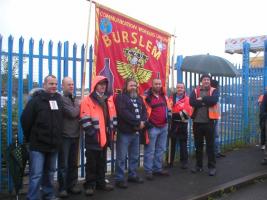
The iron skies over Stoke were nice and kind for yesterday's solidarity march with the 12 suspended Burslem postal workers. We were among the first to arrive at the picket line but very soon numbers swelled dramatically with trade unionists and posties, their families, and other local people keen to give their support. At about 2pm we formed up and walked out into the road. It was only at the top of the hill did we get a proper appreciation of the size of the march. There were 4-500 in our column, and 15-20 banners, including Stoke Socialist Party's, Manchester Unison (borne aloft by Karen Reissman), and the National Shop Stewards' Network, and we forced a fair tail of traffic to build up behind us.

SP comrades battled with Socialist Worker sellers (parachuted in for the occasion) for paper sales among passers by, leaflets were doled out to cars slowly passing on the other side of the road, and the odd numpty who shouted abuse received collective cheers and rounds of applause. The march was extremely good natured and is certainly the best one I've been on since the 2,500-strong NHS-SOS demo back in 2006.

It wasn't long before we took our seats in a packed Forum Theatre in Hanley Museum. Jane Loftus, CWU president, kicked off proceedings with solidarity greetings to the Burslem 12 from all constituencies of the union, the MKP of the Philippines (telecoms union), South East TUC, ASLEF, Unite, Keele UCU, South Yorks NUJ, and many others I didn't get the chance to write down.

Billy Hayes, CWU general secretary spoke first. He began by noting how mainstream politicians and commentators claim people aren't interested in politics or solidarity any more. Referring to the squeeze in the hall, "I haven't been at a meeting before where people have to queue up to show their solidarity!" The march is what the CWU is about, he said: standing shoulder to shoulder, giving solid backing, and working toward victory. Joan Whalley, the local Labour MP, said she will never sit by if there is no fairness at work in her constituency, and in the case of Burslem depot the 12 are standing up for what is right. Having spoken to senior Royal Mail management, the objective of the strike - an independent review of the suspensions - is opposed by them on the grounds it "undermines" local management and could "set a precedent". In other words, they want to be able to carry on bullying and intimidating staff with impunity.

Dave Ward, deputy general secretary for postal outlined how 2007 was the most difficult year for the CWU since the six week strike of 1971, but things must be so much worse for the 12. Management are trying to drag their character through the gutter with allegations of bullying, and yet time and again they've been invited to present evidence during talks, but they do not because they cannot. Of course, the suspensions aren't really about bullying: it is an attempt to break what probably is the strongest postal branch in the country. And they know if they get away with it here, Burslem will be mirrored elsewhere, in the industry and outside it. In terms of practical action, the Midlands region of the CWU is balloting all of North Staffs for strike action, Midlands region has suspended agreements over start time and work times, and will do so nationally if Royal Mail do not move. But even if the 12 are victorious, the campaign continues: bullies and macho management have no place in any workplace. Malcolm Brundrett, area delivery rep said management are scratching in the dirt to try and justify the dismissals. Also, Royal Mail have had the cheek to offer an "independent" panel of managers from anywhere in the company to review the suspensions. If such an offer was taken up and they found in favour of the 12, I suspect their careers in the company afterwards would meet an untimely end.

Dave Condliffe Jr, the "13th member" of the suspended workers said this was a straight fight between right and wrong. Management are engaged in union busting and they must be stopped. They thought the branch was broken after the national strike and arrogantly challenged the union branch to ballot the depot over the suspensions. They underestimated the depth of feeling, and the strike vote must have come as a surprise slap in the face to them. Dave gave thanks to the 12 for inspiring and lifting the branch, and setting an example to workers everywhere who suffer macho management. P of the 12 thanked everyone for the "unbelievable turn out", to local activists and officials, and especially all the families of Burslem office. This dispute didn't begin with the suspensions though, it goes back 13 months to an area dispute over work time. They then victimised Big Dave Condliffe with the same bullying smears, and stepped up petty office attacks an intimidation. For example, stripping the fittings of all personal tokens and leaving them in a nearby bin; ringing up people off on the sick and threatening disciplinaries; the list goes on. Typical of management's arrogance, one of the more obnoxious of their number even informed P that if they could take out the "vocal faces" in the depot, resistance would collapse. But they were wrong: the backbone of Burslem union organisation are the members themselves. Since December 18th, when the office went on strike, there have been upto 70 on the picket line at any one time and new workers with a year or less service have been as solid as the rest: they have stood up and been counted.

The final platform speaker was Lee Barron, an area official who has been extremely closely involved in the dispute. In an angry speech, he said the union has a moral obligation to stand up against the kinds of practices we see Burslem management resort to. He thanked everyone for coming along and repeated that the union will not walk away from the 12 - it and the trade union movement owe them a debt of gratitude. And finally a warning to the managers: "we'll see you in court for defamation of character!" Lastly, from the floor, M for the 12 thanked the union for their support and everyone for turning out, and also singled out Stoke SP for the solidarity work it has done these last 13 months.

After thundering applause, the hall dispersed to the benefit social, to the local pubs, and to home. The march and rally did the job to show how this dispute is of national significance. Wherever you work, dictatorial management is trampling all over its own procedural rules, attacking unions, intimidating workers, and making work a living hell. If the 12 win in Burslem, it's a victory for us all.

Friday, 18 January 2008

Tories Target Trade Union Political Funds

The Centre for Policy Studies was founded in 1974 by Margaret Thatcher and Keith Joseph. Since then it has become an ideas factory for neo-liberal policy formation and trades in the rhetoric of free markets, deregulation, slashing red tape, competitiveness, flexibility ... all those New Right buzzwords we've come to learn and loathe over the last 30 years. Strange how no one talks about trickle down any more.

Their latest pamphlet on political funding, Labour and the Trade Unions: An Analysis of a Symbiotic Relationship is straight out of the CPS mould. The first point of its summary reads
The Labour Government has, since 1997, made much of its "business friendly" credentials. However, study of its employment legislation and its relaxation of Trade Union regulation shows that, in reality, employers have been faced with significant extra burdens and that the rights enjoyed by Trade Unions have been greatly strengthened.
You might be tempted to ask "what planet are they on?" Even the dogs in the street know New Labour is the most right-wing anti-working class Labour government in British history. Only people with a visceral hatred for the labour movement, combined with a relationship to the class struggle mediated by The Telegraph and working lunches with corporate "risk-takers" could believe otherwise. The credited authors of this piece are Alan Duncan, Tory shadow for Business, Enterprise and Regulatory Reform, and Jonathan Djongoly, his deputy. But all of us who care about the labour movement would do well to pay attention to their recommendations. If the Tories get back in after the next election (did they ever leave?), these suggestions could well form the basis of their political funding/anti-trades union legislation.

It is worth quoting Duncan and Djongoly's most important recommendations at length. These belong to a set of positions specifically addressing union political funds and political donations:
* Unions' members should vote annually on maintaining a political fund.
* A Union's members should be required to vote on the level of the political levy annually.
* The political fund opt-out right should be clearly stated on Trade Union membership application forms or a specific opt-in introduced.
* The opt-out right should be offered annually to each union member.
* Union members who do wish to contribute to the political fund should be able to decide either directly as individuals or collectively via a members' vote to which party/parties/causes their funds should be put.
* The accounting reporting requirements of Unions should be reviewed - particularly with a view towards improving transparency.
All this, the authors claim, means unions would be "subject to similar levels of transparency and democracy as apply to companies and individuals". Physicians, heal thyselves! Anyone remember the £550,000 allegedly given to the Tories on the quiet by Wafic Said, the billionaire intermediary who greased the wheels of the infamous British Aerospace fighter deal with the Saudi despots? Yes, everything was so very above board then.

Let there be no doubt about this. There is nothing wrong with demanding financial transparency in labour movement organisations. Trade union members have every right to know where our money is going, be it to the political party that time and again kicks our class in the teeth, or into cushions padding the comfy chairs of many a general secretary. Neither is there anything wrong with democratising political funds. But these Tory proposals have nothing to do with democracy and everything to do with reinforcing the power of capital over labour. If implemented, there are likely to be two sets of consequences:

1) Trade union funding to Labour will be severely curtailed. According to Electoral Commission figures cited in the document, £55.5 million flowed from the unions into the party's coffers in the 2001-2006 period, 65.1% of all monies received. The Tories assume if their proposals become law, the majority will either opt out of paying a political levy and/or some unions could drop their affiliation. Either way, less trade union money will be heading in Labour's direction and make it more dependent on business backers than ever before. This gives the Tories more of an advantage when it comes to campaigning - their organic links to British capital ensures their ability to massively outspend Labour. Given the character of the Labour party at present, some might justifiably say "so what?" It isn't as if New Labour hasn't spent the last 11 years grovelling before business interests. But the danger this could pose to Labour party funding will also apply to any future new workers' party with trade union backing. Effectively, it seeks to lock working class people out of political participation.

2) The proposed measures on annual political levy level votes, maintenance of the fund, destination of the levies, and the annual opt-out reminder comes on top of the continued becalming affects of existing anti-trade union legislation. As bureaucracies have mushroomed to ensure compliance with a superabundance of Byzantine regulations and technicalities, resources will have to be found to run permanent departments attending to the Tories' rules. More bureaucracy = more conservatising pressures on the trade unions and less money for front line activities.

What can be done? A strategy solely concerned with keeping the Tories out is a non-starter. At the moment, choosing between Labour and Conservative governments is the difference between neo-liberalism with a smile and a smirk, and a neo-liberalism openly contemptuous of working class people. Labour's opposition to meddling with the union link will last as long as it takes to sort out party funding from the public purse. They too seek to exclude ordinary people from mainstream politics. "Nationalising" parties make them less amenable to the pressures of membership, of the activists who theoretically act as a bridge between the general public and the full time apparatus and leadership of a party. The Tory proposals amount to the same thing: "privatising" parties by making them more dependent on the grace of wealthy individuals and business entities will do the job just as well.

The best way, the only real way we can head off attacks of this character is for the left to seriously agitate for and win over as many trade unionists as possible to a programme of democratising our movement . This goes hand in hand with making it more relevant, meaningful, and responsive to the needs of our class. We have to wield the weapon of democracy, otherwise our enemies will use its name against us.

Wednesday, 16 January 2008

Torchwood Season Two

Captain Jack must surely be the first square jawed all-american bisexual spacejock to have hit TV screens anywhere. He certainly made a big impact way back in season one of the new Dr Who, so hopes were high for the spin-off series, Torchwood. Now, like many Who fans I really wanted to like Torchwood and I gave the first season a lot of slack. It got points for transforming an ostensible John Barrowman vehicle into a showcase for Eve Myles (Gwen), so yay for Russell T Davies there. And I suppose it earned a few marks for attempting to be an adult-oriented sci-fi drama. But that was about it. Torchwood fell short because it was poorly acted, derivative, hastily written, and generally, not that great. For example, take its pretensions to "maturity"; if you want to explore adult themes with an adult audience, you have to do better than a bit of swearing, a bit of shagging, and showing Owen's bum. Battlestar Galactica has shown it is possible to do the gritty and compulsive sci-fi schtick, without ripping off Buffy and Angel.

Does the first episode bode well for the new season? Have producers and writers taken press and fan criticism on board? Are there signs it's striking out into original and daring territory? And was it much cop? Actually, to all these I say yes, I was pleasantly surprised. To quickly recap, the episode begins with a Jack-less Torchwood team tearing around Cardiff after a giant goldfish. There's a hostage situation, guns are drawn, and Jack appears from nowhere to give the fish a bullet assisted lobotomy. Nice. There's a bit of tension back at base over Jack's recent trip to the end of the universe with the Doctor, and a touch of awkwardness when Gwen reveals she's gotten engaged to her long suffering boyfriend. Tsk, missed a trick there, Jack!

In the mean time Captain John Hawk (James Marsters) steps out of the hellgate time rift and summons Jack to meet him at a bar. They hook up, have a snog and a scrap, and then John reveals Cardiff is in terrible danger. Three radiation cluster bombs are busily decaying away and when the half life runs out, the Welsh capital will get a Nagasaki-style makeover. Alas, it turns out the bombs are nothing of the sort. John uses the team to hunt down the canisters and then takes them out. Toshi gets slapped about, Owen shot, Ianto menaced, while poor Gwen falls for the old paralysing lip gloss trick. Oh, and Jack pulls off a novel new yogic move courtesy of a 20 storey fall and a broken back ...

Back at base, the team confront John, he gets stuck with a limpet bomb, there's a bit of a kerfuffle involving Gwen, handcuffs, and injections, and he disappears back through the time rift. Job done.

Well, the episode is a lot better than this very rough outline suggests. The usual Torchwood tropes were in (boy/boy snogging, and, erm, more boy/boy snogging), Gwen got plenty of screen time, but Mr Marsters stole the show. He had the best lines and the Loki-like spark of dark mischievousness playing about him was missing from the other characters. Hold on a minute, haven't we seen him play a similar role somewhere before?

The trailer for the rest of the season looks quite promising. It hints that there may just be a fully realised story arc about alien insects or something. Please let it be better than last season's attack of the soul-sucking Play-Doh demon.

I'm sure there must be other interesting things that could be said about tonight's episode about the snogging (strange how two blokes in a passionate clinch had to be followed straight away by a scrap), changing power dynamics in the group hierarchy with Jack's sudden reappearance, the developing Jack/Ianto, Owen/Toshi love angles, & etc.

If you saw it, what did you think?


Tuesday, 15 January 2008

Vital Statistics

As regular readers are aware, at AVPS we are big fans of stat porn. Well, ok, I am. Brother S isn't that sad. As part of my daily routine I do like to nip over to my statcounter page and take a gander at what sites send me traffic, what the popular pages are, and last but not least, our vital statistics.

A short while ago I dug the year to date graph out on the occasion of this blog's first birthday. In true Stalin fashion, audience targets were set to make this little red (and little-read) corner of leftyblogland better known and expand the readership a bit. Since 8th December the readership had been growing slowly but steadily, at first creeping and then passing the magic 100 mark. And then, yesterday, things got a bit silly. Here's the graph for the last month and a bit:

Gadzooks! That's what I call a spike! FYI that's 67 returning readers, 635 unique visitors, and 741 page loads! Not much compared to the left's premiere league blogs like Socialist Unity, Lenin's Tomb, and Dave's Part, but for a site averaging 32, 107, and 157 respectively for the last month, it's a big deal!

The spike was driven upwards not by folks wanting to read about Louis Theroux Behind Bars, but them hunting for info about the inmates featured in the show. No end are scouting out for info on Playboy Nolan and David Silver. So to these people I apologise, I know as much about their ill-deeds as you do. It has got me wondering though - if I was to call a post 'Free Britney Spears Sex Tape', how many thousands would come baring down on this blog? I'd guestimate even big hitters like Iain Dale and Guido would be left trailing in the stats stakes! (Likewise, I wonder if the short-lived left blog, Kylie's Arse, gets loads of hits on account of the name?)

Well, visits are settling down again to more modest figures. It will be a very long time before AVPS sees the likes of those numbers again.

While I'm busy navel-gazing, I may as well draw attention to the RSS feed that's been set up in the column. If for some reason you find what we say interesting, you needn't click through to the blog every time. Tapping that and selecting subscribe will ensure the little computer fairies will deliver out latest outpourings direct to your desktop (thanks Matt for prompting me).

There's also a few additions to the blogroll. The most intriguing is Labour and Capital, which, funnily enough, has very interesting things to say about labour and capital. Highly recommended. Also added are the Thoughts of Chairperson Mikey, The Gaping Silence, Ten Percent, And Before the First Kiss ..., Left News Network (formerly My Random Thoughts), Karl Marx Strasse, Honorary Proletarian, and Another Witch to Burn. Do visit them lots.

Sunday, 13 January 2008

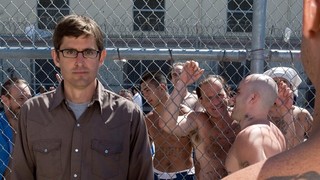
Louis Theroux Behind Bars

At 2,193,798 the USA has the highest prison population in the world. Higher even than the 1,548,498 languishing in Chinese jails. Even if you look at imprisonment rates per 100,000, the USA stands at 737 as compared to an increasingly authoritarian Russia, whose figure is 615. Land of the Free it ain't. Perhaps first among the USA's archipelago of correctional institutions is San Quentin State Prison in California. It has been home to celebrity serial-killer (and celebrity serial-killer), Charles Manson; Wallace Fard Muhammed, the Nation of Islam founder; and Sirhan Sirhan, the assassin of Robert Kennedy. It incarcerates some of America's worst criminals and has a pretty forbidding reputation, further "enhanced" by the presence of California's death row.

San Quentin is a sprawling and overcrowded site. Founded in 1852, its current inmate capacity is designed to hold 3,317 prisoners while the current population stands at 5,222. It employs 1,718 staff and sucks in $210 million a year. Californian state spending on education is lower than money allocated to its complex of prisons. Inmates tend to be divided among five gangs that operate roughly along racial lines, which can periodically erupt in outbursts of collective violence. For example, 45 were injured in a four-block confrontation between white and latino gangs in August, 2005. This is not untypical. Overall, the situation is exacerbated by the huge growth in numbers passing through the penal system. Official statistics record an increase from 59,484 in 1986 to 2006's 172,528! This can only fuel institutional and intra-inmate violence in the system.

Without a shadow of a doubt, it is one of the grimmest places within the borders of the United States, and that makes it ideal fodder for a Louis Theroux documentary. What is different about this programme is the absence of the doe-eyed send up treatment meted out to the likes of the loathsome Phelps clan and UFO cultists. It is serious and sombre, and by striking this mood the audience is able to peer over San Quentin's walls and get a beginning of an understanding of what it must be like to live within them.

Louis spends some time with the white separatist/supremacist Barbarian Brotherhood and they quickly introduce him to the rules of the game, which is simple: no contact with other races on pain of a severe beating. In return, according to 'Playboy' Nolan (a former gang member segregated for his own protection), the gang acts as an extended family, providing food, security, and drugs. In return they expect loyalty and obedience, and woe betide anyone who 'resigns'. Playboy's aware that leaving his gang has earned him a death sentence and one that will follow him beyond the jail. Another inmate kept in the so-called Alpine section (protective custody) tells Louis how he dropped out because he refused an order to stab his cellmate ... for borrowing a set of dominoes from a black prisoner. However, Louis believes gang culture is strong inside because its a way of creating camaraderie in a system designed to atomise its inmates. But its more than just that. Playboy tells us when he grew up on the streets the gang provided the acceptance and love denied him through more conventional means. For men in his position, the gang provides a reassuring presence in the traumatic transition from street to jail. Gang loyalty and culture is strengthened as a result.

Louis also speaks to Debra, a trans inmate due for release during filming. Talking to her and her partner Rob, they tell him how trans prisoners have become objects of lust in the absence of female company, and are much prized as cellmates. Chris, an openly gay prisoner, tells Louis how being out actually helps him to survive. By plucking his eyebrows, wearing a bit of make up, and acting effeminately he (and others like him) are seen as 'girls' by the general population of his wing and are more likely to avoid the threats facing straight inmates. Also, being in the closet and then getting found out is far more dangerous than being open from the start.

As a Louis Theroux show, it wouldn't be the done thing if he didn't seek out the most dangerous of the dangerous. He interviews David Silver, a man who will serve 521 years plus 11 life sentences(!) for the violent home invasion robberies he carried out. Unlike many, his crimes were not driven by drug dependency. He'd been in juvenile facilities from 11 until he reached 20, and was behind bars again when he was 22. Time inside meant his career prospects were always going to be a McJob life of low wages and long hours. So he turned to crime as a short cut to the lifestyle enjoyed by average Americans. He does accept responsibility for what he did and acknowledged he did know better. But now he's resigned himself to life behind bars, a life where the stress of a keeping a job, insecurity, and staying up to date with the rent don't apply. If an inmate can narrow their horizons and not think about the company of women, freedom of movement, etc, they can cease to be important and life can be pleasant enough.

Louis's interactions with the guards were quite interesting. Most seemed quite friendly and comfortable with the prisoners - it's hard to say whether this was a Potemkin-like display for the benefit of the BBC. If it was, Louis was certainly taken in by their "genuine warmth". One guard admitted how you can't help but build friendly rapport with people incarcerated for years, but it would nevertheless be wise to avoid friendship. Another spoke almost affectionately of Playboy, who he knew he would see again after his release because "they cannot function on the streets". He also believed inmates didn't want to learn skills they can use for the outside world, because prison provides free bed and board. "They're a somebody in prison, but a nobody on the streets" he concluded.

Louis Theroux should be thanked for exposing this harsh truth about institutionalisation and re-offending. When people are locked up and the key is thrown away, what possible incentive is there for prisoners to accept mainstream norms and abide by correctional rules? And what effect is surviving in such an environment likely to have on those who are released? Well, official statistics for California show 23,849 former inmates were readmitted to prison in 1986, and by 2006 this had shot up to 90,500. Prison as punishment in California's case is a marked failure.

It is silly to pretend crime will disappear with the building of socialism. In the context of very different social relationships, characterised by a progressive overcoming exploitation and alienation by empowering masses and masses of people, the material basis of crime will change. Crimes of property are likely to decline, as are numbers of violent offences, but there will remain the need to incarcerate those who pose a danger to the rest of the population. Peering into my rouge-tinted crystal ball, in a society that encourages human potential, prison life will be about rehabilitation. Where this is not possible, prisoners will be humanely treated and allowed to develop their potentialities as much as their situation allows. Now, such a vision of the socialist prison may seem hopelessly utopian from today's standpoint, but it is founded on principles that can be used for policy generation now. Chief among them would be measures aimed at reducing institutional violence and negating brutalisation, and wider policies attacking the material roots of crime. But all this is alien to the prevailing orthodoxy in Britain and the USA, where rehabilitation programmes are under attack and more prisons are being built. The hang 'em and flog 'em brigade are very much part of the problem. They have no solutions.

Saturday, 12 January 2008

Blogging Round Up

Just a quick one this evening.

Leftwing Criminologist blogs about one of the few aspects of the Russian Revolution not endlessly poured over by lefties and academics alike: crime. In his review of an article on the subject, he takes the author's central thesis - that the Bolsheviks fed off uncontrolled crime between February and October - apart, while arguing we need to understand the relationship between crime and revolutionary processes. Well worth a read.

I've been meaning to plug A Femanist View for a long time. Snowdrop is one of very few men who would describe himself as a feminist AND blogs mainly about feminism, sexuality, and gender issues. His recent post, Internet Webcam Sex Shows, is not for the faint-hearted. It is a brutally honest meditation on his desires and the politics of this particular form of adult entertainment. The rest of his blog is excellent too and is a must-read for anyone interested in the politics of sexuality.

Jim blogs on the political usage of the Reichstag Fire, which reminds me that we're coming up to the 75th anniversary of the Nazis taking power. Expect plenty of leftyblog comment over the next few weeks. And while we're on the subject of Jim, he's got together with Dave M and John Angliss to resurrect the much-missed Carnival of Socialism. Editors are needed so nip over to the site and volunteer! (I'm pondering on doing so myself).

Ian Bone's latest is perhaps the most surprising. This incorrigible class warrior, purveyor of extreme anarchist sectarianism, and scourge of the rich ... writes nice things about Sir Edmund Hillary! I do agree with what he writes (for once), but this is distinctly unBone-like. Could he be finally chilling a bit after his long involvement in the fringe of the fringe?

Louise, Septic Isle, Dave, and Susan have a few things to say about Peter Hain's difficulties. Surely he cannot survive this fiasco. And Neil (top UK Blogger of 2007, apparently) writes about the launch of the Campaign for Public Ownership. While we're on politics, Madam Miaow, Charlie, and Snowball have some things to say about Tony Blair's newest part time job. Nice work if you can get it.

Finally, I have to draw attention to the newest kid on the block and perhaps the first new British-based left blog of 2008. A Bit Like Lenin promises to be full of "vented frustrations" and "midnight ramblings". Knowing the comrade as I do, he forgot to add 'merciless piss-taking'. I'm sure comrades will warmly welcome the new arrival to the velvet padded viper pit that is leftyblogland, and add him to their blogrolls.

If there are any blogs missing from the roll that you think should be there, let me know.

Friday, 11 January 2008

Burslem Postal Strike Latest

Brother S and me got our sorry behinds down to the picket line of the striking postal workers in Burslem this morning, and we were very well received. We distributed copies of the latest local bulletin, Postal Worker News (produced by postal workers who are Socialist Party members and supporters), and talked about post office closures, the incompetence of the 200 managers drafted in to cover Burslem during the strike, and other local issues around the hospital and Keele University. If anything, there is a stiffening resolve on the part of the strikers to stick it out. Since this round of strike action began one worker who was giving evidence against the suspended 12 has changed their mind, aware the suspensions are being used as a pretext to break one of the most militant CWU branches in the country. Other workers who've previously been in the background and were a bit unsure of themselves are now coming to the fore. And postal workers across North Staffordshire are now being balloted for solidarity strike action.

But the Burslem posties still need your support. Messages and donations can be sent to "Defend the Burslem 12", CWU Midland No.7 Branch, Lindsay Street, Stoke-on-Trent. ST1 4EP. All should be marked "Defend the Burslem 12". Cheques are payable to CWU Midland No.7 Branch. Solidarity messages can be emailed to political@NOSPAMcwumid7.org.uk with copies to andybentley3@NOSPAMtiscali.co.uk (remove the NOSPAMs). Any solidarity messages left in the comments box will be forwarded.

The CWU has also called a march for the victimised postal workers for Saturday, 19th January. Assemble at 1:30pm at Burslem Delivery Office in Scotia Road, Burslem, Stoke-on-Trent. Rally at Hanley Museum afterwards.

Below is the text for Postal Worker News 5

Growing Solidarity
Royal Mail bosses badly misjudged the mood of Burslem postal workers. With all elected CWU reps in the [suspended] 12 they hoped to impose changes. The 79 to 2 secret ballot vote to continue the action at last Monday's meeting was further confirmation of the unity and solidarity that has strengthened during this dispute.

This scale of victimisation is an attack on suspended and sacked workers, on all postal workers, and the right of the CWU to continue to represent its members. If Royal Mail get away with this, who will be next?

All postal workers must vote yes in the area ballot. Wider action is clearly necessary to force Royal Mail to agree an Independent Review of all these cases.

Vote yes to widen the fight for justice

Reinstate all victimised postal workers

Defend CWU's right to represent postal workers

No to privatisation

Building Support on the Streets!
We asked Andy Bentley, Area Organiser of the Socialist Party about the regular solidarity stalls.

Why are these stalls important?
They are an excellent way to explain what's really going on at Burslem and gives people an opportunity to show their support. When people have the real facts explained then the majority support the strike.

Who signs the Reinstate Victimised Burslem Postal Workers petition?
Mainly ordinary working class people. At the last stall in Hanley, we had two young bricklayers who were not union members but would now consider joining up, and a Hanley firefighter who remembered the support we had given when they were on strike in 2002. A young woman, who works at Hanley M&S not only signed but after learning how Burslem posties were fighting back asked how she could join a union because of "the shit I get at work". So we sent her a form to join USDAW, which Mick, a postie from Burslem, got for us. A nurse told us of "the stress and intimidation that NHS workers suffer" and returned 10 minutes later with four family members to sign the petition! A young MDEC worker told us "Burslem postal workers are and inspiration to us all. They have my support. I haven't bothered to join the CWU yet because they don't fight back enough, but I'm going to now". A First bus driver, after signing the petition said "I'm signing this because you were the only ones who supported us when we were on strike. Good luck to the Burslem posties, we need to stand together more".

Have other postal workers signed?
Yes, from Longton, Stoke, Biddulph, Kidsgrove, Cheadle, Leek, Stafford, Sandbach, Shrewsbury, Wolverhampton, Kent, and London. All were angry about the deal and how managers are already trying to impose changes. All the locals said they would vote for wider strike action in support of Burslem.

Have those signing been able to help in any way?
Definitely. Firstly, by being part of the 6,000 who've signed it has allowed us to get coverage in The Sentinel to show how strong the support is. Secondly, all get a leaflet explaining the facts and are encouraged to pass them on to friends, neighbours, workmates, etc. One woman took away a petition and got it filled in where she works. And thirdly, many are now making donations to the strike fund. These are not people with money to burn but ordinary working class people who want to donate pennies and pounds to support postal workers at Burslem. All workers should see how ordinary people will sacrifice hard-earned money to support others prepared to fight back. A woman in her 60s told us how she cared for her handicapped son 24 hours a day. She obviously didn't have much money but she handed over a fiver to support the strike. What a breath of fresh air compared to the bosses' politics of 'cash for peerages'.

Is there anything else you would like to add?
All these examples show that where we explain things, the overwhelming majority support the strike action. This allows us to cut across the rubbish in the local press. Most frustrating for us is that as yet we are a small organisation and cannot reach as many people as we would like to. But that will change in the future.

Thursday, 10 January 2008

The cpgb and Me

Though I haven't been associated with the Communist Party of Great Britain (Provisional Central Committee/Weekly Worker) for over three years, I still occasionally get comrades, including a few leading Socialist Party cadre, who are only too keen to ask me about my time as a member and supporter. Sadly, left watchers and gossipmongers will be disappointed to learn I know nothing about the alleged Sketchleys connection, property portfolios, the INLA relationship, and input from Turkish dissidents. I wasn't a particularly active comrade, you see. My sum contribution to the cpgb consisted of turning out as voting fodder at a few Socialist Alliance meets, selling the WW at my local Stop the War group, arguing for the cpgb's general political approach on the UK Left Network, and writing the regular Around the Web column for almost two years.

For such a small group, the cpgb is a presence on the British far left most activists have to come to grips with at some point. Because the WW massively bends the stick in the direction of reporting almost every argument and significant development on the left, it quickly became a must-read paper, like it or hate it. A lot of the time, mountains are often made out of mole hills, mad predictions made about the doom of other left wing organisations, and articles are written in such a way almost guaranteed to get the backs up of other lefts. Generally, it's not noted for its high degree of accuracy. One particular set of examples were the gloomy predictions the cpgb forecast concerning the SP in the late 90s and early 00s. Readers were told the party was in crisis, and the political graveyard beckoned. There is a bit of truth to this - in that period the small short-lived Socialist Democracy Group upped sticks, as did a chunk of former cadre in Liverpool (who became the Merseyside Socialists), the majority of the Scottish organisation left the CWI, and there were splits in Pakistan and the USA. But, the WW claimed, a more serious split was brewing between Dave Nellist and the leadership over the SA, and oblivion loomed. However, evidence for such a split amounted to nothing more than brother Nellist and the Coventry comrades appearing (from the outside) to be more enthusiastic and hands-on with the SA than the rest of the organisation. This foray into Mystic Meg territory came to naught, and far from going into terminal crisis the SP has largely recovered from the experience and remains very much alive.

The big problem I have with the cpgb comes down to a question of orientation. If they want to concentrate their energies on recruiting other leftists, then fine. But this comes at the price of having an indirect relationship to the class, effectively insulating the cpgb as an organisation. In practice, the only grounding their politics have are as responses to what they perceive as deficiencies of the wider left rather than what might attract working class people to socialist ideas. This at times can assume quite comic forms. For example, long-time WW readers might recall the long-running dispute between it and the Alliance for Workers' Liberty. On paper, there was much to commend a fusion. They have similar internal regimes and attitudes to open political debate. Their views on the Soviet Union were not dissimilar, and they weren't a million miles away from each other's critique of the left's standard issue anti-imperialism. And yet could either groups discuss their differences rationally? Definitely not. The narcissism of small differences came very much into play and not for a million years would you believe these are organisations were talking about uniting! We've all seen classic front page headlines like 'Bush's 'Troop Surge' Deepens US Ruling Class Divisions. But AWL Still Won't Demand Withdrawal'. However, the intensity of their exchanges peaked some five years ago, over a thinly-attended public meeting in Leeds. The cpgb had recruited a lefty vicar, the Rev. Ray Gaston. He organised a public meeting and invited along Mike Marqusee, then of the SA and Stop the War, and the AWL's guru, Sean Matgamna to debate the issue of Marxism and religion. When comrade Marqusee found out who he was sharing the platform with, he objected on the grounds he didn't fancy being abused as an anti-semite for daring to criticise Zionism and Israel. The good reverend then left a message on Matgamna's answer phone, contacted the local AWL group, and arranged for the cpgb's Jack Conrad to step up to the plate. Unfortunately, something got lost in translation. Matgamna turned up and sat sullen and silent in the audience. Now, how should this have been dealt with? Should Matgamna have politely but firmly registered his displeasure? Should, on behalf of the cpgb, Jack Conrad have apologised for the mix up? Yes. So what happened? Months and months and months of tedious polemic in the WW's pages and on the AWL website. Matgamna alleged there was some cpgb conspiracy preventing him from addressing the massed ranks of Ray Gaston's congregation. Conrad in turn dug his heels in and refused, as a point of principle, to apologise for the mistake. In all, it was a ridiculous farce. Both sides acted like spoiled brats and, in my eyes, seriously damaged eithers' claims to be serious working class organisations. It helped put me on an exit trajectory out of the cpgb.

All this said, my association with the cpgb spanned about six years (I continued Around the Web 18 months after I left, in April 2003), and it was bound to leave some impression upon my understanding of Marxism and revolutionary politics. And it has. For starters, I went into the cpgb as a fairly orthodox Trot regarding my politics, particularly on the Soviet Union. But through reading their material, including the "unconsciously" Trotskyist From October to August (which is one of the best Marxist analyses I've read on the road from Gorbachev to Yeltsin), I came to the conclusion the USSR and other "socialist" countries could not be workers' states. This is not to say they didn't have some progressive features worth defending, but the conflation of "proletarian property forms" (in reality, legal fictions) with "proletarian property relations" is a mistake and one Marxists shouldn't really make. The cpgb position, which was more a point of departure for further analysis than a neatly rounded out category, was these social formations were neither capitalist or socialist, and belonged to those species of societies - such as European absolutism, the Andean mode of production, etc. who proved not to be viable in the long term.

Then there is the analysis of New Labour's project to remould and "modernise" the British state. Drawing heavily on Steve Freeman's ideas around the 'social monarchy', the cpgb argued that as Thatcher attacked the Keynesian compromise underpinning British capitalism in the 1945-79, the limited stake the British working class had in the state was severely undermined, and hence its loyalty to the UK was put into question. Blair's constitutional project was aimed to strengthen the union by granting Scotland a limited parliament and Wales an Assembly to head off nationalist discontent. Other projects like House of Lords reform, introduction of proportional representation to non-Westminster elections, (aborted) regional devolution, presidential mayors, and the London Assembly can be seen in the same light. The monarchy has had a bit of a makeover too. Fewer royals leech off the civil list, they pay taxes, the rules of succession changed (the next in line to the thrown is now the eldest child, irrespective of gender), and so on. The cpgb argued the left as a whole needs to take constitutional issues more seriously and develop an alternative programme that maximises political democracy under capitalism in a bid to weaken the state and help empower our class. This seems reasonable to me.

Another positive in my view is the open approach they take to differences between revolutionaries. Some comrades believe this gives the cpgb carte blanche to muckrake, but nonetheless the WW has helped facilitate debate of issues, even ones that are controversial by left standards. In my opinion the left should generally be open and honest about its internal differences and allow more open debate in the pages of its press. After all, inviting readers to submit their thoughts means they're engaging with the contents of our papers, and could draw them closer to our orbit. But unfortunately the sad truth is most bourgeois papers operate more open editorial policies. Local rags, the "quality" press, and even tabloids allow debates on their letters pages. As socialism is more democratic than anything capitalism can muster, isn't it high time our press reflected that?

Finally, there is another critique of a central plank of Trotskyist orthodoxy. The first line of Trotsky's Transitional Programme reads "The world political situation as a whole is chiefly characterised by a historical crisis of the leadership of the proletariat." I couldn't tell you how many times I've heard this repeated over the years. Problem is, it was a questionable conclusion when Trotsky wrote it in 1938, and is doubly absurd for 21st century Britain. The implication behind the phrase is the working class is out there champing at the bit and ready to strike capital its deathblow. All that stands in its way are the parties of social democracy, the leadership of the trade union movement, and of course, revolutionaries who happen to be in other socialist groups. If these are brushed aside the masses can be won to the revolutionary programme and hey presto! Job done. I don't want to sound facetious: this isn't to say the issue of leadership isn't a problem - for example, if several trade union leaders declared their support for a new party and moved to set one up, it would act as a rallying point for class conscious workers fed up with New Labour. But it would only constitute a starting point, there will be no stampede of hundreds of thousands to join and unions queuing up to affiliate. Why? Because the working class itself is in crisis. The defeats of the Thatcher years, the structural shift to a neoliberal labour market, the individuating effects of consumerism and the media, and the absence of a coherent, independent working class political voice has given us a working class much more atomised, fluctuating, fragmented, and insecure than that of 25 years ago. To be fair, the left on the whole has not allowed a bad theory to get in the way of recognising this basic fact of revolutionary political life. For instance, you could say the SP's hallmark is its ability to relate socialist politics to workers of varying levels of political understanding, but there is a gap between the correct practice and the faulty theoretical perspective. Ironically, the cpgb gets it the other way round. It has elaborated this perspective on a theoretical level but it still puts forward ultra-left slogans and positions out of sync with the thinking of the overwhelming majority of working class people. They have a formally correct understanding but, because of their self-imposed isolation from the class, are unable to follow through and have to fall back on posture politics.

So, the cpgb does have some useful things to say and they do possess a team of commentators who can be quite perceptive at times. But what of the cpgb's prospects? Let me tell you a little story. Back in the late 90s and early 00s, it built quite a reasonable profile as being one of the keenest, if not the most enthusiastic participant in the SA. It was starting to attract a number of independents into its orbit and overall made a positive contribution to the cause of left unity. Even the SWP leadership were saying nice things about the WW. They looked like the small ultra-left group most likely to succeed. But they didn't. Comrades who joined tended to drift again after a couple of years (none of the comrades who signed up roughly the same time as me are still around), and then a further round of newer recruits were shed when the cpgb prevaricated over the forming of and participation in Respect. Now though, judging by interventions at left meetings, the launching of Communist Students, and their leading role in pulling Hands Off the People of Iran together, they find themselves in a position not dissimilar to that in 1999-2001. They have recovered numbers, are not just based in London anymore, and appear to have gained a new degree of self confidence. But whether they will grow or not depends on learning the lessons of the SA and Respect interventions. If they are to become sizeable it requires a big shift away from the traditional practice of just speaking in and reporting on left meetings. This means seeing HOPI as an opportunity to engage with wider layers and new audiences, and not just an opportunity to bash the SWP and Stop the War. If they don't, the newer layer of comrades will be shed and the cpgb will continue to be seen as that rather eccentric group of lefty trainspotters.

Tuesday, 8 January 2008

Fun with Foucault

Sociology. It's not a discipline noted for its comic profile, but it has its moments. Here's a nugget most sociologists will be familiar with from Michel Foucault's preface of his 1966 book, The Order of Things.
This book first arose out of a passage in Borges, out of the laughter that shattered, as I read the passage, all the familiar landmarks of my thought - our thought, the thought that bears the stamp of our age and our geography - breaking up all the ordered surfaces and all the planes with which we are accustomed to tame the wild profusion of existing things, and continuing long afterwards to disturb and threaten with collapse our age-old distinction between the Same and the Other. This passage quotes a 'certain Chinese encyclopaedia' in which it is written that 'animals are divided into: a) belonging to the emperor, b) embalmed, c) tame, d) sucking pigs, e) sirens, f) fabulous, g) stray dogs, h) included in the present classification, i) frenzied, j) innumerable, k) drawn with a very fine camelhair brush, l) et cetera, m) having just broken the water pitcher, n) that from a long way off look like flies'. In the wonderment of this taxonomy, the thing we apprehend in one great leap, the thing that, by means of the fable, is demonstrated as the exotic charm of another system of thought, is the limitation of our own, the stark impossibility of thinking that. (1970, p. xv)
I'll leave you to chew on that. On a slightly related note, I cannot work out why this blog gets a lot of hits from people searching for Foucault. Not bad considering he's only been posted on once before.