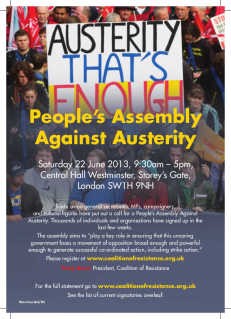
There is an odour exuded by my person, the odour of defeatism! At least according to sundry contributors to my piece on the People's Assembly over at Socialist Unity. I can understand why some comrades, like Mark Steel might get a little narked about a critical piece when you've put a lot of effort and energy into what is an otherwise welcome trade union initiative. But tough. Faith and enthusiasm are no substitutes for clear heads and the sober analysis of the opportunities and problems confronting the anti-austerity movement. But what I'm interested in is this notion of 'defeatism', of being 'tired' and 'negative'. Now, I'm going to be honest here. Perhaps the criticisms of "being tired" has a ring of truth to them. I'm certainly not burnt out - I am as active now (if not more so) as I was when I thought the Socialist Party was the bees knees. But I am tired of what appear to be cyclical motions of activity of the left and the labour movement. It goes something like this. We start with an issue, say a looming unpopular war, a perceived deficit in working class political independence, or opposition to austerity. An organisation or group of organisations hold an exciting and energising set of meetings. These are usually along the lines of a massive speakerthon in London - typically at Friends Meeting House or ULU. And followed by local launches elsewhere that often see leading figures of the new movement feature as special guests. The immediate objective laid out by the Steering Committee is a big set piece event, such as a demonstration, a day of action, or a general election campaign. Once that objective has been met and a Herculean effort pulled off by all concerned, the next target appears - a local mobilisation or another large set piece such as another national demo, another day of action, another set of elections. For some, especially those who were tempered by the initial 'heroic' phase of the movement, start getting disillusioned. It might be because there's other things going on in their lives, or they're feeling a bit burned out, or their activity is appearing to have little appreciable effect, or, all three. As disillusionment sets in for large numbers, people start dropping out of activity. Those remaining, who by this point are inveterate protestors of all types and self-decribed revolutionary organisations, typically turn in and blame each other and the SWP for screwing it up. "If only the right leadership were present ..." Rinse and repeat. The frustrating thing for me is, simplified as it may be, I have seen initiatives and campaigns of varying size and real world import come and go over the last 18 years roughly according to this pattern. And each time, the participants pick themselves up off the ground and try doing the same thing again. Very little, if anything, is learned about what went wrong last time. "Now come on Phil", someone might say, "aren't you being a miserable old, um, miserablist? Mightn't things be different this time?" The People's Assembly could be different. For one, key trade unions are on board. And not only that, mainstream trade unionists. It's one thing for the enemies of the labour movement to file Mark Serwotka and Len McCluskey under the usual suspects, but quite another to place Frances O'Grady in there with them. And notwithstanding the difficulties I picked up on, union influence could give it the coherence it needs to make a real dent in the austerity agenda. Lastly, it's not impossible that the public mood is slowly shifting against Osborne's extended programme of demented cuts. If the movement can intersect with (and help create) widespread popular rejection of the government's plans, then we will begin to live in interesting political times indeed. This is only a might-be, however. And it's a judgement based on what I've seen and participated in before. After all, the most reliable indicator of future behaviour is past behaviour ... Who was it who exhorted us to "learn the lessons of history" and added a little something about being "doomed to repeat them" if we didn't pay heed? Certainly, people should get involved in the People's Assembly. But the fire in in the hearts of every socialist should never be allowed to smoke up our view of the way ahead.
I wasn't there, but thanks to modern telecommunications I got all the happenings of today's People's Assembly broadcast directly to my computer. Now, I'm not about to butter anyone up and pretend my view of the PA initiative is anything but sceptical. I've sat in packed meeting halls in London a few times. I've heard angry words about austerity before, and promises of massive industrial action as regularly as my cat uses his litter tray. That said, there were moments the cynicism did fall away - the contributions of the eternally youthful Owen Jones and Francesca Martinez were particularly good. And, of course, the now quite frail Tony Benn did his turn too. Unfortunately, because I did not watch any of the break out sessions I was not privy to the debates that went on in them. But I can hazard a guess that the Labour Party, electoralism, and new party projects got an airing alongside trading stories of what's been happening in everyone's respective areas, the necessity of opposing all cuts, and trading Twitter handles. Indeed, some of this was reflected in the afternoon speakers to conference, most of whom were in a militant mood. But at least now it's pretty unambiguous what the People's Assembly is about. This is not a once or twice-yearly jamboree. It's about building a trade union-backed movement that brings in absolutely everyone opposed to austerity (at least from a leftish standpoint). The ambition was pretty clear. That every locality founds and grows its own People's Assembly that feeds into and mobilises grassroots action against cuts, and makes the case in the court of popular opinion for an alternative to the ruinous, class war policies pursued by this government. As John Rees noted in his remarks, when the PA meets again in the winter he wants to see the thousands attending not in their capacity as individuals but as delegates representing hundreds of thousands of people active against the cuts. As austerity has, unfortunately, so far failed to provoke a wide-scale renaissance in labour movement and protest activity, I think it unlikely a leap of such a magnitude can be made in the space of half a year. But the February Revolution caught Lenin and co. on the hop, so who knows? I'm being flippant. The People's Assembly as a trade union-backed campaign that will take the anti-austerity message directly to Britain's streets is a good thing. I hope it successfully bursts the consensus bubble and visibly moves the country's political barometer further to the left. But I will not pretend there aren't problems bubbling under the surface. Big problems. John Rees was very clear in his platform speech. The stated position is of no cuts. Not slower cuts nor shallower cuts, but no cuts at all. Another platform speaker complained that politics should not be a choice between austerity and austerity-lite. But already, the absolutely no cuts stance puts many of the sponsoring trade unions in a difficult position. By virtue of their day-to-day role as the collective voice of the workplace, in the public sector where the cuts are tumbling down onto their members' heads unions have to do deals with public sector employers who are slashing jobs and cracking down on terms and conditions. They are against cuts, but all trade unions as a matter of course are forced to accept them. Even the more-or-less Socialist Party-led PCS have settled disputes on the basis of retreats. How can the People's Assembly square this with no cuts? Can convenors and stewards look forward to getting balled by the ultra-left for signing disadvantageous settlements after a dispute? Relatedly is the role of Labour councils too. Does the People's Assembly take the view that councils who are cutting because of the budgetary position they find themselves in are as equally as culpable as the government that forces the settlement on them? Are Labour councils expected to do a Liverpool? Or will the People Assembly be a critical friend of such councils and work with them to encourage a collective local government response to austerity? The former certainly got more of an airing today but the mainstream of the trade union movement in practice appears to be minded in the opposite direction: support Labour councils locally as best they can and blame the Tories for the erosion of local authority-provided services. Again, a recipe for division and confusion from top to bottom of People's Assembly and one unlikely to be sorted out over a few cups of tea. The third main point is electoralism. Bits of Labour are involved. The Greens are in. Trots and tankies bobbed up and down in front of the microphone speaking as everything other than representatives of the political organisation they owe their loyalties to. And so is the amorphous Facebook/internet phenomenon, Left Unity. When it comes down to it, when local People's Assemblies are facing a Labour council laying off workers, shutting libraries, implementing the hated bedroom tax, and all manner of horrible things, how do they challenge that record? The non-Labour people, I imagine, would quite fancy fielding an electoral challenge. So where does that leave Labour-affiliated unions who are bankrolling the People's Assembly operation? None of these problems are new. This blog was talking about some of them in relation to the anti-cuts movement three years ago. These are structural problems that cannot be papered over, cannot be sorted out with gentlemen's agreements and non-aggression pacts. It's part and parcel of the 'hard' anti-cuts perspective the People Assembly has de facto adopted and the sorts of small, competing sectarian political forces that have come in alongside otherwise mainstream trade unions. It's a contradiction arising from trying to build a broad non-party political movement around quite narrow and politically-charged sets of issues. Can the movement put a lid on these contradictions? Yes, but it needs to clarify what 'no cuts' means if it is to see off tensions along the three sets of axes outlined here, and for the trade union leaders need to stamp more of their authority on it. Otherwise I fear the People's Assembly will go the way of all the grand projects of the left and dissipate well before it meets its potential.
They certainly played a blinder. The Daily Mirror'sexposure of Nigel Farage as a would-be tax cheat was something of a hoot, especially, when attempting to clarify his involvement in an offshore tax vehicle, NF said he "was not rich enough to need one". That's alright then, Nige. As it happens, a million miles away from NF's gilded 'man-of-the-people' existence, a team of Labour canvassers were out in Baddeley Green in Stoke-on-Trent. If you're not familiar with it, and to be honest, Stoke's districts are hardly the stuff of popular cultural knowledge; this is ever so slightly better off than most parts of town. The ward of which it is part returned a Tory councillor in 2011, for instance. So yes, this is one of the few places in Stoke where you can reasonably expect to find Conservative voters. And we did - not as many as Labour, but they're there. I had one of those Tory voters. Or should I say ex-Tory voter. She hadn't supported Labour for well over 20 years, and felt bitterly let down by David Cameron. It was for the usual reactionary reasons the Tory right fret about - too many people on benefits, too many brown faces, too many concessions to liberalism. And, as such, she was now a UKIP switcher. Here comes the interesting bit. After she had vented I happened to mention Farage's tax trouble. She'd read about it, but her demeanour visibly shifted. A look of disappointment fell over her face and she murmured that she was "very disappointed" and would be "thinking very carefully" about voting UKIP again. One swallow doesn't make a spring. But if you're the squeaky clean anti-establishment party, don't be surprised if acting like the very worst money-grubbing tax cheats invites opprobrium and electoral disaster.
As a good proportion of readers are political anoraks, I am sure most of you will of heard of In the Black Labour, the discussion document put out at the end of 2011. It made the - controversial for some - argument that as the British state is caught between the rock of the deficit and the hard place of public sector debt, it would be foolish for the next Labour government to promise a spending spree. "Responsibility" and "fiscal conservatism" should be the watchwords as Labour re-presents itself as the thoughtful and prudent custodian of the nation's finances. As you can imagine, for some this was continuity Blairism branching out into economic policy; a recipe for grey, managerial politics. And, of course, an apologia for austerity post-2015 - assuming Labour are returned to office. True, In the Black Labour can be read as all those things. But it and the temporarily on-trend zero-based budgeting quickly disappeared from public view for a while. But following the leader's speech on social security, and Ed Balls's coy preview of Labour's spending plans, guess what? In the Blackis back. The new piece, 'Moving Labour 'into the Black' claims to offer a "socially just, fiscally responsible, pro-growth, pro-social agenda", but does it? First things first, what does it say? In summary it stands for,
* Stronger, more transparent fiscal rules, open to scrutiny on both formation and evaluation. * Being honest about the scale of spending cuts or tax increases needed to return to fiscal balance over a reasonable period; it’s better for the public to understand the context of unpleasant political decisions. * Reducing departmental budgets over time in order to create space for industrial and infrastructure policy. * Over time, switching resources from current to capital spend and dropping the temporary VAT-cut policy. * Supporting growth in wages through living wage, skills and vocational education, accepting that these steps will be partial, complex and no panacea. * Confronting reservoirs of power and wealth where they swell too much. * Promoting flourishing and creative local market economies and the innovative state.
Technocracy, austerity-lite, small-statism. At least on first view. The biggies, of course, are the reductions in public spending and reconfiguring the state/economy relationship. Here follows a clutch of incoherent thoughts. There are cuts and there are cuts. Cuts by slashing support for those who need it, like Osbourne has done, is somewhat different to public spending reductions via an interventionist strategy that grows the economy, increases tax revenues, and shrinks the pool of social security recipients. That the latter is the preferred go-to strategy of self-identified centre-lefties these days shows how far economic debates have shifted since Blair and Brown were at the helm. But I do also think ITB are too willing to embrace cuts as a means of balancing the books. The problem they have, of course, remains the same as the much-lauded Darling strategy of halving the deficit over the life time of this Parliament. More emphasis on jobs and growth, yes, but simultaneous cuts to the public purse. On one level it makes more sense than the demented economics of the Tories. By reinvigorating the economy you make it less vulnerable to the fall out of cuts. But fall out there will be, and that would still present a downward pressure on economic performance. And when competition for jobs is tough, Britain *can't* afford to cut. To be fair, the ITB team aren't daft, hence their emphasis on taking everything very slowly. Grow now, cut later is the message. However, they're too locked into a technocratic mindset for my liking, their approach is redolent of treating public spending as a technical rather than a political problem. This comes to light in the section they devote to confronting monopolies of wealth and power. They discuss how the state should be an agent of empowerment rather than of redistribution (why not?), and that big enterprises and institutions lock out innovation. If you're able to cut them back, the suggestion goes, entrepreneurialism in business and the public sector will win out and provide better outcomes for all. But what is telling is they view 'taking on' powerful interests solely within the discredited frame of market fundamentalism. Sure, they have a point - monopoly, especially with little or no democratic accountability - can act as a dead hand that traps the invisible hand in a deathly grip. But they do not consider the enormous sums lost through tax dodging, which ranks possibly as the most grotesque of consequences of "reservoirs of power and wealth". Surely it should be the first duty of an incoming Labour government to ensure this yawning gap in the state's finances is properly addressed? Clamping right down on tax dodging, be it legal or illegal, won't redress the balance of incomings and outgoings by itself, but if you want to be honest and straight with the electorate about budgetary problems, you have to be prepared to go after those who are shirking their responsibilities to the rest of society first. While we're talking about honesty, Labour needs to level with the electorate about the character of the deficit and debt. For example, it is still not widely known that about a fifth of the state's debt is ... owned by the state. The Bank of England have been printing cash, sorry, operating 'quantitative easing' to buy up government bonds. Any interest earned on those bonds (gilts) end up getting handed back to the Treasury, but where does the money paid back go? Due to the operational institutional separation between the two I am sure there are ever so important reasons for including this in the overall debt figure, and counting the payments government makes to meet the debt as part of the deficit. But none of this is secret, though I suspect it suits the Tories not to mention it. After all, the debt suddenly looks much less terrifying sans the £200-odd billion the state owes itself via the Bank. I was, however, glad to see ITB identify Whitehall, i.e. the institutional apparatus of the state, as a concentrated monopoly that needs breaking up, decentralising and dispersing. For all the government's lip service to localism Britain is still one of the world's most centralised states. The idea of giving more power to local authorities and, crucially for rebalancing the economy, moving chunks of the apparatus out of London is entirely welcome. If you're a government department fancying a move to Stoke-on-Trent, drop me a line and I'll forward you the council's inward investment team telephone number. The second problem is they have very little to say on how a Labour government would encourage "good behaviour" among business - i.e. more employers that pay a living wage, take on bags of apprentices, invests in communities, and does a million and one other nice things. This isn't a position unique to ITB either. The Labour leadership have nothing to say, beyond suggesting living wages for public sector workers will shame business into accepting them. Hmmm, in the same way much higher trade union densities in the former have bounced the latter into signing recognition agreements? It's one thing to have a "pro-social agenda", but another to implement it. I think it was Eoin Clarke, on a post I cannot find anywhere, who suggested that corporation tax and business rates be whacked right up and then lowered for individual firms who tick the boxes on training, wages, trade unionism, worker management, etc. As fiscal conservatives I imagine ITB are suspicious of regulation and the like, so why not try the carrot rather than the stick to achieve "socially just" outcomes? The final point I want to make comes back to money and prudence. "Saving money" and "being careful" is not cost neutral. Carrying on with Tory spending plans over 2015-16 means keeping the hated bedroom tax, the real terms cuts in social security and the NHS, and so on. Their downward pressures on local economies are well known (though seldom heeded), but not so much the non-quantifiable costs such as worsening physical and mental health, homelessness, crime, alienation. Any "transparent fiscal rules" cannot stand alone. They must be embedded within a wider understanding of what constitutes social value - a society that runs like clockwork is nothing to celebrate if its an unceasing grind to live in. And this isn't utopianism, the TUC has done some work on this. But again, this does require political will and the capacity to think outside the envelope of austerity-lite. Unfortunately, while there is some good stuff in ITB it just does not go far enough.
T Coraghessan Boyle's The Tortilla Curtain is by no means a new book. But 18 years after publication it remains as fresh and relevant as it was when it rolled off the presses. In many ways, it is a quintessential anti-American novel. Not because it propounds the sorts of views that would make a megachurch-goer offer up prayers for its misguided author, or cause the casual reader to hunger for the flesh of babies. It does something far more subversive than that. It takes hold of the American Dream, turns it inside out and exposes it for the fraud it is. Be warned, this review contains mild spoilers. The narrative follows two sets of couples. The comfortably smug Californian liberals Delaney and Kyra Mossbacher; and Cándido and his pregnant teenaged bride, América. The latter illegally crossed the frontier, lured into the Golden State by the promise of running water, a nice apartment and half-decent wages. Their worlds collide when, after an unsuccessful morning at the local labour exchange, Cándido is knocked over and injured by Delaney. As a good, well-meaning sort he stops the car to seek him out at the side of the highway. Cándido is hurt but is mindful of getting swept up by la migra if he goes to hospital. And Delaney is worried about a lawsuit. 20 dollars - the contents of Delaney's wallet - are handed over and they return to their separate worlds. Delaney to his posh soon-to-be-gated community, and Cándido to his rudimentary camp in Topanga Canyon. From here on in, the story of Cándido and América becomes unbelievably grim. Failure, robbery, illness, rape, madness, poverty, tragedy, exploitation - this is the lot for our Mexican protagonists. But at the same time, while you feel their despair and voyeuristically peer into their destitute lives, there is a sense of authenticity about them. Despite the problems, the setbacks, the misery, they are compelled to cling on to survive. Despite the pitiful pay, day after day they climb out their canyon hideaway to scrape a living polishing Buddha statuettes, clearing scrub land and, ironically, building the fences and walls designed to keep undesirable illegals out of the well-moneyed neighbourhoods. Time and again the racial slurs of the lazy spic, the wetback, the welfare wallers find themselves on the tongues of the novel's pampered and privileged. The miserable travails Boyle puts his Mexican characters through actually speak more to the protestant values of graft and hard work that underpin America's national mythology. From the standpoint of Cándido and América, the men and women who cruise around the Californian highways in their Japanese-built air conditioned cars epitomise the American Dream. But seen through the eyes of Delaney and Kyra, it's a dream-turned-sour. For a couple that have a great house and well-paid jobs there's an utter emptiness to their lives. Delaney is a wildlife writer who churns out a regular column celebrating and bemoaning the local environment (a persistent theme is the encroachment of nature and their attempts to keep it out - especially when their two pet dogs end up as a gourmet dish for a hyena). He emphatically is not the breadwinner and there's all kinds of masculine crisis and emasculation playing out in his character - the long hikes, the hunt for the hyena, the gradual slipping away of his liberalism when confronted with the perceived threat of local Mexicans. Kyra works in real estate and makes huge commissions on the palatial desert abodes she sells to the white flight diaspora out from LA. But hers is also an existence shot through with neuroses, albeit one expressed in acquisitive desire and the pursuit of the meaningless professional desire to be the best at what she does. The tipping point for our all-American neurotics is the growing, imagined menaced represented by the Mexicans. For Delaney, his car's altercation with Cándido puts him firmly on the path to reaction. His interior monologue frets over whether he jumped out in front of the car on purpose. And slowly the worm of bigotry gnaws at his rotten liberalism. At first he objects to the installation of a gate and a guard designed to keep Mexicans criminals out, but his run in with another illegal while out hiking, seeing them at the barely-tolerated labour exchange, and learning that the same man from his walk (who, as the reader will find out, is a deeply unpleasant nasty piece of work) had scrawled obscene graffiti over a property Kyra felt "was hers" pushes him from someone who reluctantly accepts the gate, and later a white stucco wall around the whole housing development; to a man obsessively trying to prove it was his Mexican (Cándido) who has been the root of all his troubles. The closing pages see Delaney, deranged and fevered by the prejudice he formally rejects, head out into the rain with a gun to hunt Cándido down. The climax, like much the rest of the book, piles tragedy upon tragedy but right at the end, almost with the very last line, a scintilla of hope is held out. If for the Mexican protagonists the American Dream is an empty one, for Kyra and Delaney it is a dream squandered. The have everything, and yet it robs them of American virtues. Their soft, pampered and undeserved lives replete with what the internet mockingly refers to as 'first world problems' is a far cry from the thrifty get-up-and-go of Cándido and América. Perhaps most damningly, for all their liberalism they lapse into the sort of anti-immigrant prejudice even your average UKIP'er would balk at. And, perhaps the most important point of all, and where the novel makes its 'anti-American' bite is how they are determined to close off the privileges and opportunities they've enjoyed to the hispanic population living at the margins of their society. Just as Marx once observed that when one nation oppresses another, it will never be free; so their hysterical fear of illegals and desire to keep privilege locked in to people just like themselves sees them box themselves up in semi-fortified communities. Land of the free and home of the brave. Boyle shows it is not.
If you're yet to see it, the piece is very uncomfortable. Readers who've experienced and survived domestic violence might want to give it a miss, so keep that in mind before you click this link. But it's fair to say the photographs of Charles Saatchi gripping the throat of Nigella Lawson, pushing at her nose and reducing her to tears leave little to interpretation. No amount of context can spin this as anything other than an assault. While some might be tempted to see the splash as a good thing, I don't think the Sunday People have done Nigella nor anyone else a service. While anyone with a progressive bone in their body would welcome the raising of the profile of domestic violence, in this case and for whatever reason, Ms Lawson has hitherto kept it a private matter. Until she and her husband were papped, that is. What Nigella must have felt while she endured the public assault must be compounded and magnified by the coverage. She now faces the prospect of everywhere being tagged a victim and, should she decide to refrain from commenting, or not leave Saatchi; Nigella runs the risk of being seen to be undeserving of support, sympathy and solidarity. In the delightful double standards of our culture, it's down to the woman to leave her abusive male partner - not the latter's responsibility to reflect on and address his violent conduct. Even worse, it's her behaviour that is now subject to scrutiny. For she will be persistently dogged by will she/won't she separation tittle-tattle and speculation. Far from helping Nigella, the Sunday People have put her under the kind of spotlight she neither sought nor asked for. Any agency she had has been stripped out as they've boxed her into a corner in which her every move will be scrutinised. I'm no expert on this sort of thing, but surely this isn't the position you'd want to put anyone who suffers domestic violence in.
Washed-up ex-Trot sellout I may be, but even at my most orthodox and ra-ra-revolutionary I always had a problem with the term 'imperialism' as applied to global capitalism after the Second World War. In Marxism as practiced by official communism and the 57 varieties, imperialism has a highly specific meaning. In Lenin's Imperialism, the Highest Stage of Capitalism, it marks the point where capitalism in its advanced metropolitan heartlands has become dominated by monopolies and the merging of industrial and finance capital. To seek new profitable opportunities, capital of necessity must seek new markets and, in the case of imperialism, create them. In the colonies and 'protectorates' of the European great powers, feudal and communal social relations were uprooted and destroyed and economies developed that fed the markets back home. Africa, India, the Orient, whole nations fell before the imperial powers' scramble for territory and resource. And, more often than not, the development they introduced was as brutal as it was one-sided and partial. Imperialism therefore is not a policy - it's a structural imperative. With the globe more or less divided among the imperial powers, the road to war between them for a redivision of the spoils is more or less inevitable. It was this that underlay the tensions and rivalry between the great powers that led to the slaughter of the two World Wars. There is, of course, a bit more to Lenin's theory of imperialism - especially with regard to the 'super profits' of imperialism being used to provide a higher standard of living for a key stratum of the working class as a means of buying off revolt. But that's more or less it as it stands. Now, some on the far left might still quote Lenin's pamphlet as if it is the truth revealed some 97 years after publication, but a thing or two has changed in the interval. Colonialism has languished in the dustbin of history for quite some time. The US is the preeminent global power, albeit one in relative decline. The rivalries between the big powers has not been realised in inter-state warfare for nearly 70 years, and there is very little question of emergent states wishing to paint the world map Empire pink. But nevertheless the key theoretical insights remain. Capital from the advanced economies, but also from the new industrial powers, roam the world seeking profitable outlets. In the former colonies the process of expanding the sphere of capitalist relations of production continues, often at the behest of foreign capital. There clearly remains one-sided, disadvantageous relationships between ex-colonies and the former occupying power. And, overall, international relations are characterised by systemic patterns of hegemony and dominance. You can understand why Lenin's position is still regarded, by some, as authoritative. After all, an ABC of Marxism is the distinction between appearance and essence. So, where international relations are concerned, the empires of Lenin's day are gone but the character of global political economy is not qualitatively different. That said, I still think it's faintly ridiculous to drone on about 'imperialism'. Language in politics is important, so how you frame your positions and policies is vital. And I don't think the far left who, as a whole, do the right thing to highlight the machinations and interests of the big powers, have grasped this most simple of political rules. Take Syria, for example. The US, Britain and France would prefer a friendly regime installed because it is in their interests that this most crucial of geopolitical regions is not destabilised further. That the Middle East today is mostly what it is because of repeated interventions and the propping up of rancid dictatorships by the big powers is neither here nor there. Clearly, they want to impose a settlement that suits their interests - even if it means overtly arming jihadists and cannibals in Syria itself. But as far as I'm concerned, quite apart from the tendency for some of the left to give anti-Western opposition a free pass; to refer to the actions of US, British, and French imperialism or, even worse, 'Imperialism' as some malevolent free-roaming entity is to frame the issues in some of the most archaic and alienating language in the far left's vocabulary. For most people imperialism in its wider meaning is synonymous with colonialism and annexation, or even Darth Vader's pursuit of the Rebel Alliance. As an apt description of the USA's pursuit of its geopolitical interests? Well, chances are it would be well down the list. If your slogans, your banners, your propaganda are peppered with words likely to confuse or obstruct the meaning of the message you wish to convey, it would be wise to think about using them again. Can the ideas and understanding of how global political economy works be better and more popularly conveyed without resorting to the term? I'm sure they can. It's time to junk 'imperialism'.
I wonder what the celebrated Frankfurt School theorist, Theodor Adorno would have made of the video game industry? I think I have an idea, but to explore the point I'm going to ignore this week's big news about Microsoft's Xbox One and Sony's Playstation 4 (which are, looking at a couple of games, appearing rather swish). Instead, I want to take you back 25 years to one of the most technically accomplished titles in the NES library; RC Pro-Am. Unlike virtually every other racer from the time, RC Pro-Am adopted a peculiar isometric perspective, which was something of a signature trick of the game's developers, Rare. For those not familiar with the NES but have fond memories of the ZX Spectrum, Rare started out life as Ultimate: Play the Game and made their mark with stunning and, at the time, landmark titles like Jet Pac, Knightlore and Alien 8. The perspective pioneered in the latter titles served Rare well as NES developers, as it was returned to in their most memorable 8-bit outings - Cobra Triangle and the surreal Snake, Rattle and Roll. RC Pro-Am marked the moment Rare had a handle on the hardware and could turn in a virtuoso programming performance without sacrificing the truly crucial ingredient - gameplay. The game itself is quite a simple affair. You operate a red radio controlled car and race three other computer-controlled opponents around 24 tracks. As you bomb around you can pick up new tyres, new engines, and turbo acceleration that give the car permanent upgrades from race to race. Also laying about are missiles and bombs you can fire at your opponents, as well as roll bars that prevent your car from disintegrating when it crashes, and temporary speed boosts. But there are hazards aplenty from annoying puddles and rainclouds that sap your speed, to oil slicks and retractable walls. The game therefore is a challenge and once you've mastered it, there's always the high scores to amass. RC Pro-Am was extremely well-received in the video game press and sold very well in North America. But, again, this is an example of the type of game that is very difficult to write about. What you see literally is what you get. Trying to read late 80s British cultural anxiety into 8-bit radio controlled cars is stretching it somewhat, and as revolutionary Rare were, class warriors they were not. Chances are the choice of red for the player's car was not political. I suppose you could say cultural mores and ideology here are curled up in the racing format and the fact you have to not come last to progress to the next race reproduces hegemonic values, but that's as banal a point that could be made about the game. Therefore, for a game of this character which is utterly intense, absorbing and, for want of a better phrase, as "pure" a no-frills gaming experience a video game can be, an ideology critique has to step back from the resistant properties of the game itself and consider it in a wider context. The NES was particularly successful in Japan and North America because the best games developed for it were genre-defining and fun to play. This is where Adorno's critique of the culture industry comes in. Video games in the NES era more than any other contemporary medium inculcated, disciplined and pacified (mainly young) audiences. While the physical act of watching a film or reading a book is passive, as cultural artefacts there is always a certain openness. Significance of characters can be disputed, questions can be asked about symbolism, and opinions formed about whether it was any good. Video gaming was and is different. While the player can overlay the onscreen action with their own fantasies and narrative, to progress they have to negotiate the mechanics of the game. To move through the game toward completion, memorisation and strategy come into play and the player's body is disciplined by the need to develop the necessary reflexes. Enjoyment of a game like RC Pro Am comes from learning the game, surrendering to one-more-turn syndrome and, once it has been mastered, leisurely bombing around the tracks to get 24 straight wins and/or beating your previous best. This is a more physical and, perhaps, mentally demanding activity than traditional media. But from a culture industry perspective, it is at the same time more stupefying. It locks into a range of commodified cultural practices common in advanced capitalist societies that offers experiences that ameliorate the myriad social tensions thrown up by everyday life. Video games are safe but tightly-circumscribed outlets for frustration, anger, and the exercise of personal agency. And the loading tray of the NES - and the cartridge slots of its contemporaries - were gaping maws. To get the full value out of your console, you had to buy or rent more games. And of course, if you're busy with RC Pro-Am you're unlikely to find the time to dip into Negative Dialectics. But such is the pernicious character of the culture industry. Conformity is fun. Rebellion is too much like hard work.
Is there anything more visually striking than the modernity of a rocket launch?
Best of luck to the three taikonauts during their fortnight sojourn at China's orbiting spacelab. Now, this blog has talked about space programmes twicebefore, so on a lazy night like this I recommend you check them out in lieu of anything new.