Sunday, 3 February 2008

Left Unity and the Labour Party

This post was going to be a straight review of the latest edition of Labour Briefing. You can find a brief overview of its contents here, and at 15 quid a subscription it is well worth the money.

What I want to look at are three articles discussing the problems of working class political representation. Mark Serwotka of the PCS looks at the extent to which trade unions can continue to support Labour and offers a way forward for the left. Marshajane Thompson and Jon Rogers argue the peculiarities of being members of the party mean such a strategy has to be carefully followed so the Labour left does not undermine itself. Finally Stephen Beckett looks at the the opportunities opening up for the left after the abolition of conference as the nominal decision-making body in favour of the National Policy Forum.

Mark begins by outlining how New Labour's love affair with neo-liberalism demands the industrial and political unity of the left. Obviously we are as far from this as we were 20 years ago, except our influence and weight in British society is at a far lower ebb. Firstly, to achieve real and lasting unity the left has to be bold. All socialists in the labour movement, regardless of affiliation, need to tackle the hidebound conservatism of the bureaucrats who still believe the present government is qualitatively superior to any incoming Tory administration. For too long this has been used to blackmail trade unionists into thinking the Tories would be far worse, regardless of the vicious anti-working class policies pursued by Blair and Brown. Second, the unions cannot be bypassed. They have a crucial role to play in overcoming the crisis of political representation, be this by standing/sponsoring candidates and/or pressurising them to adopt pro-worker policies. Finally, the left as a whole needs to start working together without preconditions. For activists and organisations outside of Labour they need to realise there are principled leftists within the party still worthy of support. For the Labour left, they need to deal with the situation at electoral time where they're expected to campaign for the very Blairite/Brownite neo-liberals we have to organise against; particularly when they face left challenges from outside the party. As Mark puts it, "our loyalty must be to our class, not to our party card".

MarshaJane and Jon's reply looks at the difficulty of such a strategy from the point of view of the Labour left. The left outside may be able to support whoever it wishes, this is not an option for activists inside - "A gleeful Labour leadership would purge those socialist MPs who support PCS (and other unions) in a minute if they called for a vote for George Galloway or Bob Wareing". Instead, the Labour left should concentrate on supporting and campaigning for Labour's remaining socialist representatives, seek to extend the left's influence, and avoid destructive rows in public with the lefts outside of the party.

On the question of challenging neo-liberalism and advancing socialism inside Labour, is this no longer possible? Did not the abolition of conference as a forum for policy making sound its death knell as a vehicle for working class politics? Not so, argues Stephen. Though the closure of conference was a setback the NPF does afford some opportunities. All units of the party can submit proposals all year round, as opposed to the annual ritual that characterised conference. While the NPF could ignore these proposers have direct access to regional NPF members. This grants "the opportunity to lobby and demand support for our submissions, and introduce our representatives to the notion of accountability in practice". So far, Labour CND and Labour Against the War have used the new structures to circulate model submissions, and the Labour Representation Committee are going through the process of drawing up proposals as well.

Accepting these arguments, what does it mean for those of us outside the party? I would make four suggestions. 1) The game isn't over for the Labour left, despite many (including myself) arguing this in the past. As long as the avenues exist to expand the influence of socialist politics and give the leadership serious headaches they should be pursued. 2) The interminable debate over inside vs outside is not going to be resolved until the new NPF structures have been thoroughly tested. 3) The left in Labour has social weight many degrees greater than the combined left outside. But generally this weight is dependent upon residual Labour loyalty among working class voters rather than positive identification. It would be ultra left madness to abandon these positions in the absence of a serious concrete alternative, and fruitless to make demands of this character on our comrades in the party. For them it would be like a leap into the dark. 4) Standing candidates against Labour lefts is foolish and irresponsible. Instead where we can, we should be critically supporting them at election time, especially when they face a serious challenge from the reactionary right.

A de facto pact between the two wings of the left cannot be all one way. While it is too much to expect Labour comrades to actively support the likes of Galloway or Dave Nellist, given the reasons outlined by MarshaJane and Jon. Nevertheless comrades should avoid campaigning against them and try to use whatever influence they can to not make such contests a priority for the party.

If both wings of the left could come to such an arrangement it is just possible we might be able to get socialism back on the map of British politics. And leave Life of Brian firmly in our past.

Vice, Crime, and Class Relations

Last night I watched City of Vice on Channel 4. It is good viewing. For those of you who haven’t seen it, it centres around two toffs, Henry Fielding who was the author of the famous costume romp Tom Jones and his blind brother, John. Both are so concerned about the explosion of crime and depravity in the Smoke that they have formed the famous Bow Street Runners to take on the army of pimps, robbers and other ne’er-do-wells. However, it seems that the desire to rid the streets of London of such vermin isn’t just about morality. Another toff, Lord Newcastle, visits our heroes and bollocks them for their low clear-up rate. He warns them if they don’t make their target to return more stolen goods to their rightful owners, he is going to withdraw their funding. It seems that performance management in the public services is nothing new, and that upholding ‘law and order’ wasn’t so much about protecting moral values but about ensuring that there wasn’t too much redistribution of wealth from the monied classes to the hungry lower orders.

At the turn of the 18th century, I believe that the number of public hangings at Tyburn was its peak, a lot of them for petty theft. Forget stories of dashing highwaymen throwing flowers to cheering crowds as they made their final journey from Newgate Prison in the cart. The condemned would have been terrified of the slow strangulation that awaited them, and the lucky ones would have been insensible through drink or laudanum. Is it that the English aristocracy was so terrified by the fate of their French cousins in the Revolution, that they felt the need to protect their property rights through savage punishment?

One famous author (not so famous that I can remember his name) once commented something on the lines that if a man knocks another man senseless in a pub fight, the court will treat him fairly leniently, but that if he dared to use force to relieve a toff of his wallet he would lashed with the Cat o’ Nine Tails! And I can remember that when boozed-up Hooray Henrys from university rugby clubs threw their beds out of hotel windows, it would have been explained as ‘youthful high spirits’. If working-class kids committed similar acts of vandalism, Colonel Knee Jerk would have written to the papers demanding the restoration of the birch!

So it appears to me that criminal justice has always been as much about preserving class relations rather than ‘society’ preserving values. Mind you, I know nothing about criminology. Perhaps people could enlighten me.

Thursday, 31 January 2008

Keele Demonstrates Against the Cuts

Since Keele University management announced its plans to make redundant 57% of teaching staff in the School of Economics and Management Studies before Christmas, Keele UCU, students and staff in SEMS, and Labour and Socialist Students have been rallying opposition to the cuts. While negotiations have been taking place, lecturers and students have kept management under pressure. At the chancellor's annual lecture, the UCU-backed protest made national news and Janet Finch, the vice chancellor and mastermind of the cuts, made a show of speaking to activists in front of the assembled press pack. All the while, messages from alumni, academics, UCU branches, and specialist journals have been pouring in expressing their support for the campaign, and significantly Keele University Students' Union voted last week to back UCU action by a wide margin.

Today's demonstration signalled the campaign is moving up a gear. Around 200 members of staff and students assembled on the Concourse to march on Finch's office in Keele hall to deliver a UCU letter outlining our demands which, at this stage, are no to compulsory redundancies and an extension of the consultation period. Upon our arrival at the hall no one was surprised to learn she'd taken leave that day. Chopping jobs and courses is much easier if you don't have to face those who are affected. We then marched back to the Chancellor's Building where we listened to several short contributions.

First was the outgoing Keele UCU president, Colin Whitston. He outlined several areas where management have already been forced to retreat. In their haste to dispense with SEMS they overlooked the small matter of abiding by government legislation on redundancies, skill and equality audits, consultation periods, etc. He pledged that if Finch was serious about talking (she failed to turn up for scheduled negotiations in London last week) then the UCU will be happy to come to the table. If not, a combination of strikes and actions short of a strike will make her life miserable over the coming months. Naz Patel, president of KUSU (and sporting a Che t-shirt for the occasion) said the student body will back the UCU 100% because it is their interests that are under threat too. Mary Davis of the UCU exec brought solidarity from the national union. She attacked management for their arrogance and greed, as well as noting the dispute here is of national significance. If the VC can get away with such a large programme of redundancies, that will be a green light to rapacious managers elsewhere. That is why the union has made Keele its key priority, and why the rest of the labour movement needs to rally round as well. Finally, a Unison regional official pledged the solidarity of its members on campus (Unison represents most of the support staff).

Provided all the campus unions stand side by side, and with the strategy the Keele committee is pursuing, we can beat off this attack. This blog will cover any significant developments.

Wednesday, 30 January 2008

Time's-a-tickin'

I've been in the grip of a mild panic. I finally realised there's only sevenish months left for me to complete my PhD. It's not as though this was news to me as telling people how long's left has almost become routine. Scarcely a day goes by without someone asking. But it really hit me last week. I had every intention of knuckling down to get finished the ethics/methodology chapter that has been a part of my life for the last four months, but events just conspired to get in my way. The Keele Refresher's Fayre demanded I stand behind a stall for most of the day. This was followed the next day by a corporate affair, on which myself and Comrade F manned on behalf of Red and Green clothing. Then came admin, phone calls, "crucial" coffee appointments, UCU meetings, reading, more meetings ... all of it piled on top of each other like some mechanistic value-added model from the dull grey scientistic world of 50's American sociology. And the outcome? Stress. Not of the panicky variety. No, this species was far subtler, the sort that gnaws at your bones and creeps around the edges of every waking thought, the kind that could bring on fatalist resignation ... or kindly suggest it's time to get your finger out.

I met with my supervisor today and explained the situation. And the advice he offered was simple: become a hermit. So, that is what I'm having to do. Nearly. It's not easy making something that's not been a priority your very reason for being for the next seven months. It will be strange not doing as much Socialist Party stuff as I have been (now down to the weekly branch meeting and an occasional stall). I won't be taking on any organising role with regard to the SEMS dispute at Keele, nor any other group for that matter. I'm even thinking about heading into my office on Saturdays as well after next week.

Last but not but not least, there's blogging. Every blogger knows how it can devour chunks of your life. You start writing something you think can be knocked out in half an hour after lunch and before you know it the sun has sunk below the horizon and it's time to head home. There'll be no more of this, even if Elvis parks his UFO on the White House lawn. But I'm not going to stop like I did for a good slice of last year. Not a chance. Sad to say, blogging's the nearest thing I've got to a hobby, and we all need our ways to unwind. That could be be writing for writing's sake, base jumping, stamp collecting, or paying seven quid for sex and getting it broadcast on the internet. Whatever floats your boat. So AVPS will be carrying on, albeit at a gentler pace.

I may occasionally indulge myself and put some PhD extracts up on here once this chapter is out the way, if anything to see if the arguments I'm fielding make much in the way of sense. And some old school rave too. Just to annoy Darren ;)

Monday, 28 January 2008

North Staffs Stop the War Relaunched

Friday night saw 25 people gather for the relaunch of Stop the War in North Staffs. Like many other groups up and down the country, it hadn't existed beyond an email list for some years. So, to mark the occasion the comrades managed to get a couple of "big name" speakers in. First of all was Mark Fisher, our local left(ish) Labour MP who has at least been a consistent opponent of the war in Iraq, and Andrew Murray of Stop the War. The event was ably chaired by Asad Beg of the local SWP.

MF spoke first and thanked the meeting for keeping the memory of the 2002/3 mobilisations alive. He then moved to reflect on the nature of war and its causes, which for him appear rooted in the human condition. The 20th century was a century of the most appalling wars, but unfortunately "we" don't seem to have learned anything from these experiences. In the case of the Iraq war, in palls in scale next to the World Wars but its legacy is proving to be just as poisonous. When he first became privy to the contents of the dodgy dossier in the Commons, he could not believe its shoddy quality, never mind the grandiose claims of WMD stockpiles. He thought the press would sink their teeth in and take the document apart - but they didn't. Apart from a few notable exceptions, the media fell into line and regurgitated the government's lies. As a consequence the public believed them and acquiesced to the subsequent attack. Perhaps as a slightly mischievous barb toward the number of Marxists in the audience, in his opinion the war also refuted the central tenets of historical materialism. There was no historical necessity to the war, ultimately it boiled down to the beliefs and actions of just three men - Bush, Blair, and Saddam Hussein. But id there is one consolation to be drawn from the war, it is this: perhaps now we as a civilisation have reached the nadir of stupidity. People throughout history have always said "never again" in the aftermath of wars. Maybe the next generation will have the sense to keep to it these words.

Asad then briefly assumed the stand to say we shouldn't forget the war in Afghanistan, a war that continues to destabilise and threaten to consume Pakistan. And then there are the other lies in the media, lies that pretend fleets of US destroyers can be seriously threatened by a deployment of Iranian dinghies. Nor we should forget that according to opinion polls, around half of the US population believe there is a connection between the Ba'athist ancien regime and Al-Qaeda.

Andrew Murray responded by noting AB's comments show why Stop the War is still needed. Replying to MF, he argued it's equally important to remember that millions *weren't* taken in by the lies over Iraq. Inviting us to cast our minds back to 2002/3, it is possible that a meeting of this character back then may have invited arguments suggesting Iraq would be a better place after a "humanitarian" invasion. But any such claim now has been rubbished by subsequent events. Official Iraqi government figures put the number of deaths under the occupation at approximately 150,000. A further two million refugees are holed up in Syrian and Jordanian camps and would rather stay there than return. Unemployment is up to 50% in some areas, and there's less electricity, water, and food than before the invasion. Turning to the possible war to come, AM said we should be worried about the redeployment of British troops from Basra to the border with Iran - the last thing the current delicate situation needs is yet another potential flashpoint. That said, the war danger may have receded for the moment because of the US state department's own report confirming there is no evidence Iran is pursuing a nuclear weapons programme. But we cannot be complacent. The hawks surrounding Bush know none of the crop of presidential hopefuls are as wedded to their neocon foreign policy outlook, so time is running out for them. Out of necessity to fulfil their programme, an air assault on Iran cannot be ruled out.

The Iranian regime itself cannot be apologised for and is on a par with US-backed dictatorships in Egypt and Saudi Arabia, but an attack will be a human catastrophe. The job of the anti-war movement is to disassociate ourselves from this recklessness. On the one hand we should demand foreign policy independence from the USA and come up with a progressive and ethical alternative. We also need to stop the war on terror at home. The erosion of our civil liberties may be "directed against Muslims now but it stays on the statute books against everyone".

While a number of criticisms can be made, especially of MF's rather fuzzy views on war and erroneous understanding of Marxism, it is still good to see Stop the War back in action locally. Its immediate focus is mobilising for the March 15 demo in London. But beyond that, hopefully it will go beyond the merry go round of demos and rallies the movement as a whole has been trapped in since its inception. For instance, Afghans and Iraqis displaced by the war have settled in Stoke. Linking up with them should be a key priority.

Sunday, 27 January 2008

A Musical Conundrum

Can someone tell me how this


could possibly degenerate into this?

Thursday, 24 January 2008

Burslem Posties Back at Work

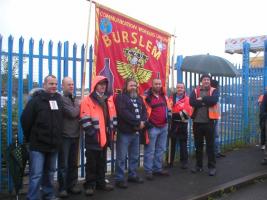
In the early hours of this morning and behind the colours of the branch banner, the Burslem postal workers ended their six week strike and returned to work. At Saturday's rally, CWU deputy general secretary for postal, Dave Ward, mentioned there was a deal on the table worth serious consideration. At the weekly meeting of striking workers on Monday the local union leadership recommended this deal. Those of the Burslem 12 who were present thanked the rest of the members for their unflinching solidarity, and backed their return to work. On the basis of a secret ballot, the branch voted 63 to 23 for acceptance.

So, what does the deal consist of? First things first, it's necessary to clear up the one glaring inaccuracy carried by The Sentinel's report of the deal. It states nine of the 12 have been given their jobs back, and three await the outcome of an independent tribunal. Unfortunately, only three have been allowed back to work outright. The three trade union reps will face an independent panel, and the remaining six will have their cases reviewed by a panel with "an independent element". Despite the face-saving language for Royal Mail, it is likely these workers will also get their jobs back.

The deal has also secured an independent review into workplace relations within Burslem depot. Whether any recommendations it makes will be binding on Royal Mail is unclear. Also, management have been forced to retreat on their attempt to reduce strikers' holiday entitlement.

In addition to the formal deal, there have been two further advances. One of the bullying managers has been removed from the depot and transferred elsewhere. When news reached the depot he was due to start at, the workers threatened to walk out if he set one foot inside. They tried the same at another Rotherham depot and were met with the same response. So for now, he's being forced to work from home. Second, the objective of management - to break the union in Burslem through "strategic" suspensions - has comprehensively failed. If anything, the branch comes out of the dispute strengthened. The bonds of solidarity and comradeship forged during six weeks of picketing will not be easily eroded, and management will be aware that in future their attacks will face determined opposition. In addition, the union is continuing to pursue civil actions against several managers through the courts.

In sum, can the dispute be regarded as a victory? In the context of unremitting attacks across all industries on workplace conditions and low levels of resistance, yes. It is not a rout of management but they have been forced to retreat in the face of solid opposition. But as Dave Condliffe jr of the local CWU noted in his press interview, "this is only half-time in this dispute". And so it is. Early in the strike, news filtered out to the pickets that management are planning to discipline a further eight posties, so another dispute could flare up at any time. Nationally, Royal Mail continues to bully and intimidate staff while closing down hundreds of local Post Offices to make the firm look like an attractive candidate for privatisation, which must surely come in the next parliament unless it is vigorously resisted. In the last fortnight we have seen the suspension of workers in Bristol, and Belfast Tomb Street's depot. There could again be national action when management and the union start talking about pensions in March. In short, a battle has been won but the war continues.

Tuesday, 22 January 2008

BNP Wives

If there was ever a case of suspending no platform in favour of giving the BNP enough rope, this was it. I cannot think of one occasion where a BNP member has come across well in the media. It tends to reinforce the impression they're either easily-led, pompous, spiteful, bitter, or clueless. Or all of those things. Back when I was a bigoted young Tory teenager I have to thank such a programme for helping make sure I never went anywhere near the fash. Then fuhrer, the late and very much unlamented John Tyndall, gave an interview that was so hate filled and condescendingly arrogant that most watching who were predisposed toward casual racism would have been put off. Unfortunately, since that time the BNP have learned unreconstructed Nazism and race hate tends not to go down well with even the most ignorant and backward of Britons. Hence the suits, the emphasis on "alien" cultures (i.e. Islam), the posing as the champion of the white working class, etc. So when its activists go on the record and make complete numpties of themselves and their vile organisation, it should be welcomed.

Of the three women featured in Sky One's BNP Wives, it was hard to tell who was taking the most stupid pills, as all three had clearly been overdosing. If one of them was at all redeemable, it was Suzy Cass, the wife of Nick Cass, a former full timer who was unceremoniously dumped by Griffin's clique last Autumn. Cass is clearly not Mastermind (never mind master race) material. She spoke of how she started to think about race when a few items from her late father's body were stolen after he died in Jamaica. This, she said, sat in the back of her mind until she met Nick, who then converted her to, if you forgive the pun, the black and white benefits of a racialist world view. Cass spoke of how she insisted on having a white midwife present during the birth of one of her children ... on the instigation of her husband. And toward the end of the show, asked what it was like being a BNP wife, she quipped "BNP wife? More like BNP widow!" She knew the party was his first love: her lot was to to bring up his kids and play second fiddle. Her longing for him to tone down his activity was plain and was quite pleased when Nick was sacked: for the first time in years, the chance of a normal life presented itself.

Marlene Guest, the organiser for Rotherham BNP, certainly fell into the stupid and bitter category. It was very quickly established this was a woman full of rage and constantly dogged by feelings of abandonment, and had only joined the BNP after her marriage had collapsed. One of the most difficult moments of the programme was her poetry reading at last summer's Red, White, and Blue festival. Guest should be thankful her bitter words of betrayal and adultery rumbled over a near-deserted field, as she succeeded in making herself look like a complete fool. And this wasn't the only time. Prodded about Nazi mass murder, she declared "Don't tell me I don't believe in the Holocaust. I do. I'm just not sure about the numbers". And she was unclear whether Britain should have gone to war with Germany too.

But most unpleasant by far was Lynne Mozar, the Southeast regional secretary. We saw her in action with her fellow fash degenerates on a stall opposing the building of a mosque in Fareham. When one woman came up and began asking questions you'd expect anyone to ask about any kind of political stall (why are you here, why are you opposing this, etc.) Mozar moved away and muttered to herself how this woman "would benefit from having a burqa". When asked by the reporter why she didn't use it as an opportunity to explain her view and try and convince her, she replied she "couldn't be bothered" and "isn't really interested in converting people". Given such an attitude it's unsurprising their paper sales were so low, and off they moved their stall to the town centre. This afforded us a keen insight into the BNP mindset when, confronted with someone who accused them of lying (they were telling passersby that the navy only served up halal meat), Andy, another organiser, claimed all critics were "leftwing operatives". Yes, and we're also transdimensional lizards who telepathically guided the planes into the Twin Towers.

BNP Wives is now available to view online here. Perhaps the funniest thing about the documentary has been the BNP's reaction to it. They hail the women as "fine ambassadors for the BNP" and believed it "helped promote the BNP to the public". Incredibly, most of the fash believe it too! Like I said, give them enough rope ...

Sunday, 20 January 2008

Burslem 12 March for Justice

The iron skies over Stoke were nice and kind for yesterday's solidarity march with the 12 suspended Burslem postal workers. We were among the first to arrive at the picket line but very soon numbers swelled dramatically with trade unionists and posties, their families, and other local people keen to give their support. At about 2pm we formed up and walked out into the road. It was only at the top of the hill did we get a proper appreciation of the size of the march. There were 4-500 in our column, and 15-20 banners, including Stoke Socialist Party's, Manchester Unison (borne aloft by Karen Reissman), and the National Shop Stewards' Network, and we forced a fair tail of traffic to build up behind us.

SP comrades battled with Socialist Worker sellers (parachuted in for the occasion) for paper sales among passers by, leaflets were doled out to cars slowly passing on the other side of the road, and the odd numpty who shouted abuse received collective cheers and rounds of applause. The march was extremely good natured and is certainly the best one I've been on since the 2,500-strong NHS-SOS demo back in 2006.

It wasn't long before we took our seats in a packed Forum Theatre in Hanley Museum. Jane Loftus, CWU president, kicked off proceedings with solidarity greetings to the Burslem 12 from all constituencies of the union, the MKP of the Philippines (telecoms union), South East TUC, ASLEF, Unite, Keele UCU, South Yorks NUJ, and many others I didn't get the chance to write down.

Billy Hayes, CWU general secretary spoke first. He began by noting how mainstream politicians and commentators claim people aren't interested in politics or solidarity any more. Referring to the squeeze in the hall, "I haven't been at a meeting before where people have to queue up to show their solidarity!" The march is what the CWU is about, he said: standing shoulder to shoulder, giving solid backing, and working toward victory. Joan Whalley, the local Labour MP, said she will never sit by if there is no fairness at work in her constituency, and in the case of Burslem depot the 12 are standing up for what is right. Having spoken to senior Royal Mail management, the objective of the strike - an independent review of the suspensions - is opposed by them on the grounds it "undermines" local management and could "set a precedent". In other words, they want to be able to carry on bullying and intimidating staff with impunity.

Dave Ward, deputy general secretary for postal outlined how 2007 was the most difficult year for the CWU since the six week strike of 1971, but things must be so much worse for the 12. Management are trying to drag their character through the gutter with allegations of bullying, and yet time and again they've been invited to present evidence during talks, but they do not because they cannot. Of course, the suspensions aren't really about bullying: it is an attempt to break what probably is the strongest postal branch in the country. And they know if they get away with it here, Burslem will be mirrored elsewhere, in the industry and outside it. In terms of practical action, the Midlands region of the CWU is balloting all of North Staffs for strike action, Midlands region has suspended agreements over start time and work times, and will do so nationally if Royal Mail do not move. But even if the 12 are victorious, the campaign continues: bullies and macho management have no place in any workplace. Malcolm Brundrett, area delivery rep said management are scratching in the dirt to try and justify the dismissals. Also, Royal Mail have had the cheek to offer an "independent" panel of managers from anywhere in the company to review the suspensions. If such an offer was taken up and they found in favour of the 12, I suspect their careers in the company afterwards would meet an untimely end.

Dave Condliffe Jr, the "13th member" of the suspended workers said this was a straight fight between right and wrong. Management are engaged in union busting and they must be stopped. They thought the branch was broken after the national strike and arrogantly challenged the union branch to ballot the depot over the suspensions. They underestimated the depth of feeling, and the strike vote must have come as a surprise slap in the face to them. Dave gave thanks to the 12 for inspiring and lifting the branch, and setting an example to workers everywhere who suffer macho management. P of the 12 thanked everyone for the "unbelievable turn out", to local activists and officials, and especially all the families of Burslem office. This dispute didn't begin with the suspensions though, it goes back 13 months to an area dispute over work time. They then victimised Big Dave Condliffe with the same bullying smears, and stepped up petty office attacks an intimidation. For example, stripping the fittings of all personal tokens and leaving them in a nearby bin; ringing up people off on the sick and threatening disciplinaries; the list goes on. Typical of management's arrogance, one of the more obnoxious of their number even informed P that if they could take out the "vocal faces" in the depot, resistance would collapse. But they were wrong: the backbone of Burslem union organisation are the members themselves. Since December 18th, when the office went on strike, there have been upto 70 on the picket line at any one time and new workers with a year or less service have been as solid as the rest: they have stood up and been counted.

The final platform speaker was Lee Barron, an area official who has been extremely closely involved in the dispute. In an angry speech, he said the union has a moral obligation to stand up against the kinds of practices we see Burslem management resort to. He thanked everyone for coming along and repeated that the union will not walk away from the 12 - it and the trade union movement owe them a debt of gratitude. And finally a warning to the managers: "we'll see you in court for defamation of character!" Lastly, from the floor, M for the 12 thanked the union for their support and everyone for turning out, and also singled out Stoke SP for the solidarity work it has done these last 13 months.

After thundering applause, the hall dispersed to the benefit social, to the local pubs, and to home. The march and rally did the job to show how this dispute is of national significance. Wherever you work, dictatorial management is trampling all over its own procedural rules, attacking unions, intimidating workers, and making work a living hell. If the 12 win in Burslem, it's a victory for us all.

Friday, 18 January 2008

Tories Target Trade Union Political Funds

The Centre for Policy Studies was founded in 1974 by Margaret Thatcher and Keith Joseph. Since then it has become an ideas factory for neo-liberal policy formation and trades in the rhetoric of free markets, deregulation, slashing red tape, competitiveness, flexibility ... all those New Right buzzwords we've come to learn and loathe over the last 30 years. Strange how no one talks about trickle down any more.

Their latest pamphlet on political funding, Labour and the Trade Unions: An Analysis of a Symbiotic Relationship is straight out of the CPS mould. The first point of its summary reads
The Labour Government has, since 1997, made much of its "business friendly" credentials. However, study of its employment legislation and its relaxation of Trade Union regulation shows that, in reality, employers have been faced with significant extra burdens and that the rights enjoyed by Trade Unions have been greatly strengthened.
You might be tempted to ask "what planet are they on?" Even the dogs in the street know New Labour is the most right-wing anti-working class Labour government in British history. Only people with a visceral hatred for the labour movement, combined with a relationship to the class struggle mediated by The Telegraph and working lunches with corporate "risk-takers" could believe otherwise. The credited authors of this piece are Alan Duncan, Tory shadow for Business, Enterprise and Regulatory Reform, and Jonathan Djongoly, his deputy. But all of us who care about the labour movement would do well to pay attention to their recommendations. If the Tories get back in after the next election (did they ever leave?), these suggestions could well form the basis of their political funding/anti-trades union legislation.

It is worth quoting Duncan and Djongoly's most important recommendations at length. These belong to a set of positions specifically addressing union political funds and political donations:
* Unions' members should vote annually on maintaining a political fund.
* A Union's members should be required to vote on the level of the political levy annually.
* The political fund opt-out right should be clearly stated on Trade Union membership application forms or a specific opt-in introduced.
* The opt-out right should be offered annually to each union member.
* Union members who do wish to contribute to the political fund should be able to decide either directly as individuals or collectively via a members' vote to which party/parties/causes their funds should be put.
* The accounting reporting requirements of Unions should be reviewed - particularly with a view towards improving transparency.
All this, the authors claim, means unions would be "subject to similar levels of transparency and democracy as apply to companies and individuals". Physicians, heal thyselves! Anyone remember the £550,000 allegedly given to the Tories on the quiet by Wafic Said, the billionaire intermediary who greased the wheels of the infamous British Aerospace fighter deal with the Saudi despots? Yes, everything was so very above board then.

Let there be no doubt about this. There is nothing wrong with demanding financial transparency in labour movement organisations. Trade union members have every right to know where our money is going, be it to the political party that time and again kicks our class in the teeth, or into cushions padding the comfy chairs of many a general secretary. Neither is there anything wrong with democratising political funds. But these Tory proposals have nothing to do with democracy and everything to do with reinforcing the power of capital over labour. If implemented, there are likely to be two sets of consequences:

1) Trade union funding to Labour will be severely curtailed. According to Electoral Commission figures cited in the document, £55.5 million flowed from the unions into the party's coffers in the 2001-2006 period, 65.1% of all monies received. The Tories assume if their proposals become law, the majority will either opt out of paying a political levy and/or some unions could drop their affiliation. Either way, less trade union money will be heading in Labour's direction and make it more dependent on business backers than ever before. This gives the Tories more of an advantage when it comes to campaigning - their organic links to British capital ensures their ability to massively outspend Labour. Given the character of the Labour party at present, some might justifiably say "so what?" It isn't as if New Labour hasn't spent the last 11 years grovelling before business interests. But the danger this could pose to Labour party funding will also apply to any future new workers' party with trade union backing. Effectively, it seeks to lock working class people out of political participation.

2) The proposed measures on annual political levy level votes, maintenance of the fund, destination of the levies, and the annual opt-out reminder comes on top of the continued becalming affects of existing anti-trade union legislation. As bureaucracies have mushroomed to ensure compliance with a superabundance of Byzantine regulations and technicalities, resources will have to be found to run permanent departments attending to the Tories' rules. More bureaucracy = more conservatising pressures on the trade unions and less money for front line activities.

What can be done? A strategy solely concerned with keeping the Tories out is a non-starter. At the moment, choosing between Labour and Conservative governments is the difference between neo-liberalism with a smile and a smirk, and a neo-liberalism openly contemptuous of working class people. Labour's opposition to meddling with the union link will last as long as it takes to sort out party funding from the public purse. They too seek to exclude ordinary people from mainstream politics. "Nationalising" parties make them less amenable to the pressures of membership, of the activists who theoretically act as a bridge between the general public and the full time apparatus and leadership of a party. The Tory proposals amount to the same thing: "privatising" parties by making them more dependent on the grace of wealthy individuals and business entities will do the job just as well.

The best way, the only real way we can head off attacks of this character is for the left to seriously agitate for and win over as many trade unionists as possible to a programme of democratising our movement . This goes hand in hand with making it more relevant, meaningful, and responsive to the needs of our class. We have to wield the weapon of democracy, otherwise our enemies will use its name against us.