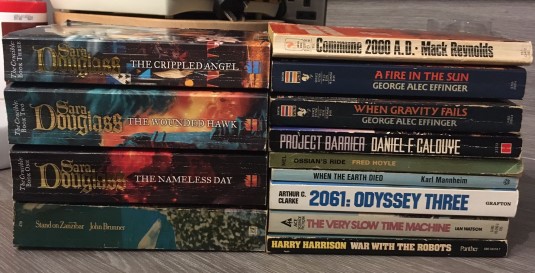
With Christmas around the corner, the discerning collector of vintage science fiction paperbacks can expect a few additions. Here are some careworn A-formats I've recently picked up.
Let's begin with something that isn't SF at all - the Sara Douglass Crucible trilogy. All three were going for a song, so it would have been rude not to. Douglass was the pen name of Sara Warneke, a medieval historian who also authored several series/trilogies of genre fantasy novels. She won a couple of awards but never gained the critical reputation and/or sales of a big hitter. The Nameless Day, which I read several months ago, was set in medieval Europe and sees Thomas Neville, an English monk, set out on a mission set by the Archangel Michael to battle the hordes of Satan. It was alright, but did so much violence to the historical record that Douglass must have winced as she wrote it. Also, the Devil portrayed here is very much the modern version dating from Goethe and not the pathetic jester/sufferer of chronic flatulence that was contemporaneous to the 14th century. But an unthreatening fool wouldn't do as an antagonist. How does Neville get on? I'm committed now so will find out eventually.
Providing a foundation for them is a sun-faded copy of John Brunner's Stand on Zanzibar. A regular on SF critics 'best of' lists, it's set in the futuristic year of 2010 and is a sprawling narrative focusing on two upwardly-mobile executives. It promises a meditation on overpopulation, artificial intelligences, economic development, genetic engineering, and drugs. It's frequently praised for anticipating our future and for being a cracking good read- certainly up there with Brunner's other semi-canonical works.
Mack Reynolds is an interesting character. Openly left wing at a time in the United States when that would be a career killer, Reynolds's SF spent a lot of time thinking about and thinking through utopias. He was raised in the De Leonist Socialist Labor Party, and for a time he was a full-time cadre for the party. Later on in the 1950s and having established himself as a writer, the SLP sought to purge him for publishing How to Retire Without Money - the type of self-help slop that was as ten-a-penny then as now. For raising illusions in capitalism, Reynolds reluctantly resigned - but he remain dedicated to pushing utopian SF. In Commune 2000AD from 1974, Reynolds imagines a sexually liberated US where everyone has a guaranteed income and government is entirely rational. Yet there is discontent - how can there be serpents in the modern paradise? Not a major piece by any means, but a welcome addition to the growing vintage collection.
The next two come as a pair. When Gravity Fails and A Fire in the Sun are two-thirds of a trilogy. If you're familiar with Richard Morgan's Altered Carbon books, there are some superficial similarities between them. Here, Marid Audran is muscle-for-hire in a world where one can swap out personality cartridges. And it happens that his job is to track down a sadistic killer who can't stop slotting in the personalities of history's worst mass murderers. Undoubtedly, much cyberpunkish grittiness and violence ensues. By all accounts, George Alec Effinger wrote his trilogy while living with severe health problems and an ever-increasing pile of medical debts. Unfortunately, his difficulties meant this was the last substantial piece of work he produced. But as final works go, they have retained a decent reputation unlike most other cyberpunk-style cash-ins.
Project Barrier by Daniel F Galouye has a not-at-all questionable premise. Humanity has the technology to send people to the stars! But the rigours of superluminal travel means only a crew component weighing 120lbs can go. The ingenious solution? Strap in a 12 year old girl and imprint the personalities of three astronauts onto her brain. But what happens when they return from their trip? Does restoring her singular personality mean murder? Actually a collection of related short stories (my UK edition does not indicate this), for some reason Richard Dawkins is a fan. I'll try not to let that put me off. Galouye is probably best known for his Hugo-nominated Dark Universe, but was another writer plagued with ill-health - this time thanks to injuries sustained as a navy pilot during the war. That this was completed and published following his medical retirement is testament to his determination.
Speaking of dodgy-sounding conceits, next up is Fred Hoyle's Ossian's Ride. In the far future of 1970 (Ossian's was published in 1959), the Republic of Ireland sits under a dictatorship and, thanks to its mysterious free port-style "science zone", its monopoly on highly advanced technologies may constitute a threat to dear old Blighty. And so a scientist-cum-secret agent Thomas Sherwood, a man with an impeccably English name, is dispatched to infiltrate Ireland's secret powerhouse and bring home the bacon. I'm not suggesting this is suffused with post-colonial paranoia, but. Fred Hoyle was a distinguished astronomer who made several important contributions to physics and chemistry, as well as originating the theory of panspermia. I.e. Life did not begin on Earth, but migrated from elsewhere and came here via meteors. He was a pillar of the establishment despite being at odds with colleagues over this and his view that the universe did not originate from a big bang - a phrase he apparently coined. Does this mean his science fiction is any good? The Cloud often gets decent write ups, but I suspect that there might be reasons why this exercise in paddy peril is not so feted.
I'm not sure many people have heard of When the Earth Died by Karl Mannheim. I have checked, this is not the German sociologist of knowledge - though his most famous book, Ideology and Utopia, almost has an SF ring to it. This, published in 1950, comes from the pen of an unknown UK author who chose to remain anonymous. How intriguing! The world here is where two power blocs face off against each other and, apparently, everyone dies in nuclear fire. Not sure how science fictional that was in 1950, but my copy was going for a song and it's in very good condition so it was hard to say no to.
From the obscure to the famous, Arthur C Clarke is by light years the biggest name on this list. And here he's represented by an almost mint early 90s edition of 2061: Odyssey Three. I watched 2001 when I was a nipper and, like most other people, was puzzled by what was happening. The novel was much clearer. Later I was quite the fan of 2010: Odyssey Two, but haven't read and don't own the book. So this here occupies a place of abeyance until 2010 falls into the collection. This? It lifts off after Jupiter has ignited and it shines down on us as our second sun. And I know no more than that. The general chatter isn't that favourable regarding the Odyssey series, but I do have a soft spot for Clarke. Growing up in the 80s, I remember Arthur C Clarke's World of Strange Powers, which was full of Fortean silliness. One episode about past lives was trailed as "Here is a man looking for his own grave." Fantastic stuff. Much later I quite liked Rendezvous with Rama - much less its sequels with Gentry Lee, which were terrible. And last year I thought A Fall of Moondust was quite jolly provided you go into it knowing Clarke's weaknesses. I expect 2061 to be broadly similar.
I blow hot and cold with Ian Watson. I thought his Alien Embassy was very good, if not a touch questionable by today's standards. However more recent reads, Chekhov's Journey and God's World did not hit the spot. Watson is an erudite and sophisticated writer, but two out of my three forays into his oeuvre have not paid off. What of The Very Slow Time Machine? This is another short story collection, the titular tale is about an old boy landing from the future in 1985 and slowly ageing backwards. Apparently, this is one of the weakest in the book - but that's because the others are stronger. We'll see if Watson's idiosyncrasies hold up in the short form.
Last is another author I've yet to read: Harry Harrison, and he shows up here with his War with the Robots. Yet another short story collection, this gives us a range of whatever-you-can-do, machines-can-do-better adventures. On the shelves I've got a load of his Stainless Steel Rat and Death World novels. Popularly seen as an overly pulpy writer, this apparently is to do Harrison a disservice as his work is full of subtle satire and irreverent gestures to overweening SF tropes. And the cover for my edition is ridiculously OTT. It's sat there now demanding that I read it.
There endeth the latest book haul. Another one is due early in the new year. Have you picked up anything interesting lately?

1 comment:
Stand on Zanzibar is a very good book. I read it in about 1970, when 2010 seemed far future, and reread it and wrote an introduction to the Masterworks edition a few years ago. Using a litery bio of Brunner and Google scholar, I was able to track down the very articles in New Scientist that Brunner had read for research. It's fascinating to see how the future turns out differently from the predictions -- but Brunner's prophecies are spot on.
Post a Comment