Another month, another slew of new(ish) blogs that deserve your attention:
1. Fourth International Revolutionary Marxists (4I)
2. A Thousand Flowers (Unaligned/Feminist/LGBT)
3. Disillusioned Marxist (Unaligned)
4. Don't Mention the 47 (TUSC) (Twitter)
5. Fur Coat Nae Nicks (Unaligned)
6. Harlow Council Tax Benefit Rebels (Unaligned)
7. Howie's Corner (Unaligned)
8. Kwami Odoom (Unaligned) (Twitter)
9. PCS Croydon (PCS) (Twitter)
10. People's Plain Dealer (Unaligned) (Twitter)
11. Splogs (Unaligned/Teaching)
12. Sussex Against Privatisation (Unaligned/Occupy) (Twitter)
13. Tea and Solidarity (Labour) (Twitter)
14. The Daily Cameron (Unaligned)
15. The Red Needle (Unaligned) (Twitter)
16. To The Victor Go the Toils (Unaligned)
17. Unwarranted Self Importance (Unaligned)
18. What Stilli Did (Unaligned/Feminist) (Twitter)
If I was to single out one for special interest, it would be Howie's Corner. One does not have to agree with the politics to recognise the interesting alternative perspective he gives on the balance of forces within PCS and, IMO, a correct critique of the general strike posturing of much of its leadership.
Well, that's it for March/April. If you know of any new blogs that haven't featured before then drop me a line via the comments, email or Twitter. Please note I'm looking for blogs that have started within the last 12 months. The new blog round up is posted on the first Sunday of every month, and is also cross-posted to Socialist Unity.
Sunday, 7 April 2013

Saturday, 6 April 2013
Chronicles of a Fallen Love
One of the greatest tunes from last year. I never rated the Bloody Beetroots, but this is something else.
Friday, 5 April 2013
Dogging and Dogging Tales

If you've lived a sheltered life, dogging is the practice of (usually straight) couples having public sex with an audience. And usually the audience - which is almost exclusively male - are invited, one after the other - or simultaneously - to have sex or engage in sexual activity with the woman while her male partner looks on. The numbers are subject to change, of course, but a constant is for dogging to take place in remote or semi-remote rural locations. Like said dogging hotspot that straddles, if you pardon the pun, Stoke-on-Trent's city limits. Some celebrities have contributed to the buzz surrounding it too - remember this and this?
Last night's Dogging Tales provided a fascinating entrée into the subculture, if you can call it that. The film profiled a handful of anonymised people who became involved for all manner of complex reasons. Their testimony certainly resisted mechanical readings of dogging as an expression of straight masculine sexual power and prowess.
Couple One were separated by an age gap of some 20 years. For the guy going dogging was about "fun" and living life to the max following the premature death of his brother. To paraphrase his words, "you could drop dead tomorrow ... but at least I'll go to my grave with a smile on my face." In a number of ways, his portrayal reinforced a Jack the Lad narrative. He was promiscuous, he had fathered at least 14 children, he "couldn't use condoms" (snore) because they were "too small" (whatevs), and felt that his adventurous lifestyle was superior and more honest than those who moralise about dogging, most of whom "sat at home and wanked at porn" anyway. Slightly more disturbing was his partner's testimony. Being much quieter she talked about how bad her previous relationships were and darkly hinted that they may have been abusive. But far from being corralled into dogging, she found their visits to the woods liberating. The act of dressing up, being photographed in lingerie and evening wear, getting feted by successions of strange men, and, of course, having sex with them had helped build her sense of confidence. She talked about how when the make up went on she became a different person - a woman in control of herself and commanding the desire of others. Dogging was more than just kinky sex. It allowed her to escape her past and remake herself, albeit with the approval and encouragement of her partner.
There were parallels between them and the second couple. For both of them dogging was something adventurous. The pair were at pains to stress their relationship was normal and healthy. Dogging was not an experiment to jumpstart things in the boudoir but an extension of their self-described active sex life. For him there was an element of trophy wife syndrome, of a desire to show her off. From the shown footage she certainly had the physique of a conventional porn star - slim, tall, augmented breasts. He talked about the satisfaction of knowing how other men wanted her, and made great play of the fact that regardless of how many turned up he was the one in charge of the situation - not the doggers nor his partner. Where she was concerned, again, there were confidence issues with her. Despite having the body held up as the hegemonic feminine dominant, she talked about not being happy in her own skin, but that sex with strangers was gratifying both physically and mentally. She got off on the idea of having sex with as many men as possible and talked about how she appreciated those who came quick most because she could then move on to the next one.
The documentary briefly featured a couple of singles. The first was a lorry driver who made the bold claim that at least 70% of his fellow truckers went dogging, and it was they who were responsible for creating the subculture in the first place. For him though, dogging was about sexual convenience rather than fetishistic behaviour. He made the hoary old reductionist argument repeated by chauvinist bores the world over that men have to pay for sex anyway, through housekeeping, taking partners out for meals, buying gifts, etc. To his own stunted view of men and masculinity, it made sense to cut all that out. Provided you knew where to look and at what time, free sex without the accoutrements of relationships was there for the taking.
The second was a woman who, somewhat unusually, went out dogging by herself. She talked about how gratifying it was that men found her sexy. But interestingly, and paraphrasing her words, she confessed how she treated dogging as foreplay, as a preface to the especially torrid time with her husband she could look forward to when she returned home. Her husband didn't partake but fully consented to it. For him, he got turned on by the idea of her going with other men. For her, she was turned on by the idea going with other men turned him on.
The final couple were an interesting pair, and somewhat tragi-comic. She was interested in dogging because, after a series of affairs and flings, she had got bored with her boyfriend. He had consented - somewhat reluctantly - to it with the promise that he could fulfil his fantasy of watching and going with two women at once. They were able to find the third woman and went dogging with her. In scenes worthy of a slightly porny Carry On, all three of them and the film maker ended up in the middle of a wood in the dead of winter having a bit of a fondle. There was absolutely no one around, though I imagine the foxes and deer got a bit of a fright. And so, disappointed, they put away their bits and went home. Later, after an interval, they were visited by the crew again. The attempted dogging and threesomes had ceased and she said the whole adventure made her realise how much she loved and cared for her fella. And so, as it appeared with the other cases, dogging worked to affirm and cement their relationship.
Dogging Tales was an interesting snapshot because no overt narrative was imposed on the footage. The questions were unobtrusive and most of it were couples describing their motives and drives in their own words. And naturally, being the kind of tabloid telly Channel 4 have coveted to corner, there were flashes of naked torsos and bonking in the back of the car. But what was interesting was how de-eroticised the whole spectacle was. But that isn't to say it was pornographic either. This was an exploration of taboo heterosexuality with the veil of mystery and forbidden pleasure entirely torn away. Perhaps it's just me, but I can't imagine many people watching it thought "perhaps we ought to give this dogging lark a go." Could this be a property of the subculture itself? Certainly and particularly the men's arguments neatly fitted into the tabloid's stock 'pervert' mould; of male heterosexuality as something promiscuous, furtive, irrepressible, dirty anorak-y. Seeing random men literally lining up for their turn does little to undermine this common trope. And of course, in the middle of the woods in the dead of night when it's freezing is hardly the most libido-stoking locale, especially as most cities now boast licensed heated swinging establishments for those of a polyamorous bent.
I also think Dogging Tales underlines how mundane sex has become in the public sphere. Various folk talk of raunch culture, of pornification, of the sexualisation of greater areas of social life. Clearly large swathes of the world that have undergone the so-called sexual revolution has seen the transgressive qualities of sexuality once celebrated by New Left and New Age utopianism become something else. The most human of needs is now repackaged and resold as sexualised aspirations, sexualised commodities, and sexualised technologies of discipline and surveillance. Dogging is 'free' and 'underground', it exists outside the mainstream, its transgression might prove attractive to a few, but the time of sexuality as a resource for progressive political and social change has largely passed. Dogging is no more a challenge to hegemonic, prescribed modes of sexuality than your favourite indie label is to the dominance of the majors. In fact, it's a wee bit seaside postcard.
Still, different strokes for different folks. Dogging's not going anywhere, except perhaps to a wood near you.
Thursday, 4 April 2013
North Korea and the Drums of War
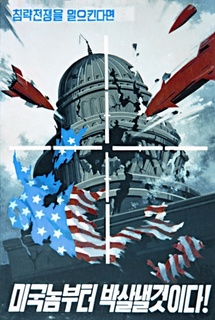
Well, no. This simply will not do. The dynamics of confrontation are always complex, and it is no less the case on the world's last Cold War frontier. So far, the rhetoric has become more extreme than any point since, well, ever. After all, it's not everyday North Korea issues formal declarations of war and threatens to nuke the Western seaboard. But for all that everything so far remains within the established rules of the Korean game. That isn't to say the situation isn't dangerous. It is.
Context, as they say, is everything, and North Korea is a product of its circumstances as much as any other government and society is. Unlike other satellite regimes of the USSR, early on the North faced its own Cold War frontier. Following the Korean War and the Sino-Soviet split (in which Kim Il-sung allied with Mao), the Soviets were understandably reluctant to provide military aid to such an uncertain ally. Therefore the North had to provide for its own defence to a degree that the likes of East Germany, Czechoslovakia etc. did not. Facing it across the 38th Parallel were ranged South Korean and US military forces, backed by nuclear weapons. Hence the North's development has by virtue of Cold War logic, been skewed toward the military. And, as surely as social being conditions consciousness, the bizarre - to us - juche ideology of self-reliance and grotesque personality cults around the Kim dynasty makes perfect sense to a nation thrown onto its relatively meagre human and material resources as it struggles to throw off a perceived superpower threat. Naturally, as the North have tried to make good the gap so the South and the Americans responded in kind through annual parades of military might, and making available the latest hardware.
As I wrote a few years ago,
The truth is no one has an interest in war. While the US would like to see a united Korea under its military protection as strategic leverage against China, Obama's administration like all those before it know the price paid in lives, materiel, and funds would be too much for the American public to stomach. It's one thing to take on lightly armed decrepit states and insurgencies: it's quite another to enter a war with the prospect of chemical, biological and nuclear weapons being deployed against US troops. Similarly for the South - even if fighting does not dip south of the demilitarised zone, the 10 million inhabitants of Seoul and the 25 million in surrounding areas are well within the range of the North's guns. In all likelihood the area immediately south of the DMZ would be comprehensively devastated. And on top of that the South would face the bill of absorbing the North. The Economist puts the cost for unification at $900bn - it would of course be much higher if the North gets raised to the ground. The North itself knows it cannot win and hopes a combination of hysterical denunciation, rocket launches and nuclear testing will be enough to keep its enemies at bay. I might not think much of Trotsky's analysis of the USSR, but his insight that the Stalinist bureaucracy wants peaceful coexistence with the big capitalist powers so it can carry on living off the backs of workers and peasants is spot on.But in recent weeks there has been something of a shift inside the North Korean regime. The Brilliant Comrade's alleged involvement in the sinking of a South Korean naval vessel off Baengnyeong Island in early 2010, followed by the shelling of Yeongyeong Island that November helped burnish his military credentials while the Dear Leader groomed him for office. But since assuming power, the apparatus of the party-state has undergone a purge. Out are Kim the Elder's cronies, and in come his own people. There are plots and rumours of plots.
With a grip on power that could be shakier than appearances suggest, Kim needs the Korean People's Army on side. Especially when the policy direction he announced in the new year is likely to exacerbate tensions among this key regime support. It is no secret that North Korea's economy is in a precarious situation, and renewed famine is an ever-present danger. Per-capita GDP is estimated to be below that of Sudan, Papua New Guinea, and Lesotho. It's 18 times smaller than the South's. Back in the summer a well-known defector revealed Kim's desire to emulate China's example - an argument that turned out to be a canny prediction. Basically, this means abandoning the 'Military First' policy that has long been the regime's priority (in 2010, the military consumed 16 per cent of total expenditure). In this context, ramping up the threat level keeps the military disciplined by external threat while resource is directed elsewhere. Furthermore, the North's pursuit of nuclear weapons and ballistics has never been irrational. Despots the world over have noticed that the US and its allies tend to militarily intervene where no real opposition exists. Kim's nukes on the other hand have the advantage of warding off the Americans while reducing expenditure on conventional arms. The "nukes plus economic development" line getting pushed by Pyongyang is, within the realpolitik options it perceives, a reasonable one.
The problem Kim has is when this crisis blows over and the Korean people avoid the abyss, the armed forces will still be there. They can only be kept on high alert for only so long. The difficulty he has is integrating them into his economic development plan. Again, China may provide a possible answer. When Deng Xiaoping initiated the great programme of economic liberalisation in 1979, he struck a deal with the People's Liberation Army that in return for a 20% reduction in military personnel and a lower budget, the army could have access to the market. This involved retooling armament plants for consumer durables like white goods, cars and motorbikes, TVs and so on. 20 years later Jiang Zemin decreed that it had led to a bloated, inefficient and corrupt sector, leading directly to a series of high profile scandals. But in its early phase at least it provided the home-grown commodities a growing domestic economy demanded, gave the army a material stake in the reintroduction of market relationships, provided employment opportunities for laid off conscripts and, crucially, brought off opposition.
But that is an if. Bellicose rhetoric is nothing new, but all it could take is for a jumpy officer on either side to take a pot shot for the conflagration to start - especially so as the North has already cut the hotline with the South. The situation has to be diffused and, as you might euphemistically put it, the US sending a squadron of stealth bombers to the peninsula is "not helpful". But the USA could have a positive role to play. It is, after all, as embroiled as much as the two Koreas. If it is serious about de-escalation and turning the DMZ into a Cold War museum, it needs to take the lead in diffusing the situation - and piously lecturing the North on atomic bombs while it has nuclear missiles and artillery shells pointed in Pyongyang's general direction is not going to do it. A plan for lasting peace requires commitment, and a good place to begin is with the North's primary foreign policy objective since the collapse of the USSR - a non-aggression treaty between it and the USA. With that as the starting point everything else - the nuclear programme, the closure of American bases, cutting the military, normalising relations, aid, and a peace treaty - can follow.
The stand off along the 38th Parallel has its 60th anniversary this summer. The longer it goes on for, the more likely the technical state of war could become a real shooting one. For the sake of millions of lives, it's time this appalling and grotesque relic of 20th century geopolitics was drawn to a close.
Image: "When provoking a war of aggression, we will hit back, beginning with the US!"
Wednesday, 3 April 2013
A Vile Product

Could this be the most disgusting headline to have hit news stands since The Sun's coverage of Hillsborough? The dehumanising of the children ("bred 17 babies"), the welfare-baiting headline, the sideswipe at social workers; seldom has a tragedy been exploited so brazenly and cynically to score political points. And for the judgement to land at the very moment the government are actively impoverishing hundreds of thousands of low paid workers, unemployed people, and the disabled, it's enough to give those of us who aren't of a conspiratorial turn of mind pause.
There is no merit in The Mail's argument whatsoever. On this Owen Jones is absolutely right. The criminal ends Michael Philpott used to try and wrangle a larger council house out of Derby City Council says nothing about people who receive Child Benefit, live in social housing, or receive out-of-work support. If The Mail seriously believed their poisonous rubbish, and I'm not convinced they do (which, of course, makes it even worse) let's have pages of moral panics against market relationships. Don't they, after all, incentivise robbery and murder?
The press usually defend the foul ideas they promote by saying they give what their readers want. If people didn't like what they had to say, the democracy of the market would kick in and no one would buy it. And indeed, with one or two exceptions, newspapers are declining almost entirely across the board - including The Mail. They're definitely not giving people what the people want. And, with a bit of luck, this headline will cost another chunk of the paper's readership too.
Nevertheless, while the print format is declining, The Mail has got the website side of things all figured out. Mail Online is more than just a newspaper in digital format, it is a mega-blog that effortlessly combines the paper's usual, swivel-eyed fare and celebrity "news". Rare is the person who hasn't found themselves sidetracked by their sidebar of shame.
Part and parcel of this strategy is friction, and it's something they cottoned on to very early on. As the print edition shows, the core audience for unreconstructed bigotry is limited and declining. The same processes prising apart organised conservatism are slowly but surely snuffing out its base. To get the wider audience in, the affluent younger, the urbane and intelligent, you don't water the content down. You up the ante. You play on the paper's reputation as the most scurrilous of all Britain's right wing rags and publish ever more outrageous things. They seek to anger, shock and outrage as many moderate, liberal and left people to drive greater quantities of traffic to their site. As a case in point, this morning's headline was bandied about on Facebook by various lefties. In other words, hate and bile is what ensures stories go viral among the very people who detest the paper the most. It's a business model. As I wrote a couple of years ago, "It's a stroke of genius: exploit your opponents' right-on politics and they will market your putrefying product across their social media networks for you."
The Mail is stupid. But The Mail is not stupid.
Tuesday, 2 April 2013
Quarter One Local By-Election Results 2013
Polls have their place, but only actual, real elections quench the psephological thirst of many a politics anorak. Wishing to "give something back" to "the community", I've been tracking local by-election results over the course of this last quarter. You can find them below.
* Scottish National Party contested all three Scottish local council by-elections.
** Plaid Cymru contested the only Welsh local council by-election.
*** There were occasions where Independent candidates contested the same seats, hence percentage of contests has been left blank.
**** 'Other' parties and organisations likewise clashed.
Overall 60,911 votes were cast over 37 individual local (tier one and tier two) authority contests. All percentages are rounded to the nearest single decimal place.
There are a number of caveats that come with the data.
Firstly, local council by-elections are extremely uneven and can be distorted by elections clustering in safe seats. For example, while Labour won almost half of all the contests this last quarter a good many happened to occur in Labour-supporting areas. Second, comparing one quarter results to another (which I'll be doing anyway in early July) can never be like-for-like precisely because contests take place randomly. Swings in support are likely to reflect the character of the seats up for election than wider patterns. Thirdly, unlike other second order elections (parliamentary by-elections, European elections, normal local authority elections) local concerns can rudely come to the fore and swing an outcome.
With these concerns in mind, I think two solid conclusions can be drawn. There is the net win/loss of council seats. While Labour's results were buoyed by lots of contests in its areas, it still managed a haul of three seats - outpaced only by the Liberal Democrats(!). The Tory decline however saw them lose seats to both parties and UKIP. To perform so poorly while standing in 97 per cent of seats (and only winning six of those elections) could well be indicative of the crisis afflicting the right.
While we're on the topic, let's talk about the strength of party organisation. The fact, for example, that UKIP were able to contest 65 per cent of the seats indicates greater organisational capacity than the other minor parties. But likewise the table also illustrates that the LibDems are not entirely out of the count yet, indicating there is still some distance our MkII Tory Party has to travel before it meaningfully displaces them as the third party in the country. Also, managing only to contest six seats was the BNP. That seems to fit the general consensus that their decline is continuing. Good.
Party
|
No. Contests
|
%
|
Vote
|
%
|
Average
|
Wins
|
+/-
|
Conservative
|
36
|
97
|
13,322
|
21.9
|
370
|
6
|
-7
|
Labour
|
33
|
89
|
23,033
|
37.8
|
698
|
18
|
+3
|
LibDem
|
28
|
76
|
7,750
|
12.7
|
277
|
8
|
+4
|
UKIP
|
24
|
65
|
5,668
|
9.3
|
236
|
2
|
+2
|
SNP*
|
3
|
2,223
|
3.6
|
741
|
0
|
-1
| |
Plaid Cymru**
|
1
|
54
|
0.1
|
54
|
0
|
0
| |
Green
|
15
|
40
|
1,929
|
3.2
|
129
|
0
|
0
|
BNP
|
6
|
16
|
451
|
0.7
|
75
|
0
|
0
|
TUSC
|
3
|
8
|
231
|
0.4
|
77
|
0
|
0
|
Independent***
|
18
|
5,243
|
8.6
|
291
|
3
|
0
| |
Other****
|
9
|
1,007
|
1.6
|
112
|
0
|
0
|
* Scottish National Party contested all three Scottish local council by-elections.
** Plaid Cymru contested the only Welsh local council by-election.
*** There were occasions where Independent candidates contested the same seats, hence percentage of contests has been left blank.
**** 'Other' parties and organisations likewise clashed.
Overall 60,911 votes were cast over 37 individual local (tier one and tier two) authority contests. All percentages are rounded to the nearest single decimal place.
There are a number of caveats that come with the data.
Firstly, local council by-elections are extremely uneven and can be distorted by elections clustering in safe seats. For example, while Labour won almost half of all the contests this last quarter a good many happened to occur in Labour-supporting areas. Second, comparing one quarter results to another (which I'll be doing anyway in early July) can never be like-for-like precisely because contests take place randomly. Swings in support are likely to reflect the character of the seats up for election than wider patterns. Thirdly, unlike other second order elections (parliamentary by-elections, European elections, normal local authority elections) local concerns can rudely come to the fore and swing an outcome.
With these concerns in mind, I think two solid conclusions can be drawn. There is the net win/loss of council seats. While Labour's results were buoyed by lots of contests in its areas, it still managed a haul of three seats - outpaced only by the Liberal Democrats(!). The Tory decline however saw them lose seats to both parties and UKIP. To perform so poorly while standing in 97 per cent of seats (and only winning six of those elections) could well be indicative of the crisis afflicting the right.
While we're on the topic, let's talk about the strength of party organisation. The fact, for example, that UKIP were able to contest 65 per cent of the seats indicates greater organisational capacity than the other minor parties. But likewise the table also illustrates that the LibDems are not entirely out of the count yet, indicating there is still some distance our MkII Tory Party has to travel before it meaningfully displaces them as the third party in the country. Also, managing only to contest six seats was the BNP. That seems to fit the general consensus that their decline is continuing. Good.
Subscribe to:
Posts (Atom)