Friday, 10 March 2017

Truxton for the MegaDrive/Genesis

Taking a night off from the politics and suchlike, it's time we had a look at a well known MegaDrive title that's been in my sights for some time. Truxton, or Tatsujin as it was dubbed in Japan, is a vertically scrolling shooter that sees you operate a rocketship of doom against waves upon waves of dastardly aliens just begging to get blasted. Yes, as no frills shooters go, Truxton pretty much wrote the book.

As an early MegaDrive title, I remember its review back in t'day in jolly old Computer and Video Games. In common with nearly all of the initial crop of games, Tatsujin as we knew it then walked away with a massive pile of accolades. Remember, these were the days when replication of the arcade experience was the sine qua non of action-based gaming. The tiny number of screen shots jumped off the page and looked like something I'd only ever see at the sadly-missed American Adventure up the road. The graphics were crisp and crapped over all the shooters available on the 16-bit home computers, and the bosses were simply huge. I think this was the moment when I realised that the pennies I had hitherto put away for an Amiga might best go on Sega's machine instead - even though the official release was still over a year away.

Summer of 1991 came round and I finally had cash enough to sink into a MegaDrive. I started off with two games and spent the next year or so (very) slowly building up a collection. Truxton as it was now styled for Western audiences by this time wasn't something I particularly fancied, until the purveyor of cheapo console games on Ripley market introduce a swapping service. For a complete game and a fiver, you could have a new game. This is how I got my copy, stupidly swapping my original, complete and pristine copy of Star Control for it. Duh. And you know what, I was disappointed.

Truxton made a fantastic first impression in 1989, but three years later while it was old hat, even if considered a solid blast by the video game mag cognoscenti. I was forced to reluctantly agree at the time. It was tough - stupidly so, in places - and for a shooter, and a Toaplan-developed one at that, the thumping soundtrack I was expecting was curiously absent. The music still disappoints to this day. It hung around on my shelf for a while before getting swapped for Michael Jackson's Moonwalker (which, in its turn, later made way for Golden Axe). And that was it until a couple of years ago when I picked it up in my second wind of MegaDrive collecting. Did absence make the heart grow fonder?

Not this time, alas. Those first impressions formed 20 years ago all came back when it flashed up on my MegaDrive. The format, fly up a forced scrolling screen dispatching waves of enemies can be quite satisfying, but in Truxton's case it is marred by a litany of cheap deaths. Baddies suddenly appearing up your backside with little chance to avoid them. Exploding light bulbs (yes, really) that throw shards of death around the screen while trying to battle hordes of aliens are annoying. And, occasionally, those evil sods off screen throwing a bullet or two in your direction. This is partially compensated by the weaponry, of which there are three types obtained through power ups. The standard spread shot eventually develops a shield of bullets that prevent any kamikaze sneak attacks from the rear. But not helpful against the light bulbs. The "green weapon" is the most powerful but concentrates your fire in a strictly narrow column of death to the front of your craft. Excellent for bosses, not ideal for the rest of the level where enemies pop up from here, there and everywhere. And lastly there is the most awesome looking weapon, the lightning. On the screenshots it looks extremely impressive, and powered up fully five columns of electrical energy stream out to encompass almost the entirety of your screen. Problems? Sides remain vulnerable, the bolts can obscure exploding enemies, and there are nefarious mid-level bosses that use the beams to home in on your craft. Though word has to go to the Truxton smart bomb, which remains the most awesomely ostentatious explosion to grace a 16-bit machine.

This might sound like a whinge (and it is), but it does make for a very frustrating experience. One moment you're basking in the near-invulnerability of total destructive power, and one cheap death reduces you back to a sluggish, underpowered vulnerable nonsense. Under these circumstances, you're sure to be less X-wing, more ex-wing. Yes, it's one of them. Truxton also has the annoying Toaplan characteristic of offering speed ups to the point of uncontrollability, making it nigh on impossible to effectively avoid enemy fire without careening into something else.

Despite being annoying and having rubbish music, Truxton managed to accomplish a few important firsts for the MegaDrive. The game helped cement its reputation as a machine capable of arcade quality action in the sphere of vertically scrolling shooting. Which, at the time, was (with its horizontally-scrolling brethren) the canonical game form - albeit one due to be replaced by the platformer on Sega's machine. As far as I know, Truxton was the first game of its type for the MegaDrive. Second, it repeated the trick Altered Beast managed to pull by showing off (a little bit) some of the tricks the machine was capable of. There was some sprite rotation-y stuff on some of the enemies, and sometimes this was accomplished with many of them at screen on once. This was then a big deal, albeit one not picked up on at the time. Second, the game throws a lot of enemies at you without any slow down - again, a truly impressive feat of programming on then new hardware. Thirdly, Truxton also established the base standards one should expect from a game of this kind. Plenty of enemies, challenge, beastly big bosses - these were the standards by which vertically scrolling console shooters were to be judged. It wasn't a canonical game, but nevertheless the conventions it condensed were sublimated into reviewers' judgement criteria. As a rule, if a game didn't advance or innovate beyond what was on offer here it was destined to be a sure fire critical failure.

As games go, Truxton is now a museum piece. Worth a whirl certainly, but rapidly eclipsed at the time by other vertically scrolling fare Super Aleste as well as Toaplan's subsequent efforts on the MegaDrive.

Thursday, 9 March 2017

Hammond's National Insurance Nightmare

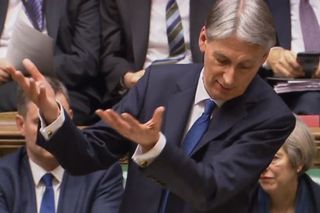
George Osborne may have been the worst chancellor of modern times, but he understood one thing. Subordinating the national interest, i.e. those of British business-in-general to the narrow concerns of the Conservative Party, allowed for good press and the accumulation of political capital. It didn't matter if these actions weakened the economy or made life worse for millions just as long as it helped secure the next election, which it duly did. "Call me" Philip Hammond, is a very different kind of chancellor. As he got up at yesterday's budget statement, he entertained the chamber with a handful of zingers at Labour and the SNP's expense, but effectively he did the anti-Osborne. His was a thin, technocratic position that didn't pay too close an attention to politics, and as a result the politics played him.

First and foremost was floundering into a trap of the Tory Party's own making. You may recall the weird campaign they ran in the run up to the general election: a promise to spray paint public services with money, while emphasising prudence and responsible spending that channnelled circa 1996 Gordon Brown. At the time, Dave and Osborne made a big show of accusing Labour of wanting to quietly raise National Insurance (or the jobs tax as they opportunistically dubbed it), and this forced the sainted Ed to publicly forswear any such thing. Meanwhile, they ensured it appeared no less than four times in their manifesto. And now, the Tories have gone and broken it. Hammond has tried saying that the pledge only meant a certain kind of NI contribution. More fool the Tory electorate for missing the caveat at the time, eh? And so it presents as a straight pledge break, which is something no politician should be seen to do.

And then it's who is affected. It's a smash and grab on the petit bourgeoisie, of the army of small business people and self-employed whose ranks swelled after the crash hit, redundancies were handed out and secure job opportunities shrivelled up. Traditionally the backbone of centre right parties everywhere, it's as if Hammond failed to make the political calculations as he was adding up the sums. Or perhaps he did, thinking it unlikely they'd pass over to Labour amidst its current travails. Which might be true, but there are other options for narked off Tory voters. From a press reception point of view, it was never going to go down well with the perennially terrified readers of The Daily Mail anyway. But neither did he latch on to the position of freelance hacks and those associated with right wing titles in a self-employed capacity: many a columnist would have to cough up. Bearing in mind Osborne delivered budgets much worse then Hammond, and much more damaging too, it's amusing to see the Tories hit with a wall of negative coverage.

Then why do it? The Conservatives are galloping ahead in the polls, May is retaining a favourable approval rating, and for the most part the media remain entirely fixated on Jeremy Corbyn and how many times he blew his nose today. An unnecessary own goal? Perhaps. From a technical-fiddly point of view of raising extra monies, it does have the virtue of bring National Insurance in line with PAYE and making the system fairer, as Hammond puts it. And, while it would be news to most wage and salary earners that self-employed people have enjoyed reduced contributions rates, now they do know about it the Tories are going to have to bank on them thinking it's fair too. A bit of a gamble to be sure, but if this is "necessary" then now is the time to do it.

This morning, Nick Robinson referred to Hammond as "Spreadshit Phil". Perhaps it wasn't entirely a slip.

Tuesday, 7 March 2017

The Stupidity of Melanie Phillips

It's chip wrappings now, but I still wanted to say a few things about Melanie Phillips and her egregious stupidity. In case you missed it, she caused a flap with this article that made a number of tendentious claims. Namely that Great Britain is an ancient nation whose existence predated the Act of Union, and is therefore indivisible while, at the same time, Ireland "has a tenuous claim to nationhood"

This is Mel up to her old tricks. Back in her day as an ideologue-in-residence at, where else?, The Daily Mail, she regularly churned out awful rubbish and racist hogwash. She in fact pioneered trolling in national newspapers as a business model. Why rely on the crusty old Colonel Blimps - for whom the internet is communism, or something - when you can pile up the visits and advertising rates by hooking in lefty audiences outraged at explicit displays of bigotry? It's a lesson the gutter press and its scribblers have long taken aboard, and it works. Would I be writing about this if no one paid her any attention?

Take her points about Linda Colley and Benedict Anderson. Judging by her brief discussion of their analysis of nationalities and nationalism, she never got past the blurb on the back of either Britons: Forging the Nation nor Imagined Communities. She falsely attributes them the argument that because nations were artificial ("invented") they could therefore be declared and dissolved. Um, no. Modern British identity is a contradictory mishmash of the reactionary and the progressive, of a nostalgic paean to a bloody legacy of conquest and empire, and a contemporary tolerance of difference and inclusivity. The bits and the bobs fixing these coordinates in popular consciousness are moments and personalities deemed to embody nationally-inflected values and character. And you know what, Mel? These are argued over constantly. Each generation comes onto the scene and rewrites the national story. Different narratives are conceived (invented, if you like) and consciously pushed by politicians, intellectuals, and movements from above and below. Each rewrite works upon the inheritance of past iterations, which carries material weight among institutions, education systems, modes of habit and thought, and so on. No rewrite is total, but the nation can be significantly redefined. And, of course, Mel knows this. If she believed the British character was an eternal set of values unchanged from Roman times, she wouldn't spend her time fulminating at the liberal turn British national identity has taken, or the cultural "threats" posed by the sundry brown-skinned minorities she despises.

On self-contradiction, she says Britain forged a national identity out of fending off successive waves of invaders to these shores. The British national story certainly draws on those experiences long after the fact, but in her addled brain, has she not considered that the Irish might also arrive at a common sense of nationhood through being on the receiving end of invasion, occupation, colonisation, emigration, partition and liberation? Climactic events like the Irish Rebellion, the Potato Famine, the Easter Rising, as far as Mel is concerned are these "improper" to hang a national narrative on? Can only the experience of being a conquering nation, of being at the centre of mighty empires just as the French, Germans, Russians were be the correct conditions under which authentic nationhood is forged? Again, we know she doesn't really believe this. As one of Israel's most fanatical and uncritical cheerleaders, she accepts the official narrative of Jews being a nation prior to the state's foundation in 1948. Experiences of persecution, repression, and genocide are legitimate building blocks for nations that get Mel's seal of approval in this case, but not for countries she dislikes.

The thing is we know Mel really believes her stuff, which makes her so bankable. But what this article betrays is a mindset in which the spark of intellect fizzled out long ago. Putting forward arguments that are self-contradicting at some points, and show her up to be a massive hypocrite in others and all the while indulging wilful misinterpretation of people she disagrees with betrays a deeply stupid, vanishingly dim, petty-minded character. Don't let anyone tell you that her and her like get a national platform on the basis of merit.

Monday, 6 March 2017

Supporting the Women's Quilt

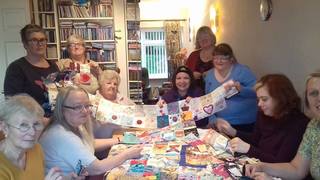
A cross post from Emma Burnell about an excellent initiative started by friend-of-the-blog, Cllr Roxanne Ellis.

How do you turn hundreds of separate tales of murder, loss, grief and abuse into something positive? How do you turn a statistic that is at once both shocking and under-reported into something that tells stories and raises awareness?

For Gedling Labour Councillor Roxanne Ellis, this became more than an academic question when she was made aware of the Femicide Census. Based on the Counting Dead Women project by Karen Ingalla Smith, the Femicide Census lists the women who have died at the hands of men since 2009.

As Roxanne said: “Even though academically I knew that it was around two a week it wasn’t until I saw it all laid out that it truly struck home just how many it was. After that I thought that these women deserved to be more than numbers.”

Many of us when faced with such shocking numbers got angry. Roxanne on the other hand, got creative.

“The idea of the quilt came about because it is a traditionally feminine skill and one that is accessible to everyone, we have had women draw on their patch with pens, paint, stick, appliqué and embroider their patches. It is also one where people can work on their patches wherever they want and then they can be brought together. There was also inspiration taken from the AIDS quilt and the visual impact of that amazing piece of work.”

Women from all over the country have contributed their anger, their mourning, but more importantly their creativity and their celebration of the women who have been lost.

Andrea heard about the project from a friend on Facebook.

“I had a very cruel and abusive father. he did terrible things to my mother, most of which I was made to watch. My earliest memory is trying to pull him off her when he was on top of her, hitting her.”

Andrea’s mother eventually did leave her father, but was left with severe depression. She died some time later in a car accident and Andrea has never quite stopped blaming herself. When her father died four years ago, she felt nothing but relief.

“I wanted to be involved because it is a small way of alerting people to such an enormous problem in our society. My 12 year old daughter and I have done a patch each, which has given me the opportunity to talk to her about my experiences and to talk about how she must never be such a victim and what she can do. This has made me feel more open about the subject.”

Laura wanted to commemorate a teacher — Julie Ann Semper — who had meant a great deal to her who was later murdered.

“I met Julie while she was part of the student support at what used to be castle college. Our relationship was based around college, but we used to drink in the same pub after class ended! I first heard about the quilt when Roxanne told me about it and asked if I’d like to take part. I didn’t even make the connection in my brain about Julie to begin with until I looked at the names to choose from and it stood out to me — I knew that was the patch I wanted and needed to do as I knew her personally.”

Laura says “I hope [the quilt] will help recognise these women not as murder victims, but as the women they were beforehand.

This is echoed by Roxanne.

“What I hope to achieve is to start a conversation about domestic violence where victims become names and not numbers. In the long term I would like to see reporting changed to be more about the woman victims and not the male perpetrators. When researching the women included, often all the quilters could find about the woman was the way she had been killed.”

The quilt is nearly finished. It will be launched in Westminster Hall on International Women’s Day and is being supported by the Women’s Parliamentary Labour Party. When that’s done. The quilt is to go on tour. There are many who would like to see it displayed in their home towns or in honour of local victims who are commemorated in it. But this costs money. So there is now a Go Fund Me set up to see this happen. They are already over halfway to achieving their target.

Eventually, the quilt will be donated to a museum. But the community of women who have come together to create it remains strong. There have also been suggestions that they could start a new quilt for the women killed in 2016–17 for next International Women’s Day. Such an ambition is — of course — bitter sweet. One can only hope such a project would never be required. But with femicide at epidemic levels, sadly that seems a distant hope.

In the meantime, as is fitting, Roxanne should have the last — positive — word.

“We have really built an amazing community. One of our members said that she had never truly understood sisterhood until she took part in the quilt project.”.

Please consider donating to support the continued progress of the quilt and the work of celebrating the women murdered by men. To give a donation please go here.

Sunday, 5 March 2017

Meet the Next Tory Leader

Let's leave behind the argy-bargy and specumalations surrounding Jeremy Corbyn and his leadership, and turn our attention to the Conservatives and who will succeed Theresa May. It's not exciting anyone at the moment because the issue is beyond settled. May convincingly took the farce of the Tory party leadership contest and now rides high in the polls. And yet, as everyone obsesses about Labour's difficulties we have a tendency to forget that May possesses a sliver of a majority, and adding Copeland to her tally does nothing to change that. Brexit is a destruction derby's worth of car crashes waiting to happen, little of which is going to reflect positively on her. The backbenchers might start getting restless, especially if sense is imbibed and a hard Brexit avoided. And there are those pesky events - the economy, NHS, schools, disability cuts - threatening to throw a spanner in the works. Oh, and lest we forget, the Tory electoral fraud story is menacing the outer edges of the problems piling into the PM's in tray.

Okay, assume May is going and the Tory benches are jostling and jockeying. Who will it be? The big beasts are set to pile in. Bottler Boris will be itching for another try. Disgraced serving minister Liam Fox and David Davis are sure to have a punt. Anna Soubry and the unlamented George Osborne are odds on to pitch in, and don't be surprised if the likes of "Handbags" Fallon, the dread Leadsom and Jake Rees-Mogg chuck in too. Yet I don't think any of these will win.

Long-time readers know I have a soft spot for Ruth Davidson. And seriously, who doesn't. From the distance of 200 miles and mediated by telly and Twitter, she comes across as smart, warm, funny, genuine. You could almost forget that as the leader of the Scottish Tories she stands implacably opposed to the interests of our movement. Now, the Tories are doing well but their historic problems haven't gone away. Secular decline in membership and vote share is temporarily offset by the exigencies of the moment, but in the long-term demographic change still favours Labour, hence the boundary review. To solve their problem, the Tories need to intersect with the rising generation: their bank of "mature voters" is paying negative interest, after all.

Someone like Ruth Davidson is what they need, someone not too obviously tainted with Tory baggage like cruel politics and comic batshittery. Someone who appears to take the one-nationism seriously, cares about working class people and their aspirations, comes across well and hails from a relatively normal background. And someone with a bit of drive too.

Unfortunately, the Tories have such a woman who isn't safely penned away at Holyrood. Apart from Johnson, who was a national political figure already, she's the stand out from the party's 2015 intake. I'm making a long range forecast now. She's charismatic, media friendly, has a few maverick tendencies but, from the standpoint of copy, for the right reasons. Ambitious, she put in for the Cambs and Peterboro' mayoralty and didn't get it, but that speaks of someone chafing at the relative powerlessness of the backbenches. That local role had real decision-making teeth to it, which no doubt proved quite tempting. So, if she has an opportunity to go for the top job, she will. And mark my words, she'll probably get it. Dear reader, I give you our movement's future nemesis: Heidi Allen MP.

Saturday, 4 March 2017

Owen Jones and Naive Cynicism

Why has there been a rapid descent in the eyes of many Jeremy Corbyn supporters of Owen Jones? Formerly the favoured son of the British radical left, he finds himself hanging out with Tony Blair and Alastair Campbell in the demonology, and he didn't even have to sex up a dossier to get there. It interests me and disturbs me for a couple of reasons. Interests because his latest missives (here and here) are pretty obvious and should be totally uncontroversial. But, and this is the disturbing bit, for some, they are anything but. What the hell is going on?

Naive cynicism, that's what. This is the "spontaneous" mode of thought entirely appropriate to the age of anti-politics and, you might argue, the logical common sense culmination of our economics. You know what it is, especially if you were out in Stoke, it's jolly old you're-all-the-same-ism. The view that everyone, everyone is self-interested and motivated by ulterior reasons. For example, I write this blog because gizzajob. Owen has criticisms of Corbs because he wants a seat/is paid to by The Graun. I think you get the picture. This belief about hidden agendas isn't just a property of loyal Corbyn supporters. I've seen it assume different forms over the last three or four years in the mutterings of, respectively, UKIP supporters, ScotNats, self-identified Milifandom (remember that?), and our friends over the water for whom Donald Trump is their saviour. It shades into conspiracy theory, but it's something a bit more than that: a bona fide political phenomenon.

From within Corbynism, that is as a trend and movement rather than a body of ideas, there is a correspondence between naive cynicism as a sensibility and the 18 months Jeremy has held the leadership. First, there was the character assassination during the 2015 leadership campaign. Then came more press attacks and sniping in the media from MPs. This was followed by the attempted coup, a summer of flailing ourselves in the full glare of the media, and since then even more bad press and endless speculation about the leadership and eventual succession. For many Jeremy supporters, this is an appalling spectacle and they're absolutely right: no other political leader, perhaps not even Arthur Scargill at the height of the Miners' Strike has faced such levels of hostility. It's one reason why, for instance, I set aside my Corbyn scepticism and voted for him second time round. With this not totally-unjustified siege mentality, more than a few take the view that if you're not defending the leader and the party but raising criticisms of your own, you're not helping. In fact, worse than that, you're part of the amalgam of enemies lining up to put the boot in. In Owen's case, because he's using his Graun slot to raise tricky questions instead of taking on the enemy 100% of the time, he's part of the problem. As is anyone vaguely on the left and not sold on the leadership and its strategy. Even worse, because of Owen's history, presence and prior following, his doubts amount to a red Tory Trojan horse designed to undermine confidence in Corbyn and supplant him. Owen's noted enthusiasm for Clive Lewis is evidence enough that he's not interested in making the project work.

Naive cynicism finds more fuel from the parliamentary party not respecting the will of the members, and it burns with a great deal of resentment. Now, though the briefings and public slaggings off have piped right down, the boycott of front bench positions is still on. And Labour MPs continue to infuriate Jeremy supporters by greeting him with silence every time he bobs up at Prime Minister's Questions, refuse to shout encouragement, barrack the Tories and back him even when, time after time, Theresa May comes off worse. This rubs off on Owen's work because while he criticises the right of the party for not understanding where Corbynism came from in the first place (and, it has to be said, they're still not interested and hope it will simply go away), in their view he doesn't take the PLP to task enough for not fulfilling their obligations. If the party's public representatives did unite behind the leader, if they did all pull in the same direction then our media problems would disappear and people would take a look at Labour's radical policies. The flip side to naive cynicism is naive faith, that everything would be okay if Corbyn and Corbynism was given a chance. Only if that were the case ...

The persistence of naive cynicism among Corbyn's supporters is reinforced by the actions and inactions of others, but its ultimate root lies in the continued immaturity of Corbynism as a movement. Last summer, I wrote about how he was the focal point of a diffuse anti-austerity/left anti-politics sentiment looking for a catalyst to bring it into being, and the adulation and support Jeremy received was symptomatic of a young movement in the process of formation. This, however, was organising from a low base - the tidal wave of support thrust aloft a Labour left that was barely clinging on as Alex Nunns argues - and it was mostly masses of atomised individuals encouraged to join the party by the strength of social media ties. Events have conspired since to disperse the movement. Corbyn supporters have become involved in constituency parties and campaigning activity mostly as individuals or small groups and mixing with old members. This was inevitable and necessary, but without a clear lead from either Momentum (as it became bogged down in internal battles) or strategic guidance from the leader's office about what the left should be doing now, or even attempts from within the left to push political education - something sorely missing from the Labour Party as a whole - the Corbyn movement became stuck. Now fed by an ecology of blogs and spokespeople who coheres it solely as a support group, this does precious little to develop it as a movement that can turn outwards and work around the obstacles presented by a hostile media and recalcitrant political establishment. Because its development is stuck, it's starting to shake to pieces.

It doesn't have to be like this. Naive cynicism is the start of something. It's the most elementary form of rejectionist thinking and is malleable in all kinds of directions. The job of everyone in the labour movement who fancies themselves leftwing is to engage, persuade, develop and push the enthusiasm and energy Corbyn brought into the party, of shaping nascent oppositionism into critically-minded materially-rooted socialist politics. But development requires action from the leadership too, and they will find good advice about what needs to be done - ironically - in the very pieces by Owen that have earned a whirlwind of condemnation.

Friday, 3 March 2017

Thursday, 2 March 2017

Unsolicited Advice for New Labour MPs

No, not New Labour MPs, as in Blairites, but Labour MPs that, um, happen to be new. Or will be new, soon. Like that there Gareth Snell recently returned from Stoke-on-Trent Central. Except not him, because he knows this stuff already. Here's some advice about the small p politics of being an honourable member from someone who has never been a MP and doesn't work in politics, but has opinions.

First, before you get there. If you're applying for a seat, especially if it's a by-election make sure your social media is thoroughly cleaned up before you've announced you're in the running. As soon as your name appears anywhere in connection to the seat, whether as a possible contender or a long listed candidate, there will be someone from a certain sewer-dwelling website going through your feeds looking for stinky stuff. In fact, don't wait until then. Sort it now.

Okay, well done, you've won your election and you're off to the Commons. All of a sudden you're expected to be an advocate, a lobbyist, a leader, a tribune, an example, and an office manager more or less from day one. Oh yes, and you don't have much power either. Did no one tell you that? But you do have a pretty hefty salary. Your first decision is what you're going to do with it. You can trouser the lot, but that's not recommended. Nor is doing the workers-MP-on-a-workers-wage schtick if you don't want ostracising, which isn't good for getting stuff done on behalf of the people you're representing. So, once the PLP has taken its share (ah, you weren't told about that either), and with plenty left over a yearly donation to CLP/branch funds is a must, whether the local party is cash strapped or not. Also, during this Parliament Ruth Smeeth was one of the few MPs to refuse the 10% pay rise and instead used that cash to fund charitable causes in her Stoke North and Kidsgrove constituency. Doing that or something similar is the right thing to do, and has the happy consequence of paying itself back many times over in goodwill.

That's the easy bit. Then comes sorting out your staffing. The first rule here is do not employ your family. Conservative MPs are buggers for doing this. Nearly every Tory MP whose office arrangements I know something about employ otherwise unemployable husbands and wives and sons and daughters. All at the top of IPSA pay scales, funnily enough. Also, they tend not to get too much heat from the media for it. As you're Labour, if you're daft and go down this route there's a much greater chance you'll cop for it. So don't. Second, it is absolutely crucial you have two operations, regardless of whether you represent a London constituency or not. You need parliamentary staff (one usually suffices when you're a backbencher) and staff in a constituency office. And this is more than just a matter of division of labour.

Your parliamentary assistant is useful for briefing notes, speeches, popping down to the Commons library, tours for constituents, babysitting guests and a thousand and one other things. Just don't get them washing your laundry or driving round London doing your shopping. That. Is. Not. What. They're. For. There is another, understated advantage for having permanent parliamentary staff. They will hang around and socialise with other bag carriers. This is good, so make sure you hire someone gregarious. Because they can do a lot of networking for you. If you're interested in making a splash in a particular policy area, a good staffer will have a working knowledge of what their mates are working on and might suggest meetings with such-and-such MP looking into something similar. That's the good, noble reason. Then there's gossip. You might have gathered by now, politics loves gossip and Westminster is full of it. Having a staffer helps keep you abreast of what's going on where indiscretions are rife and nothing stays under wraps for long. As much as you might dislike this sort of thing, you've got to have eyes and ears working for you.

Constituency staff are slightly different but no less important. Unless you're from the the Paul Nuttall school of lazy arses, you're going to be in Parliament most of the time, so your constituency staff will be the primary means by which the constituency and the members interact with you. So choose wisely. You don't want staff watching Jeremy Kyle all day instead of doing work. You don't want anyone taking a haughty attitude to members, and you certainly don't want employees causing embarrassment by inappropriately using your constituency property when you're not around. My recommendations would be two or three staff who don't necessarily share your brand of Labourist politics, which is good for advice/speaking truth to power. So go on, hire a Progress member and a Corbynist. Make sure you take on people with good writing and communication skills - they will be making representations on your behalf to ministers and sending things to constituents in your name. Preferably, hire people who live in or will move into your constituency and so know what it's like living there. And, this cannot be emphasised enough, employ party members. Membership is no guarantee of good judgement, but party members more likely have an eye for bits and bobs of casework that have local and national party political ramifications. Also, as members in the local party they straight away strengthen your base and will likely build close relationships with councillors and key local activists. The gossip function applies here too. Staff, however, aren't robots. Turn over is quite high, partly because there is no career progression. So give them autonomy. Allow them to fill their notebooks with contacts, to go on visits to local employers, public bodies, charities, etc. Give them projects to do and goals to work towards. Don't be an overbearing boss, don't micromanage and ensure you don't employ anyone as office manager with that kind of attitude. If you treat them well, take them seriously, listen to them, you will have their loyalty and support beyond the terms of employment.

On your relationship to your constituency party, take it very seriously. Only fools don't believe the CLP is the boss. Remember, you're only going to Westminster because the Labour badge was against your name. So be hands on, but not too hands on. Make sure you turn up to constituency meetings and give your report. If you're invited to a local party event, make sure you're there much more than not. Go out for drinks with members after meetings. Organise affordable socials and muck in. Even accept the odd dinner invite, and not just with the nice middle class professionals who want to show you their bookshelves. Have time for people, don't give politicians' answers in meetings, and listen. One thing you'll find are lots of irritating members like me: people wanting to tell you how to do your job. Take the time to respond as the one thing you want to avoid is a reputation for having a tin ear. And if you haven't got it, you're going to have to dig deep wells of patience - there's no way round it. At the same time, don't be afraid to push your politics. The sad fact is the best place to go to avoid talking politics is a Labour Party meeting, so change that, politicise things, work to persuade members of the merits of your views. Also, be very clear and provide a political rationale for the two or three priorities/hobby horses you have and update folks on any progress made. The members chose you and are invested in your success, so make them feel part of it.

While we're talking constituencies, you simply must be all over yours like a rash. Good staff can cover for your absence some of the time, but you should lead from the front. This is doubly important in marginal seats, for obvious reasons, but also "stronghold" working class seats like Stoke Central to break the cycle of disenchantment and disengagement. Do the bulk of your surgeries. Make sure you or a staff member attends stuff you're invited to. Make sure you have an extremely good relationship with local unions and do what local members ask. Keep an eye on new businesses opening up and get in touch to offer support. Work to bring people together around common interests and projects. Build a good working relationship with the local authority, whether Labour-run or not, but do not be afraid to take them to task or go to war with them when necessary. And campaign hard by helping out local councillors, running your own doorknocking/leafleting sessions, and supporting local Labour Group priorities. Show you're an attentive, dynamic MP by putting yourself out there.

Last of all, remember you're a member of the PLP. You're in a privileged position, but that doesn't grant you a privileged point of view. You may be clever, be a good organiser, possess a silver tongue, great charisma, or an unaffected manner, but you're no better, smarter, or savvier than the great bulk of Labour activists. Luckier, maybe. Do bear that in mind as your brain starts playing host to the parliamentary ways of doing things. As an opposition MP, your powerlessness will be reinforced every time the Tories push through legislation that attacks our people. As you dwell inside a media bubble, all of a sudden things that barely registered when you were a civilian loom large in yours and others' imaginations. Both of these work together into a commonsense in which Parliament and getting power is the be-all and end-all, and that will work to distort your view of the world. Hence why you need good staff and good relations with your constituency party, these people can anchor you.

The second thing to remember is what politics is about. It's the interests, stupid. The Labour Party is the political expression of the labour movement, and was founded by the organised working class and the progressive middle class to prosecute their interests. Arguably, its failure to do so is the root of the party's present malaise. The story is the same in France, where too many of our people have been abandoned to the fascists, and in Italy. Your job as a Labour Party activist who happens to be a MP is to follow those interests through. The boarding school/pressure cooker environment can engender the feeling of all MPs being in it together, regardless of party. You start feeling that way you need to shut that shit down. Go ahead, pursue friendly, congenial relations with politicians from other parties, but never forget they're means to an end to get your way - the party's way. Because they will be doing exactly the same to you. Remember, it's only Labour that think the party's there for the common good, the Tories aren't naive enough to entertain such a delusion.

Karl Mannheim on the Death of Utopia

Thought that this was quite an arresting passage in Ideology and Utopia. Sounds very now:
... where the decline of ideology represents a crisis only for certain strata, and the objectivity which comes from unmasking ideologies always takes the form of self-calrification for society as a whole, the complete disappearance of the utopian element from human thought and action would mean human nature and human development would take on a totally new character. The disappearance of utopia brings about a static state of affairs in which man himself becomes no more than a thing. We could be faced with the greatest paradox imaginable, namely, that man, who has achieved the highest degree of rational mastery of existence, left without any ideals, becomes a mere creature of impulses. Thus after a long tortuous, but heroic development, just at the highest stage of awareness, when history is ceasing to be blind faith, and is becoming more and more man's own creation, with the relinquishment of utopias, man would lose his will to shape history and therewith his ability to understand it.
- Karl Mannheim 1936, pp 262-3.

Wednesday, 1 March 2017

Five Most Popular Posts in February


Phew, what a month! The five most read posts were:

1. On the Doors in Stoke Central
2. Is the Corbyn Moment Over?
3. At the Stoke Central Hustings
4. On Labour's Victorious Campaign in Stoke
5. Lies, Damned Lies, and Paul Nuttall

Crazy horses! Last month recorded 118,000 page views, making it the second highest on record. Would the blog like a base of 4,200 page views a day from here on in? You bet it would. As the story of the battle of Stoke-on-Trent Central fades from the memory and becomes the preserve of ragged trousered oral historians in the local party, and skinny jeaned politics geeks elsewhere, the normal service of calmly commenting on Britain's chaotic politics - among other things - continues.

Amid February's hurly burly, there are probably a few posts you missed. But the one I think you should read, and I hope to expand on in the future, is this on Labour and insecurity. Until we sort that problem out we can look forward to the Tories walking all over us, regardless of who is sitting in the leader's office.