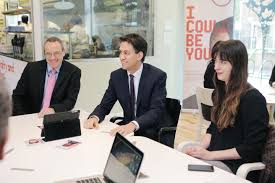
"He mysteriously appeared out of nowhere, a bit like an action hero ... He kept asking if I was ok, if I was hurt," she said. “He was there for a good few minutes. What added to all the confusion was that he was actually attractive and not geeky at all. Even the way he appeared was suave. He was dressed casually but he had style." Who could Ella Phillips, the victim of a cycling accident in Camden, be talking about? Believe it or not, the good samaritan, the "action hero" of the piece was none other than leader of the Labour Party, Ed Miliband. Good stuff.
Unfortunately, that's about the only good press the Dear Leader attracted all week. After last Thursday's county elections, the miserablist tendency have been decrying the party's performance. I happen to be of the school that 'winning' the election in contests that, eight times out of 10, were in Tory-held constituencies AND against the backdrop of the media's hyping up of UKIP isn't bad at all. It hasn't stopped the Blairite ultras from having a whinge - though I will note they proved somewhat reticent to comment on the whopping 0.2% contact rate their Prince Across the Water bequeathed his successor.
But this is about Ed, not David. Personalities are important in politics, so the profile of a party leader has to be just right. And on this score, as the internets, Tories and sore David fans keep telling me, Ed is somewhat lacking. He doesn't appear to be one of us because he's led a rarefied life. From Oxbridge he went into bag-carrying, spaddery, and parliament - in many ways the archetypal career path for the Westminster insider. He talks funny too. His stilted speeches comprise of short statements and assertions, boiled down into a kind of newspeak in which ambiguity - but passion and colour also - have got bleached out. He insists on repeating insincere-sounding political catchphrases, like "it's hurting, but it's not working", "cutting too far, too fast" and dropping 'One Nation' into every other utterance. And speaking as an out-of-sorts oaf myself, he occasionally comes across as physically awkward. As my wife might say, there is something of the Creature Comforts about him.
Taken together it means Ed lacks that undefinable something that constitutes the 'Prime Ministerial'. Or, so I'm told. But this understates and overlooks Ed's strengths. He certainly hasn't been right on everything, but he has taken significant political risks. From not stepping aside for his brother and challenging Murdoch, to sticking up for people on social security he is not as insipid - and is much more ruthless - than his opponents suggest. And take him from behind a lectern and put him in a Q&A, or better, a street, the man from Planet Wonk becomes an engaging and sympathetic human being. Unlike Nigel Farage's "common sense" jolly of photo opps and and pub lounge rallies, and Dave 'n' Nick's complete invisibility, Ed's street election campaign played to his strengths. His events were not stage-managed, he took all questions and tackled the hecklers. Some might snort, but it was John Major's willingness to do the same that helped the Tories to victory in 1992. In an age when politicians appear more remote than ever, being seen out and about properly engaging with people can go some way to eroding accumulated anti-political prejudices.
Personalities are important and assume overweening preeminence when there is little or no policy difference between the main parties. But there are significant differences between Labour and the Conservatives. For example, compared to wafer thin announcements in the Coalition's Queen's Speech, Labour offered this alternative. And counterposed to the Hayekian hellhole the Tories will offer in 2015, the policies so far outlined by Labour are very different:
- Repeal the Health and Social Care Act (otherwise known as the NHS privatisation Act)
- Build 125,000+ homes
- Regulate private rents
- Promote a Living Wage for public sector workers and shame the private sector into following that lead
- Offer a minimum 33-40 per cent cut in tuition fees
- Limit rail fare increases to one per cent
- Reimpose the 50p rate of income tax for the super-rich
- Impose a mansion tax on the rich
- Repeat the bankers’ bonus tax
- Reverse the bedroom tax
- Scrap Workfare and replace it with a ‘compulsory’ Jobs Guarantee
- Offer a VAT cut or a ‘temporary’ VAT holiday
- Implement the High Pay Commission report in its entirety
- Scrap Ofgem and bring in proper energy price regulation
- Break up the banks and set up a National Investment Bank
- Support mining communities and clean coal technology.
It's just a shame this had to be mined by Michael Meacher rather than sung from the rooftops. They're not storming the Winter Palace stuff by any means, but are a definite break with the Tory way of doing things, if not the cadaverous neoliberalism Dave and Gidders cling to.
Therefore, policy matters. What parties and politicians will do, matters. Whether Ed trips over an interview in The World At One doesn't. What Labour need to do between now and 2015 is to continue offering an alternative, but be bolder in doing so. Ed needs to play to his strengths and avoid baseball-cap-and-log-flume "populism". And crucially, he must pay no heed to the siren voices of the Blairite outriders. Their grey managerialism will only dash Labour on the rocks of more cynicism, more alienation, and more anti-politics.
It's a heart-warming story. Three young women, long since given up for dead by the authorities are found alive and well 10 years after their disappearance. It's a horrific story. Three young women are abducted and subjected to a decade of imprisonment, degradation, sexual abuse and forced pregnancy.
Guess which bits the media have focused on.
It was that there Karl Marx's 195th birthday yesterday, and things would be remiss if this blog didn't mark it in some way. So here are my five favourite books on Marx and Marxism. What books have you particularly enjoyed and/or had the biggest impact on you?


Ukip's local election surge: whatever happened to the Great Progressive Realignment?
What is Dan talking about? What on earth is this 'Great Progressive Realignment'?
Send in the clowns. At the time of writing we’ve only got a relatively small number of results in, but the story of the 2013 local elections can already be written. A plague on the houses of everyone, except that of a certain Mr N Farage of Westerham, Sevenoaks.
We are about to experience the tyranny of the moment. Whatever happens, it must be viewed as transformational, simply because it is happening to us, here, today. In the 1970s the National Front was set to shatter the political consensus; in the early 1980s the SDP were going to break the mould of British politics; in the mid-1980s the Greens were going to radicalise British politics; in the early 1990s the Referendum Party was going to lead a popular revolution; at the start of the 2000s that revolutionary banner was going to be picked up by George Galloway and Respect, or, if they dropped it, Nick Griffin and the BNP.
It didn’t happen then, and it won’t happen in 2015. A posse of experts and commentators are at this very moment fanning out to tell us how this time it will all be different. That the tectonic plates below Westminster really are shifting. They’re not, but there’s little to be gained from arguing the point. Ukip must be allowed their moment in the May sun.
While Dan is right to be sceptical of the claims being made for UKIP. In all likelihood they will not win any seats in 2015 though, with a bit of luck, they will sufficiently damage the Tories to let in a slew of Labour MPs. But it's never the done thing to be complacent, especially when UKIP's politics legitimises and fans the rightwing flames of the bigoted gutter press. Born of fear, despair and ignorance, UKIP unchecked compounds these problems with lies and hysteria. Harking back to an imaginary imperial Arcadia, its yearning for community and belonging that never existed serves, in the here and now, to segregate, atomise and alienate. If Thatcherism displaced the unsaid class politics underpinning of the post-war consensus with a war of all against all, UKIP picks up that mantle and deepens it further by setting up Britain (England) vs Europe, (white) Britons vs immigrants, common sense vs political correctness, the masses vs the elite, men vs women, the old vs the young, straight vs gay, the in-work vs the out-of-work. UKIP are the purest manifestation of the right wing of the culture wars in the UK. Their us and them populism in practice works against any kind of collective approach to politics, apart from that manifested solely through the ballot box.
But I digress.
Which isn’t to say last night’s results aren’t significant. As I wrote earlier in the week, councillors are the footsoldiers who will fight the election in two years' time. And the Tories, and in particular the Lib Dems, have suffered some damaging losses.
I suspect it will also bring to a halt, in the short term at least, the developing narrative of a Tory recovery. The pressure will be back on David Cameron (and will probably prove intolerable for Tory party chairman Grant Shapps).
A narrative of Tory recovery? Who, what, where, when?
But there is one lesson to be taken from these results that eclipses all others. The talk of a great progressive realignment, beloved by so many on the Left, is for the birds.
I have no idea what Dan is talking about. I'm not privy to the London dinner party circuit like Dan is, so perhaps I'm missing something. But let's be clear. For the 'left' at large, however you define it, there is no talk of 'progressive realignment'. Compass might like to push its hobby horse of a Labour love-in with the LibDems (yes, even now) but come on, who pays them any mind any more? They're hardly "so many on the left". Who, outside the bubble of Westminster, the commentariat, and blogging have even heard of them? The 'great progressive realignment' is so much hot air - a canard conjured up to stand for something Dan's opponents supposedly subscribe to when, in fact, they don't.
The British electorate is moving decisively to the Right. Yes, we’ll see lots of clever articles written over the coming days about how the traditional distinctions between Left and Right no longer matter. How politics isn’t linear.
Like trying to explain the complexity of vote results by understanding them is sooooo unfashionable.
It’s a smokescreen. Nigel Farage is leader of a hard-Right party. Not necessarily extreme. But a party that pushes the boundary of respectable Right-wing politics to its limits. And as we’ve seen over the past week, at times crosses it.
On all of the issues on which Ukip has taken a significant public stance – immigration, gay marriage, Europe – they have done so from the Right. The vast bulk of their support is from the Right, with recent polls showing that Ukip voters are drawn from former Tory voters by a margin of approximately four to one in comparison to Labour switchers. It is the hard Right, not the Left, that is benefiting from discontent with the Coalition.
Hold on a moment. By Dan's own admission the "vast bulk of UKIP's support" comes from the right, mainly thanks to its hard right positioning on the EU, migration and equal marriage. And yet, somehow, because UKIP have been able to articulate Tory grassroots discontent and cornered the 'none of the above' market, we are supposed to take this as evidence that "the British electorate are moving decisively to the right". No Dan, you haven't proved anything of the sort. Apart from a willingness to use political sleight-of-hand to back up a pre-determined position that no amount of evidence will shift.
This has implications for all three parties. David Cameron will now come under intense pressure not merely to park his modernisation strategy, but stove its headlights in, rip off the wheels, and set the whole thing alight.
Of course he will, but not because the electorate at large have swung to the right. The discontented Tory grassroots now have somewhere to go, and thanks to their consistent promotion by the papers and - crucially - the BBC, UKIP receives disproportionate national coverage and, on the whole, soft soap press treatment. When you inhabit a bubble as all the leaders of the mainstream political parties and the professional commentariat like Dan do, and its primary inputs are filtered through the media, through think tanks, through the upper layers of party, trade union, business and the professional association apparat, you're dealing with a skewed reality. This is not to say the Westminster-media axis has no necessary correspondence with the 'real world', but one has to be careful not to take its narrative framing of the world as the world itself. Rather than evidence of a wider shift to the right, UKIP and its coverage represent a (noisy) consolidation of the discontented right and its atomised hangers on.
Nick Clegg, who has been pursuing what is in effect his own core vote strategy, will be faced with a series of tactical dilemmas, especially on areas such a Europe and the removal of Abu Qatada.
I pity the fool.
And Ed Miliband and Labour will have to face up to the reality that their entire electoral strategy is built on sand.
Since 2010 Labour has moved Left, anticipating it would be inundated by people seeking sanctuary from the evils of austerity. They’re not coming. Those angered by the Coalition are knocking on Nigel Farage’s door, not Ed Miliband’s.
A couple of weeks ago I wrote about how Labour is pursuing a “35 per cent strategy”, trying to lock in a coalition of disaffected Lib Dems, Labour stalwarts, and new voters. Actually, it’s probably more accurate to call it the “cross your fingers and pray strategy”. By shifting Left at a time when the electorate is self-evidently shifting to the Right, Ed Miliband is effectively abandoning any prospect of winning the next election. He’s reduced to sitting there hoping Nigel Farage will win it for him.
No. Labour has moved left, but the way Dan's talking you would think EdM has been calling for the nationalisation of the top 100 monopolies. What Dan does not address, because they're not on his radar, is where a whole tranche of Tory 2010 voters have gone. In case he needs reminding, many people voted Conservative three years ago because Dave had, temporarily, succeeded in presenting the Tories as a fluffy, modernised small-l liberal party. Others so voted because they liked what he said about the deficit and national debt, and still more because New Labour was tired, discredited and had been in office for an age. Most of these people who live in the crucial marginal seats Dan likes to bang on about have little truck with the bigotry of the UKIP kind, and will be much less likely to vote Tory in 2015 should Dave pitch to the right. It is this cohort of middle ground swing voters who delivered scores of Labour victories over their Tory opponents in the County Council elections on Thursday. So yes, those angered and disgusted with the Coalition are supporting Labour in large numbers. But, again, despite the poll leads and consistent evidence from local council elections and the smattering of by-elections that take place every week, it would appear Dan takes UKIP's coverage as proof of generalised discontent over Labour's actual performance.
It’s a pretty desperate gamble. Ignore all the noise; today’s results confirm what the opinions polls have been showing for months. The move Rightward of the political centre means they are easily enough votes there for David Cameron to form a good working majority at the next election. The only question is whether he can unite the disparate members of his tribe behind his rather confused vision of modern Conservatism.
But that's not the situation at all. The election results showed that a) Labour are not immune, but suffer much less than the Tories and the LibDems from the 'UKIP surge'. How many seats did Labour lose to UKIP again? b) Labour made steady progress in the key marginals that need to be won in 2015, winning seats mainly from sitting Tories. c) UKIP did disproportionately well and mainly robbed Tories of council seats in traditional Tory-voting areas. Which ever way you look at the bones the electorate have cast upon the ground, they do not point to a centre ground that is moving to the right.
Labour and the Lib Dems, frankly, aren’t in the game. They are becoming mere spectators to the great Tory family feud.
We are not witnessing a progressive realignment, but a conservative one. It is the Right, not the Left, that now holds the cards. And if David Cameron has the political acumen to play them skillfully, he will yet escape the tyranny of the moment.
Taking election results that demonstrate nothing of the sort as evidence of a shifting centre ground, of completely writing off former Tory voters that gave Labour the bulk of Thursday's council seats, of mistaking UKIP's consolidation for a much wider electoral resonance. It's clear who's really caught up in the tyranny of the moment.
It will no doubt be a cack-handed operation, but that is - apparently - what the BNP are planning to do. This from Nick Griffin's "analysis" of Thursday's election results on the BNP's website.
Join us – or do this!
If, for whatever reason, anyone who thinks of themselves as a nationalist isn’t prepared to join us and lend a shoulder to our wheel, then there is one other useful thing they can do:
That is to join UKIP or to put in effort in the social networks to find and `influence those who have. Over the next few months, UKIP will sign up thousands of new, mainly newly politicised, members. Most of them are not merely patriotic, they are also instinctively, though at present totally incoherently, nationalist and racially aware. They don’t really belong with Farage and his internationalist big business set at all.
It will not take many people within UKIP to set about the quiet, careful promotion of genuine nationalism in order to create an underground ideological tendency. Done systematically, this can bear big, juicy fruit for real nationalism in the future. UKIP is growing too fast to be stable and it contains too many fundamental contradictions to avoid explosive divisions in the future.
Those nationalists who are not willing to be with us in the BNP should take note of this massive medium-term opportunity and get to work to seize it. We’ll be doing our bit too, but the more who move in and spread nationalist groundbait in the expanding UKIP pond the better.
The bedroom tax. An entirely punitive policy allegedly designed to shove “under-occupying” social housing tenants into size-appropriate properties when there is a massive shortage of one bedroom homes. Not that it matters to the Tories, of course. Very few people hammered by this policy are likely to place their cross against the blue party anyway come election time.
But there has been something of a black hole in the rules governing the bedroom tax. It boggles the mind, really. If you are creating legislation designed to punish those who do not use all the bedrooms in their house because “not enough” people live there, surely it would be common sense to include a definition of what constitutes a bedroom - even if to avoid confusion. But no, this has not been the case, potentially leaving the government open to legal challenges and the consequent waste of public funds dragging poorly-formulated legislation through the courts would entail.
Mindful of this, Stoke-on-Trent Central MP Tristram Hunt recently wrote to Lord Freud, the minister responsible for welfare reform asking that he gives the definition some, well, definition. This is what the good lord had to say in reply:
We do not define what we mean by a bedroom or what size it should be within Housing Benefit legislation. How many bedrooms a property contains will have been determined by the landlord and reflected in the level of rent being charged.
There are minimum space standards that can be used to assess statutory overcrowding. The space standard is in section 326 of the Housing Act 1985. It provides that the space standard is contravened when the number of persons sleeping in a dwelling is in excess of the permitted number having regard to the number and floor area of the rooms available as sleeping accommodation (and for this purpose a living room is counted as a bedroom).
We are not proposing to issue separate guidance on the size of rooms or their suitability for use as a bedroom. As rent levels generally reflect the number of bedrooms in the property and may take into account their size, it is in the tenant’s best interest to decide at the point of accepting the tenancy whether the rooms are of a suitable size for their needs.
The DCLG has published statutory guidance which includes advice to the effect that landlords, when allocating property, should make households aware of the implications in relation to Housing Benefit in the event of under-occupation.
What was that? “It’s got nothing to do with us, guv. It’s up to the landlords!”
This is a typical Tory move. Make some regressive changes to a public service, and then wash one's hands of all responsibility for the outcomes.
The bedroom tax comes with a hefty dose of political cynicism. The bedroom tax will hit those local authorities that tend to have concentrations of the low paid, the long-term sick, and the unemployed. Those are usually city or metropolitan councils, almost all of whom are Labour. And, of course, when it comes to elections people who fall into these categories are more likely to support Labour than any other party. So what the Tories have done is cut the help Labour-run authorities can give to its poorest people, make them lord and master over what constitutes a bedroom, and therefore open them up to the financial cost of appeals and court cases, as well as making them pay a political price for hitting their core support.
I suppose you could argue in response that councils (and housing associations) simply redefine their two and three bed properties as something else. This might be possible in a handful of cases where, for example, a "spare" bedroom is used for some vital function, such as storage for essential medical equipment. But a local council reclassifying hundreds of properties would give the finance officer kittens. I understand a wholesale reclassification would devalue housing stock, impact on the value of assets it holds, and badly knock on its capacity to borrow money. There could also be problems with existing loans as, suddenly, the balance sheet would look less healthy to a creditor than it did before the reclassification and may spark rounds of loan renegotiations to the detriment of the local authority. And there is also the small matter of the Department for Communities and Local Government threatening to punitively cut the local government grant in the next round if a council is seen to be avoiding implementing the bedroom tax.
The words 'over' and 'barrel' come to mind.
The five most read posts of the month were:
1. A Vile Product
2. The Demonisation of Paris Brown
3. Thatcher
4. A Quick Note on Ed Miliband and George Galloway
5. Dogging and Dogging Tales
Thatcher passes into the night and still the two hideous Daily Mail scandals from the last four weeks trump her. An unremarkable post pushing a common sense interpretation on the "secret" meeting between EdM and Gorgeous George got a surprising amount of traction while my pondering of, ahem, dogging pulled in the numbers too. I always knew you were a mucky lot. What will feature next month? Your guess is as good as mine. Though I will endeavour to respond to comments more. I've been somewhat tardy in that department of late.
There are quite a few April posts I think are deserving of a wider audience, but I'll inflict two on you. North Korea and the Drums of War argues that Kim Jong-un isn't crackers and is pursuing a strategy that makes perfect sense from the standpoint of the North's interests. The second is The State and Anti-Racism, a chin-strokey piece on capitalism, racism, the state and changing British nationalism.