At this evening's Stoke Socialist Party branch meeting, comrade D delivered a short lead off on socialism in one country. As Keele Socialist Students are hosting a debate between SP and Socialist Party of Great Britain speakers on the Russian Revolution next week, this served as an ideal primer.
D began with the origins of the term. He explained it was coined by Nikolai Bukharin to justify measures Russia took to strengthen itself after the revolutions in the West had failed in the aftermath of the First World War. Its promulgation coincided with his championing of the New Economic Policy. For those not familiar with NEP, this was an attempt to get the economy going after the period of severe dislocation brought on by civil war and war communism. Here, whole swathes of the economy had fallen into bartering and the state was more or less forced to seize what it needed to combat the counter-revolution. NEP tried to get things going again by introducing limited market reforms and allowing production for profit in some agricultural and some industrial sectors. Though Lenin at the time acknowledged this was a step backwards, Bukharin made a virtue out of necessity and equated this necessary development with the building of socialism.
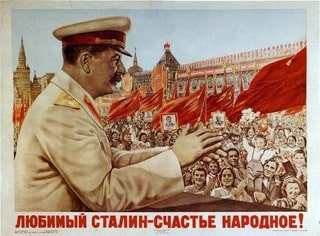
As we know, after Stalin had dealt with his opponents to the left; the right, including Bukharin, were systematically removed from power in the late 1920s and NEP gave way to forced agricultural collectivisation and industrialisation. Market relations were forcibly and brutally liquidated as production was subordinated to the dictates of the bureaucratic plan. Nevertheless, socialism in one country suited Stalins designs and a number of his works were retrospectively doctored to make it appear as if he'd originated the concept. Most famous is the chip-chopping of his 1924 lecture, Foundations of Leninism. Here, passages asserting socialism would only come through the combined efforts of many countries were deleted in favour of the possibility of it being built within the borders of the USSR.
Moving to the discussion, F argued the experience of Stalinism, how it developed, and the baleful effects it had on the international workers' movement are key parts of our history that every socialists should address - not least because there remains a popular identification of socialism with the Stalinist regimes. D added it remained important we understand the ins and outs of the issue.
P, playing devil's advocate, asked to what extent were the features we associate with Stalinism forced on the soviet government by circumstances? If, for instance, the Left Opposition had won the faction fights of the early 20s, wouldn't Trostky have been as authoritarian? Possibly - the same problems the bureaucracy faced would have been there, but on the other hand, if the Left Opposition programme of democratisation and the rejuvenation of the soviets was implemented, these contradictions could not have played themselves out in the same way. The grotesque deformations of the personality cult, the purges, the show trials, and the mass use of slave (gulag) labour would unlikely have taken place under these circumstances.
In his contribution, A turned to bourgeois and "radical" accounts of Stalinism that attribute dictatorship to Bolshevism's political DNA. Such arguments are distortions of history because they ignore the conjuncture at which the Bolsheviks came to power, and suppose an essential continuity between Bolshevism (as a revolutionary Marxist tendency in the Russian working class); and Stalin's Communist Party of the Soviet Union, a party of managers, bureaucrats, and careerists. After the civil war when party membership was opened up, these were the elements that flooded into it and it was they who provided a material base for the rise and consolidation of the Stalinist dictatorship.
Looking at the lessons of Stalinism for socialists in Britain today, it's obvious to even the dogs in the streets that circumstances are very different from Russia in 1917. D noted the absence of a peasantry and the crushing preponderance of a well educated, mobile, and highly communicative working class means the objective situation is far riper for socialist transformation. It is highly unlikely the Stalinist experience could be repeated, given these conditions. However, P added the other key lesson is the centrality of democracy to our politics. Just as socialism in one country is unthinkable, socialism without democracy is not socialism at all. It has to be at the heart of our understanding of what a socialist society could look like, and in our practice as socialist activists in the here and now.
D began with the origins of the term. He explained it was coined by Nikolai Bukharin to justify measures Russia took to strengthen itself after the revolutions in the West had failed in the aftermath of the First World War. Its promulgation coincided with his championing of the New Economic Policy. For those not familiar with NEP, this was an attempt to get the economy going after the period of severe dislocation brought on by civil war and war communism. Here, whole swathes of the economy had fallen into bartering and the state was more or less forced to seize what it needed to combat the counter-revolution. NEP tried to get things going again by introducing limited market reforms and allowing production for profit in some agricultural and some industrial sectors. Though Lenin at the time acknowledged this was a step backwards, Bukharin made a virtue out of necessity and equated this necessary development with the building of socialism.
As we know, after Stalin had dealt with his opponents to the left; the right, including Bukharin, were systematically removed from power in the late 1920s and NEP gave way to forced agricultural collectivisation and industrialisation. Market relations were forcibly and brutally liquidated as production was subordinated to the dictates of the bureaucratic plan. Nevertheless, socialism in one country suited Stalins designs and a number of his works were retrospectively doctored to make it appear as if he'd originated the concept. Most famous is the chip-chopping of his 1924 lecture, Foundations of Leninism. Here, passages asserting socialism would only come through the combined efforts of many countries were deleted in favour of the possibility of it being built within the borders of the USSR.
Moving to the discussion, F argued the experience of Stalinism, how it developed, and the baleful effects it had on the international workers' movement are key parts of our history that every socialists should address - not least because there remains a popular identification of socialism with the Stalinist regimes. D added it remained important we understand the ins and outs of the issue.
P, playing devil's advocate, asked to what extent were the features we associate with Stalinism forced on the soviet government by circumstances? If, for instance, the Left Opposition had won the faction fights of the early 20s, wouldn't Trostky have been as authoritarian? Possibly - the same problems the bureaucracy faced would have been there, but on the other hand, if the Left Opposition programme of democratisation and the rejuvenation of the soviets was implemented, these contradictions could not have played themselves out in the same way. The grotesque deformations of the personality cult, the purges, the show trials, and the mass use of slave (gulag) labour would unlikely have taken place under these circumstances.
In his contribution, A turned to bourgeois and "radical" accounts of Stalinism that attribute dictatorship to Bolshevism's political DNA. Such arguments are distortions of history because they ignore the conjuncture at which the Bolsheviks came to power, and suppose an essential continuity between Bolshevism (as a revolutionary Marxist tendency in the Russian working class); and Stalin's Communist Party of the Soviet Union, a party of managers, bureaucrats, and careerists. After the civil war when party membership was opened up, these were the elements that flooded into it and it was they who provided a material base for the rise and consolidation of the Stalinist dictatorship.
Looking at the lessons of Stalinism for socialists in Britain today, it's obvious to even the dogs in the streets that circumstances are very different from Russia in 1917. D noted the absence of a peasantry and the crushing preponderance of a well educated, mobile, and highly communicative working class means the objective situation is far riper for socialist transformation. It is highly unlikely the Stalinist experience could be repeated, given these conditions. However, P added the other key lesson is the centrality of democracy to our politics. Just as socialism in one country is unthinkable, socialism without democracy is not socialism at all. It has to be at the heart of our understanding of what a socialist society could look like, and in our practice as socialist activists in the here and now.