Wednesday, 18 March 2026

Labourism and Social Conservatism

"Social conservatism has always been part of Labour!", so wrote Connor Naismith last week. Seeing that Labour suffered humiliation in Manchester, he argues that there are "voices" who are laying the blame for the defeat on Blue Labour. "Traditional values", they say, need junking if Labour is going to dust itself off and return to winning ways. As a self-identifying supporter of this trend, Naismith has gone into print to defend it.

There are two parts to his argument. Firstly, social conservatism is embedded in Labourism. The party's forward march and its reformist zeal was driven by the need to protect what he calls "the moral economy". That is taking home a wage enough for a family to live on, the sustenance of "communal discipline" (i.e. solidarity), and localism. Social conservatism is social glue, and every radical programme needs that if it's going to succeed. Speaking of the 1945 Labour government, he says "They built the NHS and the welfare state not to dismantle the British way of life, but to fortify it. They were radical in their means because they were conservative in their ends: the health, dignity, and stability of British families."

Therefore, purging social conservatism is like amputating a limb. Labour and Labourism are radical because they are conservative. Social conservatism respects people where they are, imbues places with meaning, and gives relationships substance. It is a rooted politics based in the every day, and one aimed at preserving what is good while making things better. Labour would be foolish to abandon anyone who aspires to such.

The second part of his argument is why Labour in such a state. Naismith says that Labour has abandoned its vote. The breaking of the so-called red wall " ... was because gradually, over decades, the party’s centre of gravity shifted toward a metropolitan liberalism that felt increasingly judgemental of parts of the tradition that founded it." What does this actually mean? In British politics discourse the term "metropolitan liberalism" has distinct connotations. It's right wing shorthand for "things we don't like", such as equal rights and affording racial and sexual minorities recognition and respect. I don't know how long Naismith's been in Labour for, but in my nine years of knocking on doors in Stoke-on-Trent, from the dog days of Gordon Brown to Jeremy Corbyn's Waterloo, no one told me they weren't voting Labour because it supported gay rights. Or offered help to the disabled. What I got instead was a lot of "you're all the same", you "don't listen", some anti-immigration bile, and even an occasional "you've abandoned the working class". For much of the previous 30 years, that last comment was absolutely right. Who oversaw a greater decline of manufacturing than Thatcher? Tony Blair. Who did nothing to enhance collective rights in the workplace? Tony Blair. Who continued the undermining of sate institutions by subjecting them to the market? You get the idea. This was not thanks to metropolitan arrogance, though there was plenty of that around, rather it was because New Labour was open about its contempt for the labour movement, its aspirations, and presented itself as a reliable custodian of British capitalism and manager of its class relations - for capital's benefit. And when this anti-working class agenda was challenged by Corbyn's leadership, we know what happened.

Naismith's class-blind history aside, he really gives social conservatism too much credit. When we look at the toerags and fools who present themselves as Blue Labour, it's telling that this club are a) middle class, b) white men, and c) have absolutely no standing or roots in the wider labour movement. Read Maurice Glasman - I have - and it's obvious that the "economic radicalism" that is supposedly the flip side of this very, very moral politics is merely a rhetorical nod. A never-articulated alibi for a miserable dismalism of scapegoating, and stop-the-world fogeyness. If only Blue Labour was a careful plea to understand the interests of our class, its (long-declining) culture of collectivism, and putting that at the heart of policy making and the vision for a better future. Instead, what we have had under Keir Starmer is a racist effort to out-Reform Reform, the rolling back of trans rights, and until recently a noted reticence to take on bigotry. Very middle class Labour MPs and well-heeled friendly journalists defended all this because this was their idea of what social conservatism was, and they were merely giving voice to values shared by the salt-of-the-earth. Meanwhile, polling of working age Britons has found this ventriloquism is a poor impression of what they say and think. The Labour working class base was imploding because other parties were actually speaking to their interests and their actual values. It was them talking the language of respect and reciprocity, while Labour imitated the spite, the division, and the small mindedness of their opponents on the extreme right.

Thirdly, Naismith's definition of social conservatism is empty to the point of meaninglessness. If Naismith is impressed by the class cultures of old, what policies are he and his party following to promote a new collectivism appropriate to the actually existing working class? The answer to that, of course, is very little. Instead, along with racist and transphobic divide-and-rule politics, we've seen the same commitment to labour market flexibility, of letting capital run riot in the NHS, and the handing of a veto to business over crucial aspects of their much trumpeted, and much watered-down Employment Rights Act. The danger, the existential threat to Labour lies not in the call for the party to be less racist and binning off Blue Labour, but in its refusal to act as the political fulcrum of the class that made it. And this is why that class is now turning elsewhere.

Friday, 13 March 2026

Thursday, 12 March 2026

On Labour-Green Defections

One of the culprits for rendering Your Party a nullity was its importation of Labourist culture. The bureaucratic shenanigans, the behind-the-scenes bullshit, the flouting of democratic votes and "abbreviations" of its constitution have turned a promising project into a Corbyn Glee club, minus decent tunes and a promise of joy. So it's of interest that, according to The Graun, would-be defectors from Labour to the Greens want to bring something distinctly Labourist along with them: a God-given right to "their" seat.

We read that among the chats/negotiations Zack Polanski and other leading Greens have had with disaffected Labour MPs, the issue of guaranteed seats has come up. I.e. If they make the jump, that want to be sure they will be the Green candidate in the subsequent election. This is custom and practice among the other parties. Remember when Christian Wakeford waltzed over from the Tories to Labour? His automatic reselection for Bury South was part of the deal. Of course, when politics is just another career you can imagine politicians treating defection as a shuffle sideways from one position to another, with the same perks and pay intact. This attitude is baked into Labourism, seeing as the party's constitution enshrines it and successive generations of parliamentarians treat Labour as an apparatus to serve them. Hence their utter horror when the party started showing signs of a democratic life of its own during Jeremy Corbyn's tenure.

That, presumably, left wingers thinking about crossing the floor have the same attitude is disappointing, but not surprising. What's bred in the bone will out in the flesh. The problem, unlike Labour, is it's not in the gift of the party leadership to guarantee seats. Mandatory reselection sensibly rules in the Greens, as does a more decentralised structure of party affairs. An approach that has deep roots in Green parties across Europe as a collective prophylactic against bureaucracy and institutional capture by unelected party officials. The relevant part of the party's constitution lays out the procedures for candidate selection, a process that sitting MPs would, at present, be expected to go through prior to the next election. In terms of the rules, there are no privileges that attach to being a sitting member. Formally speaking, everyone is equal in candidate selection.

There are provisions for leadership intervention where no candidate has been selected, which would be appropriate to a snap election like 2017, or where a selected candidate drops out for whatever reason and a replacement needs slotting in hurriedly, but that's it. The party membership are unlikely to vote in a Labour approach simply because they like being in a party in which the membership are actually sovereign. Nor are the leadership likely to expend political capital bending over to accommodate the uncertain pledges of defectors. Right now, heading into the local elections, as the rising electoral power the Greens have the psychological whip hand. New MPs coming from Labour are a nice-to-have, but are inessential. If Labour politicians are serious about coming on over, they have to leave the belief in the supremacy of MPs, the chief tenet of Labourism, at the door.

Image Credit

Wednesday, 11 March 2026

Science Fiction Book Haul #7

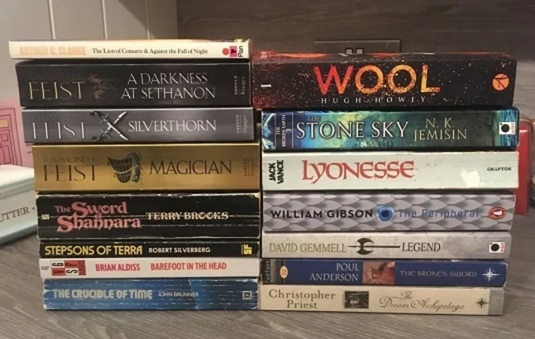
Let's haul some books!. What we have here are a collection of gatherings from my out and abouts, and arranged by format. In the first pile are some ropey-looking As, and the other features better weathered Bs.

Beginning on the left, sitting at the bottom is John Brunner's The Crucible of Time. This involves a bunch of aquatic aliens trying to flee their world as it passes through a (potentially) civilisation-ending debris field. This is SF at its most ambitious as Brunner tries putting together a convincing history of a species. Having recently finished George Zebrowski's excellent - and under appreciated - Macrolife, I'm not averse to epic scale thought experiments. I still haven't read any Brunner, despite acquiring his celebrated Stand on Zanzibar in haul #6, but aware of his reputation. If there's anyone who can pull it off, it's sure to be him.

Next is Brian Aldiss's Barefoot in the Head. Known (to me at least) as an early chill out track, Barefoot is set after a global war in which the primary weapons were payloads of psychedelic drugs. Far out. The survivors are on a permanent trip, seemingly unable to tell the difference between the real and the hallucinatory. The story follows a sober protagonist in a drive across Europe as he slowly succumbs to pharmacological intrusion and psychosis. Published at the close of the 1960s, it's one that could be described as being of its time. But the fact it found its way into the SF masterworks range means there must be something to commend it.

Robert Silverberg's Stepsons of Terra is an isolated colony story. Corwin hasn't had anything to do with mother Earth for 500 years, but desperately want to now as a rising military power has sent an armada in their direction. It's almost as if Silverberg had Dubai ex-pats in mind when he wrote this nearly 70 years ago. An ambassador is promptly appointed and dispatched to Earth to beg for help but, horror of horrors, the home world has slipped into indolence and decadence. As a relatively early novel, I'm not expecting much - but did find his Invaders from Earth from the same period jolly enough.

And then we have a famous/infamous book, depending on where you're sitting. Terry Brooks's The Sword of Shannara, the novel that sparked a trilogy and the huge boom in fantasy publishing that continues to this day. Often decried as a direct rip off of The Lord of the Rings, I've come round to occasionally collecting interesting spells-and-swordplay silliness. Given its importance, I couldn't pass it up after spotting it for a couple of quid.

Continuing the theme, going for a song in a local second hand bookshop was Raymond E Feist's Rift War trilogy, which is the first in a seemingly endless sequence of 30 novels. A portal is opened between a Middle Earth-type world and all sorts of perils come spilling out. Inspired by playing Dungeons and Dragons with his mates, apparently - just like Shannara - there are some unacknowledged and "accidental" homages. In this case to the setting of another early role playing game that subsequently influenced D&D. Nevertheless, The Magician is well thought of and now I have it, I'm duty bound to read it.

Sitting atop the pile is an Arthur C Clarke double bill, The Lion of Comarre and Against the Fall of Night. These two short works share a similar theme: that utopias are boring. Lion sounds like a centrist fantasy. The world is governed by wise politicians and technology can pinpoint and take care of citizens' needs. With everything taken care of, the best and the brightest choose to enter politics. Richard Peyton rebels because he wants to become an engineer, and he gets mixed up with some robots' rights stuff along the way. Sounds delightfully naive. Against is one of Clarke's more famous works, and follows Alvin, the last child to be born in 7,000 years. This is immortals-at-the-end-of-time stuff, and everyone is bored rigid. No one can leave the last city of humanity, but Alvin wants to. Cue the story. I don't mind Clarke and, to reiterate, found what I've read so far fairly decent - including more recently A Fall of Moondust. Not expecting literary fireworks, but then that's not what Clarke was ever about.

On to the B pile, at the base is our chum Christopher Priest and his The Dream Archipelago. A collection of linked short stories, here Priest subtly unsettles by offering a series of worlds that are immediately recognisable and familiar, but are off in some way. Something that is done in different ways in each of his books I've so far read - Fugue for a Darkening Island, Inverted World, The Prestige, and The Adjacent. Priest is a bucket list author and one whose oeuvre I plan on reading in full.

We're back in fantasy now with Poul Anderson's The Broken Sword. His sword and sorcery is often lauded in ways that his science fiction isn't, this is historical fantasy set in the time of the Vikings. There's Norse mythology, elves, fights with trolls, and has plenty of limb chopping and blood fountains. Not something you'd expect from the middle of the 1950s.

Then we have David Gemmell's Legend. By the mid-80s the fantasy boom was underway, and Legend offers a bloody vista of medieval warfare. The undermanned fortress is threatened by a half-million strong horde from the north. Hmmm, where has a very similar plot detail turned up in another popular fantasy series? Druss the Legend is the hero of the Drenai Empire, but as the enemy approaches he's retired and contemplates his death. Can he be called back into the fight? There is, as you might expect, plenty of action and siege scenes. Should be fun.

The Peripheral is the first in William Gibson's latest trilogy. Two viewpoints, one in near future rural US and the other in London 70 years after, and is a return to the noirish sensibilities of The Sprawl books. Flynne is a working class woman working on a 3D printer, and Wilf lives in her future where inequality has run so amok that there aren't many people left apart from the 1%. But is it really her future? Is it real at all? I enjoyed Neuromancer after last year's re-read, which I followed with Count Zero. Gibson is also another bucket list author, so will get round to this eventually!

Fantasy again. I read all four books in Jack Vance's Dying Earth science fantasy sequence a couple of years back, and especially enjoyed the middle two Cugel books. But the thing you take from them is the soupy, languid texture of an Earth sluggishly dragging itself through the end of its days. In Lyonesse, Vance's effort at a King Arthur-linked fantasy series, I'll be interested if this sensibility translates. It's high fantasy stuff with princesses and princes, star crossed lovers, and a load of intrigue and magic. I understand Merlin features, because of course he does. Lyonesse appears well thought of, so if I like this I'll pick up the other two.

Speaking of the dying Earth, NK Jemisin's Broken Earth trilogy tap dances on Vance's toes. The Stone Sky is the third book in the sequence, and I can't say much because I don't own the second and haven't read the first. All I know is it's the far future, technology and magic are indistinguishable, and the Earth is shaking itself to bits through a plague of devastating earthquakes. What gives? Each book in Jemisin's sequence is highly rated and collected an embarrassment of awards, so this series won't stay at the bottom of the tbr pile forever.

And lastly, there's Hugh Howey's Wool. Now a TV series, the remnants of humanity are ekeing out a bleak existence living inside a missile silo. This protects them from the dangerous radiation outside. Life isn't great, and there's little sense of what it was like before the apocalypse came. Anyone who expresses curiosity or a desire to go outside are duly obliged. They're expected to clean the external sensors, even though it means certain death. It's very much a YA piece, and I read the graphic novel adaptation ages ago and don't remember being that impressed. But this was practically being given away and so it's here.

Since getting these, I've also grabbed several more piles of books. We'll look at them when the mood takes me.

Have you picked up anything interesting lately?

Monday, 9 March 2026

Slipping the Leash

"I think the war is very complete, pretty much. They have no navy, no communications, they’ve got no Air Force." So said Donald Trump, during an interview with CBS. The reason for the war has never been set out, because neither Trump, his office, nor the Israeli government have a justification. Judging by their commentary, they don't think one is even needed. This is aggression for aggression's sake, an effort to bedazzle and distract from domestic issues. But hard realities are biting. Far from being a bloodless affair, Benjamin Netanyahu condemned Tel Aviv to repeated missile strikes as stores of interceptor supplies remain depleted from last year's exchange with Iran. Meanwhile, despite suffering heavy damage and political decapitation the Iranian regime and military remain robust and have shown a capacity to fight back. Something the US and Israel are not accustomed to. And there is the small matter of Iran's closure of the Strait of Hormuz and the heart attack this has sent through oil and energy markets. The knock on consequences won't do Trump any political favours, and we'll see how much of his base are willing to stump up for this pay-per-view none of them asked for.

Unusually for a US war of aggression, the UK have proven extremely reluctant to get involved. Keir Starmer tried his best to be accommodating without actually committing British forces. After the initial raids over Tehran he was quick to call on Iran to show restraint, and was equally quick to condemn when their missiles and drones found their targets in reply. When British bases and Gulf "partners"/clients were hit, he announced that the US Air Force were welcome to use British facilities for "defensive strikes". Which is so much evasive lawyer babble to avoid admitting his government's complicity in something that, in theory, should see its instigators in the dock at The Hague. Not that this has impressed Trump, who branded Starmer "no Churchill", and downplayed belated UK efforts to move aircraft carriers in sortie distance from Iran. Trump's cheerleaders in this country couldn't help themselves either. The Tory/Reform press have been attacking Starmer ever since the bombs started falling for not joining in, with preposterous stories that the nature of Labour's voting coalition has stayed his hand. Oh yes, the same party so concerned with Muslim voters that they gave Israel a free hand in massacring Palestinians in Gaza. Kemi Badenoch has dived in, saying Starmer can find plenty of money for social security instead of bullets and bombs. Laughable. Nigel Farage said the UK should be dropping ordinance alongside the US. Both have received backing from Tony Blair. He, unsurprisingly, thinks Britain should follow whenever the White House says heel. Once a poodle, always a poodle.

Starmer's effort to keep Britain to a limited role has little to do with the niceties of international law, and even less to do with electoral embarrassment. On paper, the UK's interests in the Middle East and the Gulf are practically identical to the Americans. They want friendly, preferably autocratic regimes, and Israel's role in this set up is the quick-to-anger gendarme. Iran is the destabilising element who, through its own regional strength and networks of irregular allies and semi-state actors were checks on Israel's aggressive posture and, by extension, the challenger to Western hegemony. This suffered severe setbacks with the obliteration of Gaza, incursions into Lebanon, the bombing of the Houthis in Yemen, and missile exchanges between Israel and Iran over the last 18 months. From Britain and, by extension, Western Europe's perspective Iran had largely been put back in its box. There was now no real threat to Israel. Everything was fine.

Until Netanyahu and Trump started their war of aggression. Britain is not concerned about civilian deaths, be they Iranian, from the Gulf states, or fiercely patriotic tax exiles. It is worried about the consequences of destabilisation. As far as the government and the foreign office are concerned, the war is utterly reckless. The disruption to energy supplies, air travel, shipping, and the sloshing of Gulf money into and through the City are unwelcome costs with a range of politically undesirable consequences. Being at odds with the US is a rarity thanks to establishment slavishness - as typified by the repugnant axis of Badenoch, Farage, and Blair - but remaining separate and disengaged reduces political costs and keeps material costs to a minimum. The price shock and mess of Trump's war is not worth it when the overall outcome will largely be no different to when the bombing started, despite White House hyperbole. The special relationship has proven to be anything but since the razzmatazz of the second state visit, and it appears Starmer, David Lammy, and friends have - rightly - calculated that nothing would be gained from joining this criminal enterprise. All of which helps explain why, for once, we're not being dragged into an unwanted war by the government at America's behest.

Image Credit

Friday, 6 March 2026

Tuesday, 3 March 2026

On Anti-Green Hysteria

Maybe I have a weird sense of humour, but I found Tuesday morning's YouGov poll putting the Greens in second and Labour a distant joint third hilarious. Reform on 23%, Greens 21%, and Labour and the Tories both on 16%. As the world can see, Labour's attempts to bounce back after the the Gorton and Denton drubbing have not proven successful. Who could have guessed that the Prime Minister's decision to equate Reform and the Greens would not go down well with the voters he's losing? Meanwhile, things aren't looking fantastic for Reform either. A weekend spent telegraphing what sore losers they are, Moreincommon finds Reform topping its negative poll tracker on 38%, with Labour on 34%. Its looking like the crisis in establishment politics has taken a turn for the worse.

The reasons why Labour are sinking are well rehearsed, and doesn't bear repeating. But the steady evaporation of the party under Keir Starmer is a problem. Labourism from its earliest manifestations was always a means of reconciling the organised working class with the social order, of aligning the industrial incrementalism of trade union struggle with the coalition-building and proceduralism of constitutional politics. It was and, in its best moments, remains less a moral crusade and more a means of integrating the working class into the politics and (sensible) management of British capitalism. For it to do this, Labour needs to keep its base among the popular layers. However, it's been evident since Starmer became party leader that he either does not understand this or doesn't care. Because his approach to politics is both managerialist and obsequiously deferential to business, above all the City. Yet hollowing out the party before it even took office is to undermine Labour and Labourism's utility to British capital. Apart from its hyper class conscious and, therefore, paranoid elements, capital likes Labour because of its historic role in dampening down aspirations and movements from below. They appreciate Rachel Reeves's orthodox approach to state finances, but that's a nice to have. Labour is supposed to manage and police the class relations of British capitalism for capital's benefit from within the organised workers' movement. Something it cannot do if the mass support has vanished and has gone, in the main, to a radical upstart.

This is where the hysteria seen across the Tory press since Thursday's result comes in. It has been occasionally noted that the collapse of the Tories hasn't occasioned much soul searching or panic on the right. The reason being that Reform are available to articulate the interests that have hitherto animated the Conservatives, and that despite occasional argy-bargy between Nigel Farage and Kemi Badenoch, it's clear that should the situation demand some kind of electoral arrangement or governing coalition deal could be struck. With Reform leading the polls, the right are intensely relaxed about the vestigal status of the Tories. But, having driven all before it, if they weren't expecting Reform to win in Manchester they too believed the polls about how close the contest was. Instead they were handily seen off. This shouldn't be too much of a concern considering the character of the constituency, but have inhaled their own fumes. They - like the Labour right - caricature the working class as racists moved by the same oddball concerns as they. Having had their reality impinged upon, and seeing green left populism crowding out their tired old shtick, all of a sudden they're worried. Farage's cache is anti-political establishment, of being the "change" candidate. That the Greens have successfully contested these claims on one occasion, the right are now worried that they were getting high on their supply, and that we could be back in 2017 again. A fear reinforced by Reform's stalling in most national polls.

Here then is the problem. Labour are no longer suitable as a vehicle for mass politics, and therefore cannot be a reliable pacifier. Meanwhile, the great white hope of the right is not as popular as they thought it was. Centrism is, once again, a dead letter. And the right might not be strong enough to win an election, be it a Reform government or a coalition with the Tories. At the same time, as far as both parties are concerned the insurgent Green Party has come from nowhere and threatens to drag politics as a whole into confrontation with property, work, income, living standards, and why the rich have prospered at everyone else's expense. I.e. The class concerns politics normally works hard to obfuscate, smother, and deny. It follows that the press will try everything to shove hope back in its box - character assassinations, gossip mongering, smears, scare mongering, whipping up new scapegoat campaigns. But ultimately, these efforts are doomed. Since the final defeat of Corbynism in 2019, the Tories, Reform, and especially Labour have done everything possible to keep the left out of politics. And yet here we are - the Greens are becoming the new vehicle for working class interests and is mounting a renewed challenge to the establishment's class compact. No wonder so many of them are panicked.

Sunday, 1 March 2026

Five Most Popular Posts in February

A loud month in politics, but a comparatively quiet one posting-wise around these parts. As is customary, here are the most popular posts this February.

1. A Farewell to Morgan McSweeney
2. Why Labour Can't Argue with the Left
3. What is the Point of Keir Starmer?
4. The Unmaking of Mandelson
5. Labour after Gorton and Denton

February 2026 is a month to savour. All the worst things happened to the worst people in Labour Party politics. And joyful moments weren't confined to seeing others taken down a peg or two. Leading, unsurprisingly, was the overdue fall of Morgan McSweeney. The man partly responsible for the topic of the number two post - Labour's inability to square off against anything to its left. With the mastermind behind Starmerism out the door, the question then arises concerning the point Starmer now has - the topic of the third placed post. In at four was the public disgrace of Peter Mandelson, and fifth is the political culmination of all their works: the loss of one of Labour's safest seats to the Greens.

What for the second chance saloon? As I was a member for all of three months, I'll give my temporary political accommodation a shout out. Your Party's leadership elections finally coughed up a result after some bilious mudslinging, so here's my take on what comes next.

And there we are for the shortest month. As Trump and Netanyahu have unleashed hell against Iran, one can't expect too many political highpoints in March. And, undoubtedly, the government will disgrace itself again bending over backwards to support the latest criminal venture. But as the reverberations of Gorton and Denton work their way through domestic politics, perhaps there will be some nice surprises.

Image Credit