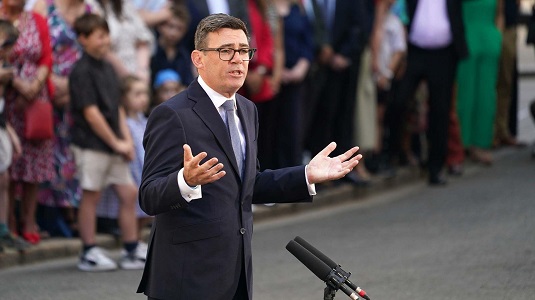
The cabinet appointments were more a mixed affair. Seeing sackings handed out to Rachel Reeves, David Lammy, Liz Kendall, Darren Jones and "resignations" from others, like Steve Reed, were encouraging signs. Unfortunately, that's where the fun ended. Burnham defied the Fleet Street sages who were forecasting Shabana Mahmood in Number 11, and - rabbit number two - out popped John Healey instead. There are several ways the appointment can be interpreted. Unlike Keir Starmer's last reshuffle, that saw all the powerful offices of state filled by empty suits from Blairite central casting, Burnham's cabinet is poised to be more ecumenical in its political colouration. Healey is well-respected across the PLP, so for the operation it's a good "non-factional" pick. Lots of Labour love the military, and his standing wasn't harmed when he resigned as defence secretary over budgetary allocations. The question is what does this mean for the politics? On the one hand, the "surprise" might be suggestive of Burnham wanting a chancellor firmly subordinate to Downing Street. Which is a definite if one is serious about restructuring British capitalism. But on the other, it can suggest continuity. Healey is no stranger to the Treasury and did five years there under Tony Blair. Treasury brain is a thing in British politics, and one that reproduces its institutional pre-eminence in state institutions. Anyone thinking like this is a safe pair of hands as far as the common sense of British commercial and financial capital is concerned.
More continuity is found in keeping Pat McFadden at the DWP and, most disappointingly, Mahmood gets to stay on at the Home Office. Not what you would call a clean break. Making Ed Miliband foreign secretary gives him a big job that's unlikely to get the unhinged right wing press going. Indeed, this move might convince them it was their pressure that kept him out of the Treasury and ejected from from his energy brief. But it opens that up for someone keen to make a splash. At the time of writing, Wes Streeting hasn't been given a job yet. Yvette Cooper has been shuffled over to health, and room has been cleared for a somewhat triumphant return of Louise Haigh, who was punished under the ancien regime for being too independent and settling the Tory-stoked rail dispute relatively promptly. Taking the reins of the Cabinet Office means she will play a central role in Burnham's oft-floated devolution, including the relocation of some of the operation to the promised Number 10 North. Angela Rayner is back in housing, Jonathan Reynolds is at business, and Lucy Powell - this last year Burnham's representative at the top of the party - is in education. Hard lines again to Bridget Phillipson.
Hoping for the best but prepared for the worst is the mindset of many current and former Labour Party people this evening as the appointments news dribbles in. As Burnham said after winning Makerfield, this is his party's one chance to make everything right. Retaining some key Starmer-era figures in position, and a new chancellor famous for wanting more cash for the military points to the status quo that did the last government in. But, commenting earlier, former Blair aide John McTernan rightly argued that what matters are the first actions the new government takes. Starmer had a disastrous start, all of it self-inflicted. On Tuesday Burnham will set out his immediate decisions, and those will point to what kind of government we're getting. They will affirm whether or not the pre-emptive pessimism a lot of people are feeling is warranted.
Image Credit

4 comments:
You are being very charitable towards this cynical remix of the same old war-mongering, genocide-denying, cut public services, goons that Andy is filling his cabinet with, Phil. The key appointment is actually the warmongering John Healey as Chancellor. Lots more money will go to preparing the UK , with the rest of NATO , for a suicidal war with Russia by 2030.
Warning: this is about property as usual :-).
«this is his party's one chance to make everything right. [...] McTernan rightly argued that what matters are the first actions the new government takes.»
That is the usual position where "we are all thatcherites now" as to the things that matter so the only things that matters are personalities and PR of which "first impressions" is a big deal.
But the issues with the UK are not personalities and PR but deep economic ones that mean that thatcherism may eventually go away ("populism" is a symptom). The biggest issue that the UK has (and many other "golden billion" countries) is this:
https://old.reddit.com/r/sysadminjobs/comments/1gltmn3/systems_administrator_salary/
"I work as a sysadmin in a small financial organization in one of the economically deprived countries in Africa. Work is good and not too demanding but the only problem is the pay. I am a fairy experienced professional, I have about 2 years experience in systems administration and bachelor's degree in Computer Science. I get around $172 a month after subtracting employee taxes. Life here is not very expensive, living costs like rent, food and transport cost around $114 a month. It leaves me with just over $50 to spare. This is what most people are getting when they start off in any IT career by the way( sysadmin, developers etc...)."
Once upon a time the UK had as main resource sheep (the "Woolsack"), then piracy (the "Golden Hind"), then coal (the "industrial revolution"), and between 1982 and 2007 scottish oil. Now the only resource left is (moderately good quality) workers and they want to be paid 10 times the global market wage. Something has got to give.
In the quote above the big deal seems to be “I get around $172 a month” (probably around $200 before tax) but is “living costs like rent, food and transport cost around $114 a month”: if UK workers could live on $114 a month they could be quite wage competitive.
But they cannot live on $114 a month for mainly one reason: property owning voters and business owning "sponsors" control politics and have had tremendous success in pushing up the rents and incomes they extract from workers and at the same time "moderating" labour costs.
To be sustainable typical wages for graduate IT specialists in the UK should be at most £500-700 a month instead of £2,000-2,500 a month and all living costs including rents should be scaled down and more than proportionally. Otherwise sooner or later a wage level of 10 times the global market wage will be unsustainable and there will be an argentinian style crash and property prices and business profits will also crash as they are all currently built on the assumption of the workers they are extracted from being paid 10 times the global market wage.
There is a giant long term incompatibility between the level of prices and profits that property and business owners have entitled themselves to extract from the lower classes and the sustainable levels that the lower classes can pay given global market wages.
No government can square that incompatibility in current political conditions. Only a deep crash can create a reset that allows that.
The conservative and centrist plan is rather transparently to let the crash happen *outside London* (that is the 1980s will happen in the south East and Home Counties too not just Merseyside and Tyneside etc.) and to continue to run London as a northern Dubai with a small crust of wealthy property owners and finance executives and a vast number of mostly immigrant servants (already 50-60% of employees and 40-50% of residents).
The question is whether Andy Burnham will be able to "foam the runway" for that outcome by slowing down a bit the evolution of the crash by either getting property prices booming again (thus gaining for a while the support of "Middle England") or by giving some minor wage and living costs improvements to the lower classes (thus gaining for a while their support).
«this is his party's one chance to make everything right.»
This is the implicit expression of a point often made by the columnists and bloggers (and Corbyn) that is one of those who has made me think that I live in a parallel world where sometimes the Internet crosstalks with the real world:
* Apparently in the real world there has been a thing called "austerity" and things, in particular government services, are wrong for everybody: landlords, finance executives, dentists, ... are living as precariously as delivery drivers and cleaners and shelf stackers, for no other reason than low-quality personalities in government so fixing things is in everybody's interests and Andy Burnham's task is expected to put in government better personalities.
* In my parallel world there have been since Thatcher and Blair decades of booming living standards for business and property owners and incumbents in posh areas are content with their government services and delighted with how cheap and prompt are private services like deliveries, gardening, cleaning, nursing, ...
So apparently in the real world there has been "austerity" (Which C. Dillow for example attributes to incompetency or biases by the governing class) but in my parallel world there has been something completely different "upward redistribution" (managed very competently by the governing class) which is eventually going to reach levels incompatible with an adjustment of UK wages towards global market wages. Fixing that is going to be opposed ferociously by those making a lot of money from it so far.
How much luckier is the real world than my parallel world!
Yawn.......I can only assume, Blissex, that you personally are well off, in a secure middle class job, so haven't personally suffered from the endless NHS waiting lists for very serious operations , and even endless waits for the local GP appointment, the collapse of most local government services, decades of falling real value wage levels , the endless covering of the old Green Belt with crap but incredibly expensive housing, the huge debt levels that most ordinary people are living with, and the huge growth in insecure zero hour jobs.
Apart from that , and actually so much more, such as the utter transformation of their local community from unprecedented mass immigration (and its resulting unlimited labour supply in semi and unskilled jobs), in a historically unprecedented short timescale,, that afflicts the lives of the majority of our poorer citizenry, everything is just great, Blissex. Give it a rest mate . Your property value monomania is nowadays a satire of itself.
Post a Comment