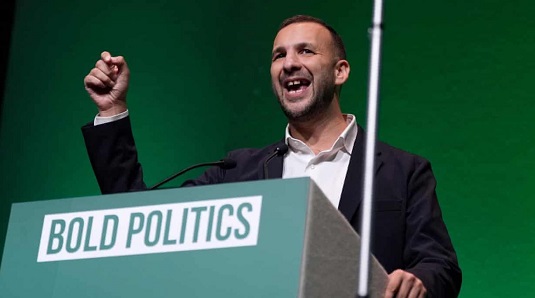
There has been some pushback from centrist sensiblism. Duncan Robinson, writing as Bagehot in the regular Economist column attacks wealth tax populism as a measure that won't raise a great deal, and certainly not as much as Polanski supposes. It peddles the myth that the refurbishment of public services can't be managed without taking more tax off most people. As such, this is irresponsible politics. If this was put to the test, the measure would fall short and state revenues would have to be found from elsewhere. This is a recipe for political damage and disillusionment if the Greens or the left or whoever tries flying in the face of fiscal realities. That, and it would scare the wealthy off. In short, Polanski is promising "a world of common good without sacrifice; a vision of socialism without society."
Two points are worth mulling over here. Polanski and the Greens are absolutely correct to push for a wealth tax. It's a demand designed to shift the political direction of travel away from the right, both in terms of the oligarchical economics the main parties embrace and the racist gutter politics of immigration and asylum. That the political establishment, from the mainstream to the far right have united against wealth taxes is a sign that the Greens have hit a common sensitive spot.
The second point is on what taxes are for. The Economist, as the bourgeois house magazine, deals in common sense. Their common sense. The state's finances are like a household budget, and taxes go into its "current account" - the consolidated fund, which is held by the Bank of England. Like any normal account, its income and outgoings have to be managed and it's not great if the latter exceeds the former. Hence the need for more tax revenues if we want to fund more things. Leaving aside well-worn critiques of this, such as the state being able to borrow from itself, having the power to structure its own debt, and how public spending can boost the tax take through multiplier effects, there are other ways of looking at tax. Chris Dillow, for example, makes the case of using tax to reallocate labour to priority areas. Another way of looking at it, the socialist way, understands that tax isn't about balancing the books. It's a tool for remaking society.
In addition to tax measures that disproportionately hit the wealthy as helpfully outlined by Prem Sikka, if anything Polanski's wealth tax does not go far enough. Steeply progressive income tax, graded rates of employers' National Insurance Contributions based on staff levels and turnover, taxes on dividends, City capital flows, levies on rental income, punitive multiple property ownership taxes, measures aimed at high end luxury consumption, action against offshore wealth repositories under British jurisdiction, and so on. This would be accompanied by tax incentives to encourage cooperatisation, democratise workplaces, the meeting of certain social, civic, and environmental objectives, etc. The concerns of such a tax programme is not primarily about raising money, but lashing capital in chains, abolishing the super rich, removing power from the unaccountably wealthy, and making inroads into the private ownership of the means of life. Obviously, such an approach to tax can't stand up on its own. It needs a mass movement behind it, concerted activity with others across the globe, and a political understanding that they would meet fierce elite resistance - and a programme to defeat it.
In other words, tax needs to be recognised as a weapon. The establishment knows it can be used against them, just as they've used it against us. And for that reason, the left, regardless of its party colours, should keep pushing for wealth taxes.
Image Credit
No mention of the "Patriotic UK Millionaires" and their public call for the government to tax them more? (The point of that being, of course, that unlike voluntary contributions, the greedy and unpatriotic rich would have to either also pay up, or fuck off to Dubai.)
ReplyDeleteZack Polanski’s political trajectory raises serious questions about opportunism and credibility. Unlike figures such as Zarah Sultana, whose political commitments have been consistent and rooted in lived experience, Polanski’s path reflects a series of abrupt and self-serving shifts.
DeletePolanski’s journey from public school education, to US acting school graduate, to trained hypnotherapist, is unusual enough. But what stands out is his recent, opportunistic conversion to socialism. Only a few years ago, he was attacking the Left over Brexit and the IHRA definition of antisemitism, wielding those issues as a stick against the very movement he now claims to represent.
In 2017, Polanski was a Liberal Democrat. At that time, he blamed Jeremy Corbyn for Brexit, accused him of responsibility for antisemitism within Labour, and even praised David Baddiel’s book Jews Don’t Count—a text widely criticised for its reductive and misleading claims about antisemitism. These positions placed him firmly in the camp of those undermining the Left, not building it.
His sudden embrace of left-wing politics, culminating in his rise to leadership within the Green Party, cannot be dismissed as coincidence. It comes precisely at a moment when the Left is struggling to find political space and voice. That he has been elevated so quickly, and given disproportionate media attention, should be seen as a red flag rather than a sign of genuine grassroots support.
The mainstream media’s willingness to give Polanski a platform is telling. Figures who genuinely challenge the establishment rarely receive such treatment. His prominence suggests not a threat to the status quo, but a carefully managed attempt to redirect and contain left-wing energy into safer, more palatable channels.
Polanski’s rhetoric mirrors the hollow promises of figures like Keir Starmer, who pledged transformative change only to deliver continuity. The pattern is familiar: bold words, progressive branding, but little substance when it comes to challenging entrenched power.
Polanski’s record shows a politician who has repeatedly attacked the Left, only to reinvent himself as its champion when it suited his career. His rise is not the product of grassroots struggle but of opportunism, media amplification, and establishment convenience. For those seeking genuine left politics, his history and rhetoric should be scrutinised carefully — his Twitter history alone reveals the contradictions.
Yes, anon 09:58, he's an obvious career politician and an even more obvious establishment appointee to the office of controlled opposition.
DeleteBut if he's moving the Overton Window, and being allowed to move the Overton window, that's nevertheless a much needed positive sign.
The key is not to invest too much in him personally - and even more importantly, to watch out for people of his kind capturing the Green party the way that they captured and gutted the Labour party.
It's good you've acknowledged tax as an ideological weapon as opposed to just a practical measure for raising revenue, because wealth taxes are the former not the latter. For a variety of boring, technical, practical reasons wealth taxes are a bad idea and they have a mediocre track record in the real world. If you are looking for practical ways to raise revenue there are simply better ways.
ReplyDeleteMost activists advocating wealth taxes refuse to engage with, or in some cases acknowledge, the problems, they rely on magical thinking. Most people supporting wealth taxes embrace that magical thinking. People who called out Farage and Brexiters as charlatans peddling fairy tales are now stretching their own credulity to destruction; the Boob Whisperer is their chosen charlatan and this is their fairy tale. But Polanki can offer free stuff with someone else paying (who doesn't like that message?) because he's not expected to deliver.
For Reeves, this magical thinking, cannot hold. Even if she believes in wealth taxes as ideological weapon, which I don't, she still has to deal with the problems it would cause. It would not raise the mythical sums, it would not be a fix for underlying problems, if the money genuinely needed it would have to be found elsewhere (probably from the middle class), which perpetuates this destabilising cycle of scrabbling around for random things to stick tax on. Because wealth isn't actually 'hoarded' in Scrooge McDuck moneybins, but mostly circulating through the economy, their are second order effects to be dealt with. The UK Gov't cannot credibly talk up investment whilst simultaneously threatening to expropriate the rewards.
But fundamentally the productivity problem at the root of this remains. It increasingly looks like the strategy is to disincentivise productivity in order to subsidise/incentivise unproductivity. It is a doom loop. The left can use tax as an ideological weapon, but it also need to be honest about the doom loop.
It's curious how often we hear that wealth taxes are pointless as they won't raise much money (although almost always accompanied by "for reasons too complex to explain" ). Perhaps I'm cynical but would the complex reasons include that the wealthy would fight with all their considerable power and influence to ensure that they tax was not introduced, or that if it was it would include plenty of flaws and loopholes?
DeleteThat aside, the main reason for taxing the wealthy is not to raise money, but to reset expectations. It would be the first, tentative step in reversing the 45 year trend to greater inequality, and the ever accelerating operation of the wealth pump that sucks riches up to the top. There would need to be many, much more dramatic interventions that would make Kamo raise a patrician eyebrow to express his restrained shock - before launching into a politely abusive rant seemingly based on cartoon characters and a cartoon understanding of f*ku'nomics (the 'science' of justifying why the very rich should be even richer, and the rest are just too stupid to understand, or to deserve any more).
Kamo might be surprised to learn that raising revenue is not what taxes are really about. They are about taking excess liquidity out of the system, and the fact that most of the wealthy have theirs salted away in all sorts of clever and protected schemes, means that going after them is relatively ineffective at freeing up resources. But...should the tax be directed, along with a suite of other measures, at all those hiding places, with the primary aim of redistributing the uber wealth that has been accumulated to the detriment of stable society, that would be a step in the right direction.
The stark reality is, Kamo, without such intervnetion, we are headed towards authoritarian dystopia or collapse. That is the lesson of history. Extreme inequality leads to instability leads to chaos or revolution or the end of civilization. So, suck it up, or watch it all unravel. And understand that f*ku'nomics is an unconsciously apocalyptic belief system not a science. The cool aid you are drinking will kill you as well as everyone else.
@Anon, The 'Patriotic Millionaires' stuff is performative, virtue signalling, nonsense. As you mention if they want to pay more tax, they can quietly, voluntarily, do so. But no kudos in that.
ReplyDeleteBesides income taxes are highly progressive in the UK. Beyond the attention seeking, the 'Patriotic Millionaires' are still in 'politics of envy territory'; what they actually want is for the people who are much richer than them to be less so, this way they get to signal their wealth to the plebians whilst also signalling their moral superiority to the patricians.
Ah yes; of course, whenever someone appears to act with motives that are not myopically self-interested, they must be virtue signalling! Because the idea that a human might actually have motives that are not myopically self-interested is simply impossible to imagine, right? [Ticks off square on right-winger bingo card]
DeleteIronically, the likes of Kamo will be the last to have their roles replaced by AI, because AI actually has a lot of trouble affecting a facade of humanity which is quite so obviously hollow and reptilian!
If his amygdala were properly functioning, he'd be able to forecast benefits to the individual accruing from wider benefits to the group. It's not hard for the rest of us to do: we can naturally see that a community in which fewer people around us are damaged and/or desperate, and in which real power is less likely to fall to those with the least ability or inclination to use it responsibly, is a far more survivable environment for ourselves and our conspecifics. Whenever someone gives away the fact that they can't see that, it's a colossal tell.
Dubai- just like an ex Unison boss.
ReplyDeleteGlad we have a choice- I will be voting Green.
ReplyDeleteI agree we should not forget we have a choice. Having always voted Labour I will also be voting Green .
ReplyDeleteYou are 100% correct Anon 9:58, Polanski is an absolutely obvious cynical opportunist , as his career path undoubtedly illustrates. However , given the absence of anybody else mouthing the anti capitalist rhetoric so effectively ( with dubious MSM support , a la Farage, as you point out), we can only hope that the well expressed socialist patter raises expectations that outgrow the man, as the campaigning of the Czarist police agent , Father Gapon, did in the febrile politics of 1905 Russia !
ReplyDeleteNoticeably, possibly State asset stooge, Polanski, isn't up for challenging UK NATO membership , despite the fact that the ever increasing reckless escalation of NATO in Ukraine against a nuclear armed Russia endangers the very future of our planet much, much, sooner than global warming.
Even when taking sense about other matters, our resident Putin asset simply can't resist throwing in a nod to the campaigning that his master requires from him.
DeleteDearie me , Anonymous 23:22 , back again. Our regular NATO shill just has to have a wee dig at anyone who doesn't buy into the utterly bogus NATO/EU/US narrative - that may well yet lead us into all out thermonuclear war . Try some actual historical facts Anonymous , including the US/NATO organised 2014 coup overthrowing the democratically elected Ukraine president, with fascist militia support, that set the whole disastrous war off on its path. Or are you simply an AI on automatic mode ?
ReplyDelete"Politics of envy". What a lovely phrase. It takes all the complexity of human motivation and experience and mushes it up into a throwaway pejorative judgement. Those people are motivated purely by jealousy! Unlike us, who are motivated purely by greed!
ReplyDelete