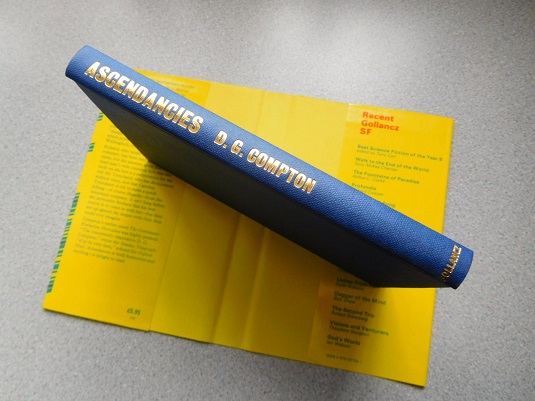
Society has adapted, of course. And the economy is booming. The disappearances, however, have thrown the legalities of declaring a death into a minefield. With no one knowing if the evaporated will return, the old rule that death is officially declared after seven years comes into play. Insurers can avoid paying out in the absence of a body, and spouses, families are left in limbo over payouts and inheritance. With insurance companies wanting to see the body prior to paying out, a black market grows up around the procurement and renting of the recently deceased to expedite insurance claims.
This is where DG Compton's Ascendancies begins. Richard Wallingford is employed by Accident and General as a claims assessor, and is called to the house of Caroline Trenchard. Her husband, Havelock, apparently collapsed at the top of the stairs and fell down breaking his neck. Examining the corpse, Wallingford goes through the routine questions and fills out the declaration paperwork. With everything signed, as he's about to leave, he asks the grieving widow what colour Havelock's eyes were. "Brown", she says. He goes back and checks - the body's eyes are blue. Instantly realising this is a scam and the body was acquired after Havelock's disappearance, Wallingford blackmails her. He demands a sizeable chunk of the life insurance payout, or he'll shop her for fraud. There follows the development of a stilted relationship as they're mutually drawn to and repelled from each other. For Wallingford, she's a "bloody woman" and a cash cow, someone subject to his misogynistic internal monologue. For Trenchard, he's inappropriate, almost a bit of rough. Someone not quite suitable, a feeling reinforced when he's introduced to her set.
Ascendancies is a slow book and not a great deal happens. The couple riddle out the body scam and face down a blackmailer. A small detail, some of the best drawn scenes are the inconsequential Wallingford has with his boss, Bernie Caldwell. Compton's characterisation here is exquisite - a man who pretends to friendship with his overfamiliarity, a put-on hatred against the suits upstairs, and a subtle sense of menace that tacitly suggests he knows exactly what's happened and is waiting for Wallingford to throw himself on his mercy. Behind the bonhomie lies the hint of threat. There are a couple of moments where the book unnecessarily crosses into prurience, but this is a science fiction novel written by a bloke of a certain generation and at a certain time. But if accurate forecasts of the near future are worth noting, Compton was right to conceive of charging points for cars as not uncommon sights on British streets.
Compton is better known for the much-praised, and increasingly hard-to-find Farewell Earth's Bliss about a Martian penal colony, and The Continous Katherine Mortonhoe, a novel about reality television and a critique the obsession with novelty approximately 25 years before programming of that type was wall-to-wall. Ascendancies is never spoken in the same breath as these books, and that is a shame. While not a lost classic it is a slice of literary SF that works well for those bored with flash bang and the usual genre tropes. A character study of two people thrust together by coincidence and opportunism, and how a common, dramatic experience doesn't bridge their mutual solitude probably explains why it's rated so poorly on Goodreads - a case where the wisdom of crowds have turned into their opposite. A worthwhile read for sedate palettes, and one that would benefit from a reissue.
Image Credit
This has answered a question that had been bothering me (although only me). Years ago I started reading an sf novel featuring a lower-middle-class guy thrown together with an upper-m-c woman and getting rather enviously horny; it was really well done but gave me the icks, and I didn't finish it. I was convinced it was The Continuous Katherine Mortenhoe, which was sitting on my shelf unread; last year, though, I finally got round to reading TCKM and found that – while it is really well done and it did give me the icks – it doesn't feature those characters. Sounds like this was the one. I shall have to track it down – DGC's an interesting writer (and, as you suggest, far from the worst when it comes to reproducing the sexist (etc) attitudes of his time).
ReplyDelete