As the third gulf war drags into its fifth week, neither the end nor the end game are anywhere in sight. Big bets on the stock market before Trump makes an announcement are now routine. And the President's remarks are as incoherent and contradictory as ever. "We're talking to nice people in Iran" one hour, the next is a threat to smash power stations and destroy desalination plants. He says negotiations are ongoing, while Tehran denies any such dialogue. The bombs keep raining down from Iranian skies, while in return their ballistic missiles and drones prick Israel's Iron Dome hype and thwart US defences to make life at 13 of its regional bases difficult. Here, Keir Starmer castigates the Tories and Nigel Farage for wanting to drag the UK into this war, while at the same time the US Air Force is using these islands, as well as Cyprus and Diego Garcia for "defensive strikes". Airstrip One is very much part of the conflict.
It doesn't take much to bamboozle Trump, but the White House and military planners cannot grasp why Iran is still fighting. The boasts about annihilating the navy and air force are noisy brags, but do contain some truth. Conventionally speaking, Iran cannot hold a candle against the firepower America and its Israeli satrap can field. So why aren't they surrendering? Why aren't they keen to cut a deal? Why haven't Iranians taken to the street to depose the regime? Instead, Iran is absorbing the punishment, following through with promised retaliation, shouting its defiance, and trolling Trump with Lego memes. He was expecting a gift-wrapped victory, as per Venezuela, or perhaps an Iraq-style collapse into barbarism. Something that could be sold at home as mission accomplished and, for the Israelis, the elimination of the one regional power that goes some way to matching them. None of this has happened, nor is it likely to happen.
The inscrutability of Iran, its refusal to play by the White House's rules of war is not new. It was something dissected with precision by Jean Baudrillard over 20 years ago in his famous essay, The Spirit of Terrorism. Written in November 2001 and reflecting on the September 11th attacks, much of what he diagnosed then carries over to the Iran war and the country's - apparently baffling - resistance to overwhelming force.
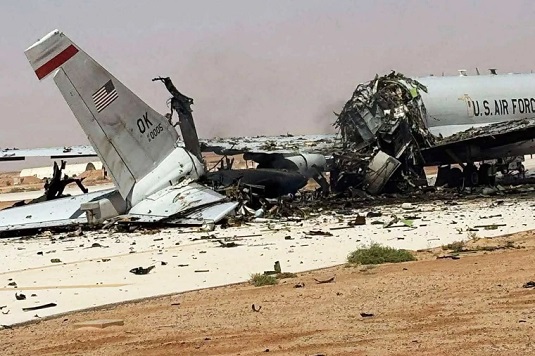
On the spectacle of the attack on New York, Baudrillard wrote the destruction of the Twin Towers fascinated and appalled because of their position in the global order. It symbolically embodied American-led globalisation. But, at the peak of its power, order begot an internal will to disorder, a dream of destruction fed by the conveyor of Hollywood disaster movies. As he put it, "Very logically - and inexorably - the increase in the power of power heightens the will to destroy it." (The Spirit of Terrorism and Other Essays, pp 6-7). Entertainment was meant to exorcise this suicidal impulse through pyrotechnics and special effects, but instead of dampening it down it readied us for catastrophe, almost to the point of desiring the spectacle of disaster. The West was primed for September 11th long before it happened, and the spectacle of the attack was captivating precisely because it showed the mortality of the world's greatest military power. Trump, as a television man, understands the superficiality of the spectacle. Burning Iranian cities and cratered infrastructure is dazzling to him, and plays well to his base. But far more fascinating are the military reversals - the banned footage of Iranian missile strikes across the Gulf states, the hard-to-find smashing up of US military bases, of Israeli cities mourning their dead and counting the cost of demolished districts.
The spectacle of one's own defeat goes beyond the furtive hunt for concealed imagery. It's seen in the endless reams of punditry. The discussion of how, come what may, Iran can exert its control over the Strait of Hormuz. Of how targeted bombing taking out leading regime figures, past and present, has solidified the Iranian position. How Trump's war is spiralling into global economic chaos. How, despite the severe asymmetry in the respective militaries, the US is on the brink of a catastrophic strategic defeat. The talk is of nothing else. The spectacle is as much about the tarnishing of Trump's star power and how he can lie his way out of the calamity. Like all good reality TV, the audience wants his actions to rebound back on him in abject humiliation.
What makes this more acute for Trump and the US is that Iran are refusing to abide by their rulebook. Baudrillard talks about the singular character of large scale suicidal terrorist attacks. In a system of generalised exchange, which American-led globalisation is, this kind of terrorism cannot be "exchanged" - there is no equivalent of it. 20-odd years ago pundits characterised the domestic terrorism in Europe, be it of separatist/nationalist provenance or rooted in political extremism of the left or right, as entirely understandable. Their goals were within the horizon of the modern, if not theoretically possible within the prevailing system. But suicidal Islamist terror was not. The very thing Western societies try and deny - death as a rude tragedy, as the worst thing that could possibly happen to any of us - lies at the heart of its fundamentalist nemesis. This itself is an inevitable outcome of the free, unhindered, and unbalanced operation of global capitalism since the end of the Cold War. Baudrillard argues that the duality of struggle, of good and evil, or capitalism and communism, are as interdependent as they are opposed. When one triumphs over the other, as the principle of good has in the operation of our system, and capitalism has versus its other, the defeated party becomes disarticulated but autonomous. Resistance to and the rejection of globalisation assumes an unpredictable virality, of which Islamist terrorism was one example. And one that, because its existence lies in the inherent contradiction of the system's victory, appears anywhere and everywhere against which the most powerful society in existence appears impotent.
The virality has moved on since then, but the character of Islamism has not. The Islamic Republic is now the repository of this logic. Iran's defiance attacks the logic of an order based on the positivity of life. By propaganda and by deed, the Iranian state is willing to stake its lives and those of its citizens in what amounts to a symbolic challenge. It knows Iran cannot possibly win a military confrontation, but through sacrificing itself while inflicting damage on the US, Israel, and the Gulf states, it assumes the monstrosity of terrorism, of an implacable and fundamentally other foe that will not yield. Faced with such an implacable opponent, of seemingly suicidal defiance, the US is powerless. It can commit troops to a ground invasion, carry on the bombing, see through the promised destruction of civilian infrastructure - but because the Iranian state will offer up any number of lives to maintain this position, the US is doomed to defeat. For Baudrillard, as it was for the 9/11 terrorists the same applies here. For the Iranians are in a duel with the Americans, it is very personal. Their maximalist demands - reparations for damages, closure of American bases, sovereignty of the Strait - dovetail with the "internal" Western desire. Both want to see the US humiliated, not liquidated. Hence Iran's responses to missiles and bombs are missiles and drones, its counter-violence is governed by a symbolic logic, not the operational calculation of x airfields destroyed, and y soldiers and civilians blown up. Trump's empty boasting about victory secured followed swiftly with fire and brimstone is the usual bombast that ordinarily keeps his opponents unbalanced, but Iran has rejected this logic. And that is why underneath it all, panic is the mood among White House insiders, the military, and their allies abroad.
Trump then is looking for the exit ramp, and nothing he does now can look like a victory. More killing and more unnecessary destruction is, sadly, entirely likely. But the strategic defeat has already happened. Iran knows this, and so does the rest of the world.
Image Credit